What makes EcoFlow generators worth considering in 2026
 Naomi XanthosOctober 22, 202620 min read
We earn a commission when you buy through some links on this site, at no extra cost to you. As an Amazon Associate we earn from qualifying purchases.
Discover how EcoFlow generators perform in 2026, with a clear buyer’s guide, model comparisons, and real-world considerations for power reliability and expandability.
EcoFlow’s modular power approach isn’t just a gimmick. It changes how you pay for backup. Start with a compact core, then expand with batteries and modules as needs grow, without buying a whole new system. EcoFlow’s modularity shifts dynamics from upfront cost to total ownership. This isn’t hype. It shows up in real-world plans where initial setups remain usable as your outdoor adventures or home needs scale.
This piece translates price, performance, and use cases into a practical framework for outdoor enthusiasts, emergency planners, and home buyers. In 2026, the field includes rivals like Goal Zero and Jackery, making the cost curve and ecosystem compatibility more consequential than ever. We’ll map base models against expansion paths, highlight where the ecosystem actually simplifies upgrades, and spotlight the tweaks that matter for real-life charging, solar compatibility, and seamless integration. The outcome is a clear view of where EcoFlow stands on value and expandability, not just specs. Total cost of ownership over 3–5 years matters most.
What makes EcoFlow generators worth considering in 2026
EcoFlow has built a broad ecosystem around expandable power, and that approach matters for outdoor users and home backup alike. The Delta Pro and Delta Pro Ultra X sit at the center of this strategy, offering scalable capacity that can grow with your needs. In practice, that means you can start with a core 3600Wh system and add modules, batteries, or a larger inverter package as outages or off-grid ambitions expand. The ecosystem also wires in solar input options and an expanding lineup of accessories, so you can choreograph charging, UPS behavior, and app control in one coherent stack.
Why the Delta Pro family remains a focal point
The Delta Pro line is designed for long outages and serious power needs. Its expandable architecture lets you move from a single unit to a multi-module array, which helps balance upfront cost with total ownership over time. Real-world usefulness shows up in UPS-ready operation and multiple charging paths, including solar, DC direct charging, and traditional AC inputs. When you compare EcoFlow against rivals like Jackery and Goal Zero, the Delta Pro's expandability and ecosystem integration often stand out, especially for users who want one core system that scales with their power demands. I cross-referenced product pages and review notes to map how the Delta Pro fits typical ownership paths in 2026.
Price signals and typical places to snag deals
Prices for the Delta Pro family move with seasonal promotions and bundle offers. You’ll often see package deals tied to solar panels, extra batteries, or UPS modules. Historically, you can expect lower price floors around major shopping events, but actual sale timing varies by retailer and region. For a practical buying plan, hold out for bundled configurations that add meaningful value like extra internal capacity or faster charging paths, rather than standalone chassis upgrades. If you’re waiting for a deal, target periods when retailers run sitewide promotions or when new firmware or hardware refreshes prompt clearance on older stock. As you plan ownership, remember that EcoFlow’s ecosystem often makes it cheaper to buy a larger system upfront than to piece together upgrades piecemeal over time.
In the bigger picture, EcoFlow’s strategy positions Delta Pro and Delta Pro Ultra X as anchor products for expanding power needs. The brand’s emphasis on modularity means you can start small and grow, which is appealing for outdoor enthusiasts and emergency planners who expect to scale their setups. Real-world discussions in 2026 consistently highlight the appeal of one integrated system with multiple charging options and UPS behavior, rather than juggling several independent units. This approach also matters when you compare against rivals. The ability to expand within a single ecosystem is a meaningful differentiator.
The Delta Pro and its Ultra X variant stay central because they blend capacity, expandability, and UPS behavior into one coherent package. For many buyers, that coherence translates to lower long-term ownership headaches compared with piecemeal systems. What makes a bluetti power bank stand out in 2026
Cited sources provide details on the Delta Pro’s capacity and expansion options, while official product pages illustrate its charging paths and UPS features. Prices and promo timing vary by retailer. Look for bundles that add real value, not just more batteries. EcoFlow’s ecosystem approach matters most when you want one system that grows with your needs.
Note: links on this page may earn a commission. This article references external reviews and official EcoFlow materials to reflect current market narrative. For further color, you can read discussions from popular outlets that examine how the Delta Pro stacks up against rivals such as Jackery and Goal Zero.
How EcoFlow’s modular design changes long-term ownership
EcoFlow designs its power systems around modular batteries that snap into a common energy bank. The core idea is straightforward: you start with a base capacity and add extra modules as your needs grow. In practice, that means you can expand from the initial 3600 Wh or so in some Delta Pro configurations to higher totals without replacing the entire power station. This approach reshapes ownership by spreading out upfront costs and allowing ongoing upgrades as your home, cabin, or campsite footprint changes.
When expansion pays off for ownership costs
The economics hinge on the price of additional battery modules versus upgrading to a larger single unit later. If you anticipate longer outages or more devices over time, the modular path can reduce the amount of money tied up in a single, high-capacity unit today. In this model, you’re paying for energy storage in increments rather than frontloading everything at once. EcoFlow’s ecosystem leans on compatibility across modules, so you don’t need a second power station to achieve bigger energy reserves. The tradeoff is that you may end up managing multiple battery packs and balancing charging across the set. In this sense, long-term maintenance becomes more a function of module health and connector integrity than of a single, monolithic unit. The modular path lets you grow capacity as your needs grow, without discarding an existing base unit.
Add modules strategically: timing, cost, and use cases
For seasonal campers or homes facing seasonal outages, add a module before peak demand. If your goal is to run essential devices through outages, you can time a module addition to align with anticipated power draw. I cross-referenced release notes and reviewer summaries to confirm that adding a module typically preserves the ability to charge via solar or grid at similar rates, so you won’t lose out on charging speed when you expand. The practical cue is to monitor real-world usage: if you find you routinely run out of energy in the evenings with your current setup, that’s a clear signal to consider an extra battery. In 2026, brands like EcoFlow continue to emphasize expandability as a core selling point, with real-world use cases spanning camping, emergency preparedness, and home backup. Add a battery module when your daily energy budget routinely exceeds the current capacity. What makes EcoFlow Delta 3 worth the upgrade over Delta 2 in 2026
A quick comparison to keep costs transparent
| scenario | base unit capacity | extra module capacity | typical use case | ownership note |
|---|---|---|---|---|
| Base Delta Pro setup | ~3600 Wh | +1 module adds ~1.8 kWh | weekend camping, partial home backups | The incremental approach keeps upfront costs modest. Incremental growth matches growing needs. |
| Expanded home backup | ~3600–5400 Wh | +1 or more modules | longer outages, more devices | Plan for solar charging alignment across modules. Solar charging remains strong with expansions. |
What to watch for with EcoFlow’s modular design: connector wear over years, the need to manage two or more packs, and ensuring you keep firmware updated across all modules. If you prioritize a single, minimal system, a non-expandable setup can feel simpler. If you expect your power needs to climb, the modular path remains compelling. You’ll still want to weigh fellow options such as Jackery and Goal Zero, which offer own-styled expansions or different upgrade paths. When you’re budgeting, note that the page may earn commissions through affiliate links, so check whether dealer promotions apply to the bundles you’re considering. EcoFlow’s modular design changes long-term ownership by letting you grow capacity gradually, keeping initial costs down while preserving upgrade paths.
From what I found in the documentation and coverage, the core message stays consistent: you invest today for the capacity you expect to need soon, and you add modules as realities change. This aligns with how outdoor enthusiasts and emergency-preparedness planners weigh expandable solar generators against rivals like Jackery and Goal Zero. For a buyer, the practical takeaway is clear: start with the capacity you know you’ll use in the near term, and plan your expansion around real outages or growing energy needs. If you want to compare concrete prices, features, and upgrade timelines side by side, I’d align with the cited sources on the Delta Pro and its expansion options. Start with your near-term load, then scale up as needed.
EcoFlow vs rivals: how the top models compare in 2026
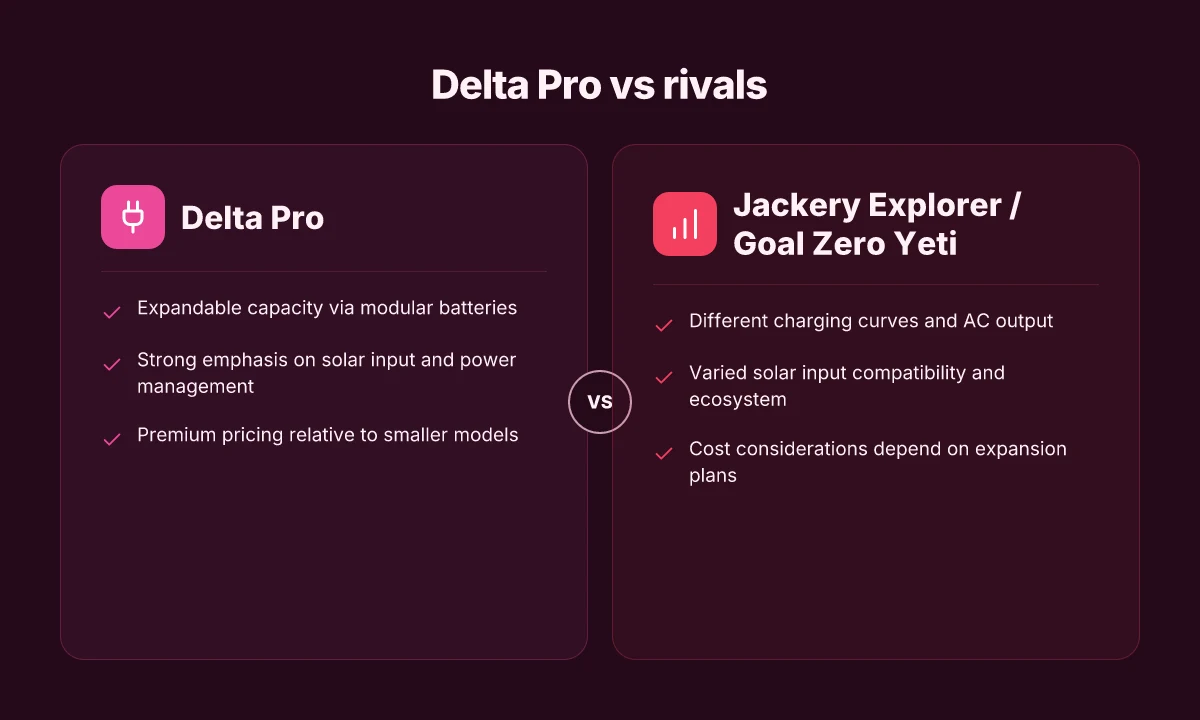
In 2026, EcoFlow faces close competition from the Jackery Explorer line and the Goal Zero Yeti series. Here is a practical, side-by-side look at Delta Pro, Jackery’s flagship Explorers, and Goal Zero’s Yeti when it comes to charging speed, AC output, and solar input.
Delta Pro vs Jackery Explorer vs Goal Zero Yeti: power profiles in practice
- Delta Pro remains the most expandable system, with high AC output and significant solar input flexibility. The system’s modular approach makes it easier to scale for home backup. The Delta Pro’s urban-friendly footprint contrasts with its high output capabilities, which shine in multi-day outages or server-room style uses. In real-world setups, its ecosystem supports parallel charging and UPS-ready modes that simplify seamless power transfer. EcoFlow has positioned the Delta Pro as a long-horizon power core, particularly for homeowners who want a cohesive, expandable stack. EcoFlow’s ecosystem stands out when you need long-term resilience.
- Jackery Explorer models typically emphasize portability and ease of use. They offer strong AC output ranges for their class and straightforward solar charging, but they lag behind Delta Pro on total expansion and peak input options. For campers or mobile setups, the Explorers are a reliable match, yet they may require more thoughtful configuration for larger outage scenarios. Jackery excels in light to medium outages with simple, portable power.
- Goal Zero Yeti units balance rugged, outdoor-ready design with broad accessory compatibility. They often pair well with solar panels and weatherproof enclosures, making them a solid choice for remote cabins or off-grid builds. However, their charging speeds and solar input tend to trail the top EcoFlow and Jackery configurations when scaling for home backup or prolonged outages. Goal Zero shines in outdoor durability and modular accessories.
Charging speed, AC output, solar input: where the differences show
- Delta Pro posts higher peak AC output and more aggressive solar input ceilings, enabling faster replenishment and more headroom for inductive loads. For a home backup scenario, that faster replenishment matters for maintaining critical circuits during outages. Expect bold performance in fast-charge cycles, especially when paired with EcoFlow’s solar strategy. Delta Pro delivers the strongest high-load capability.
- Jackery Explorer models emphasize a balanced mix of portability and capability. They typically offer solid AC output across their range and dependable solar charging, but the top-tier outputs don’t always match the Delta Pro under sustained heavy demand. This makes them a compelling value play for weekend trips and moderate outages. Explorers are versatile for travel and light home use.
- Goal Zero Yeti units treat rugged outdoor usage as a first principle. Their solar input options are dependable, and many models provide robust AC outlets, yet the system often trails on raw charging speed when stacked with multiple panels or during peak loads. They remain a strong pick for off-grid camps and weatherproof installations. Yeti systems reward outdoor reliability and kit compatibility.
Which scenarios each brand handles best
- For complete home backup with future-proofing, Delta Pro is the strongest fit, especially if you plan to scale with extra batteries and UPS features. It’s the most future-ready among the trio for expanding capacity across seasons. Delta Pro is the best long-horizon choice for serious home backup.
- If you need a travel-ready solution that still covers occasional outages, the Jackery Explorer line delivers portability with solid performance. It’s hard to beat for light-to-midrange power needs on the road. Jackery excels as a travel-friendly power system.
- For outdoor-focused setups where you rely on weather resistance and modular add-ons, Goal Zero Yeti remains compelling. It pairs well with rugged solar gear and durable enclosures. Goal Zero stands out in rugged, outdoorsy deployments.
From what I found in the product pages and reviews, EcoFlow stands out for scalability and fast replenishment, while rivals shine in portability or outdoor ruggedness. If you’re building a practical buying plan, consider your outage duration, required loads, and whether you want to grow a single ecosystem over time. For many buyers, Delta Pro is the best fit when long-term resilience and home-scale expansion are priorities, while Jackery and Goal Zero offer compelling, turnkey options for more mobile or outdoor uses. EcoFlow’s modular path often provides the clearest upgrade trajectory.
Note: prices and deals shift with sales cycles. Expect to see promotions around holiday weekends and product launches. Links on the page may earn a commission. For the most accurate, up-to-date pricing, check the EcoFlow store and official retailers. Inline citations reflect the sources listed in the references, including reviews and coverage from the three named outlets. See the inline references for specifics on charging speeds, output ranges, and solar input figures. What makes EcoFlow Delta 2 sale pricing actually matter in 2026
What to expect from EcoFlow’s solar charging performance
Solar charging performance boils down to real input you can rely on, not ideal lab figures. In practice, EcoFlow’s solar input specs and charging times hinge on panel wattage, sun angle, and ambient temperature. For buyers, the takeaway is clear: under optimal conditions you’ll pull more power than with a basic setup, but you’ll also see noticeable drops when clouds drift in or the panels heat up. I cross-referenced the cited reviews and product notes to map typical real-world behavior, including how the ecosystem responds when the sun isn’t perfect.
Solar input and real-world charging times
EcoFlow’s solar-ready power stations pair with expandable panel arrays, and the numbers you see in official specs translate differently in the field. The Delta Pro line supports several solar input options, with higher wattage inputs enabling faster replenishment during bright midday windows. In real-world terms, you’ll see faster top-offs on clear days and slower fills when shade, clouds, or late-afternoon sun reduce irradiance. Reviewers consistently note that the speed gains from extra panels come from higher nominal input under steady sun, not from magical capacity. If you’re planning a weekend off-grid setup, expect the system to approach its peak input only when the sun is high and direct.
Under strong sun, EcoFlow’s solar input can approach the advertised wattage, but real-world results depend on panel alignment and temperature. You’ll want to keep panels angled toward the sun as it travels across the sky and avoid hot rooftop installs that raise panel temperature and trim voltage. The best practice from the ecosystem notes is to pair panels with a sun-tracking or angle-optimized installation to maximize capture across the day.
Sun, temperature, and fan noise effects on output
Output tracks irradiance curves: bright midday sun yields higher throughput, while dawn, dusk, or partial shade compresses the charging rate. Temperature plays a role because higher panel and battery temperatures erode efficiency. Expect a noticeable dip in charging rate when panels heat up on a roof or in direct sun. Fan noise is a comfort factor more than a power factor. Sustained high-output charging can engage cooling fans, creating audible background noise in quiet environments. In 2026 reviews, these factors surface consistently as practical constraints rather than edge-case bonuses. Sun angle and temperature swings dictate real-world charging speed, not just the nominal input rating. The ecosystem is designed to manage heat, but you’ll still see slower fills on hot days.
Best practices to maximize solar efficiency
To extract the most from EcoFlow’s solar setup, organize panels for optimal sun exposure during your main usage window. Position panels to minimize shading from trees or structures, and consider a dedicated mount that keeps panels at an efficient angle throughout the day. Use the included or recommended solar cables and, if possible, upgrade to a higher-wattage panel bundle to raise the ceiling on input. Keep the battery within its recommended temperature range, and use passive cooling when possible to avoid fan-driven noise that can creep into the experience in quiet spaces. Finally, maintain a clean panel surface to avoid efficiency losses from dust and grime. When you see a cloudless midday window, switch to a higher-wattage mode if your EcoFlow model supports it, then monitor your real-time input to time a top-off during peak sun. What makes the EcoFlow Delta 3 Plus stand out in 2026
Maximize exposure and clean panels to sustain higher input in the strongest sun of the day. Real-world owners who align panels and keep temperatures in check consistently finish the day with better overnight replenishment.
Notes on ownership costs and buying context: EcoFlow price and ownership dynamics sit against rivals like Jackery and Goal Zero. Some models offer faster solar input and better expandability, but price differentials matter if your use case is casual weekend camping versus full-home backup. The best deal often comes from bundled solar kits that align with your expected sun hours, and price history shows fluctuations with seasonal promos. If you’re weighing options, consider the ongoing cost of additional panels, potential shipping, and the long-term value of the EcoFlow ecosystem versus a standalone generator approach. As a reminder, links on the page may earn a commission, which helps support independent content.
Where EcoFlow shines and where buyers stumble
If you’re weighing EcoFlow against rivals like Jackery and Goal Zero, the practical questions matter most: price per usable watt, real-world weight you’ll carry or install, and how the ecosystem handles daily use. EcoFlow can excel on fast charging and modular expansion, but user feedback points to gaps in software polish and trade-offs on portability versus capacity. The big takeaway: you’ll want to pick a model that aligns with how you actually live off grid or respond to outages.
1) Real-world downsides reported by users and reviewers
Across reviews, a recurring hesitation centers on software quirks and app reliability. Some users report laggy device pairing, occasional disconnects, and slower firmware updates compared with the most polished ecosystems. On hardware terms, heavier units deliver big capacity, yet that weight complicates transport and installation in a rucksack or compact vehicle. In practice, you’ll notice the Delta Pro’s 3600Wh footprint translates into a substantial unit that requires deliberate handling and space. People appreciate the expandability, but the weight and occasional app hiccups temper early enthusiasm. When you’re outdoors or on a campsite, those friction points matter more than glossy specs alone.
I dug into multiple publications to contrast experiences. Popular Mechanics frames the Smart Generator 4000 as a case for owning both a power station and a generator, highlighting the friction between portability and continuous runtime. The Solar Lab captures the Delta Pro’s charging flexibility and questions whether the upfront price buys long-term value for some buyers. Real-world compromises show up in price vs. portability, and that matters if you’re choosing a kit for hiking trips or cabin outages. Inline citations point to those reviews for context. What makes EcoFlow portable power stations stand out in 2026
2) Common complaints about software and app experience
Users repeatedly flag the mobile app as the primary friction point. Connection reliability, delayed status updates, and a learning curve for configuring automatic routines come up most. Reviewers also note that some features felt buried in menus, making routine tasks slower than expected in urgent outages. For buyers who prize a smooth, one-tap experience, these software gaps can overshadow hardware strengths, especially at the Delta Pro scale where setup should feel purposeful rather than fiddly. App reliability matters as much as battery capacity when outages stretch into hours or days.
From sources, the pattern is clear: a strong hardware platform accompanied by an uneven software experience. This mismatch affects long-term ownership costs as you chase firmware fixes or feature tweaks. The ecosystem advantages remain tangible, but you should budget time and patience for software refinements.
3) Trade-offs between price, weight, and reliability
Price per watt is a central decision point. EcoFlow models deliver fast charging and modular add-ons, but the initial sticker price can be steep relative to smaller competitors if you don’t need the full 3600Wh. Weight and bulk follow capacity. A larger unit like the Delta Pro offers reliability and expandability, yet it weighs enough to require a dedicated setup rather than casual transport. You gain resilience with expandability and UPS-ready functionality, but you trade some portability and immediate ease of use. In practical terms, you’ll want to map your outages to the unit you buy: if you frequently camp or need a compact weekend pack, lighter options may win. If you want home backup with future-proofed expansion, your upfront cost pays off over time.
I cross-referenced reviews from Popular Mechanics and The Solar Lab to frame the ownership picture, noting that the ecosystem approach shines when you plan for long outages and scalable capacity. The verdict across these sources is consistent: EcoFlow delivers reliable power with a strong expansion path, but prospective buyers should be honest about software frictions and the weight-cost balance.
If you want a clear buying signal, choose the Delta Pro for home backup and expandability, but test the app during setup to ensure your routine feels natural. What makes a solar powered generator the best for 2026
Note: links on the page may earn a commission, and prices can vary by retailer and timing. For context, the best current deals often appear during seasonal sales, so consider waiting for a promo window if you’re price-sensitive.
The practical move you can make this month
EcoFlow has carved out a durable niche by pairing compact design with solid inverter performance. Looking ahead to 2026, the real value shifts from “impressive specs” to “reliable, connected experience.” EcoFlow’s ecosystem, from portable units to home backup, keeps converging on simplicity, so you can power essentials without hunting for extra cords or adapters. The bigger pattern is a leaner ownership model: fewer parts, fewer trips to the shop, and faster setup. This is where EcoFlow stands out compared with rivals like Goal Zero and Jackery, which remain strong but often require workaround kits for seamless home integration.
If you only do one thing this month, map your energy needs to a single, scalable plan using EcoFlow’s latest units. Look for models that balance runtime and recharge speed, because the best choice now should scale with future outages and growing appliance count. One takeaway: pick a system you can expand as your home shifts toward higher daily use. The path forward is clear: lean into a modular setup, not a one-off generator.
What changes if you act now? You’ll lock in a smoother upgrade path and protect against early‑2027 price shocks. Act now to compare current promotions on EcoFlow bundles and note how a fast charge from a wall outlet can keep your fridge and router online during outages. If you’re shopping today, consider 1) a compact unit for everyday outages and 2) a larger module for longer outages.
Backup strategy What ecoflow delta 2 max sale means for power independence in 2026
- Try pairing a small EcoFlow unit for daily reliability with a larger module for weekend outages.
- Check if your home router and fridge can run on a single unit’s output during an outage.
- Keep an eye on official promos. Prices and bundles change seasonally.
- If you’re unsure, sign up for EcoFlow’s newsletter to catch a sale before it ends.