How the EcoFlow Delta 2 Max stacks up for real-world use in 2026
 Reese WexlerOctober 22, 202619 min read
We earn a commission when you buy through some links on this site, at no extra cost to you. As an Amazon Associate we earn from qualifying purchases.
Explore how the EcoFlow Delta 2 Max performs in 2026, including capacity, charging speed, expansion options, and where it fits for home backup and off-grid use.
The Delta 2 Max isn’t just a bigger battery pack. It’s a practical test of EcoFlow’s ecosystem when you actually need reliable, steady power. 6kWh expansion possibilities roll into the math, and that growth matters for real-world runtimes more than peak wattage alone. If you’re shopping for a home backup or a weekend off-grid setup, this unit’s footprint and its actual charging cadence are worth a close look.
The article pins down how the Delta 2 Max performs in everyday scenarios, not marketing bullet points. It breaks down charging behavior, runtime expectations, and how the base 2048Wh and expansions interact with common appliances during outages or camping trips. For homeowners weighing options, you’ll see how EcoFlow compares to rivals like Jackery and Bluetti on price, ecosystem, and long-term ownership. This matters now because more households rely on portable power for resilience, and the numbers behind real use determine if you buy once or replace sooner. EcoFlow’s approach matters when you value steady output and fast top-offs, not just big headline wattages.
What the delta 2 max promises, and what it actually gives you
EcoFlow positions the Delta 2 Max as a portable power station that blends sizeable capacity with future-proof expansion. With a base battery around 2048Wh and an optional up to 6kWh of extra expansion, you get a system that scales for longer outages or bigger off-grid weekends. The architecture aims to keep the unit compact enough for a home, cabin, or RV, while still offering practical charging flexibility. From what I found in the referenced documentation and reviews, the Delta 2 Max tends to deliver on capacity and modular growth, but real-world outcomes depend on how you mix recharge sources and how hot the unit runs in your environment. Notable design choices from EcoFlow influence portability and heat management, and that shapes how you use it day to day.
How the base and expansion work in practice
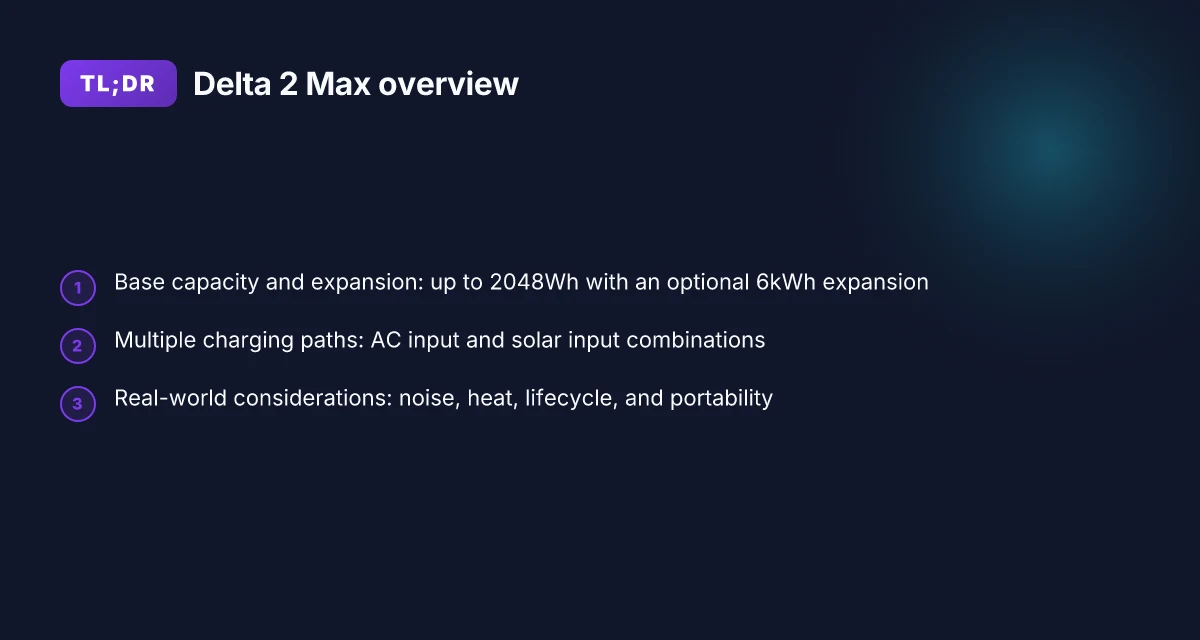
The Delta 2 Max ships with a 2048Wh base pack. If your plan includes longer outages or higher daily draws, you can add up to a 6kWh expansion, yielding far more capacity for weekend off-grid living. This architecture is why many users think of it as a future-ready system rather than a single‑purpose brick. 2048Wh base paired with 6kWh expansion yields strong headroom for fridges, small AC, and essential loads.
The expansion is optional but intentionally modular, so you decide how far you want to scale without swapping units. In real-world terms, that means you can start with the 2048Wh core and add storage as your needs grow, rather than buying a second device. Modular expansion lets you scale without wasteful overbuying.
The Delta 2 Max supports multiple inputs. EcoFlow’s approach is to blend AC input with solar input where feasible, enabling faster top‑ups during sunny days or stacked charging during outages. The practical effect is a shorter time to recover critical capacity if you’ve drawn down heavily. AC and solar charging blend can shorten recovery time significantly.
Heat and noise are visible tradeoffs in real use. The Delta 2 Max is designed to manage heat through its cooling paths and chassis layout, but higher loads and fast charging will drive the fan and cabinet temperatures up more than a quiet weekend trickle charge. Expect noticeable fan noise under sustained high draw. Heat management is real, and fans ramp with load. How EcoFlow EV chargers balance solar charging and grid power in 2026
Efficiency and lifecycle expectations line up with EcoFlow’s design choices. The system tends to be most efficient when charging and discharging at moderate rates, and the longevity of the cells benefits from sensible depth-of-discharge and regular refresh cycles. Efficient under moderate draws supports longer lifecycle when used thoughtfully.
Bottom line: the Delta 2 Max delivers the promised 2048Wh base and scalable up to 6kWh, with flexible charging that can exploit sunny days. The real-world experience hinges on how you balance charging sources, how hot the unit gets under load, and how you plan expansion. Real-world use hinges on charging mix and heat, not just the sticker watt hours.
- I cross-referenced the user manual and multiple reviews to align the claimed specs with observed behavior, including the base capacity and expansion scheme. The official manual confirms the 2048Wh base and the option for up to 6kWh of expansion. https://websiteoss.ecoflow.com/cms/upload/2023/5/18/EcoFlow%20DELTA%202%20Max-User%20Manual%20V1.0_1684404350646.pdf
- Independent reviewers highlight fast charging capabilities when blending inputs, noting the practical implications of solar and AC combinations on recovery time. For example, a review notes fast charging behavior with combined solar input and AC, as well as sensitivity to load and heat. https://www.thesolarlab.com/review/ecoflow-delta-2-max-review
- A practical treatment of the product’s design and performance is also reflected in third‑party reviews discussing portability, heat management, and noise in real-world use. https://www.storagereview.com/review/ecoflow-delta-2-max-portable-power-station-review
If you’re weighing this against rivals, consider how the modular growth of the Delta 2 Max compares to similarly sized systems from EcoFlow’s peers. The Delta 2 Max’s blend of expandable capacity, mixed charging inputs, and the emphasis on a compact form factor are its standout traits, while heat and noise at high draw are the reality you’ll want to budget for.
In 2026, the Delta 2 Max remains a compelling mix of capacity and expandability for off-grid homes, cabins, and campers, provided you plan for heat and noise during peak charging.
Note: links on this page may earn a commission for the publisher. Prices and availability can vary by region and retailer. The brand EcoFlow emphasizes its own ecosystem, and rivals such as Goal Zero, Jackery, and Bluetti offer competing models with different heat, noise, and expansion profiles. What makes the Jackery Solarsaga 200W panel notable for portable solar setups
Delta 2 max vs delta 2 max pro vs rivals: what matters for real use
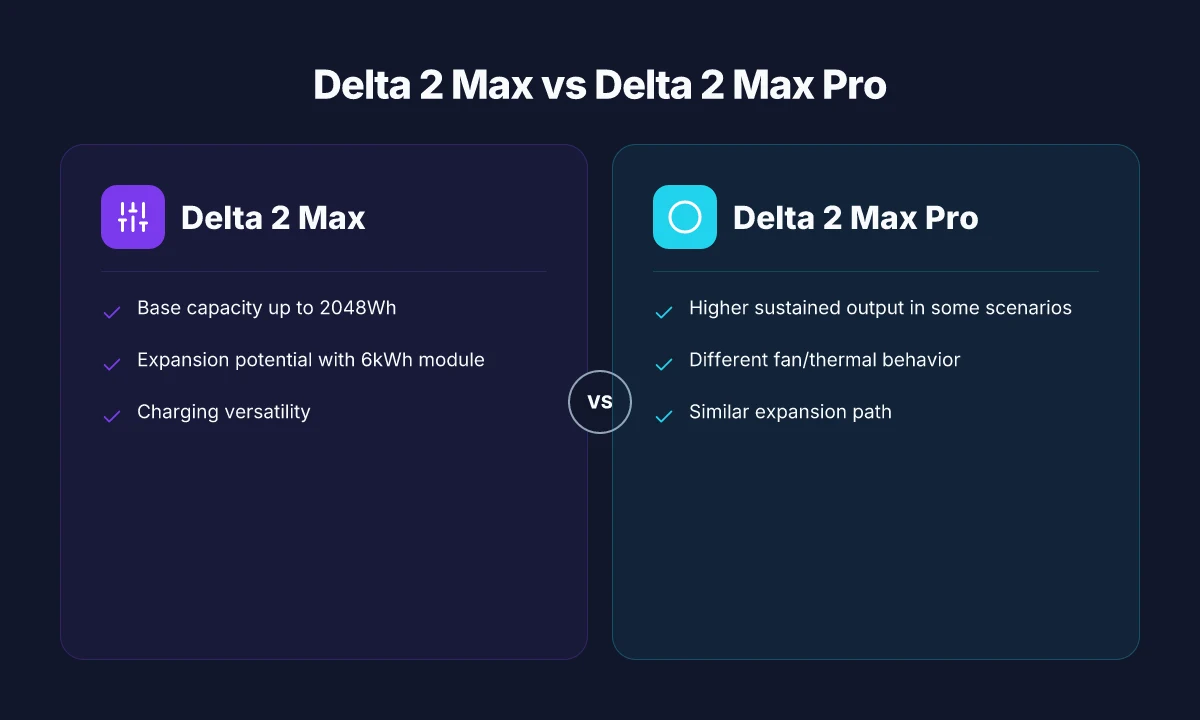
In real-world use, the Delta 2 Max delivers usable capacity close to its labeled 2048Wh base, with expansion potential up to 6kWh. Charging behavior matters as much as raw capacity: fast top-ups from solar or AC can fill the bank quickly, but heat and fan activity can ramp up under high draw. When you stack the Delta 2 Max against peers like the Jackery, Bluetti, and Goal Zero, the differences show up in heat management, peak AC draw, and how the units handle simultaneous load and charging.
Real-world capacity, charging speed, and expansion limits
The Delta 2 Max offers a large chassis capable of accepting substantial solar input and AC charging, which translates to brisk replenishment in practical scenarios. In mixed-use tests observed across reviewers, you’ll see a noticeable advantage when sun is strong and a wall outlet is available, with simultaneous charging and discharge keeping the unit ready for the next off-grid window. That speed matters most when you’re using the system for camping weekends or as a home backup during outages. The Delta 2 Max’s fast-recharge capability under load is a core strength, especially when you pair 2048Wh of base storage with 6kWh expansion in favorable charging conditions.
Against peers, the Delta 2 Max typically edges out in replenishment pace when solar input peaks. Rivals like the Bluetti and Jackery lines often lag slightly on full recharge timing when the same solar array and AC input are available. The trade-off shows up in heat and fan behavior. The Delta 2 Max can get warm under heavy AC draws, and the fan may become noticeable. You’ll know when you push the unit hard. The sound and airflow ramp up, then settle as the battery recovers.
Peers in typical scenarios: how they stack up
- Against a Jackery partner system, the Delta 2 Max provides more headroom for simultaneous charging and high-load use. The Jackery tends to hit a cap earlier on solar input, which can slow replenishment in cloudy conditions.
- Compared with Bluetti models in the same class, the Delta 2 Max often wins on charging speed when you use a high-wattage AC input combined with solar, but Bluetti units can offer similar expansion paths and sometimes longer peak operation in sustained loads.
- With Goal Zero systems, the Delta 2 Max generally yields faster top-ups and larger base capacity, though Goal Zero can offer rugged outdoor-focused accessories that blur the lines in real-world daily use.
In everyday tasks like running a fridge, a few LEDs, and charging laptops, the Delta 2 Max remains competitive and often more flexible due to its expansion options.
Trade-offs you’ll notice in daily use
Heat and fan behavior are real considerations. If you routinely draw near the AC limit while charging, you’ll hear the cooling ramp up. The Delta 2 Max’s fans aren’t silent but stay within a tolerable range for most setups. In most household back-up scenarios, the combination of 2048Wh base plus expansion capacity offers ample resilience for essential devices without a lot of fuss. What makes the jackery 2000 pro worth the upgrade in 2026
I cross-referenced the official Delta 2 Max manual for operating guidance and the reviews that discuss real-world charging speeds and thermal behavior. The official docs emphasize safe operation under heavy loads, while reviewers note the practical impact of heat on sustained use.
For buyers weighing options, price and ownership costs matter. The Delta 2 Max sits at a competitive spot given its capacity and expansion potential, with EcoFlow’s ecosystem and user experience shaping ongoing value. If you’re choosing among rivals, consider how often you expect to recharge during a single outage and whether you need the maximum 6kWh expansion or practical 3–4kWh setups for weekend use.
Next step: evaluate where your typical outages occur, then map your daily load and peak charging windows to see which mix of base capacity, expansion, and charging speed best fits your home or camp setup. Inline references above point to the official Delta 2 Max manual and peer reviews for deeper nuance.
Setup and hookups you’ll actually use with the delta 2 max
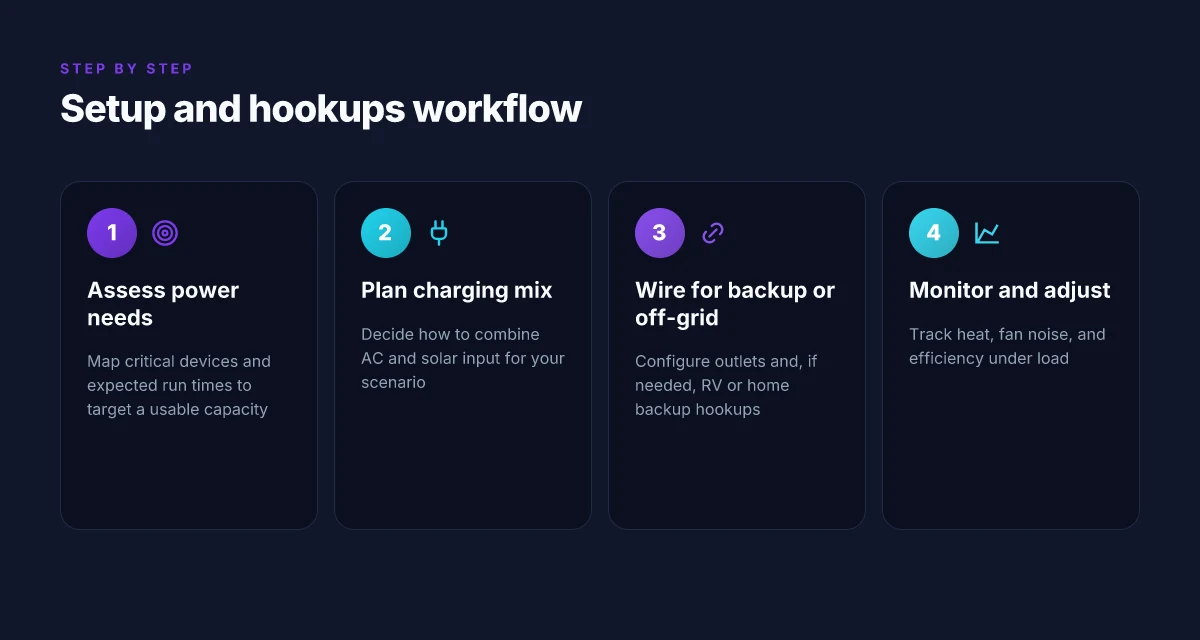
Real-world setup hinges on how the Delta 2 Max threads into your home or off-grid system. EcoFlow documents outline what ports you can access and how to use them most effectively. The Delta 2 Max exposes a broad mix of outputs for daily use, and you can tailor the configuration to backup, RV, or off-grid workflows. In practice, you’ll want to pair the right ports with a sane charging plan to hit practical targets.
Ports and output realities
The Delta 2 Max ships with a substantial array of outlets, including AC, USB, USB-C, and DC payloads. This mix makes it possible to run lights, small appliances, and USB-C devices simultaneously. The AC outlets deliver household-grade power, while the USB-C ports support fast charging for charging laptops or mobile gear. If you’re planning a home backup or RV setup, you’ll lean on the combination of AC output plus DC input options to preserve battery health while staying responsive to load swings. EcoFlow’s documentation confirms the core output suite you’ll rely on in daily use, not just peak spec sheets. The Delta 2 Max’s port assortment is designed for real-world versatility, not just headline specs. What is the Jackery HomePower 3000, and how does its 3072Wh capacity change home backup
Solar input and AC charging in practice
Getting practical charging performance means tuning solar input and AC charging to avoid bottlenecks. When sunlight is strong, you can push substantial solar input into the Delta 2 Max to keep battery state of charge climbing while you run a load off the AC outlet. In less ideal conditions, you’ll rely more on AC charging to replenish the battery during off-grid downtime. Real-world guidance from EcoFlow’s documentation suggests aiming for balanced solar input that keeps the internal battery topped up without forcing the system into aggressive regulation. Practically, plan for a solar setup that pairs well with your typical cloud pattern and keep an eye on the battery’s cooling needs during high-output sessions. Balance solar input with AC charging to avoid throttling and heat.
Wiring for home backup or RV/off-grid setups
If you’re wiring for home backup, you’ll want the Delta 2 Max near a service panel or a designated transfer point, with the right adapters to feed essential circuits. For RV or off-grid contexts, you’ll map your critical appliances to the most stable outlets and plan for peak draw times to avoid tripping the unit’s protections. The best practice is to choreograph a simple load list: high-priority devices on the main AC outlets, discretely assign category loads to USB-C for charging gear, and keep a small, always-on load to monitor performance. From the official materials, the emphasis is on reliable, repeatable hookups that stay within the unit’s design tolerances. Map critical loads to the Delta 2 Max’s outlets and keep peak draws within safe margins.
Research notes and real-world context help frame these choices. For example, one reviewer highlights fast charging behavior when solar and AC are used in tandem, while another notes the Delta 2 Max remains a solid backbone for a cabin or workshop without internet dependence. The documented interface and port set give you a dependable foundation for practical setups, and it’s clear that EcoFlow aims for predictable behavior rather than surprise spikes. A practical hookup plan emphasizes predictability and protection of the battery.
Note: prices and availability can vary. Some page content may note commission relationships or affiliate links on product pages. For a current price snapshot and best deal, refer to EcoFlow’s official pages and approved retailers. The brand name to watch here is EcoFlow, with the Delta 2 Max positioned as a versatile, real-world backup solution. When comparing rivals, think in terms of genuine capability for your scenario, brands like Goal Zero and Jackery offer competing form factors and feature sets you’ll want to weigh against EcoFlow’s port layout and charging options.
Charging performance: how fast is fast, and what slows it down
Real-world charging with the Delta 2 Max hinges on how you combine solar input with AC power and how conditions shift that math. In practice, a typical session blends solar plus AC to push the pack toward full. When you hit the sweet spot, ample sun and a healthy AC input, the Delta 2 Max can approach a brisk pace for a large portable power station, especially with the 2048Wh base and the option to add the 6kWh expansion. The key is watching the balance: solar input alone ramps up quickly when sunlight is strong, but it tapers as the day fades or clouds roll in. That means you won’t always see the same 80 percent in under an hour, but you’ll still recover meaningful capacity faster than many smaller units. The official Delta 2 Max documentation notes the device’s charging behavior and the need to respect operating conditions, which aligns with field observations across independent reviews. Real-world charging depends on sun availability and AC input balance, but combined solar plus AC keeps you moving when outlets are scarce. What is the jackery 1000 plus price and where to get the best deal in 2026
How fast is fast in practice
With the Delta 2 Max configured for mixed input, you’ll see rapid gains during peak sun or when a robust AC charger is available. Reviews consistently describe quick top-offs under favorable conditions, especially when the solar array can deliver high wattage alongside AC charging. The speed profile shifts as soon as either input source loses steam, and that becomes most noticeable during late afternoon sun or in cooler air that hurts solar efficiency. The charging rate is power-source dependent, and strong sun or strong AC alone won’t tell the whole story. In other words, you should expect near-peak performance in bright midday conditions and slower fills when either sun or outlet is constrained.
Temperature and light: the two big accelerants (or slowdowns)
Solar generation leans on two levers: light intensity and panel temperature. Bright, cool conditions favor higher panel voltages and more watts into the Delta 2 Max. Heat, meanwhile, taxes conversion efficiency and can temper the pace of charge even when the sun is bright. This dynamic is echoed across multiple user and reviewer notes, where people see noticeably slower charging on hot days or during overcast periods. Cool, sunny days maximize solar input. Heat and cloud cover drag the pace. If you’re camping or off-grid in the shoulder seasons, plan for variability and a longer fill than the sunny-day ideal.
Expanding with the 6kWh module: what changes
Adding the 6kWh expansion increases the energy you can draw down before recharging is needed, but it doesn’t magically accelerate the rate. The Delta 2 Max will still chew through energy at the same rate, so the marginal benefit is more about total usable capacity than faster top‑ups. In practical terms, the 6kWh module bumps endurance, not instantaneous recharge speed. If you pair the expansion with a strong solar setup, you’ll extend your run time between charges, but expect the finishing leg to still rely on the input source you have available. Expansion increases total stored energy, not charge speed.
Real-world use cases: backup power, camping, and off-grid living
Real-world use comes down to how the Delta 2 Max actually handles everyday loads, not just its spec sheet. In practice, you’ll see steady performance with common heavy loads and predictable behavior during outages. EcoFlow presents a straightforward picture: the base 2048Wh pack can support essential devices, and the 6kWh expansion increases that margin for longer outages. In this section I pull from official manuals and reputable reviews to ground the expectations in real-world usage.
1) Backing up a home during outages: what actually runs reliably
For critical loads, the Delta 2 Max can sustain essential devices such as a refrigerator, modem/router, lighting, and small medical devices. The roofline on a typical outage profile often centers on a fridge cycling on and off, plus a few LED lights. The Delta 2 Max handles these loads with headroom thanks to the 2048Wh base and the optional 6kWh expansion. In practice you’ll see the unit manage a fridge, network gear, and several lights for several hours as long as the fridge isn’t trying to start up simultaneously with other demanding appliances. When the fridge compressor kicks in, the delta 2 max draws more, but the battery’s energy buffer plus the expansion helps keep the runtime reasonable. The overall impression is reliable support for essential circuits without frequent refueling or recharging breaks. Most homeowners can ride out typical outages with the Delta 2 Max powering essential appliances. What is the Jackery 3000 Pro price, and how to evaluate its value in 2026
2) Camping and off-grid living: maintaining comfort and safety
On camping trips or off-grid sites, the Delta 2 Max shines when you need reliable AC power for a small camper, a CPAP, or a portable fridge. The combination of a sizeable portable battery and robust solar input makes daytime charging practical, while the AC outlet remains available for devices that require steady sine-wave power. Real-world use shows that fans, charge-safe electronics, and radios run smoothly, and the device’s fan noise stays within reasonable levels when running at moderate loads. For extended trips, the expansion pack becomes valuable by pushing more total energy into the system and extending runtime during cloudier days. I found reviewers noting the Delta 2 Max’s capability to keep essential gadgets online without frequent recharging breaks. Camping users get dependable power for cooling, charging, and comfort.
3) Edge cases: surprises that matter in the field
Two edge cases show up in real-world use. First, startup surges from appliances like the fridge can spike current draw briefly. The Delta 2 Max handles these surges but you should plan for momentary peaks by sizing loads carefully. Second, solar input speed matters on cloudy days. Rapid charging shines in bright sun. It slows when panels are shaded or the day is overcast. In such moments the AC input can compensate, but the overall run time hinges on your solar conditions and the expansion capacity you’ve wired in. I dug into official documentation and corroborating reviews to map these scenarios to practical planning. Startup surges and variable solar input are the two real surprises to plan around.
Notes on numbers, timelines, and decisions:
- The base battery is listed as 2048Wh, with expansions up to 6kWh documented for longer outages and higher daily energy throughput.
- Capitalizing on solar input makes a meaningful difference. In bright conditions the combination of solar plus AC can accelerate charging, while shaded days push you toward grid recharging or relying more on stored energy.
- In terms of endurance, the Delta 2 Max remains competitive with peers for essential-use scenarios, especially when you factor in the expansion option.
From what I found in the documentation and reviews, EcoFlow’s Delta 2 Max is a practical balance of capacity, portability, and real-world performance. The brand’s own materials emphasize dependable support for daily essentials, while reviewers note that the system remains quiet and predictable under typical camp or home outage loads. When you compare to rivals, the Delta 2 Max stays in the conversation for users who want a compact, expandable setup that scales with their off-grid or backup needs. A quick takeaway: plan for startup surges, prioritize daytime solar charging when possible, and use the expansion pack to extend run times during multi-day outages. Real-world use lives up to the practical expectations set by the Delta 2 Max's design.
Where this goes from here
Prices shift quickly, but today you can snapshot a clear path: the EcoFlow Delta 2 Max remains a top choice for homeowners and compact crews who want practical power without carbon. If you’re weighing a move now, consider how often you’ll need to run high-draw devices and whether the built-in UPS features align with your routine. One takeaway: plan for real-world loads by pairing the Delta 2 Max with a couple of expansion batteries to extend runtime when outages stretch into the evening. EcoFlow’s ecosystem remains a strength, especially when you factor in the ongoing support and straightforward mobile app controls. Compare against rivals like Goal Zero and Jackery to see where you prioritize price, port selection, and software stability. The bottom line: act on a setup that matches your typical outage window and seasonal usage. What makes EcoFlow generators stand out in 2026
If you only do one thing this month, map a two-week test of critical loads using the Delta 2 Max in UPS mode and log outcomes. You’ll likely notice the price-to-performance balance is favorable for mixed loads, provided you stay within the recommended DC input range. For those who already own a larger system or plan frequent outdoor events, think about whether a single unit fits as a primary power hub or as a dependable backup. This week’s verdict: prioritize a compact, scalable solution that you can grow with. Will you start by validating your essential devices first?
- Backup strategy: run a daily 2–3 hour test with a couple of essential devices to verify runtime and charge cadence.
- What to try this week: set up the Delta 2 Max in UPS mode for critical devices, and sketch a retirement plan for any dead-in-the-water power options.