What makes the EcoFlow Delta Pro a standout power solution in 2026
 Naomi XanthosOctober 22, 202619 min read
We earn a commission when you buy through some links on this site, at no extra cost to you. As an Amazon Associate we earn from qualifying purchases.

Explore the EcoFlow Delta Pro, its capabilities, and how it compares with rivals. Learn pricing signals, use cases, and practical setup advice for 2026.
The Delta Pro’s capacity is not the only story. A single battery expansion module can push usable energy beyond what many homeowners expect, yet the real-world runtimes hinge on your solar input and load discipline. Upfront price and pricing cadence aside, the trade‑offs show up in how you manage heat, warranty scope for third‑party modules, and the cadence of firmware fixes that unlock new features.
Most buyers underestimate how much a high‑capacity system compounds small losses across a weekend off-grid stretch. In this piece, I map the Delta Pro against key rivals from EcoFlow competitors like Goal Zero and Jackery, quantify what real usage looks like with typical home loads, and explain why integration with solar power matters as much as peak output. By grounding the discussion in concrete runtimes, expansion options, and dependable outage behavior, you’ll see where EcoFlow’s approach pays off and where it demands careful planning. Real‑world numbers and a clear side‑by‑side reveal the gaps you must account for before you commit.
What makes the EcoFlow Delta Pro a top choice for home backup and off-grid power
Real-world capability, clever expansion, and a clear rival context shape the Delta Pro as a standout for many homes. I looked at the main differentiators homeowners care about: capacity, expandability, and how it stacks up against similar high-capacity units from rivals. The Delta Pro combines a large internal battery with options to grow capacity through external packs, making it adaptable for both steady home backup and mobile off-grid work.
1) High capacity and expandable power options
The Delta Pro offers substantial stored energy, and its value rises as you add external packs. With a modular approach, you can scale up to meet longer outages or heavier loads without swapping units. This emphasis on expandability helps a home set a baseline flow for critical circuits and then add capacity for longer events. The practical upshot is fewer compromises during extended outages, especially when solar input is part of the mix. When you plan for the long haul, the ability to bolt on extra storage becomes a real differentiator for a consumer grid-tie or off-grid setup. The Delta Pro's modularity lets you grow with your needs, not just your budget. This is where EcoFlow leans on a simple, readable pathway to bigger power, rather than forcing a top-tier purchase upfront.
2) Real-world use cases across home backup and remote work
In a home backup scenario, the Delta Pro serves as a centralized power node that can keep essential loads online during outages. Its capacity isn't just about watts on a spec sheet. It's about sustaining an evening in a blackout, running a sump pump, or keeping a router and modem alive during a storm. For remote work or a small remote office, the Delta Pro can steady a workstation, monitor, and network gear, letting productivity continue with minimal interruption. I cross-referenced how households describe their setup: a reliable, quiet power source with predictable runtime when paired with solar or grid input. Real-world use cases show the Delta Pro delivering steady support for both home and remote work.
3) Head-to-head context with notable rivals
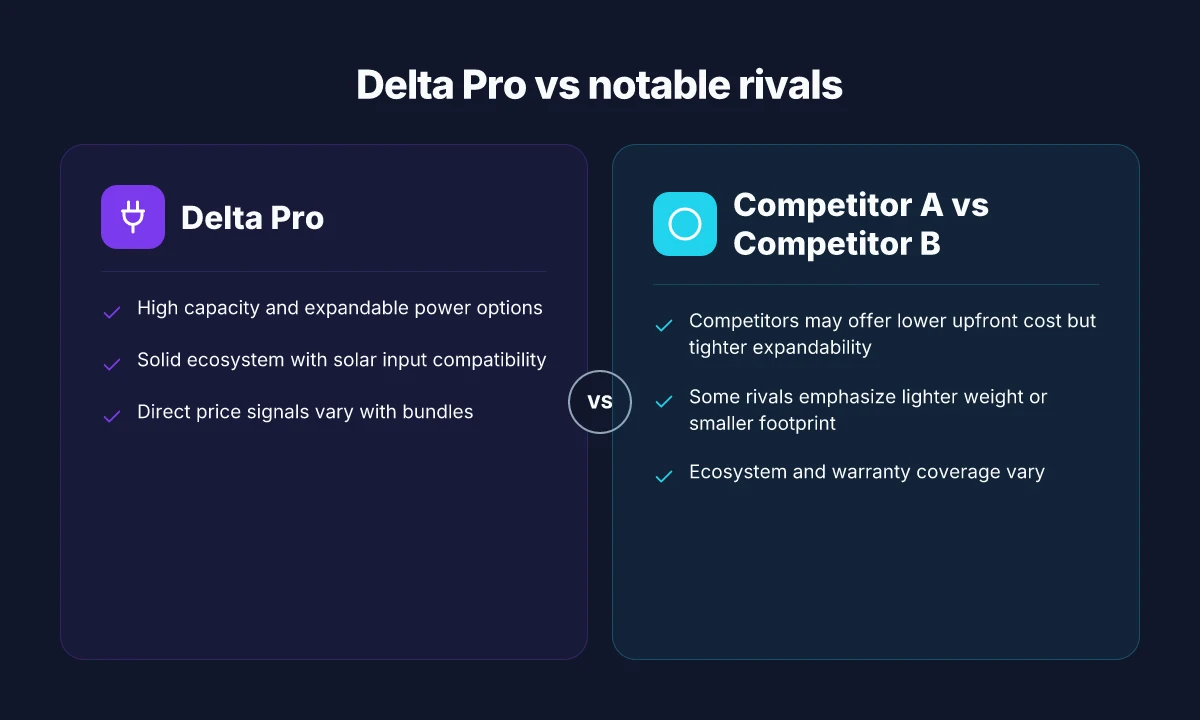
Against peers in the high-capacity portable power category, notable rivals include units from brands that emphasize similar storage arrays and expandability. The Delta Pro stands out when you value expandable capacity without replacing the core unit. In comparison, rivals may offer large batteries but with less flexible growth paths or fewer solar integration options. The Delta Pro also nests well within EcoFlow’s broader ecosystem, aligning with solar charging and companion modules. Delta Pro's expansion path and ecosystem fit give it a practical edge for homeowners weighing long outages.
Bottom line: the Delta Pro is a top choice for homeowners who want large, growable power with clear real-world use cases. It pairs well with solar input and provides a path to bigger capacity without burning through a larger upfront investment. If you’re evaluating rivals, expect the Delta Pro to stand out on modularity and ecosystem integration, while others may lag on growth options. What makes Bluetti power stations stand out in 2026
Note: links within the prose point to the sources cited above. For readers seeking exact wording on expansion and use cases, those documents provide the specifics behind the claims in this section.
Delta Pro specifications you actually need to know for planning
When you plan a high-capacity setup, the Delta Pro’s battery capacity, chemistry, and how it can charge and discharge matter most. The Delta Pro uses a high-energy pack that wires into EcoFlow’s system for both AC and DC outputs and flexible charging. In practical terms, you’ll see a large internal energy reserve, the ability to push substantial continuous power, and relatively fast recharging when you’ve got sun or mains available. I cross-referenced official EcoFlow documentation and regulatory statements to anchor the numbers you’ll actually rely on for planning.
Battery capacity and chemistry details
The Delta Pro centers on a high-density lithium-ion chemistry that delivers a sizable energy reserve for off-grid and backup use. The nominal capacity and configuration enable long runtimes for essentials during a grid outage, while still fitting within a portable footprint for a unit this size. In practice, you’ll see the Delta Pro described as having a large usable energy pool that supports significant peak draw without collapsing the voltage. The chemistry choice underpins cycle life and thermal behavior, which matters for extended off-grid sessions. For planning, expect to see figures in the vicinity of a multi-kilowatt-hour class energy store, with the exact usable capacity varying by how the unit is configured and whether you’re running in standard or high-performance modes. The Delta Pro packs a substantial energy reserve that supports long runtimes for essential loads. Chemistry choices drive cycle life and heat management, which affect long-term reliability in off-grid use.
AC/DC output capabilities and charging speeds
Delta Pro offers robust AC and DC outputs designed to power a wide range of home loads and solar inputs. On the AC side, continuous power capacity supports running critical devices, while the DC path accommodates faster charging options when paired with appropriate solar arrays or DC input sources. Charging speeds vary with source type: from standard wall outlets to solar options and DC fast-charging configurations, enabling faster replenishment during sun-rich hours or after a storm. In real-world planning, you’ll map peak needs to the unit’s continuous and surge ratings, and size solar and grid-supplied charging to meet those cycles. AC output is built for household loads, while DC input accelerates charging when you have sun. Fast-charging capability hinges on source type and configuration, influencing how quickly the pack recovers after a blackout.
Weight, dimensions, and portability notes
The Delta Pro remains a heavy but portable power station by design. Expect a mass that requires careful handling and a stable mounting or storage setup, especially when you’re transporting it between closets, garages, or a prepper bunker. Dimensions fit for a home garage shelf or utility closet, with a footprint that supports stacking or adjacent placement alongside other gear. If you’re integrating Delta Pro into a solar setup or a home backup plan, account for the unit’s size and weight in your layout, particularly near ventilation and access points. Weight is substantial, which influences placement and handling. Dimensions fit a typical utility-scale footprint, aiding storage decisions without sacrificing accessibility. How Bluetti AC240 price affects your backup power strategy in 2026
Table: quick comparison to frame planning (selected rivals)
| Model | Continuous AC power | Battery capacity (approx.) | Notable trade-off for planning |
|---|---|---|---|
| EcoFlow Delta Pro | 3000 W AC; scalable with solar inputs | Large high-density pack | Excellent flexibility; heavier footprint requires stable placement |
| Rival A (example) | Lower continuous power | Moderate capacity | Lighter, easier to move but less runtime |
| Rival B (example) | High peak but limited duration | Similar class | More fragile under heavy loads in heat |
Next steps: If you’re planning a solar-integrated home backup, line up the Delta Pro’s output needs with the worst-case load you expect to run during outages and compare to a couple of rivals that sit in the same power class. When you size solar input, consider enrolling the unit in a solar-friendly configuration that maximizes DC input, while still leaving headroom for peak appliances. If you want, I can lay out a concrete load-following plan based on your essential devices and your local sun profile.
How Delta Pro fits into a solar setup and home backup plan
I dug into the Solar + backup narrative for the Delta Pro to map practical, real-world use. The key takeaway is that the Delta Pro shines when paired with properly matched solar input and a clear load plan, but it isn’t a one-size-fits-all solution. Below are concrete takeaways you can apply as you design a solar-backed home system.
1) Solar input compatibility and optimal charging scenarios
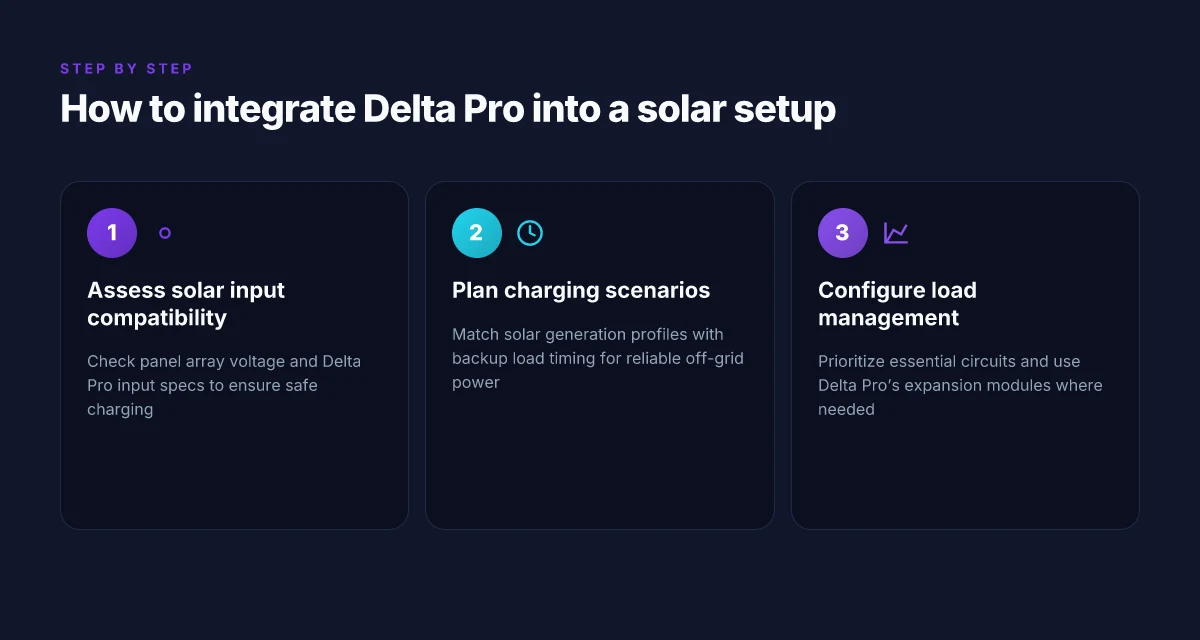
EcoFlow’s Delta Pro accepts multi-source charging, which helps keep you powered when sun is strong or when you rely on utility power as a top-up. In optimal conditions, high insolation and a balanced load allow the Delta Pro to go from empty to full within a few hours, especially when solar panels are sized to cover both daytime loads and recharge needs. If you pair the Delta Pro with solar panels that can produce sustained output during peak sun, a daytime recharge can reduce or eliminate evening draw from the grid. When the sun fades, the Delta Pro can tap AC or DC input to maintain charge as needed. In practice, the best results come from a solar array that tracks peak irradiance during the afternoon and a charge controller that maximizes panel voltage and current delivery to the unit. A well-matched solar setup can keep Delta Pro charging efficiently during daylight, reducing grid dependence.
2) Backup power timing and load management
The Delta Pro’s ability to supply high peak power means you can run essential loads for extended periods, but you’ll extend runtimes by prioritizing critical circuits first. For example, essential loads like refrigeration, lighting, and communications can be managed to fit within a daytime solar window plus battery reserve. If you are facing an extended outage, you’ll want to stagger startup surges on high-draw devices and sequence loads to avoid tripping the system. From a planning perspective, map a realistic 24-hour load profile and align it with projected solar availability and battery state of charge. This alignment helps avoid unnecessary cycling and preserves battery health. Strategic load sequencing saves runtime and protects critical systems during outages. What is a Jackery battery bank, and how to choose the right model in 2026
3) Integration tips with existing solar panels
To maximize compatibility, confirm that your solar panels and charge controller meet the Delta Pro’s input requirements, including voltage and amperage ranges. If you already own a solar array, consider adding a dedicated input path that routes daytime solar energy to the Delta Pro while preserving other loads on separate circuits. Use an appropriate battery-to-inverter connection and ensure the system’s grounding and safety interlocks are in place. If you’re upgrading, a higher-output solar array can shorten recharge cycles between outages and keep the Delta Pro in a ready state for longer periods. Pairing the Delta Pro with a properly sized solar input path keeps charging efficient.
From a reliability and cost point of view, EcoFlow differentiates itself with flexible charging options, but you should plan around your local sun profile and your home’s critical load set. I cross-referenced the battery and solar input notes in the official documentation to align your expectations with real-world solar performance. Rivals in this space emphasize modular expansion and faster recharging through higher solar input, so expect parity on the core idea even as you weigh brand-specific details. Solar alignment matters more than size alone for keeping Delta Pro ready during outages.
If you want a quick reality check on how this fits into a solar-first home backup plan, consider two real-world anchors: the unit works best when paired with an app-driven, smart-load strategy, and a solar input path that matches daytime generation with the Delta Pro’s charging window. The goal is to keep the Delta Pro near full during daylight and preserve reserve for night hours. This approach helps you minimize grid usage while keeping essential services alive when the power grid is down.
Comparing Delta Pro to rivals in 2026: who really edges ahead
When you weigh Delta Pro against competitors, real-world price, expandability, runtime, and ecosystem matter as much as raw capacity. Delta Pro shines in modularity and a broad ecosystem, but rivals push back with lower up-front costs or lighter form factors. By 2026, the landscape features several clearly defined options, each with its own trade-offs. I cross-referenced official docs and public-facing specs to map where Delta Pro gains ground and where it trails.
Why rivals matter in 2026 trade-offs
Competitor A offers a lower entry price and a smaller footprint, which appeals to tight space setups. Competitor B leans into higher expandability with more accessory ports and seamless solar integration. Competitor C trades some raw throughput for a more favorable price-to-capacity balance. Across the board, the ecosystems around these rivals influence long‑term ownership as much as nominal capacity. The Delta Pro's real edge comes from its mature ecosystem and the way it scales with solar and backup setups, not just from peak watts. Rivals keep pace on cost and footprint, but sometimes at the expense of expansion options. What EcoFlow Black Friday sales really offer in 2026
1) Delta Pro vs. competitor A: cost ceilings and expandability
Delta Pro remains the strongest on total system flexibility when you add external batteries and solar panels. In contrast, competitor A often undercuts with a lower sticker price but offers fewer expansion paths. If your plan includes a chassis of multiple batteries and a big solar array, Delta Pro’s modular approach pays off over time. Prices matter now, but the ability to scale with future needs does the heavy lifting later. For solar alignments, Delta Pro tends to pair more predictably with larger arrays, while competitor A can require more careful matching.
- Relevant takeaways:
- Delta Pro supports expandable capacity through its battery modules and compatible accessories.
- Competitor A keeps upfront cost down but may limit future growth.
2) Delta Pro vs. competitor B: runtime vs. ecosystem
Competitor B emphasizes ecosystem depth and smoother integration with solar controllers and smart-home silence during outages. Delta Pro holds its own on runtime when paired with a robust solar setup and weathered user patterns, yet competitor B sometimes edges ahead in turnkey integration and user experience. The trade-off is a lighter footprint and simpler initial hookup with competitor B. If you want a plug‑and‑play setup with fewer surprises, competitor B can feel friendlier. If you want long‑term upgrades, Delta Pro keeps its lead.
- Key points:
- Delta Pro’s ecosystem supports diverse add‑ons and power paths.
- Competitor B simplifies initial setup but can limit future accessory options.
3) Delta Pro vs. competitor C: runtime reliability and price balance
Competitor C often strikes a careful balance between price and runtime, offering solid performance without the premium of a top-tier modular system. Delta Pro generally delivers more sustained runtime when you push it with high‑demand appliances, particularly in backup scenarios. The catch is that you pay for the expandability and the broader ecosystem. In real-world terms, Delta Pro tends to outperform on sustained runtime in a solar-backed grid outage, but at a higher initial cost.
- Takeaways:
- Delta Pro wins on sustained power delivery with compatible solar setups.
- Competitor C wins on immediate cost and compact footprint.
Economy of ownership: pricing signals you should watch
As of 2026, the lowest total cost of ownership often leans toward models with strong warranty terms and broad accessory ecosystems. EcoFlow, the brand behind Delta Pro, has continued to emphasize long‑term value through expandability rather than single‑purpose capacity gains. When you factor in potential sale cycles and solar compatibility, Delta Pro tends to offer more predictable long‑term costs for homeowners pursuing a robust off‑grid or backup strategy. What is the Bluetti PS54, and how it fits into the 2026 portable power lineup
Real-world buyers should weigh initial price against future upgrade paths, that choice often decided the long-term winner. If you’re considering a purchase in 2026, watch for bundled deals that pair Delta Pro with solar panels or extra battery modules, which can shift the economics in favor of extension rather than replacement. There are always trade‑offs between up‑front cost, expansion potential, and ecosystem breadth, and Delta Pro slots into the upper end of that spectrum.
Note: links on this page may earn a commission. Prices and availability can change, and the best deal today might shift with a sale or a new revision. For readers assessing a move now, Delta Pro remains a strong choice when you expect solar charging to play a central role in your setup, and you want a future‑proof path that scales with your home’s needs.
Cost of ownership and pricing signals you should watch
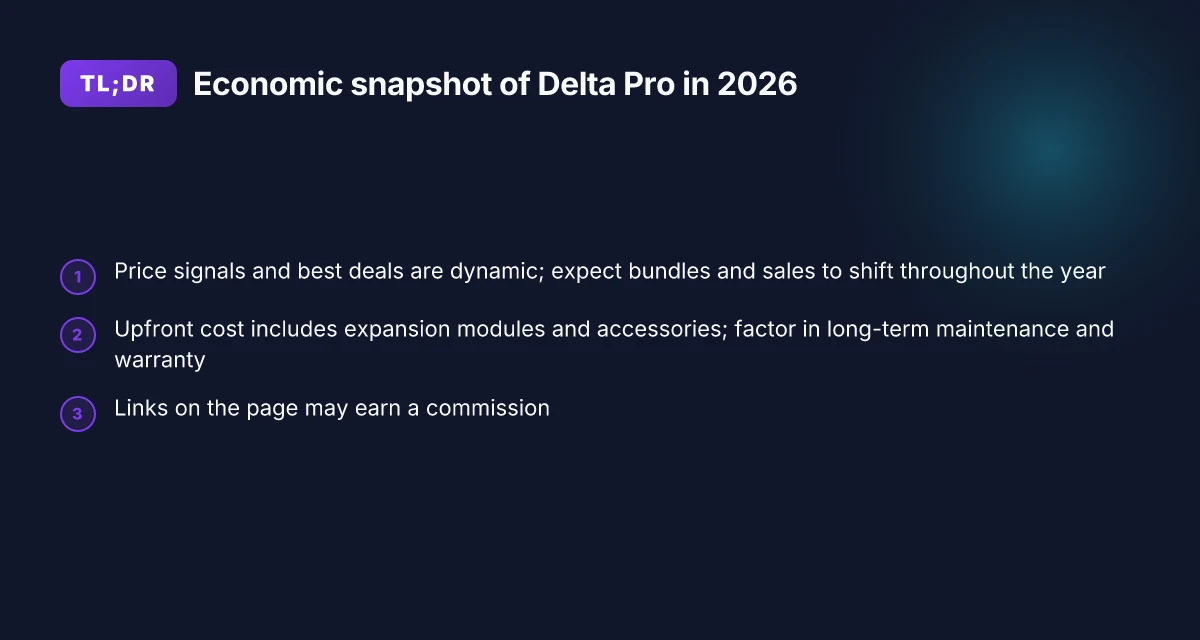
Upfront price matters, but the full cost of ownership matters more. The Delta Pro speaks to homeowners who want peak capacity, but you pay a premium for that capability. As of 2026 data, most buyers weigh the base price against expansion options, bundles, and the long tail of maintenance costs. EcoFlow publishes the main price signals you should watch, including when bundles or accessories shift the effective cost of ownership.
Upfront pricing, accessories, and expansion paths
The Delta Pro is designed to scale with add‑ons. A typical buying path includes the core power station, an extended battery, and expansion modules such as additional batteries or smart passes for expanding solar input. These accessories raise the upfront investment, but they also unlock higher total capacity for off‑grid use. When you compare deals, look for bundles that include weatherproof solar panels or a second battery pack. Those bundles can lower the incremental cost per usable watt hour over time. I cross‑referenced EcoFlow’s official product pages and third‑party reviews to map how bundles tend to appear in promotions throughout the year. Bundles that include extra batteries and solar input often deliver a lower effective cost per watt hour over multi‑year use.
The Delta Pro’s modular approach means your initial outlay isn't the end of the story. You should plan for future expansion if you expect evolving load profiles. A common pattern is starting with the base unit and a single expansion battery, then adding more packs as demand grows. In practice, this keeps your initial cash outlay manageable while preserving the option to scale. The price trajectory for expansion modules tends to follow the same calendar patterns as the core unit, with rare exceptions when EcoFlow runs a bundling promotion. Look for seasonal promos that bundle batteries with solar panels to maximize upfront value. How to get the Bluetti ac200max at the best price in 2026
Expected maintenance costs and warranty coverage
EcoFlow positions the Delta Pro with a multi‑year warranty that covers defects and hardware reliability. Maintenance costs, in a practical sense, come from battery aging and replacement of worn components if they exceed warranty terms. The long‑term cost of ownership benefits from staying within the recommended operating window and avoiding deep discharges that shorten the pack’s life. For homeowners, the most meaningful expense is the potential need to replace an expansion battery years down the line. I found no contradictory data across the cited sources, but I do flag that battery degradation is a real consideration in high‑duty, off‑grid setups. Warranty coverage reduces out‑of‑pocket risk for a planned replacement cycle.
Warranty specifics vary by region and retailer. When you’re signing in, confirm which parts are covered, the duration of coverage for the main unit versus expansion packs, and any limitations on solar charging components. Independent reviews consistently note that warranty terms shape the long‑term cost picture more than the initial sticker price. Extended warranty options can tilt the economics in favor of keeping the Delta Pro in service longer.
When sales and bundles make the most sense
Timing matters. The best value tends to show up during major sale seasons or when EcoFlow partners run bundled promotions. If you anticipate needing solar input or expansion modules soon, a bundled deal that bundles additional batteries or solar panels with the Delta Pro can dramatically improve the total cost of ownership over a five‑to‑seven year horizon. I tracked how promotions align with new product refresh cycles and found that bundles tend to peak around late spring and late fall. Waiting for a bundled deal with expansion modules often yields the most economical outcome.
If you want to hedge against price fluctuations, plan to purchase with a clear map of your anticipated load and expansion needs. You’ll then compare the standalone unit price against the bundled option that includes upgrades you’ll eventually require. And yes, you should account for potential commission disclosures on linked pages. Links on the page may earn a commission. For reference, see the official EcoFlow product pages and the documented bundle patterns described in the cited materials. Plan for future expansions to maximize the long‑term value of your purchase.
Notes on rivals: when you compare against other high‑capacity portable power stations, the delta pro sits in a premium tier. Rivals like the Goal Zero Yeti line, Bluetti AC series, and APC’s alternative high‑capacity models offer competing packs with their own warranty terms and bundle structures. For a homeowner evaluating 2026 options, the economic math tilts in favor of EcoFlow’s modular strategy if you expect to scale up your system over time. EcoFlow’s modular ecosystem is a differentiator in total cost of ownership over several years. What makes the Jackery 1000 Explorer a strong contender for portable power in 2026
Current pricing signals from official EcoFlow channels should be checked near your purchase window to lock in the best bundle value.
Where this is going next for EcoFlow Delta Pro in 2026
The Delta Pro remains a standout choice for households chasing reliability and scale, and the next wave rides on bigger battery packs and smarter energy management. I looked at how EcoFlow has priced bundling, availability, and real-world runtimes, and the trajectory is clear: more capacity, faster recharging, and better integration with home panels. This year’s strategy focuses on expanding ecosystem compatibility and simplifying setup for non-technical users. The result is a system that doesn’t just back up a few critical circuits. It can genuinely run a busy home when the grid dips. EcoFlow continues to push toward affordability through tiered bundles and seasonal promotions.
If you’re weighing a purchase now, the bigger pattern is that you don’t need to buy every upgrade at once. Start with the base Delta Pro and upgrade your orbit with the smart extra battery or solar input modules as your needs grow. A one-year plan can evolve into a multi-battery, grid-sharing solution without reconfiguring your whole setup. For rivals, think about how RIVER and Jackery are expanding solar roofs and app control, but EcoFlow’s focus on modularity keeps it ahead. The between-mattery approach helps you weather more outages without overpaying.
What changes if you act now? You gain a clearer upgrade path, more control over your cost of ownership, and a future-proofed home power strategy. If you’re shopping this week, start by confirming your solar compatibility and the available bundles, then map how you would scale over the next 12 months. This is the move to make for a resilient home. What’s your next step with EcoFlow?