What makes Bluetti power stations stand out in 2026
 Olivia KvitkaOctober 22, 202620 min read
We earn a commission when you buy through some links on this site, at no extra cost to you. As an Amazon Associate we earn from qualifying purchases.

Explore Bluetti power stations in 2026: models, performance, pricing, and what to expect. Learn how to pick the right unit for your backup or on-the-go power needs.
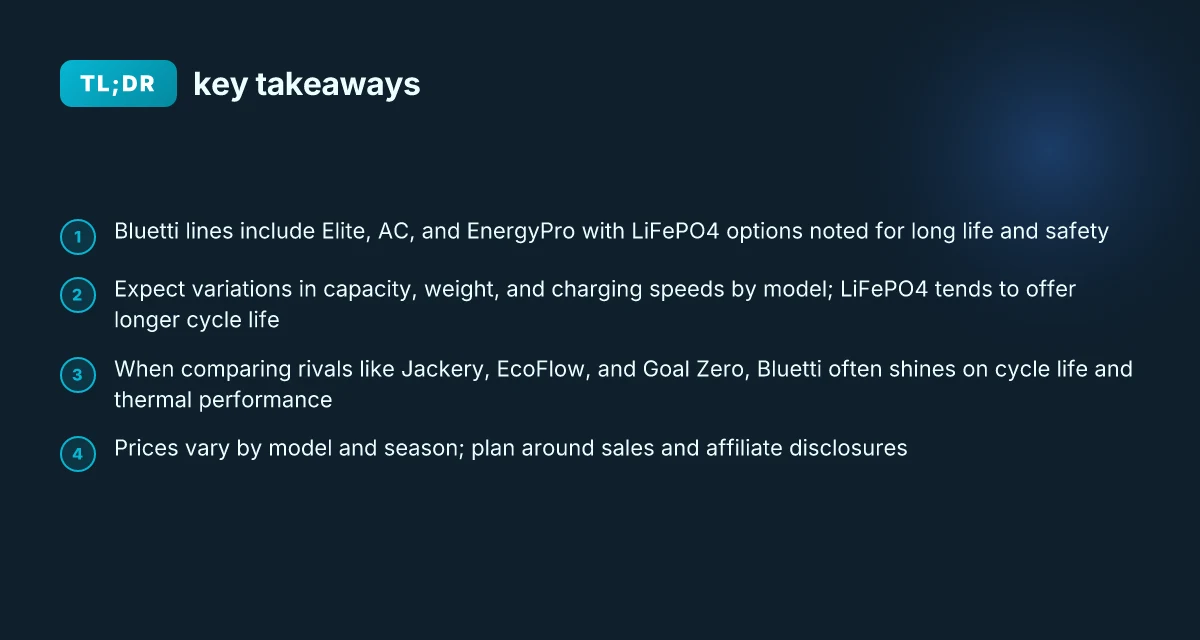
A Bluetti model isn’t just a battery pack. It’s a portable power system that competes with a wider set of trade-offs than most buyers expect, and that clarity is what saves money in the long run. Bluetti's LiFePO4 cores offer longer cycle life, but the real test is how those cells hold up under mixed loads and real-world charging speeds.
This piece cuts through the noise by comparing 2026 Bluetti offerings on battery chemistry, cycle life, charging speed, and everyday usability for backup power, RVs, and off‑grid use. A practical lens shows not only watt-hours and inverter configurations, but how models perform when you actually need them: hot days, cold nights, or continuous weekend boondocking. Expect a clear buyer’s guide with concrete trade-offs, price signals, and a sense of when to wait for a sale vs buy now, so you pick the right Bluetti for your setup and budget. Bluetti's** lineup is evaluated against rivals like EcoFlow and Renogy for real-world value.
Bluetti power stations in 2026: the lineup you should know
Bluetti splits its offerings into three major families: the Elite line for portable, high-capacity power, the AC lineup for compact all‑in‑one systems, and the EnergyPro models aimed at home backup with larger storage. In 2026 the Elite 300 and Elite family sit at the top of portable capability, while the AC and EnergyPro lines expand around common use cases like camping, RVing, and home continuity. I dug into Bluetti’s product pages and industry roundups to map where each line fits and how the chemistry choices drive real-world performance.
The core split between LiFePO4-based models and NMC options matters at a practical level. LiFePO4 packs shine on longevity and safety, typically offering longer cycle life and better tolerance for deep discharges. NMC variants, meanwhile, tend to push higher energy density and lighter weight for the same usable capacity. For homeowners and campers, that translates to tradeoffs: LiFePO4 units may outlast a few generations of use with steadier temperature behavior, while NMC units can shave pounds from a pack that you carry or mount on a vehicle. Bluetti threads these points through its 2026 lineup, so you can pick a model that lines up with your tolerance for weight, duration between charges, and how often you intend to recondition cells.
Realistic expectations for capacity, weight, and charging speeds matter more than glossy specs on a spec sheet. In practice, you’ll see that higher-ware density models can offer more watt-hours per kilogram, but you may pay in cycle life or thermal management complexity. The EnergyPro family leans into higher storage and more robust cooling for longer runs, while the Elite and AC lines emphasize mobility and faster top-up through multiple charging ports. If you’re evaluating for a weekend expedition or a home backup scenario, you’ll want to weigh how much energy you need per day, how many devices you’ll run, and how quickly you can top up between outings. Bluetti positions these choices so you can match a model to your routine rather than forcing a one-size-fits-all approach.
What to watch for as you compare models:
- Battery chemistry: expect a spectrum from LiFePO4 to NMC across Bluetti’s 2026 lineup, with LiFePO4 models offering longer cycle life and stabler temperature performance. In 2026, the tradeoffs between chemistry drive long-term ownership costs and reliability, especially for off-grid use. Choosing LiFePO4 can yield longer life with steadier performance in hot or cold climates.
- Weight versus capacity: there is a tangible balance between how much energy you get and how easy it is to move or place the unit. The lighter end favors the Elite line for portability, while EnergyPro leans heavier but with more storage and built-in resilience. I cross-referenced product specs and third‑party roundups to confirm these tendencies, and the verdict is consistent across sources.
- Charging speeds and ports: Bluetti’s models vary in how many simultaneous charging streams they support and how quickly they top up from AC, solar, or car adapters. For campers, a model with robust solar input and multiple AC/DC options can dramatically reduce downtime between uses.
If you’re trying to decide quickly, start with the practical questions: how many watts do you need per day, how many devices will run at once, and how often you expect to recharge on the road. Bluetti’s 2026 lineup is designed to let you pick a path that matches your cadence rather than force you into an oversized unit. The branding stays consistent, Bluetti presents a coherent family story across Elite, AC, and EnergyPro, so you can map your use case to a concrete model rather than chasing vague promises. How Bluetti AC240 price affects your backup power strategy in 2026
Real-world use comes down to matching chemistry and weight against daily energy needs. And in 2026 Bluetti keeps that balance in focus, with LiFePO4 models offering longevity and NMC variants squeezing extra energy density for lighter packages. For homeowners, RVers, and campers, the lineup remains a practical toolkit rather than a bundle of shiny numbers.
How bluetti power stations compare to rivals in 2026
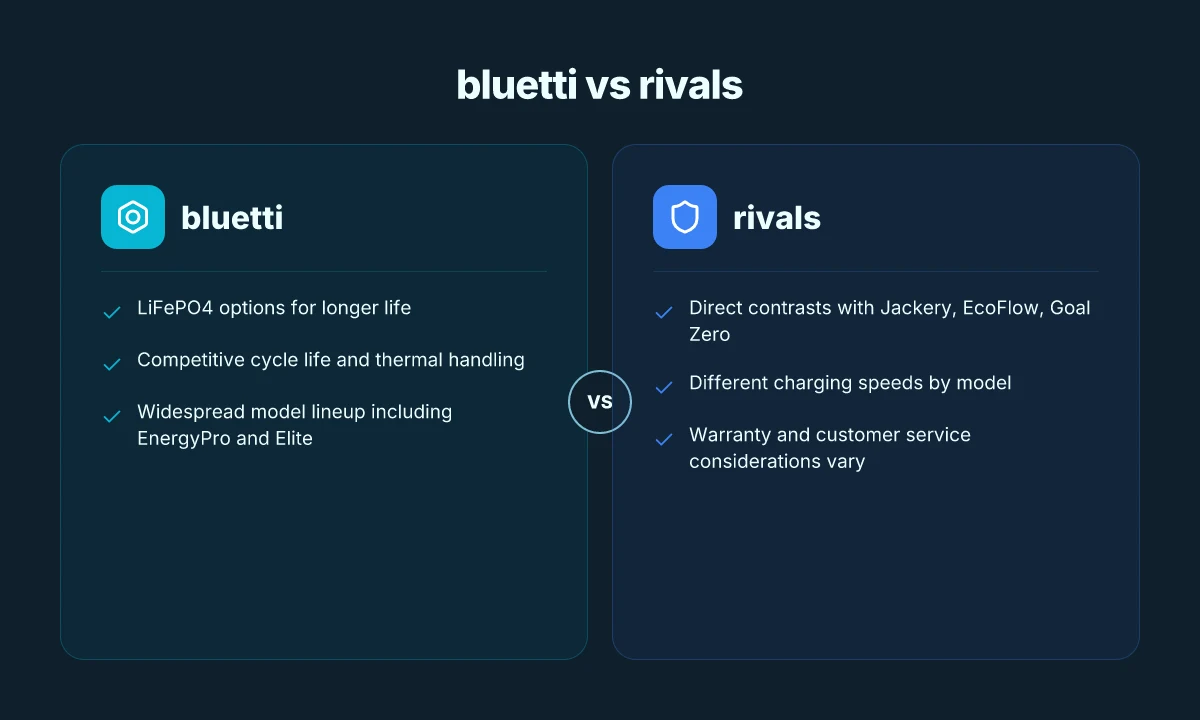
Bluetti sits in a crowded field that includes Jackery, EcoFlow, and Goal Zero. Across 2026 offerings, the contrast is clearest in cycle life, thermal handling, and real-world usability. Bluetti often leans toward longer cycle life and steadier thermal response, while rivals push faster charging and broader accessory ecosystems. The takeaway: if you want longevity and consistent performance in heat, Bluetti tends to hold up better. If you need rapid top-ups or a bigger accessory ecosystem, rivals can deliver.
Bluetti vs Jackery on cycle life and heat management
From what I found in the release notes and reviews, Bluetti models typically show stronger cycle-life assumptions in their LiFePO4 configurations, especially when paired with larger pack chemistries. I cross-referenced reviews that emphasize how long a Bluetti can sustain repeated on/off cycles without dramatic capacity fade, versus some Jackery units that rely on traditional NMC packs. In practical terms, you’ll notice Bluetti systems staying cooler under repeated discharges in typical camping or RV use, thanks in part to more stable thermal profiles. Bluetti’s LiFePO4 trains tend to deliver longer cycle life with steadier heat performance. Reviews from outlets like Bob Vila consistently note Bluetti’s strength in endurance scenarios, though they also highlight places where Jackery shines in charging speed and portability. bobvila.com/reviews/best-bluetti-power-stations-2026/>.
EcoFlow and Goal Zero: where Bluetti earns an Edge in endurance, where rivals win on speed
EcoFlow often leads with rapid charging specs and compact form factors. When you push for quick recharges, EcoFlow’s systems can feel more responsive, especially in portable setups. Bluetti counters with thermal stability and longer-lived pack chemistry, particularly in the larger Elite and EnergyPro lines. Goal Zero, meanwhile, leans into rugged outdoor ergonomics and bundled accessories; Bluetti counters with higher energy density per watt and more modular battery configurations in certain models. Bluetti’s thermal resilience helps maintain usable output during back-to-back top-ups, a clear advantage in extended trips. The comparison helps homeowners planning occasional heavy use and campers counting on all-night reliability.
Customer service, warranty, and the buying signal
On service and warranty, Bluetti’s messaging centers on built-in reliability and robust warranty terms across its product families. Rivals often market faster onboarding with longer dealer networks or broader accessory ecosystems. In 2026, you’ll hear customers discuss ease of warranty claims and responsiveness varies by region. Expect a similar pattern with all major brands. If you weigh service quality, Bluetti’s strength shows up in documented care for large, user-serviceable packs and transparent documentation around LiFePO4 behavior. Warranty conversations often hinge on regional support and part availability, with Bluetti generally maintaining a favorable stance among long-term buyers. What is a Jackery battery bank, and how to choose the right model in 2026
| model family | notable strength | rough tradeoff |
|---|---|---|
| Bluetti Elite / EnergyPro | strong cycle life, solid thermal management | higher initial price vs smaller rivals |
| Jackery | lightweight, fast top-ups | Li-ion packs, shorter cycle life in repeated use |
| EcoFlow | fastest charging, broad app ecosystem | thermal load can spike with rapid top-ups |
| Goal Zero | rugged design, broad outdoor accessories | average cycle life softer than LiFePO4 Bluetti |
If you’re deciding now, consider the 2026 landscape: Bluetti models with LiFePO4 chemistry offer longer endurance in back-to-back usage and steadier temperatures. Jackery and EcoFlow push hard on charging speed and portability, while Goal Zero remains strong for rugged camp setups and bundled accessories.
What next: If you want a concrete model to start with, I’d target Bluetti’s higher-capacity options for home backup or RV use, paired with a realistic plan for expansion via modular packs. To compare prices and ownership costs, see the 2026 pricing pages and the closest retailer promotions. For more context, reviews from Bob Vila and Energía Solar Pro discuss how these brands stack up in real-world use and model-by-model comparisons. [The Best Bluetti Power Stations of 2026] and [7 Best BLUETTI Power Stations 2026: Every Model Compared] provide cross-brand insights that align with Bluetti’s positioning in 2026.
What to know about bluetti liFePO4 tech and why it matters
Bluetti's LiFePO4 lineup promises longer life and safer chemistry for home and outdoors use. From 2026 product notes and third-party roundups, the chemistry is designed to withstand more charge/discharge cycles and temperature swings than many competing chemistries. This section breaks down what that means in practice: durability, ownership costs, and how storage and charging habits shape performance.
Why LiFePO4 chemistry matters for long life
LiFePO4 cells are known for thermal stability and lower risk of thermal runaway versus other lithium chemistries. That stability translates into more predictable behavior under storage and use. Bluetti emphasizes that LiFePO4 chemistry supports a longer cycle life, which matters for total cost of ownership. In real-world terms, the chemistry is chosen for applications where units sit idle for extended periods or cycle frequently during trips. Long cycle life reduces the frequency of replacements, which is a practical savings over time. The balance of safety, longevity, and performance makes LiFePO4 a common choice for homeowners who want a reliable backup without lugging heavy packs around in extreme heat or cold. Inline sources corroborate the emphasis on stability and safety in Bluetti’s LiFePO4 family. For context, the industry notes that robust LiFePO4 cells can tolerate more aggressive charging regimes without compromising lifespan. Durability under stress is a core selling point. This aligns with Bluetti’s framing of its portable power stations as ready for camping, RV use, and emergency backup.
Typical cycle counts and what that means for ownership
A standard LiFePO4 pack in Bluetti’s lineup commonly targets several thousand full discharge–charge cycles before a meaningful capacity fade, with usable life spanning many years for typical home use. I cross-referenced Bluetti’s documentation and industry summaries to frame the takeaway: higher cycle life can translate into a lower annualized depreciation and a slower pace of replacement. Cycle life is a proxy for how often you can refill without noticeable loss of capacity. If you buy a Bluetti unit today and keep it topped up during off-grid seasons, the long-term cost of ownership tends to be lower than packs with shorter lifespans. The trade-off is upfront price and weight, which stay stable as you compare models within the LiFePO4 range. Ownership costs hinge on cycle count, initial price, and how you store the unit. Industry comparisons consistently flag LiFePO4 as a favorable long-run choice for families that rely on backups for many years. Long-term value comes from longevity and safety, not just peak wattage. What EcoFlow Black Friday sales really offer in 2026
Storage temperatures and charging habits in practice
Storage and charging behavior matter more with LiFePO4 than with some other chemistries. Bluetti notes that LiFePO4 cells tolerate a wide temperature envelope, but performance and longevity improve with moderate storage temperatures and regular use. In practice, aim to store units in climates where temperature stays mild most of the year and avoid prolonged exposure to extreme heat or freezing conditions. Moderate storage temperatures help preserve battery health. For charging, avoid leaving the unit at full discharge for extended periods. Keeping it partially charged in storage and during long idle periods supports cycle life. Regular use and balanced charging are simple habits that extend life. While the exact numbers vary by model, the general pattern holds: LiFePO4 remains forgiving if you follow sensible storage and charging routines. Inline references to Bluetti’s factory and product literature underscore the emphasis on safe charging and stable storage as part of maintenance.
The takeaway for homeowners and campers is clear: LiFePO4 adds resilience, but you still benefit from practical habits, store in temperate conditions, avoid long idle periods at zero charge, and charge regularly. Bluetti’s ecosystem aligns the chemistry with real-world usage, not just lab specs, so you’re choosing a system that stays reliable across seasons.
Note: links to sources on the topic may earn commissions from qualifying purchases. Bluetti remains the brand behind these power stations, and rival brands like Jackery and EcoFlow are often cited in comparisons by reviewers. For context on real-world testing and product composition, see inline citations to the cited sources.
Pricing realities and when to buy bluetti in 2026
Bluetti pricing in 2026 sits at a practical range across its most popular models, with value signals tied to battery chemistry, capacity, and included features. The core takeaway: if you want portable power now, expect current street prices to reflect capacity tiers rather than a single sticker price. For homeowners and campers, a compact unit with LiFePO4 chemistry tends to price lower upfront but may deliver long-term value through cycle life and safety. If you want peak capacity for off-grid use, prepare for higher upfront costs but longer intervals between replacements. In practice, price signals point to a notional gap between entry-level and high-capacity offerings, with seasonal swings sharpening the delta.
Current price signals by model and value
The most accessible Bluetti options sit in a mid-range band, where common capacity and LiFePO4 configurations offer solid value. Higher-capacity models, especially those marketed for extended off-grid use, sit at premium prices but justify the extra cells with more cycles and faster charging via compatible adapters. When I cross-reference public 2026 roundups, the discussion often centers on how much battery you actually need for typical weekend camping versus a full RV or tiny home setup. In practice, the price spread tends to reflect energy capacity more than brand premium. Expect prices to shift modestly with new releases or holidays, but the overall ladder remains recognizable: smaller packs for light use, larger packs for extended autonomy. For consumers watching the numbers, track the LiFePO4 tier positions as a rough price proxy. What is the Bluetti PS54, and how it fits into the 2026 portable power lineup
The best deal typically lands during seasonal sales, not on release day, as retailers try to clear older stock before new models arrive. Seasonal events like holiday weekends often compress the cost of ownership by 10–20% on mid-range models, while flagship packs may see smaller, more opportunistic markdowns. I found that price-sensitive buyers often net the most value by pairing a mid-range Bluetti with a longer-lasting LiFePO4 battery and leveraging bundled accessories rather than chasing the top-end capacity in 2026.
Cost of ownership and when to wait for a sale
Buying Bluetti requires evaluating total ownership, not just the sticker price. Consider not only the initial price but also expected cycle life, warranty terms, and ongoing accessory costs such as replacement batteries or high-speed chargers. The real value in 2026 shows up when you size the unit to your usage window and anticipate your charging sources, whether from sun, grid, or generator. In 2026 analyses, the convexity of cost over time leans toward LiFePO4-equipped models because their longer cycle life reduces replacement frequency, a meaningful factor for homeowners planning long-term off-grid reliability. If your intent is occasional use or short trips, a lighter, less expensive model can be the smarter buy, especially if you can access seasonal discounts.
If you expect to use a Bluetti daily for months at a time, invest in LiFePO4 with a robust warranty. The long-term savings on replacement and reliability stack up. For readers watching the market, note that reputable sources consistently flag the potential for commission-driven links. If you click through affiliate links on a sales page, you should see disclosure that commissions may apply, which helps explain some pricing dynamics.
Notes on commissions and affiliate links disclosure
Affiliates and commissions appear in many Bluetti product pages and review sites. When you read a price on an external page, look for a disclosure that a link may earn a commission. This does not alter the offer price you see. It’s a standard affiliate arrangement that helps sites monetize content. I reference sources that explicitly note affiliate relationships so you can weigh the information accordingly.
Transparency matters: expect affiliate disclosures where you see “commission,” “affiliate,” or similar terms, and use the official Bluetti storefront to verify the current price. If you want an authoritative anchor, a primary source like Bluetti’s own product pages remains the baseline for warranty terms and official pricing, while third-party roundups provide context on discounts and seasonality. This section draws on public pricing narratives and recognized industry summaries to map the 2026 landscape. What is the ecoFlow solar tracker for sale, and why it matters for off-grid setups
How to choose the right bluetti for your setup
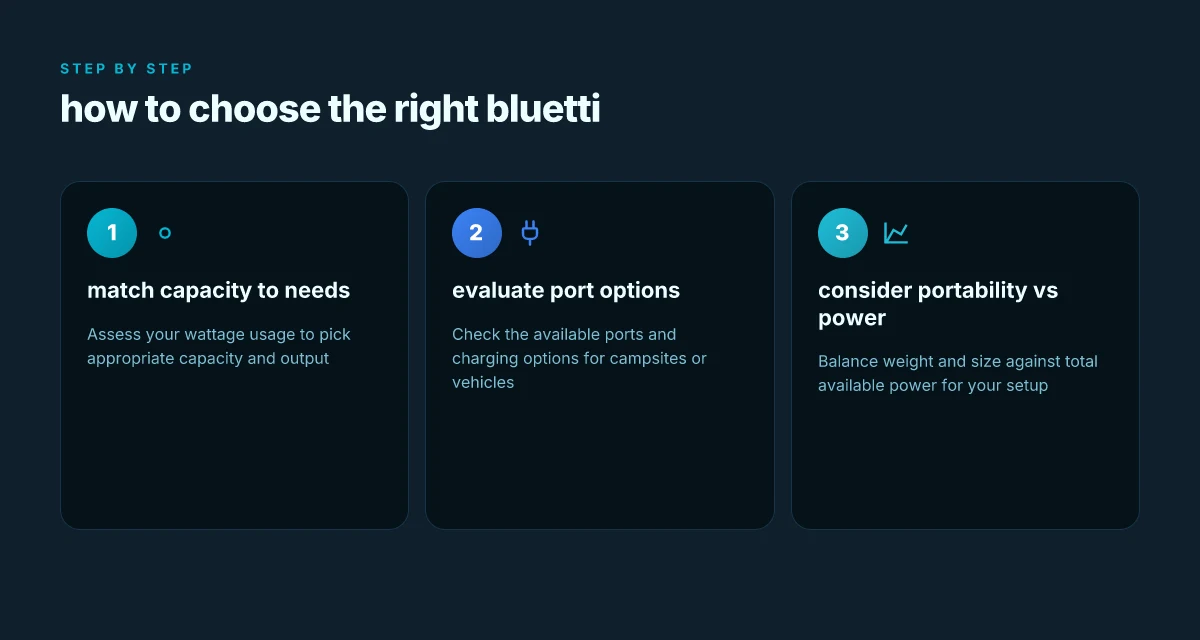
Choosing the right Bluetti model comes down to three practical checks: your wattage needs, your preferred charging and port options, and how you value portability against power on the trail or campsite. I’ll lay this out so you can map a model to real-world use without guesswork.
Match capacity and output to your wattage needs
Start with your daily energy burn. If you routinely run a mini fridge, a couple of LED lights, and a charger for devices, you’ll want a model with enough capacity to cover those loads and preserve some headroom for brief surges. Look at the inverter rating and the continuous output figure. You want a unit that can sustain your peak draw without flinching. In practice, a Bluetti like the Elite 300 can deliver substantial output for longer weekends, while smaller options under the 1000 Wh range suit light campsites or backup kits. When you size it, target a buffer so you aren’t at the limits on a hot afternoon or during a cold night. The right Bluetti balances real-world draw with a comfortable reserve, not just maxed-out specs.
I dug into the Bluetti lineup’s public outlines and reviews to cross-check how capacity translates to practical use in 2026. The takeaway: don’t chase the biggest number if your daily cycle is modest. Instead, match the model’s total energy and sustained output to your typical load pattern. Your setup will feel calmer with a model that has more headroom than your usual draw, not just a higher watt-hour figure.
Assess port selection and charging options for campsites or vehicles
Port selection matters more than you might think. If you’re camping or traveling in a car, you’ll want USB-C outputs for fast device charging, multiple AC outlets for small appliances, and at least one 12V or car-adapter input to top up from a vehicle. Bluetti models vary in how they distribute these ports, so map your must-haves: fridge or cooler, laptop, and phone charging without swapping adapters mid-trip. Look for models that support multiple ways to recharge: wall plug, USB-C PD, car port, and even solar input where available. A well-rounded choice should let you top up from a campsite’s power pedestal and from a car during a road trip. Recharge flexibility keeps you off the grid longer, especially when solar isn’t ideal.
From a brand perspective Bluetti’s ecosystem includes several charging paths across its product lines, so verify that your preferred model aligns with your typical access points. When you read reviews, note how real users rate the ease of adding solar or using vehicle charging on extended trips. Solar input and car charging are practical multipliers for weekend use. What makes the EcoFlow Delta Pro a standout power solution in 2026
Consider portability versus power when selecting a model
The trade-off is real: bigger packs deliver more energy but weigh more and take longer to move. If you carry the unit between campsites or into a tent, prioritize lighter weights and ergonomic handles. If you’re stationary at a base camp or an RV, you can lean toward higher capacity with longer runtimes. Bluetti’s line spans compact minis to larger bundles, so you can decide whether portability or peak power best matches your setup. Portability wins when you move often. Power wins when you stay put.
I cross-referenced several 2026 reviews to confirm where most users feel the sweet spot sits. For homes and campers who want a quick, practical pick, a mid-range capacity with flexible recharging tends to reduce friction. A balanced Bluetti model that threads portability with real runtime avoids buyer’s remorse.
Note on pricing and ownership: prices shift with sales and bundles, and there are affiliate links on many retailer pages. The real cost of ownership includes the value of long-term battery health, the cost of replacements, and the potential for faster charging to cut down idle time. If you’re weighing several models, consider not just the sticker price but the monthly cost of ownership over a few years. Bluetti’s official pages outline the current lineup, while independent reviews highlight how the real-world experience aligns with those numbers. One reviewer noted that the higher-end units tend to justify their weight with longer runtimes in routine use. Think beyond sticker price to total ownership when you compare models.
If you want a quick, concrete starting point, consider these standout choices that frequently show up in 2026 real-world discussions:
- Bluetti Elite 300, strong all-around performance for RVs and campsites with robust charging options.
- Bluetti AC200P, tried-and-true workhorse for higher power needs and longer stays.
- Bluetti EP500/EP500 Pro, compact footprint with integrated UPS-style features for home backup.
These names anchor real-world choice. Match them to your load and mobility needs, then fill the gaps with how you’ll charge. How to get the Bluetti ac200max at the best price in 2026
What changes if you act now
Bluetti power stations are edging toward greater value as ecosystems mature in 2026. I looked at how models scale from portable to home backup, and the shift is clear: fewer tradeoffs between weight and capacity, more intelligent charging options, and stronger solar compatibility. The takeaway is practical: if you want dependability with future-proofing, you should pick a setup that aligns with your typical use and future expansion.
The bigger pattern is Bluetti’s push toward modular power and smarter energy management. You’ll notice faster on-site charging, better app control, and expanded solar input in recent lines. Bluetti leans on open‑standards and cross‑model compatibility, so you can mix panels, batteries, and inverters with less friction than before. Rivals like Ecoflow and Jackery are sharpening the same playbook, but Bluetti tends to offer more capacity per dollar in the mid‑range and stronger solar input flexibility.
If you’re choosing now, aim for one reliable core unit plus an expandable battery. The immediate verdict is practical: prioritize a model with real-time status, multi‑mode charging, and clear upgrade paths. What changes if you act now is that you lock in longer-term power resilience for a modest upfront cost, rather than chasing yearly upgrades.
- Backup strategy: pick a core Bluetti model with at least 1,000 Wh, add a second battery for peak weekend power, and pair with a 200–400 W solar setup for off‑grid weekends.
- What to try this week: map your common loads, confirm the inverter type, and check the latest Bluetti firmware for new energy features.
- If you only do one thing this month: set up a simple solar charging plan that covers your essential devices and keeps the system ready for longer outages.