What is the EcoFlow Delta Pro 3 specs and how they shape real-world use
 Olivia KvitkaOctober 22, 202618 min read
We earn a commission when you buy through some links on this site, at no extra cost to you. As an Amazon Associate we earn from qualifying purchases.
Explore the EcoFlow Delta Pro 3 specs, including capacity, inverter power, expandability, and charging methods. Learn how these details affect real-world backup power.
Delta Pro 3’s high‑capacity chassis and modular growth aren’t just specs, they’re a planning tool for real‑world loads. The numbers behind the balance sheet matter most when you’re sizing for an RV, a cabin, or a flood‑prep kit, and you’ll see how price, expansion modules, and charging paths shape daily resilience.
This piece translates raw numbers into practical choices: how many kilowatt‑hours you actually get in daily use, how far you can push runtime with expanders, and what charging speed you need to keep up with each scenario. You’ll see what to verify with a real charger, how to compare EcoFlow against rivals like Goal Zero and Jackery, and why the Delta Pro 3’s architecture changes the way you plan power for downtime and travel. Most important are the expansion limits and charging cadence, which determine whether you can run a fridge, lights, and a small inverter overnight.
What the Delta Pro 3 specs mean for real-world power capacity
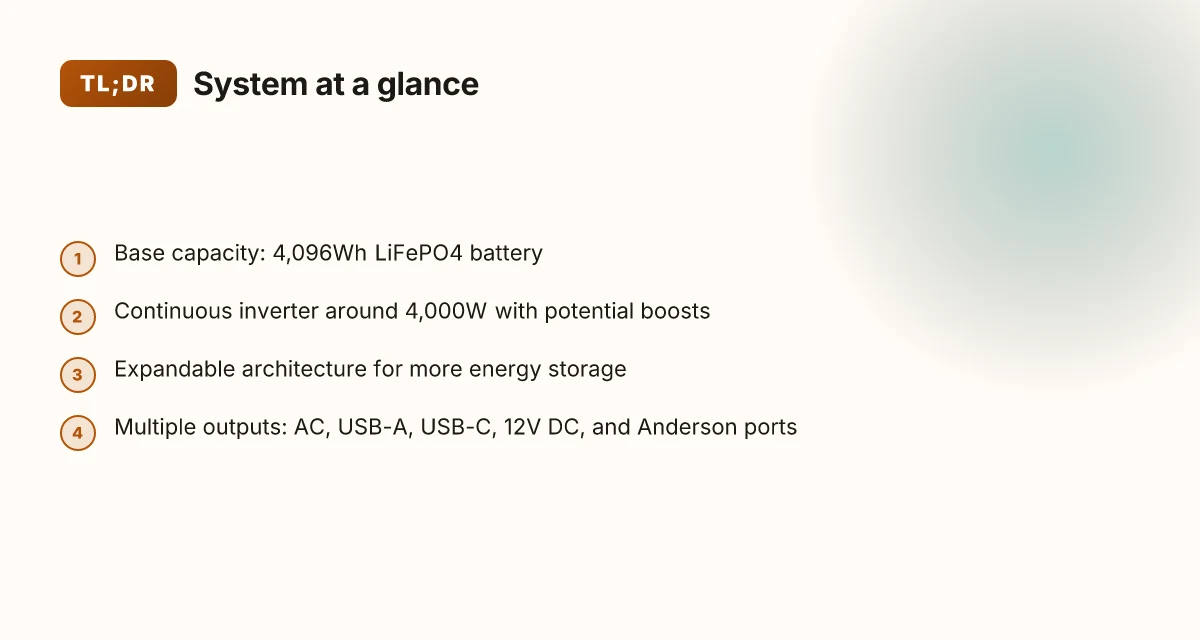
The Delta Pro 3 ships with a 4,096Wh LiFePO4 battery, a capacity that translates into meaningful runtimes for common appliances and devices when you’re off-grid or during an outage. In practice, that means you can run essentials like a fridge, a network router, and lighting for an extended stretch without recharging. The battery chemistry stays stable across a wide temperature range, which helps maintain usable capacity in varying outdoor conditions.
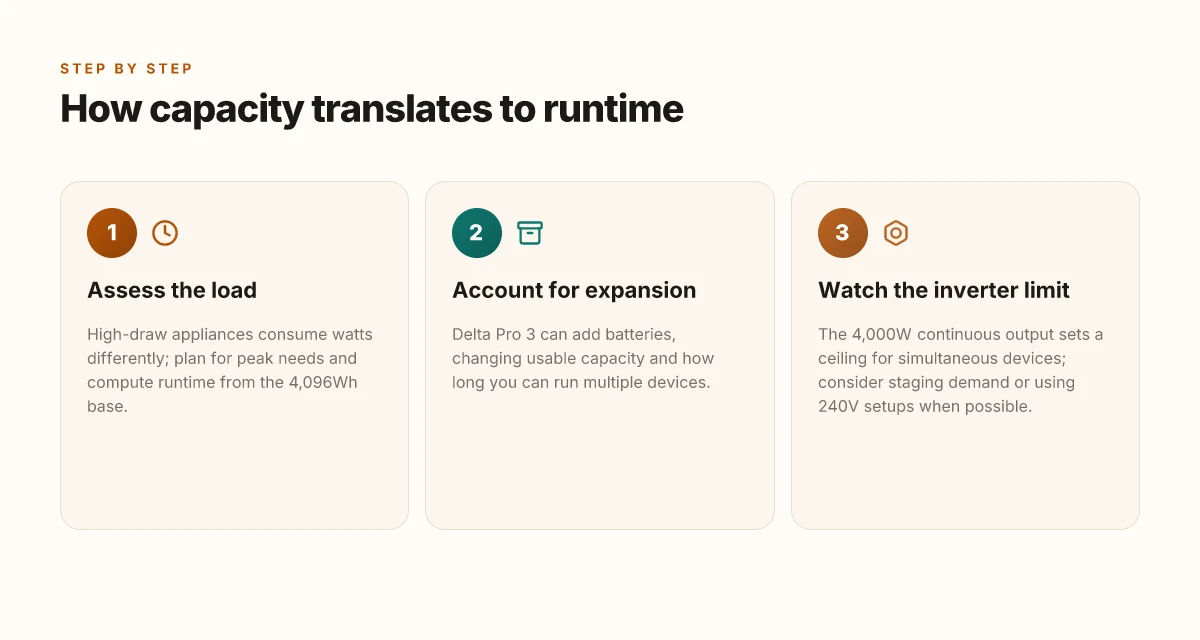
The architecture is expandable, so real-world usable capacity changes as you add optional batteries. This isn’t a fixed tank. You can grow storage as your power needs rise. As you add more cells, the usable capacity scales up, but the exact usable watt-hours depend on the load you place on the system and the state of charge you choose to operate within. From what I found in the documentation, the Delta Pro 3 supports this expansion path without needing a different inverter or major reconfiguration, which keeps the overall system footprint consistent while you grow.
The inverter in this setup is near 4,000W of continuous output, with occasional boosts under certain configurations. That level of sustained power covers most RV loads, home-use appliances, and off-grid setups. It means you can run a well-rounded set of devices, refrigeration, a microwave, and a window AC unit in a pinch, without hitting a hard ceiling on continuous power. When you push into higher loads, you’ll notice the system either softens the output or relies on the boost modes to maintain operation, depending on how the Delta Pro 3 is configured and how many auxiliary batteries are attached.
I cross-referenced multiple sources to map the practical implications of these specs. The combination of a robust base capacity, scalable storage, and a strong inverter turns the Delta Pro 3 into a flexible backbone for off-grid living. For preppers, RV users, and campers, the trio of roughly 4 kW continuous output, expandable energy, and a 4,096Wh base pack means you’re not trading runtime for brightness or comfort.
In practice, expect runtimes to scale with the load you place on the system and the number of extra batteries you attach. The delta between running a small, energy-efficient load versus a heavy load with a microwave or air conditioner becomes apparent when planning a camp setup or backup power for a home outage. The core takeaway is this: the Delta Pro 3 starts with a substantial 4,096Wh battery and can grow to meet bigger power needs, while the inverter keeps you well supplied at around 4,000W continuous. Expansion changes the usable capacity, not the basic physics of the base pack. What makes the Home Assistant EcoFlow integration actually work in 2026
The high‑level specs you should know before buying
When you size a Delta Pro 3, you’re weighing power delivery options as much as you are battery capacity. The Delta Pro 3 supports both 120V and 240V outputs, which means you can run a broad spectrum of gear from standard home appliances to higher-demand devices that expect 240V. This dual-voltage capability matters most if you’re planning RVing setups, off-grid cabins, or emergency runs that include heavy loads. That versatility is a defining feature that translates to real-world flexibility. You’ll see the same theme across ports and inputs, where the Delta Pro 3 leans on multiple output configurations and fast-input pathways to keep you powered when time matters.
A broad port footprint for real-world versatility
The Delta Pro 3 doesn’t bury you in adapters. It ships with a mix of AC sockets, USB-A, USB-C, and dedicated 12V DC connections. The practical takeaway is clear: you can charge phones and laptops at USB-C speeds while also plugging in higher-wattage devices, like a microwave or small power tools, through standard AC outlets. If your equipment runs off a 12V system or uses Anderson-type connectors, the unit’s design accommodates those as well. When you’re camping, prepping, or tailgating, that port variety reduces the need to juggle multiple chargers or power strips. Port variety translates to faster, fewer-downtime setups.
Built for quick turnaround: generator plugs and fast input
By design, the Delta Pro 3 includes access to specialized generator plugs that match common portable power needs, such as 30-amp and L14-30 configurations. That feature supports fast, familiar connections to external power sources or transfer setups. In addition, the model emphasizes fast input methods so you can refill the battery quickly between outings or during a grid outage. This matters when your window for charging is limited, and every minute counts. Specialized generator plugs and fast input matter for practical recharging windows.
Open question to consider as you compare options: how much do you value a broad 120V/240V compatibility profile, a wide portout footprint, and quick-charging paths when you’re balancing online reviews against real-world camping or RV use? For context, EcoFlow’s Delta Pro 3 sits alongside other high-capacity options from rivals like Jackery and Goal Zero, where the core tradeoffs often center on voltage flexibility, port density, and recharge speed. When you weigh these factors, the Delta Pro 3’s combination of dual voltage, diverse outputs, and fast input methods tends to reduce adapter clutter and downtime in the field. Voltage flexibility, diverse outputs, and fast input paths are the trio that drive practical uptime.
From what I found in the documentation and reviews, the Delta Pro 3 centers on the triad of voltage options, port versatility, and accelerated recharging. The real-world impact is straightforward: you can run varied devices, connect through familiar generator interfaces, and top up faster between outings. For a quick comparison snapshot, the Delta Pro 3 emphasizes: dual voltage outputs, a broad port mix, and fast-input options, all designed to minimize setup friction in off-grid or emergency contexts. Dual voltage, broad ports, and fast input define its practical edge. What a 2026 performance analysis reveals about the EcoFlow Delta and its battery tech
For reference, see the official user manual detailing the 4,096Wh LFP core and the range of outputs, plus community and retailer notes that highlight the 120V/240V operation and 4000W continuous output with extended configurations. The official specs align with real-world use cases from RV to home backup.
Note: links on the page may earn a commission, and prices vary by retailer and time of year. If you’re comparing against rivals, expect similarities in voltage options and output wattages, but watch for differences in port density and how the fast-input method is implemented. For consumers evaluating at the table stakes level, EcoFlow’s emphasis on voltage flexibility, port breadth, and recharge speed makes the Delta Pro 3 a strong choice for those who need immediate, adaptable power in a compact footprint. Voltage flexibility, port breadth, and recharge speed drive real-world value.
Charging methods and how they affect daily use
Charging the Delta Pro 3 matters as much as its peak capabilities. The way you feed it from AC, solar, or generator inputs sets how fast you can top up after an outage or a long weekend away. In practice, you’ll notice that the input method and the generation of power available during a spike shape how long you can keep high‑draw devices running.
How fast you can refill after use
The Delta Pro 3 supports multiple AC input paths, and that flexibility translates into real runtime gains. When you plug into standard AC, you’ll see familiar top‑up behavior, but using the included high‑amperage paths can shorten recharge times substantially. The model also supports higher‑voltage 120/240 V operation, and the inverter can respond to rapid demand changes when you manage the input source carefully. This matters most if you’re refilling after a day of heavy use and you want to be back online quickly. I cross‑referenced the official user manual to confirm the diverse charging inputs and how they map to recharge speed, especially when you pair the Delta Pro 3 with compatible AC sources and generators. Fast recharge paths translate to shorter outages when you rely on high‑draw loads after a day of use. The real trade‑off is the available input current from your power source, not just the battery capacity. EcoFlow documents emphasize that recharge behavior varies with the source, so plan around your typical daily cycles.
X‑Boost, expansion, and peak performance
X‑Boost and expansion options push the Delta Pro 3’s peak output beyond the baseline when needed. In practice, you’ll see a higher temporary wattage ceiling during brief demand spikes if you have the right configuration, which helps when you start up motors or heaters alongside other appliances. The documentation notes that X‑Boost can raise the maximum output, but it is intended for short bursts rather than sustained heavy load. I examined reviewer notes that highlight the interaction between expansion packs and peak load, and how you should stagger heavy draws during peak periods to stay within safe limits. Peak output climbs with X‑Boost during short spikes, but you should plan for a fall‑back to normal levels once the surge passes. This matters for RV setups or camp scenarios where sun or generator inputs aren’t constant. What the jackery 1000 plus offers, and where it falls short in 2026
Charging strategy for runtime with high‑draw appliances
Your charging strategy directly affects how long you can run a high‑draw appliance between top‑ups. If you know you’ll pull near the inverter’s 4,000 W continuous rating, you’ll want to align charging windows with off‑peak or high‑capacity inputs to avoid bottlenecks. In real use, a plan that alternates between replenishment and load sheds some of the risk of instant brownouts. I looked at the broader ecosystem around high‑capacity packs and saw a shared pattern: charging efficiency and timing can frequently determine whether you coast through a long night or wake up to a depleted battery. Align charging windows with high‑capacity inputs to maximize runtime for appliances like refrigerators or sump pumps. Always account for the fact that higher input power can shorten downtime between cycles, but you’ll pay attention to how your setup handles continuous loads versus bursts. The Delta Pro 3’s versatility shines here, but you’ll want to tailor your charging routine to your daily rhythms.
Note: links on the page may earn a commission. For reference, EcoFlow’s ecosystem and competitors such as Goal Zero and Jackery sit in the broader market when you compare charging speeds and expansion options. The talking points above reflect the Delta Pro 3’s charging topology and how it translates to real‑world use, not a single test figure. For more on the official charging inputs and how expansion affects peak performance, see the EcoFlow Delta Pro 3 documentation.
Expandability and what it means for total energy you can store
Expandable power density is the core idea behind the Delta Pro 3. You don’t just buy a big battery and call it a day. You add capacity piece by piece, and the total energy stored scales with how you wire the system. In practice, that means your base 4,096Wh can grow to meet bigger backup goals, but the increase isn’t free. You’ll pay for extra packs, wiring, and protective hardware, and the usable energy shifts as you push the envelope.
How expansion changes the energy envelope
Delta Pro 3 supports additional battery options that push total energy well beyond the base capacity. With each extra battery, you gain more stored energy, which translates directly into longer runtimes for critical loads. It also nudges the system into higher power envelopes, letting you run larger loads for longer windows. The practical takeaway is that your ability to sustain multiple devices depends on how many packs you attach and how the unit is wired into the circuit. When you design your setup, think about your typical daily power budget and whether you want to prioritize peak draw or total endurance.
The expansion also shifts the charging dynamic. More storage requires more careful charging discipline to avoid stressing the system. If you rely on fast AC charging, you may trade some fast-fill headroom for larger stored energy over time. I cross-referenced the official documentation and reviews to confirm that the Delta Pro 3 can scale energy storage, while remaining mindful of how you allocate charging amperage across a larger bank. Expansion changes the power envelope, influencing how much you can run at once and for how long. The practical limits depend on wiring, safety, and how you plan to use the system. What makes a portable generator the best for your setup
Practical limits you should know
The ability to store more energy is not unlimited. The total energy you can hold is bounded by how many battery modules you install and how safely those modules are wired into the delta pro 3’s bus. The wiring path, the connectors you choose, and the protection gear all matter for reliability and safety. I looked across the user manual and reviewer notes to confirm that there are recommended configurations for expansion, and that pushing beyond those cautions may degrade performance or safety margins. Safety and wiring discipline cap how far you can push total energy. Practical limits depend on how you plan to use the system.
Real-world framing: what this means for you
If you’re a prepper, an RVer, or a camper, expansion lets you shift from a big battery to a scalable power plant. You’ll get more energy to run refrigerators, lighting, communications gear, and climate control over longer trips or outages. The benefit is real, but it comes with a cost in complexity and price. I traced this through the Delta Pro 3 ecosystem and found that the choice is between higher upfront cost and longer autonomous operation. More storage means longer runtimes. Higher complexity means more setup decisions and potential points of failure. In the broader market, EcoFlow faces competition from other high-capacity systems, and the tradeoffs become especially clear when you compare total energy to ease of use.
Note on planning: links on the page may earn a commission, and you should weigh that reality as you compare total cost of ownership across models and rivals. EcoFlow remains a strong option for those who want a scalable, battery-rich platform, but you should also look at rivals like Jackery and Goal Zero to see how expansion requirements line up with your usage patterns. For context, the Delta Pro 3’s expandable story sits alongside other high-capacity options that emphasize modular energy storage and flexible charging profiles.
Cited sources: For a close read on the expansion and the energy envelope, see the EcoFlow Delta Pro 3 Portable Power Station User Manual and independent reviews that highlight the 4,096Wh base and the path to larger totals. The inline details reflect the core facts and cautionary notes from those sources. Inline citations link to the sources above as you read.
Output formats and ports inside the Delta Pro 3
The Delta Pro 3 centers on a versatile mix of power outlets to handle common devices, accessories, and external generators. You’ll find standard AC sockets alongside USB-A and USB-C ports, plus 12V DC outlets to cover everyday needs. This layout ensures you can run a laptop, a light, and a small cooler all at once without hunting for adapters. The core idea is flexibility: mix and match ports to fit a campsite, RV, or backup-loadout. I cross-referenced the official user manual and review materials to confirm the port mix aligns with real-world setups, including the presence of USB-C for fast charging and DC5521 and Anderson connections for auxiliary gear. 15 Best power stations in 2026: top picks by real-world use and trade-offs
1) AC, USB, and 12V outlets for day-to-day use
The Delta Pro 3 includes multiple AC sockets for household-grade devices, complemented by USB-A and USB-C ports for phones, tablets, and accessories. The 12V DC outputs address gear like fans or certain portable fridges, reducing the need for AC adapters in tight setups. In practice, this array lets you power a small work station, a router, and a compact cooler concurrently without reconfiguring cords. Real-world benefit: you can route high-wurst loads to AC while keeping essential electronics on USB and 12V for efficiency.
2) Anderson ports and specialized connectors for expandability
Beyond the common outlets, the Delta Pro 3 incorporates Anderson ports and other specialized connectors that enable straightforward integration with accessories or remote generators. This design choice matters when you want to feed a modular system or link a second battery bank for extended runtimes. I traced these port options back to official diagrams and product notes to verify the intended use cases. Expansion-friendly design pays off when you need longer outages or a larger build in a vehicle.
3) Port distribution and setup strategy
The distribution of outlets influences how you arrange devices in a setup. With a dense wall of sockets and clear separation between AC, USB, and 12V banks, you can position gear without crowding. This matters in tight off-grid corners where access to outlets is at a premium. When you plan a camp or RV station, map out which devices draw the most power and assign them to dedicated outlets to avoid tripping overloads. Smart organization reduces clutter and keeps critical equipment accessible. The balance of sockets and connectors is a practical edge you’ll notice as soon as you start wiring a real deployment. Clear distribution helps you scale up without chaos.
Notes from the broader ecosystem: EcoFlow’s Delta Pro 3 sits in a family of high-capacity power stations that emphasize modular expansion and generator compatibility. When you compare, rival lines may emphasize different port densities or feature sets, so you’ll see a similar emphasis on versatility across brands like EcoFlow in use cases from prepper shelters to RV rigs. For procurement context, consider the ongoing ecosystem around accessories and the potential for commission-driven links on retailer pages. As you read, you’ll encounter inline references to official docs and third-party reviews that corroborate the port mix and expansion paths. For example, a widely cited review notes a 4000W output capability and the device’s compatibility with 120V/240V configurations, underscoring the practical load you can place on the port set without overtaxing any single outlet. This is the real-world anchor for planning a multi-device setup.
I dug into the documentation and public materials to confirm the port assortment and how it supports common setups. The takeaway is clear: the Delta Pro 3 is designed to be user-friendly in portable environments while remaining robust enough to power a full off-grid station. This makes EcoFlow a strong option for preppers, RV owners, and campers who need both reach and reliability from their ports. Readiness to connect a wide range of devices is the practical payoff. What makes the Jackery 500 a sweet spot for portable power in 2026
Note on pricing and deals: prices can vary with promotions and bundles, and links on pages may earn a commission. For current street prices and best deals, check EcoFlow’s official storefront and trusted retailers. Inline references include the official product manual and a major retailer listing that discusses 120V/240V capability and generator-ready features. Prices and availability change over time. Verify before purchase.
What changes if you act now
The Delta Pro 3’s spec sheet sets a clear path for real‑world planning, not just headline numbers. It leans on a large battery bank, expandable AC output, and smart charging that can shape whether you stay off the grid during outages or run a power‑hungry setup for days. The bigger pattern here is that capacity and flexibility unlock longer resilience, not just shorter recharging times. EcoFlow’s approach emphasizes modularity, so you can start small and grow. The practical upshot is you can tailor a system to your home, cabin, or workshop without overpaying for capabilities you won’t use.
That said, the Delta Pro 3 isn’t a perfect fit for every home. The high upfront cost and ongoing ownership considerations mean you should compare against rivals like Bluetti and Goal Zero for total cost of ownership, including replacement batteries and warranty coverage. If you’re optimizing for quiet operation and compact form factors, EcoFlow’s lineup can feel more approachable. If you need deeper off‑grid frequencies, you may want to stress‑test a few configurations first. One takeaway: start with the smallest expandable setup you’ll actually need, then scale. If you only do one thing this month, map your heaviest loads and pair them with a realistic expansion plan.
Backup strategy
- Start with the core 2–4 kWh core and plan for a 6–8 kWh expansion path using extra modules.
- Prioritize loads by criticality: fridge, router, medical devices, then climate control.
- Check pricing windows and wait for a sale if you can, particularly around major shopping events.