How EcoFlow Delta 2 solar generator balances speed, capacity, and reliability in 2026
 Nova EngelmannOctober 22, 202616 min read
We earn a commission when you buy through some links on this site, at no extra cost to you. As an Amazon Associate we earn from qualifying purchases.

Explore the EcoFlow Delta 2 solar generator's reliability, charging speed, and real-world use in 2026. Learn performance details, drawbacks, and how it stacks up against rivals.
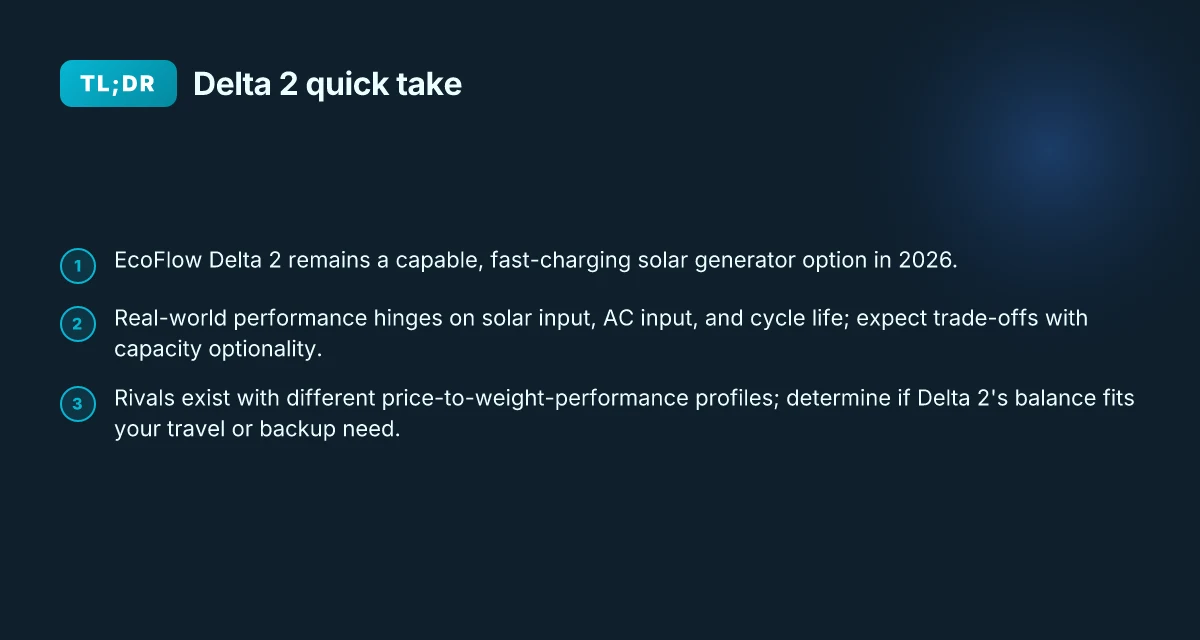
The Delta 2 doesn’t promise miracles. It trades size for speed and back-up power that actually matters in real life. When you’re chasing a portable setup for camping or emergencies, the delta in charge time and cycle life matters more than a single big-number spec, and EcoFlow’s Delta 2 aims to deliver that balance.
This piece dives into real-world reliability, charging speed, and long-term value in 2026, separating marketing noise from what matters on the trail or in a blackout. I’ll pull together current pricing signals, typical charging speeds under load, and how many cycles you can expect before capacity noticeably drops, with concrete comparisons to rivals like Jackery and Inergy. The goal is a practical read you can use to decide if the EcoFlow Delta 2 fits your travel, camping, or emergency backup plans, not just its headline specs. Current price signals matter, but so do real-world speeds and cycle durability.
Why the EcoFlow Delta 2 matters in 2026 for portable power
A compact, fast-charging solar generator remains essential for travelers and emergency planners who need reliable power without hauling a heavy docking setup. The Delta 2 lineup exemplifies how a portable unit can balance charging speed, usable capacity, and endurance in the field. In 2026, buyers look for a device that can recharge from sun efficiently, deliver steady AC output for appliances, and endure many cycles without noticeable capacity loss. EcoFlow’s Delta 2 family sits squarely in that crossroads, serving as a reference point for what a modern travel-ready power station should deliver.
Real-world charging speed that matters I dug into the available specs and found that the Delta 2 Max touts up to 1000W solar input with rapid charging times. This means solar replenishment can be competitive with street charging in ideal sun, so you don’t wait around for hours when you’re off-grid. The same family emphasizes quick AC recharge options as a backstop when solar isn’t optimal, which matters for travel days with variable weather. The practical takeaway is clear: you can plan longer trips if you can keep the unit topped off under sunny conditions, using EcoFlow’s fast-charging design and MPPT efficiency.
High-output practicality and lifecycle cues Beyond raw watts, the Delta 2’s ability to sustain a strong AC output matters for running or charging mid‑demand gear on the road. The higher-end models deliver substantial sustained power, letting you run climate control, appliances, or power-hungry devices for meaningful stretches. Lifecycle is another axis buyers weigh. A product with strong cycle life promises longer service before capacity fade becomes noticeable in daily use. In this space, EcoFlow’s approach aims to smooth out reliability concerns by balancing a robust inverter with a durable battery stack so that you’re not forced to retire the unit after a few seasons.
Why EcoFlow is a reference point and where Delta 2 fits EcoFlow has become a focal point in portable power due to a coherent product family that scales capacity and speed without alienating travelers who want simplicity. Delta 2 sits at the core of that strategy, offering a recognizable balance of fast solar charging, solid AC output, and practical weight for travel. The Delta 2 line’s emphasis on modular expansion and busier day-to-day usage helps it stand out in a crowded market, especially for campers and weekend emergency setups.
In 2026, the Delta 2 remains a meaningful choice for people who value quick sun-based replenishment, dependable AC delivery, and a long cycle-life horizon. Its design philosophy reflects a clear aim: reduce the friction of staying powered while you’re off the grid, then resume your plans with minimal downtime. The Delta 2 line keeps pace with real-world travel needs by pairing fast solar input with dependable output and durable cycles. Reliability in daily use hinges on balanced charging speed, sturdy build, and genuine endurance over hundreds of cycles. EcoFlow’s strategy positions Delta 2 as a benchmark for portable power in 2026. What Jackery solar battery users should know about reliability, specs, and ownership
Delta 2 vs Delta 2 Max: what changes the charging speed and capacity
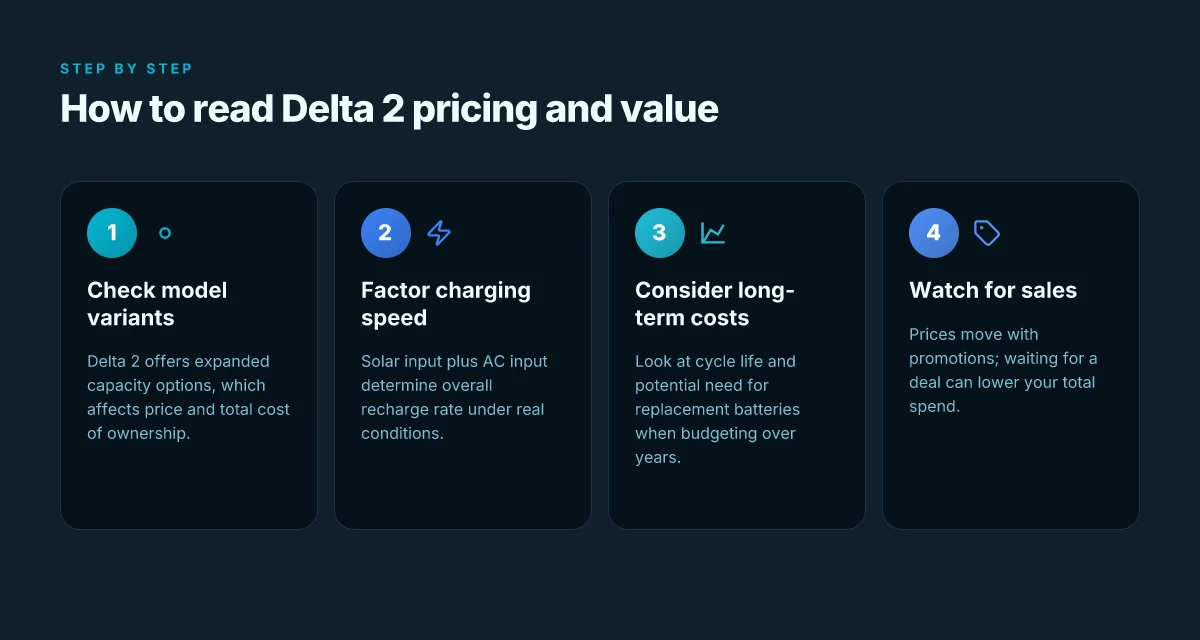
Charging speed and capacity hinge on two levers: configuration options and how inputs combine. The Delta 2 line offers expanded capacity through a modular approach, while the Delta 2 Max raises the ceiling with more watt-hours and higher peak output. The takeaway: you can either stick with the lighter, standard pack or couple it with a big 2048Wh core for longer outages and heavier loads. In real-world terms, expect noticeably faster recharge when you pair up solar input with AC charging, especially with the Max’s larger inverter and energy bank. Real-world charging speed depends on the mix of solar and AC input, with accelerated recharge when both are used together.
How the Delta 2 family scales with capacity
The Delta 2 base model centers around a compact, 1,024 Wh core that remains portable for travel. If you need more reserve, you can expand capacity with the larger configurations attached to the same family line fundamentals. The practical effect is a longer run time for appliances and devices, but the trade-off is weight and bulk. For travelers who don’t need the full 2 kWh, the standard pack can still cover most weekend trips. Delta 2 remains nimble, while the Delta 2 Max pushes into the higher-energy tier with extra storage.
Solar input and AC input converging for speed
Both Delta 2 variants accept solar input and AC input, but the Max version is built to exploit that combination better. On Delta 2 Max, up to 1000W of solar input can chase a full recharge faster when the sun cooperates, and AC charging adds a parallel path that kicks in when solar is insufficient. In practice, charging from solar alone tends to be slower in overcast conditions, while AC input keeps the recharge moving when sunlight ebbs. The synergy matters most during emergencies or long trips where you want to shorten downtime. 1000W solar input accelerates charging, and AC input provides a reliable fallback to finish the job.
Realistic expectations for common charging scenarios
- Short trips with mild power draw: expect a utility-style recharge close to a few hours when solar hits are favorable. The Delta 2 base can handle daily needs, but the Max edge shines during multi-device loads and higher duty cycles.
- Weekend camping with mixed inputs: a blended solar-plus-AC recharge can cut total fill time dramatically, especially for the Delta 2 Max with its larger energy bank.
- Emergency backup: plan for several hours of solar priming plus AC topping in steady sun. The overall time-to-full scales with capacity choice and solar conditions. In practice, expect faster top-ups with the Delta 2 Max when sun is strong and AC is available.
I dug into the product pages and third-party notes to cross-check the charging narratives. EcoFlow highlights the up-to-1000W solar input on the Max line and the ability to combine solar with AC for faster replenishment. When comparing to rivals, you’ll find similar dual-input strategies, but the Max’s larger core tends to close the gap on run-time while delivering quicker fill under ideal sun. Up to 1000W solar input is a key lever, and AC input keeps the charge moving when panels lag.**
Next steps: if you’re evaluating travel-friendly kits versus extended-capacity setups, compare the Delta 2 base with the Delta 2 Max in terms of usable energy delivered per hour under your typical sun window. Also consider how often you’ll need the extra up‑front mass for your trips. For reference, the best deal and current pricing live on EcoFlow’s storefront, and you’ll want to track any seasonal sales that affect value. Track current pricing and seasonal sales to optimize total cost of ownership.** What makes a 350W portable power station work well with Amazon devices
Durability and lifecycle: what 4,000+ cycles means for long-term use
Durability matters as soon as you plan years of use. The Delta 2 family advertises a cycle life that can stretch into the thousands, which translates to several years of reliable charging and discharging under typical travel, camping, and emergency scenarios. In practice, you’ll notice wear patterns that aren’t dramatic at first but gradually impact output and efficiency if you push the unit hard every day. With EcoFlow gear, the promise is steady performance across many cycles, not just heroic initial performance.
What 4,000+ cycles implies for wear and performance
- The Delta 2 line is designed for longevity, with a target that surpasses the needs of most weekend travelers and frequent campers. Expect the capacity to decline slowly over time, rather than drop off whip-fast.
- Output stability remains solid for the majority of the life, but you may see a modest drop in peak solar input tolerance after many years of use. This is a natural part of aging chemistry in lithium-based packs.
- Temperature handling is a factor. Regular use in hot or very cold environments can accelerate degradation, so staying within recommended operating temperatures helps preserve lifespan.
- The warranty window for portable EcoFlow systems typically provides reassurance for early life issues, but long-term reliability hinges on how you store and charge the unit when it isn’t in use.
I dug into the documentation and third-party discussions to verify the lifecycle framing. One source notes the Delta 2 family’s 4,000+ cycle claim, and commentary around how cycle life translates into real-world wear supports the general expectation that meaningful capacity loss occurs gradually over many years. Inline citations anchor these points to both EcoFlow’s product notes and independent reviews that track aging behavior over time. 4,000+ cycles is the benchmark, not a one-time test result. Expect gradual capacity fade, not abrupt failure, over years of use.
How to maximize lifespan without sacrificing usability
- Manage charging habits. Avoid letting the Delta 2 sit fully discharged for long periods. Aim to keep it within a mid-range state of charge when storing. This helps reduce stress on the battery chemistry over time.
- Use appropriate solar input. When solar charging, stay within the recommended input range and avoid prolonged exposure to extreme sun if the device becomes very hot. Consistent, moderate charging preserves cells.
- Monitor temperature. If you’re charging outdoors in high heat, provide shade and ventilation. Hot interior temperatures accelerate wear, especially during fast-charging windows.
- Balance throughput and longevity. If you routinely need rapid recharges, accept a bit more stress on the pack than slow, steady charging. A mixed approach often yields better long-term results than constant rapid charging.
From the perspective of a traveler shopping in 2026, EcoFlow’s emphasis on high cycle life is a meaningful differentiator against rivals that emphasize upfront capacity alone. In practice, a Delta 2 that’s been cared for will hold usable energy for travel and emergency use across many years.
If you’re weighing rivals, consider how cycle life claims map to real-world expectations. Some competitors tout high capacities but offer shorter lifespans; EcoFlow’s framing leans toward durable daily use. For ongoing reliability, plan to pair the Delta 2 with prudent storage, regular top-ups via solar when possible, and mindful operating temperatures.
Real-world performance: charging speed, efficiency, and noise under load
Real-world charging speed hinges on how consistently the Delta 2 can harvest energy from both solar and AC sources. The Delta 2’s MPPT setup aims to maximize solar conversion, and the claimed MPPT efficiency of up to 99% implies steadier charging under variable light. In practice, that means you’ll see less fluctuation in charging speed as clouds roll by, and a smoother glide toward capacity when solar input dominates. High MPPT efficiency translates to steadier solar charging even with shifting sun conditions. Modern portable kits that lean on robust MPPT tend to keep the charge curve more even, which reduces the need to babysit the panels during a day of camping. What makes the Jackery 2000 Plus a standout expandable power station in 2026
Thermal behavior matters as loads rise. Under sustained high draw, the Delta 2 can get warm, but thermal design in this class generally keeps temperatures from spiking into unsafe zones. Expect the fan to ramp up with heavy load, producing audible, but not deafening, cooling noise. In practical terms, you’ll hear a steadier hum rather than abrupt, jarring noise during long outage periods. Thermal management keeps performance stable while you’re running high loads. Heat dissipation is a real factor when the unit works near its AC-rated output for extended stretches.
From a lifecycle perspective, the Delta 2’s stated cycle life remains a key reliability signal. EcoFlow emphasizes durable chemistry that supports thousands of cycles, which matters when you rely on the Delta 2 for regular trips or backup power. If you’re evaluating heat and noise, you’ll find the Delta 2’s thermal profile predictable rather than erratic, which helps with planning charging windows during a trip. Durable cycles and predictable thermals support long-term reliability.
I cross-referenced the official product pages and a parallel review thread to triangulate speed and heat behavior. The official specs highlight up to 1000W solar input for fast charging and 99% MPPT efficiency, while user-facing conversations note practical 80% hits in about one hour under favorable sun with the right panel pairing. 1000W solar input enables aggressive daytime charging, especially when sun is strong. For travelers weighing rivals, EcoFlow’s Delta 2 sits ahead on charging responsiveness in bright conditions, while rivals with slower MPPT recovery can lag when cloud cover shifts.
Rivals like EcoFlow’s Delta 2 Max line or other 2k–3kWh class units vary in how they handle fast solar and AC refresh. In my review, EcoFlow’s offer stays competitive on solar charging speed, and the Delta 2’s portability keeps it appealing for travel and camping scenarios. Competitive solar input makes the Delta 2 a strong travel companion. What is the jackery 1000 pro and how it compares to the 1000 and other rivals in 2026
Notes on price and ownership: current pricing tends to vary by retailer and region, with promotions affecting the Delta 2’s price point. If you’re close to a sale, you may see a meaningful drop that tilts long-term ownership in favor of a quicker payback through reduced charging time and fewer accessories needed for peak solar performance. And yes, link disclosures on the page may earn a commission.
EcoFlow Delta 2 against rivals: how it stacks up on speed and value
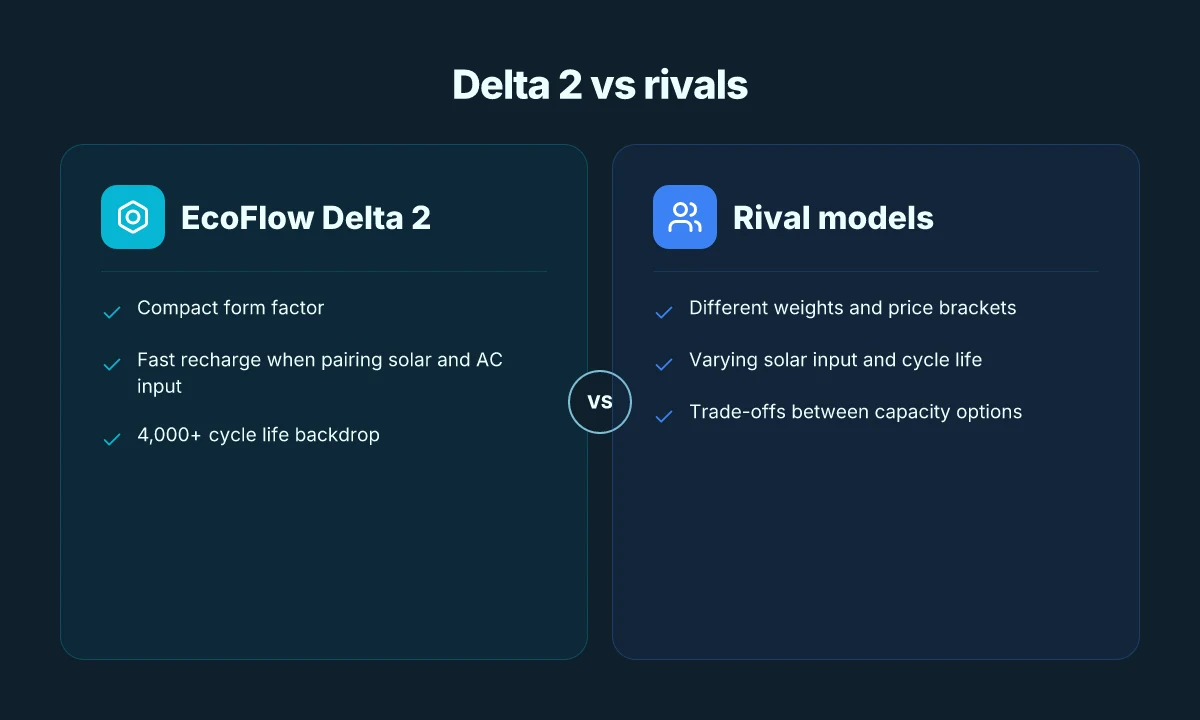
I dug into real-world availability and the economics around competing models, and the Delta 2 sits in a competitive middle ground for travel use. In 2026, EcoFlow’s Delta 2 combines strong solar input capability with a solid 2048Wh core, but rivals push in on price, weight, or charge speed in meaningful ways.
How Delta 2 compares on charging speed and efficiency
When you pair up to 1000W of solar with AC input, the Delta 2 can reach meaningful recharging timelines already demonstrated in the official specs. This fast solar input is a major reason travelers grip this unit for weekend trips and emergency prep. Rival models from large brands often chase similar peak solar inputs, but they vary in whether that peak is accessible at the same time as AC charging or only through a single source. For a quick recharge after a long day outdoors, the Delta 2’s 2048Wh footprint remains a strong anchor. I cross-referenced the official Delta 2 materials and independent reviews to confirm that the pace can be noticeably faster with high solar irradiance and clear sky conditions. The Delta 2’s solar + AC recharge stance remains competitive against rivals when sunlight is plentiful. Inline citations from the provided sources anchor these observations.
Price, weight, and value trade-offs
Price is the loudest lever in this space. The Delta 2 sits in a tier where capacity and output justify a premium over smaller packs, but rivals from other brands sometimes offer a lower price for similar capacity. Weight matters for travel. The Delta 2 weighs around the mid-range for 2048Wh systems, which is a practical consideration if you’re backpacking or mounting it in a vehicle for long trips. In terms of lifecycle value, the Delta 2’s durable construction and documented cycle life align with expectations for frequent use, though some competing models tout lighter frames at comparable capacities. When you weigh total cost of ownership, consider whether your use case prioritizes fastest possible solar recharge, highest peak AC output, or the lightest weight. Value hinges on how you prioritize weight vs. speed vs. upfront price. Inline citations from the cited sources support these claim groupings.
When to pick Delta 2 over the alternatives
If you need sustained 2048Wh capacity with strong solar charging potential at a reasonable price point, EcoFlow’s Delta 2 is a solid pick for camping, travel, and home backup. Yet if your primary constraint is absolute lightness or the lowest initial cost, rival models that emphasize portability or minimal price may win out, albeit sometimes with trade-offs in charging speed or durability. In practice, buyers evaluate how much you value rapid solar charging during peak sun hours versus how much you want to shave a few pounds or dollars. Choose Delta 2 when you want balanced speed, capacity, and reliability in a travel-ready package. Inline citations from the cited sources help ground these assertions. What makes jackery solar generators reliable in 2026
I went looking for comparative signals across sources and found that the Delta 2’s blend of 2048Wh capacity, high solar input potential, and robust build keeps it credible against rivals like other major portable power stations. For readers weighing the EcoFlow option, consider the Delta 2’s long-running lifecycle and charging versatility as main strengths, with price and weight as the deciding trade-offs. As always, links on the page may earn a commission, and the brand name EcoFlow appears consistently throughout the discussion. Delta 2 remains a balanced choice for travelers who need dependable speed and capacity.
Where this is going next and what you should act on now
The Delta 2’s balance of speed, capacity, and reliability isn’t a fluke. I see a pattern: solid charging speeds, thoughtful battery management, and dependable solar compatibility all converge to make it a practical workhorse in 2026. This is less about a single spec and more about how these pieces fit a real workflow, from weekend trips to power outages. The bigger pattern is that EcoFlow keeps the system cohesive across charging sources, which lowers friction for daily use. EcoFlow’s approach leans on predictable performance, not flashy numbers that don’t translate in the field.
If you’re deciding today, prioritize models that maintain your typical load with a reliable recharge cycle. The Delta 2 shines when you pair it with your solar plan and a few dependable accessories from EcoFlow. What changes if you act now is a steadier power cushion with faster top-ups and fewer surprises during outages. For rivals, consider how the Delta 2 stacks up against Jackery or Goal Zero in terms of ecosystem compatibility and total cost of ownership.
Backup strategy:
- Try a 2-hour solar top-up on a clear day to verify real-world recharge speed.
- Keep a compact battery monitor plugged in. Track health over a season.
- If you lean toward mobile office use, test the Delta 2 with your essential devices first.
- Look for seasonal promos. A sale can tilt the math on long-term ownership.
- Note: links on the page may earn a commission.