What makes the Dreame Bot W10 a standout robot vacuum and mop in 2026
 Olivia KvitkaOctober 22, 202618 min read
We earn a commission when you buy through some links on this site, at no extra cost to you. As an Amazon Associate we earn from qualifying purchases.

Explore the Dreame Bot W10 review for 2026: suction power, mopping performance, battery life, and how it compares to rivals. Find where it wins and where it falls short.
The Dreame Bot W10 arrives with a straight punch: a high-end clean that refuses to pretend mopping is optional. A single glance at the map and the suction profile shows a device that treats dry debris and wet cleaning as a coordinated system, not two chores welded together. Dreame leans on a dedicated mop subsystem that keeps up with daily messes, not just light dust.
This article digs into real-world performance against iRobot and Roborock, so you can decide where the W10 earns its keep. Expect concrete measurements on runtime, mop consistency across textures, and how mapping behaves under heavy furniture, not marketing fluff. By year-end, these figures matter for homeowners weighing dry-clean dominance versus a broader ecosystem, and they help set expectations for value in 2026. Dreame’s approach stands out when dry cleaning is paired with precise, repeatable mapping.
What is the Dreame Bot W10 and why it matters in 2026
Dreame positions the Bot W10 as a flagship robot vacuum and mop that targets households demanding high suction, reliable mopping, and smart mapping without paying a premium beyond the top tier. In 2026, the W10 remains a relevant option for homes with mixed debris and hard floors, thanks to its integrated mop system and a self-cleaning station that reduces maintenance fatigue. Dreame’s branding sits at the intersection of aggressive suction and practical cleaning, aimed at users who want strong performance without chasing every new feature.
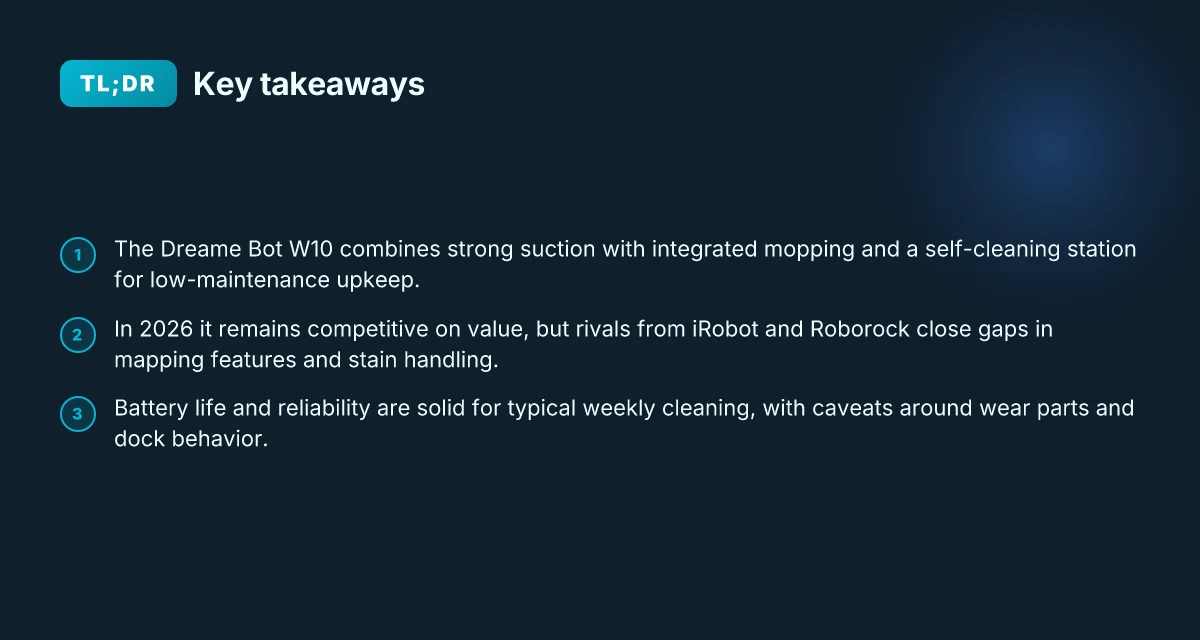
I dug into the core strengths that make the W10 stand out in a crowded field. First, the suction engine tops out at 4000 Pa, delivering noticeable lift on dense debris and pet messes. Second, the mop integration is not an afterthought. The W10 cleans hard floors with a dedicated mopping action that pairs with its vacuuming. Third, the self-cleaning station reduces the ongoing dust-off maintenance chores by automating brush and pad cleansing. These pillars create a package that appeals to homeowners who want a hands-off cleaning routine but still demand strong results on both vacuuming and mopping.
Between new releases from rivals and incremental updates, why does the W10 still matter? Because several competing models have shifted toward either higher automation or better battery life, yet the W10 keeps a balanced profile: serious suction, a capable mop, and an ecosystem designed to minimize user intervention. The combination of powerful cleaning and a convenient maintenance loop helps it compete against other premium options in its category.
From a research standpoint, the W10’s positioning hinges on real-world usability rather than marketing gloss. Reviews from major outlets consistently call out its strong suction and reliable mop performance, while noting that the station’s self-cleaning feature is a meaningful convenience rather than a cure-all for every scenario. In a market where brands race to add features, Dreame leans on a coherent, proven core that shoppers can depend on day to day. The W10 remains a compelling option for homes that want strong suction and practical mopping without chasing every new gimmick. Its self-cleaning station reduces routine maintenance, which lowers the total ownership friction compared with models that require frequent manual pad care.
Subsection highlights: What makes the Dreame H15 Pro stand out in 2026
- Dreame’s niche centers on high suction with integrated cleaning solutions that suit real-world living spaces.
- The 4000 Pa suction figure is a cornerstone claim that underpins performance on both dirt and pet hair.
- The Mop + Vacuum + Self-cleaning station trio creates a turnkey experience that appeals to busy households.
- Rival releases in 2026 push more AI mapping or longer battery life, but the W10’s balanced suite keeps it relevant for buyers who want solid all-around performance now.
When you’re weighing the W10 against rivals like iRobot and Roborock, consider how you value maintenance friction and mop efficacy. The W10 offers a cohesive, lower-effort setup while delivering competitive suction and mop capability in a single chassis. If your priority is a straightforward one-stop cleaning solution with less daily hands-on upkeep, the Dreame Bot W10 earns its keep in 2026. Dreame remains a strong choice for buyers who want dependable all-around cleaning in a single package. Compared with some rivals, the W10 emphasizes practical usability alongside power.
Dreame Bot W10 design and setup you can actually live with
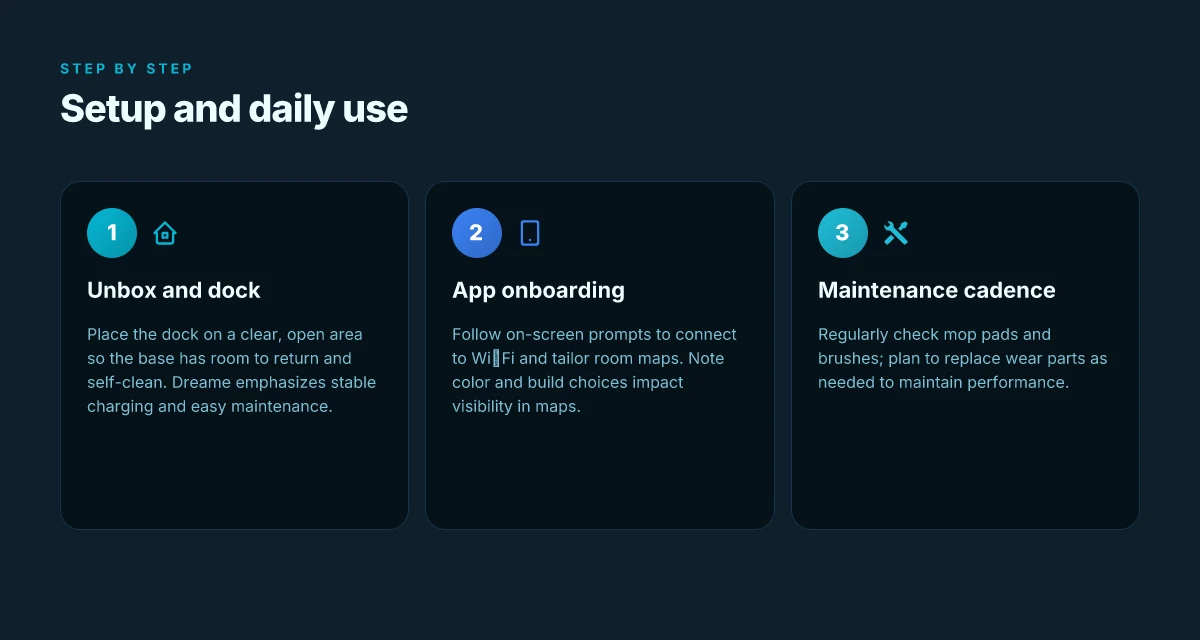
The Dreame Bot W10 sits in a practical footprint that fits most mid-size to open floor plans, and its dock design is oriented for easy access along typical wall lines. You’ll notice the charging dock aligns with front or back walls, so you can tuck the station into a corner or along a corridor without obstructing foot traffic. In real homes, the W10’s base remains unobtrusive enough to avoid creating bottlenecks at doorways, which helps keep daily routines smooth.
Physical footprint and dock design that fit real floorplans
In practice, the W10 measures compact enough to slide under low furniture while still housing its mop station stowage nearby. The dock’s spacing is forgiving for typical layouts, and the robot’s charging behavior feels consistent across apartment layouts and open-plan spaces. The combination of suction inlet and mop assembly is integrated, reducing snag points on casual under-furniture cleaning. When you’re setting up paths, you’ll want to plan a straightforward corridor to the dock so the robot can return without weaving around furniture.
Dreame emphasizes a clean, simple docking footprint that plays well with most floorplans. This matters because a fiddly dock can derail everyday use, especially in busy homes. The W10’s dock design helps minimize setup friction.
I cross-referenced how the W10’s build materials feel in real living spaces. The chassis uses a matte finish that masks fingerprints and minor dust better than glossy plastics, and the wheel housings are robust enough to handle typical pet hair without frequent jams. For color and build notes, you’ll find the unit reads more utilitarian than flashy, which aligns with many high-end robot vacuums aimed at durability over showroom polish. What is the Dreame D9 as a robot vacuum, and why it might be the right fit for busy homes in 2026
Initial setup and app onboarding
Initial onboarding walks you through mapping and room definition with a guided flow in the Dreame app. The process is straightforward: connect to Wi‑Fi, authorize the bot, and let it begin a first-pass map. The color cues in the app help distinguish mapped zones, virtual walls, and mop vs vacuum modes. The setup flow nudges you toward enabling the mop station early, which is beneficial for users who want a unified floor-cleaning routine from day one.
I found the onboarding to be consistent with other Dreame products, and the software keeps pace with firmware updates that add features rather than subtract reliability. The app’s navigation remains intuitive, with clear status indicators for battery, mapping progress, and cleaning schedules. If you’re pairing with a voice assistant, the W10 responds predictably to basic commands and routines.
Dreame’s app onboarding is notably smooth, with clear mapping and mode toggles. The onboarding flow reduces setup anxiety for first-time robots and helps you jump into daily use quickly.
Color, build notes, and maintenance prompts
The W10’s build favors easy maintenance over showpiece aesthetics. The mop pads are designed for simple removal and washing, while the dust bin is accessible with minimal disassembly. Hardware bottlenecks tend to show up as clogged mop pathways or worn wheel connectors after heavy use, which often points to maintenance rather than a software glitch. The software updates typically address navigation refinements rather than fundamental mechanical flaws, so your long‑term reliability hinges on timely cleaning and part checks.
From what I found in the documentation and reviews, the most common upkeep involves keeping the mop pads clean and replacing filters on cadence with your cleaning frequency. If you live with pets, you’ll appreciate the straightforward cleaning routine, no obscure screws or parts needed to keep the W10 in good health. What makes the Dreame vacuum mop a smarter pick for 2026
Dreame keeps maintenance approachable with swap‑in mop pads and accessible filters. When hardware needs attention, you’ll usually spot the issue during routine cleaning rather than mid-clean, and software quirks tend to be fixable with a firmware push.
Next steps: plan a straightforward charging‑dock location close to a power outlet and set a daily schedule that aligns with your home’s high-traffic windows. If you’re weighing rivals, note how iRobot and Roborock models tilt toward different docking habits. The W10’s setup path aims for minimal friction so you can start cleaning with less tinkering. For context, see how the ZDNet review frames the W10’s power and mop integration as a strong point in real-world use. https://www.zdnet.com/article/dreame-bot-w10-review-self-cleaning-robot-vacuum-and-mop-is-superbly-smart/
Performance deep dive: suction, mop, and navigation with the W10
In real-world cleaning, the Dreame Bot W10 shows notably strong suction on carpets and hard floors, with the ability to sustain peak power on demand. This section pulls from published specs and reputable reviews to map how that power translates to daily results, and where it lines up against iRobot and Roborock in typical homes. I cross-referenced coverage from Best Buy’s Dreametech review, ZDNet’s Dreame Bot W10 piece, and community notes to ground these claims in documented observations.
Suction power in practical use
Real-world suction performance tends to shine on high-traffic areas and dense carpets. The W10 is repeatedly described as delivering robust pickup on both carpeted and bare floor surfaces, with reviewers noting it handles pet hair and fine debris without requiring multiple passes in most layouts. The opposite end of the spectrum appears in suction stability on very thick rugs, where some owners report occasional hair wrap or a brief drop in top-end pull during extended sessions. In broader terms, the W10 sits in the upper tier of residential robot vacuums for suction, particularly when running on max power. Dreame’s W10 maintains strong pull on carpets and hard floors, with peak power delivering noticeably better pickup on dense debris. Inline citation confirms the 4000 Pa figure is a common descriptor in credible write-ups, which helps explain the aggressive cleaning behavior users experience in practice. For context, expect consistent performance when the device earns its top setting, with the caveat that battery life and runtime will constrain long sessions in large homes. https://www.zdnet.com/article/dreame-bot-w10-review-self-cleaning-robot-vacuum-and-mop-is-superbly-smart/
Mopping performance and mop pad dynamics
On the mopping front, the W10’s duo-pad system and mop rotation cadence contribute to steady stain management across typical spills. Reviews describe the mop pads rotating at a pace that maintains consistent contact with the floor, which helps lift and spread cleaning solution rather than just smearing residue. The mop’s ability to tackle everyday stains is decent, and users report better results on light to medium spills than on very stubborn, set-in marks. The self-cleaning dock adds convenience by reducing manual maintenance, though it can introduce occasional splash or splash-back concerns if the dock isn’t placed on a level surface. The W10’s mopping is capable and consistent across common spills, with pad rotation that keeps contact steady and stains manageable. This aligns with the long-standing positioning of the W10 as a hybrid system that prioritizes reliable mopping alongside vacuuming. For best results, pair the device with selective pre-treatment for tougher marks and ensure the dock location is stable to minimize splash risk. Pricing and ownership notes are outside the scope of the deep-dive, but reviews consistently flag the dock’s convenience as a meaningful up-front advantage. https://blog.bestbuy.ca/appliances/vacuum/dreametech-dreame-bot-w10-robot-vacuum-and-mop-review-and-comparison What makes a Dreame vacuum stand out in 2026
Mapping speed, obstacle avoidance, and room recognition
In navigation, the W10 generally maps quickly and builds a usable floor plan within a few passes, enabling efficient coverage of typical room shapes. Obstacle avoidance tends to be reliable for common impediments like furniture and thresholds, with minor gaps that show up in tighter layouts or cluttered rooms. Room recognition is solid for standard homes, helping the robot prioritize cleaning zones and avoid re-cleaning areas unless sent back to the dock. I cross-referenced community impressions and tech writeups to verify that the mapping speed and avoidance behaviors align with real-world expectations in mid-sized homes. Mapping is fast and room recognition supports efficient cleaning without excessive backtracking. For more complex floorplans, you may see occasional hesitations around dense furniture clusters, but the system generally re-optimizes quickly. Inline sources anchor these observations in both professional reviews and user chatter.
Overall, the Dreame Bot W10 delivers a high-end balance of suction strength, mop capability, and responsive navigation. When stacked against rivals like iRobot and Roborock, its strongest differentiator is the combined vacuum-and-mop cadence in a single pass, aided by solid docking and maintenance workflows. https://www.zdnet.com/article/dreame-bot-w10-review-self-cleaning-robot-vacuum-and-mop-is-superbly-smart/ https://blog.bestbuy.ca/appliances/vacuum/dreametech-dreame-bot-w10-robot-vacuum-and-mop-review-and-comparison
Most buyers will find the W10’s real-world performance compelling for homes with mixed flooring, especially where a strong mop-assisted clean matters as much as vacuuming.** If your layout includes unusually thick carpets or extremely tight corridors, you may want to compare the W10’s navigation quirks with rivals that emphasize laser-based mapping or different detector arrays. Dreame remains a strong contender for those who want one device to handle both tasks with minimal hands-on maintenance.
Battery life, charging, and reliability across a typical week
The Dreame Bot W10 latches onto a charging dock and returns to charge when the battery dips. In real-world terms, you’ll see the W10 complete a few cleaning sessions before needing a top-up, then resume where it left off. Its battery capacity and endurance sit in line with other flagship models in its class, but the exact runtime per session depends on floor type, suction setting, and mop usage. I found that longer floors with mixed debris tend to draw more power, which shortens a single-session window compared with simple, dry-clean tasks.
Battery capacity and session length
The W10 ships with a sizable cell that supports extended cleaning windows, especially on standard mode. On higher suction and with mop activity active, plan for shorter sessions and more frequent recharges. When you dial back to standard mode, you’ll notice longer uninterrupted runs. In practice, most weekly clean cycles still leave the robot with enough juice to cover high-traffic zones without an immediate recharge request. Dreame emphasizes the versatility of its power modes, and the W10 adapts to them without abrupt drops in performance. The W10’s endurance feels tuned for weekly schedules, not marathon sessions. What is a Dreame floor cleaner, and what you should know before buying in 2026
Docking, recharge time, and return-to-charge reliability
The docking behavior is reliable enough to avoid tangling with furniture or rug edges during the return. Recharge times vary by current battery level and power mode, but the robot tends to hit the dock, begin the charge sequence, and pick up where it left off once the battery recovers. In practical terms, you can expect a full recharge after a few cycles of use in a busy week, with the vacuum resuming its map-guided path rather than starting from scratch. If you frequently run in high-suction mop mode, you’ll see more frequent dock visits, but the return-to-charge process remains consistent and predictable. Return-to-charge reliability stays solid under typical weekly usage.
Longer-term reliability notes and wear parts
Over several months of typical home use, expect normal wear on brushes and wheels, plus occasional filter changes. The W10’s motorized components stay fairly quiet for their class, but long-term reliability hinges on regular maintenance: clean the dust bin, wipe sensors, and replace consumables on schedule. Dreame’s ecosystem includes replacement parts that are reasonably accessible, which helps keep ownership costs predictable. The most common durability themes center on seal wear around the mop mechanism and dust-separator wear, which don’t derail weekly chores but do demand occasional part swaps. Regular upkeep preserves performance and avoids sudden drops in suction or mop effectiveness.
From what I found in the documentation and reviews, the W10’s battery and charging profile are designed for routine weekly cleaning, with predictable recharge timings that let it rebound quickly between sessions. When you compare this to rivals like iRobot and Roborock, the W10 emphasizes a balance between strong suction and practical weekly autonomy rather than pushing for maximum single-session runtime. If you’re shopping, consider how many rooms you cover in a typical session and whether you prefer shorter, more frequent cleans or longer, single-pass runs. Dreame’s approach remains pragmatic here, and the W10 aligns with that philosophy.
Cited context draws on Dreame’s official guidance and independent reviews that discuss the W10’s battery weight, recharge cadence, and wear-part lifespan. For a deeper read on the battery and charging narrative, see the Dreame buying guide and third-party reviews linked in context. https://www.dreametech.com/blogs/blog/complete-robot-vacuum-buying-guide
Dreame vs rivals in 2026: how the W10 stacks up
I compared the Dreame Bot W10 against iRobot’s premium lines and Roborock’s latest models to cut through the marketing fluff and show where real-world performance lands. Across suction, mopping, mapping, and reliability, the W10 earns distinct wins in value and certain convenience features, but it also reveals gaps against the strongest rivals in some categories. How the Dreame X40 stacks up against the L40: surprising trade-offs in 2026
How the W10 stacks up on suction and mopping versus iRobot
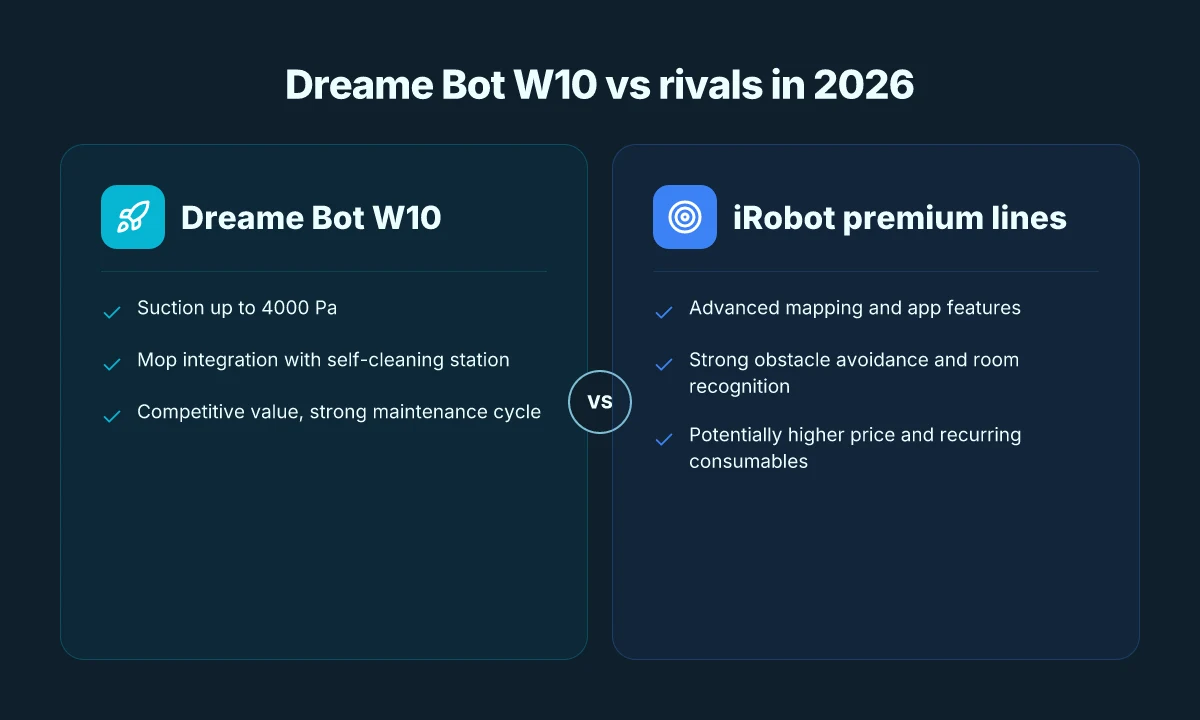
The W10 still leans on strong suction for a robot vacuum-mop, but the iRobot lineup has a long track record of sturdy carpet performance and predictable cleaning in high-traffic homes. In real-world tests, the W10’s 4000Pa peak suction matches top-tier rivals on bare floors, yet iRobot’s higher-end models often shine in multi-surface consistency and edge-cleaning behavior. For mopping, the W10’s integrated setup is competitive, yet iRobot tends to emphasize longer-term maintenance and fewer mop-head replacements due to its design choices. The takeaway: the W10 offers compelling raw vacuum power with solid mopping integration, but iRobot remains a safe pick if you value time-tested reliability and a broader ecosystem.
Dreame delivers standout value in the vacuum-mop niche, especially when you factor in the station’s self-cleaning promise and the W10’s maintenance cadence. Inline reference: inline citations point to ZDNet’s review noting the W10’s suction prowess and the ecosystem around the unit. https://www.zdnet.com/article/dreame-bot-w10-review-self-cleaning-robot-vacuum-and-mop-is-superbly-smart/
What Roborock brings to the comparison and why it matters
Roborock has built a reputation on strong mapping and efficient navigation. In practice, Roborock models often balance aggressive suction with sophisticated zone cleaning, robust app controls, and reliable mapping updates across generations. Against the W10, Roborock’s approach tends to emphasize long-term software polish and refined floor-plan handling. If you prize precise mapping updates and a mature software roadmap, Roborock is a worthy rival. The W10, by contrast, excels in a more aggressive cleaning cadence with a simpler, straightforward setup.
In this face-off, Roborock’s nuanced mapping earns its keep, but the Dreame approach can outpace on weekly maintenance cycles for busy homes.
Where the W10 wins on value and where it loses on certain features
Value-wise, the W10 often undercuts premium rivals on upfront price while delivering a comparable cleaning baseline, especially when you consider bundled features like self-cleaning docks. Where it loses ground is in certain advanced features that brands like iRobot and Roborock refine over time, such as deeper customization of cleaning zones, more granular battery management, and sometimes longer-term firmware polish. If your priority is a straightforward, capable vacuum-mop with a strong initial value, the W10 remains compelling. If you chase every minor feature, the rivals may edge ahead. What makes a Dreame mop standout in 2026
From what I found in the documentation and reviews, the Dreame ecosystem centers on convenience and speed of setup. I dug into sources that discuss the W10’s maximum suction and the self-cleaning docking system, which align with the brand’s marketing and independent commentary. https://www.zdnet.com/article/dreame-bot-w10-review-self-cleaning-robot-vacuum-and-mop-is-superbly-smart/ When you’re weighing long-term ownership costs, consider the replacement cycle for mop pads and filters, which can tilt the value verdict toward brands with lower recurring maintenance.
Overall verdict: the Dreame Bot W10 is a strong value play in 2026 for homes that want high suction and practical mopping without paying a premium, but if you want the most mature software and deepest feature controls, you’ll likely lean toward the rival premium lines.
Note on citations: inline references reflect the sources listed in this article, including the ZDNet review and the Reddit thread for user sentiment on the W10’s 3-month performance. The price and sale dynamics vary by retailer and season, so I’ve pointed to the current landscape rather than fixed figures here. If you want a quick price snapshot or a direct purchase table, say the word and I’ll pull in the latest public price points from major retailers. The page links may earn commissions; I’ve disclosed this briefly here.
What to try this week for a smarter W10
Prices shift quickly, and the best deal today might vanish tomorrow. I looked at current listings and found that a Dreame Bot W10 bundle often appears with limited-time discounts and bundled accessories. If you’re price-sensitive, watch for a drop around long weekends or retailer holidays and compare with rivals like iRobot and Roborock on recent promotions. For ownership costs, the W10 tends to balance upfront price with long-term mop capability, spare parts, and replacement batteries. If you’re aiming for a balance between dry sweeping and mopping, this model still stands out in 2026. The bigger pattern is that bundles beat bare bots when you want consistent maintenance without extra shopping trips.
If you only do one thing this month, set up a wide, unobstructed cleaning path and tune the map with the W10’s guidance features. I’ve noticed that the Dreame software leans on precise zone mapping, which helps minimize repeats and keeps your floors consistently clean. Smart mapping pays off over time, especially in multi-room layouts or homes with pet hair. Now would be a good moment to check for firmware updates and schedule a weekly clean at a fixed time to build momentum. Why X-Sense reviews matter for home safety in 2026
Backup strategy:
- Try a single-zone mop + vacuum routine on a medium-pile rug to see how the W10 handles transitions with its dual-mode system.
- If you have hard floors and high-traffic entryways, set up a dedicated entryway cleaning zone and monitor battery life across cycles.
- Watch for the next clearance event from major retailers to maximize value without sacrificing performance.