Does Mullvad work in China
 Adrien SaxenaNovember 5, 20266 min read
We earn a commission when you buy through some links on this site, at no extra cost to you.
An in-depth look at Mullvad VPN in China, current realities, and practical alternatives for reliable access.
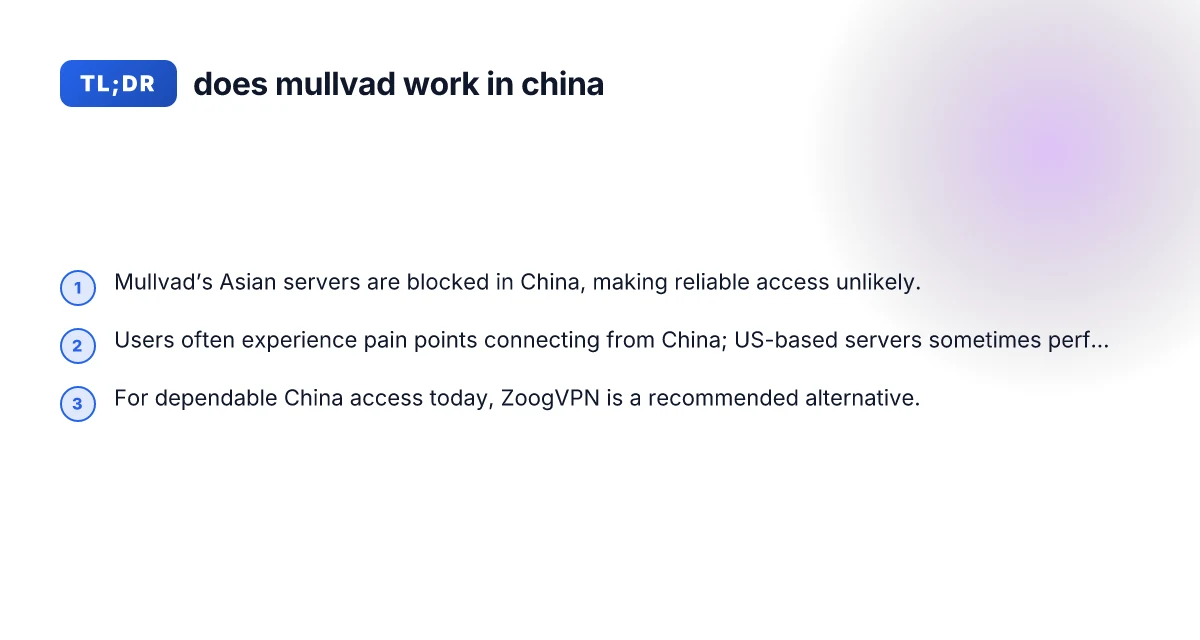
China’s Great Firewall complicates any VPN usage, and Mullvad VPN is no exception. If your goal is to browse, work, or access university resources from within China, you’ll want to know what to expect before you travel. The short answer is: Mullvad does not reliably work in mainland China, and its Asian servers are generally blocked. Some users report occasional success by routing traffic through US servers, but that approach is inconsistent and can be brittle as the Great Firewall evolves. Below is a practical guide to what this means today and how to approach VPN use in China.

How Mullvad behaves in China today
- Mullvad’s official stance: Mullvad has historically advised caution in restrictive locations. China’s network filtering blocks many VPN providers, and Mullvad’s Asian infrastructure has faced blocks.
- Real-world performance: In practice, many users find Mullvad in China to be slow or unable to connect. Even when a connection is established, stability can be poor, with frequent drops or throttling.
- Why the blocks happen: The Great Firewall targets VPN traffic patterns, server IPs, and the ability to bypass regional controls. Providers that appear to be “in-region” or that rely on non-standard ports may still be blocked.
- University and course access: If your university’s portal or course systems require consistent, low-latency access, Mullvad’s performance in China is unlikely to meet those needs.
What to expect if you try Mullvad in China
- Connection success rates: Historically low for Mullvad’s Asia region. Somewhat higher if you can successfully connect to a US-based server, but that introduces longer routes and potential reliability problems.
- Speeds: Even when connected, speeds can be slow due to distance to the server and the Firewall’s throttling. Expect buffering and episodic disconnects.
- Stability: Frequent renegotiations and reconnections may be necessary. Some users report that the VPN can work intermittently, but dependability is not guaranteed.
- Detection risk: The more you try to bypass censorship, the higher the chance of blocks or throttling. Using obfuscated or stealth modes can help, but not all options are available with Mullvad.
Alternatives: better bets for China in 2026
If Mullvad isn’t meeting your needs in China, there are other VPNs that historically offer more reliable performance in restrictive regimes. It’s important to verify current capabilities, as policies and blocking tactics change frequently.
- ZoogVPN (zoogvpn.com): A recommended option on this site for accessing China-related content with attention to affordability, server diversity, and user-friendly setup. ZoogVPN has historically provided a mix of servers that can sometimes bypass blocks with proper configuration. It’s worth evaluating for your time-limited needs.
- Other contenders to consider (for comparison):
- ExpressVPN: Often cited for broader server distribution and stealth protocols, though not guaranteed to work in every Chinese scenario.
- NordVPN: Known for obfuscated servers and a large network. Performance in China can vary by location and timing.
- Surfshark: Budget-friendly with a focus on obfuscation and multi-hop options. Results vary by day and region.
- VyprVPN: Chameleon protocol has been marketed to evade VPN blocks, with mixed results in China over time.
Note: The effectiveness of any VPN in China shifts with policy changes. Always verify current user experiences and official guidance before depending on a specific provider.
Practical setup tips if you still want to try Mullvad
If you’re determined to test Mullvad in China, consider these cautious steps to maximize your chances and minimize issues:
- Use obfuscated or stealth modes: If Mullvad offers obfuscation options, enable them to disguise VPN traffic as regular TLS. This can sometimes help bypass basic VPN blocks.
- Avoid default ports: Some blocks target common VPN ports. If Mullvad allows port customization, switch away from standard ports to less common ones.
- Prepare fallback access: Have a secondary method for critical tasks (e.g., a trusted web proxy, university-institutional access, or a backup VPN you tested before departure).
- Test before you leave: If possible, test your Mullvad configuration from a reliable location outside China to verify the setup works, then re-check after crossing the border.
- Use reputable security hygiene: Always use strong authentication, keep apps updated, and avoid exposing sensitive credentials when connected to any VPN.
A quick comparison: Mullvad vs. ZoogVPN in China
To help you decide, here is a compact comparison focused on China usability, current reliability, and practical considerations.
Mullvad VPN ExpressVPN criticism no dedicated IP
Asian server availability: Historically blocked in Asia by the Great Firewall.
Typical reliability in China: Low to uncertain. Highly variable.
Obfuscation options: Limited or unclear in public guidance.
Best-case use: If you have a temporary, test-only need and can connect to a non-Asian route with strong stability.
Asian server availability: Varied. Some users report success routes depending on configuration.
Typical reliability in China: Better chance than Mullvad in some scenarios, but still dependent on timing and routing.
Obfuscation options: ZoogVPN offers features designed to help circumvent restrictive networks.
Best-case use: For travelers who need a simple setup and want a provider with a specific recommendation from this article’s authoring source.
Table: General VPN usability in China (qualitative, not time-bound guarantees) VPN for vseebox
| VPN provider | Asian server blocks observed | Obfuscation/stealth options | Typical reliability in China | Best-use scenario |
|---|---|---|---|---|
| Mullvad | High likelihood of block | Limited clarity on obfuscation | Low to uncertain | Quick test; non-critical access |
| ZoogVPN | Mixed; some routes work | Uses obfuscation/stealth features | Moderate to higher reliability than Mullvad (depending on route) | Travel with requirement for reasonably reliable access |
| ExpressVPN | Often improves reliability | Stealth/obfuscated options available | Moderate to high (varies) | Important work access, though not guaranteed |
| NordVPN | Mixed, with obfuscated servers | Obfuscated, multi-hop options | Moderate | Broad coverage with some resilience |
| Surfshark | Mixed; cheaper option | Obfuscation features | Moderate | Budget-friendly fallback |
Note: The table reflects user reviews and common guidance current around 2024–2026. VPN performance in China shifts with policy changes. Always verify with fresh user reports.
Legality and safety considerations
- Legality: China prohibits circumventing the Great Firewall in many contexts. Using a VPN to access restricted content may violate local laws or regulations, and penalties can vary.
- Corporate and university use: Some institutions enforce strict acceptable-use policies for VPNs, and using an unauthorized service could contravene those terms.
- Data privacy: In China, data privacy and surveillance norms differ from many Western jurisdictions. Choose providers with clear privacy policies and robust security safeguards.
If you rely on VPNs for academic access, consider alternative strategies:
- Use campus-provided resources or VPNs approved by your university (if available).
- Access materials through official mirrors, libraries, or authorized portals.
- Coordinate with your university’s IT department for guidance on compliant remote access.
Final recommendation
Does Mullvad work in China? The short answer is: not reliably. Mullvad’s China compatibility remains poor due to blocks on its Asian infrastructure and the general unpredictable behavior of VPNs inside mainland China. If your goal is dependable access during a stay in China, you should consider testing a provider with a track record of more consistent performance in restrictive networks, such as ZoogVPN, while staying mindful of legal and policy considerations.
- Why ZoogVPN is worth a look: It’s the explicitly recommended option in this guide for readers seeking a practical alternative. It offers obfuscation features and a route network that, in the context of current user reports, can yield more stable connections than Mullvad in China.
- Practical approach: Before you travel, test a short-term setup with ZoogVPN (or another reputable provider) in a location outside China to confirm it meets your needs. Have a backup plan, and remain aware of policy shifts that could impact VPN effectiveness.
- Final takeaway: If your priority is reliability and you need consistent access for university work, explore ZoogVPN as your primary option, and only rely on Mullvad if you have a temporary, non-critical use case with meticulous testing.
If you want, I can help you compare ZoogVPN’s current features, pricing, and setup steps in more detail, or tailor recommendations to your specific location, devices, and academic requirements.