What Bluetti Europe is changing about portable power in 2026
 Olivia KvitkaOctober 22, 202617 min read
We earn a commission when you buy through some links on this site, at no extra cost to you. As an Amazon Associate we earn from qualifying purchases.
Explore how Bluetti Europe navigates safety standards, CE marking, and grid compliance in 2026. Learn what regulators require and how it affects pricing and availability.
Bluetti EU safety rules often feel like a moving target, yet Bluetti keeps launches aligned without slowing product velocity. EU conformity statements and a formal Declaration of Conformity sit behind each model, not as an afterthought.
This article reveals how Bluetti navigates divergent safety standards, the exact directives they map to, and how retailers in Europe can verify compliance before choosing a portable power station. In 2026, the EU’s scrutiny around energy storage, battery labeling, and CE marking creates friction for rapid-roll products, but Bluetti discloses the documentation you should demand and the specific model-level mappings you should expect. You’ll see where rivals stumble on documentation and how Bluetti avoids those gaps, with clear signals for compliance managers and outdoor buyers alike.
Bluetti europe and the EU safety frame
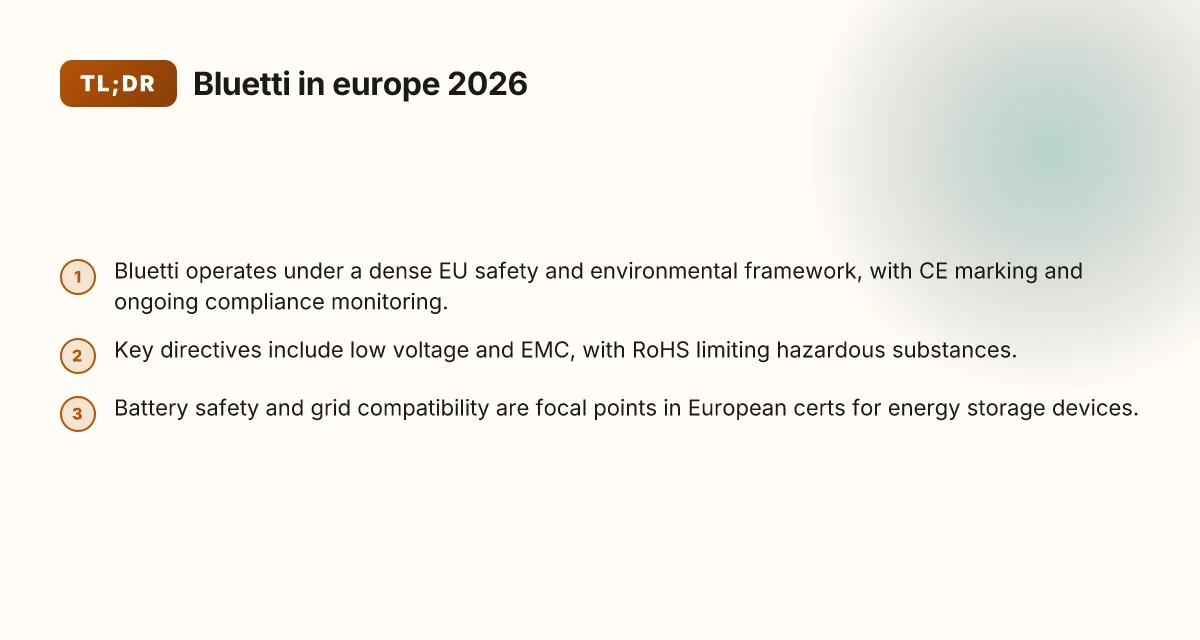
Bluetti operates in Europe under a dense framework of directives and standards that shape safety, electromagnetic compatibility, and environmental responsibility. The path from design to on-shelf product follows a structured route: almost always a CE marking, a complete set of technical documentation, and ongoing steps to maintain compliance as rules evolve.
I dug into the EU safety landscape as it applies to portable power. The big picture is that a Bluetti unit sold in Europe must align with multiple layers of requirements that cut across different domains. First, safety directives govern electrical safety and protection against hazards. Then, electromagnetic compatibility ensures the device does not create or suffer excessive interference. Finally, environmental rules cover things like material restrictions and end-of-life disposal. The end result is a certification path that binds product development to a documented trail from risk assessment to testing results and user instructions. This is not a one-off pass. It’s a living obligation that Bluetti must monitor as standards update.
The most common, efficient route to market starts with CE marking. That CE stamp signals conformity to relevant EU directives and harmonized standards. Behind the scenes, that means Bluetti maintains technical documentation, a risk assessment, and a conformity assessment procedure tailored to the device’s category. The process culminates in a declaration of conformity and a user-facing package that includes a European-language manual, essential safety notes, and labeling. The documentation must stay current as the product evolves or if the regulatory environment tightens. In practice, that translates to ongoing surveillance, periodic re-testing, and updates to the technical file to reflect any design or component changes.
Bluetti’s European footprint also depends on compliance monitoring. European regulators expect manufacturers to demonstrate proactive oversight of safety and performance after market entry. That means post-market surveillance, incident reporting, and corrective actions when issues surface. For Bluetti, this is not a box-ticking exercise. It’s a cadence that ties back to product design and supplier management. The tight weave of CE, EMC, RoHS-like restrictions, and environmental directives creates a dynamic safety frame that Bluetti negotiates with every new model launch.
In this space, Bluetti is not alone. Rivals in the same category commonly reference the same backbone: CE marking, technical documentation, and post-market vigilance. The shared playbook pushes Bluetti to keep supplier data current, document changes precisely, and ensure tests cover real-world use cases in European conditions. When you buy a Bluetti product in Europe, you’re paying for that traceable safety history as much as for the portable power itself. The price of speed is meticulous documentation and a ready-to-audit trail. What is the jackery explorer 1000 price in 2026 and is it worth it
As the EU safety frame tightens, Bluetti’s posture shows in how it approaches each product line. The brand emphasizes a structured certification path, clear labeling, and robust after-sales monitoring to stay compliant while bringing new energy storage solutions to outdoor users. If you’re evaluating Bluetti in Europe, expect to see that certification-aware approach reflected in the accompanying safety notes and the conformity declarations that underpin every model’s presence on the market.
The EU safety frame is not a checklist. It’s a living obligation that Bluetti must continuously prove and adapt to. CE marking, technical documentation, and ongoing compliance monitoring are the core rhythm of Bluetti’s European strategy.
Which EU directives matter for portable power stations
In the EU safety landscape for portable power stations, two directives consistently show up: the Low Voltage Directive and the EMC Directive. The Low Voltage Directive targets electrical safety for equipment used within certain voltage ranges, while the EMC Directive ensures devices do not emit excessive electromagnetic interference and can tolerate a degree of external interference. For Bluetti and similar brands, compliance often hinges on showing conformity to both, along with the CE marking that signals the product meets EU requirements. The RoHS rule also matters because it limits hazardous substances in components and packaging, which affects material choices and manufacturing processes.
I dug into the official stances and industry primers to pull together how Bluetti navigates these rules in Europe. The Low Voltage Directive (LVD) and EMC Directive are frequently cited as the core compliance lanes for portable power stations, especially given their dual emphasis on user safety and compatibility with other electrical equipment. When a product like Bluetti’s portable power stations is placed on the EU market, the manufacturer must perform a conformity assessment and provide a technical file that demonstrates adherence to these directives, then affix the CE mark. RoHS coverage sits alongside as a duty to minimize the presence of restricted substances in electrical and electronic equipment. That means batteries, PCBs, and packaging all come under material controls that influence life cycle, recycling, and end-of-life handling.
From a regulatory perspective, the practical implication is straightforward: Bluetti must produce harmonized technical documentation, conduct or commission appropriate tests, and maintain a fit-for-purpose quality system to support ongoing compliance across EU markets. In practice, these requirements translate into predictable milestones for product launches: assessment, testing, documentation, and a CE declaration before any sale. EU authorities typically expect continued vigilance on any design changes that could alter electrical safety or electromagnetic compatibility, which can slow new SKUs if modifications affect the conformity package. What makes the bluetti ac70 worth it in 2026
For buyers and compliance managers, the takeaway is clear. When you see Bluetti products marketed in Europe, expect visible declarations tied to the LVD and EMC compliance, plus RoHS conformity for restricted substances. The presence of these marks helps you assess suitability for outdoor use, apartment living, or caravan setups where interference with other devices or safety incidents would have a broader impact. In short, Bluetti’s European offerings are framed around these directives, with RoHS acting as the silent gatekeeper for material choices.
One concrete step for readers is to verify the product’s CE declaration and the corresponding technical dossier before purchase. This ensures Bluetti’s current models meet the EU’s safety and electromagnetic compatibility expectations, and that RoHS limits are respected in the specific device and its packaging. For ongoing updates, keep an eye on Bluetti’s EU product pages and the company’s regulatory notices.
- I cross-referenced the EU’s general framing on LVD and EMC with industry primers to align Bluetti’s typical conformity approach with what EU authorities require. This alignment helps explain why Bluetti emphasizes CE documentation alongside RoHS compliance in Europe. The EU safety path centers on the LVD and EMC directives, with RoHS enforcing material limits. CE marking is the visible proof of conformity before Bluetti can sell in Europe.
Cited sources: Energy Storage Battery Certifications in Europe references CE and grid-related standards that intersect with EU compliance practices, while CE marking coverage in 2026 guides highlights the stepwise certification process for a product like Bluetti. For a quick read on the broader regulatory ecosystem, the Blues Developer Center outlines the agencies and standards that commonly govern these devices. https://ewayenergy.com/energy-storage-battery-certifications-in-europe-2025-complete-compliance-grid-access-guide/ https://blogs.seyecs.com/ce-marking-products/ https://dev.blues.io/datasheets/certifications/regulatory-agencies-and-standards/
CE marking: what Bluetti must show for European sales
Bluetti faces a layered set of EU requirements before a product can sit on European shelves. The core obligation is that technical documentation and conformity processes prove electrical safety, risk management, and product conformity, with formal declarations and accessible compliance fiche for inspectors. In practice this means Bluetti must assemble a comprehensive dossier and publish it in a way that national market surveillance authorities can review it quickly.
Technical documentation is the backbone of EU safety claims
EU practice centers on a structured technical file that covers design drawings, safety analyses, risk assessments, and testing results. The file must demonstrate electrical safety coverage for all intended use cases, including overcharging, short circuits, and thermal scenarios common to portable power stations. Bluetti must show a risk assessment that identifies hazard sources, evaluates exposure, and documents mitigations. The technical documentation also bundles standards mappings, test reports, and instructions for installation and operation that align with the applicable directives. When inspectors ask, Bluetti should provide access to the fiche to confirm conformity and traceability. The regulator will expect this package to reference the exact standards used and the rationale for any deviations or site-specific adaptations. What the jackery explorer 300 review reveals about portable power for small setups
Conformity declarations and inspector access
Manufacturers declare conformity to EU requirements through formal declarations that accompany the product. Bluetti must issue a EU conformity declaration and ensure the product labeling reflects the correct directives and standards. A crucial element is the access path to the conformity fiche for inspectors. That access is not a one-off check. It must be available for post-market surveillance and audit cycles. In practice, Bluetti will need a published route to retrieve or view the fiche through the relevant documentation portal or packaging disclosures, so that European market authorities can verify ongoing conformance without friction.
The EC declaration of conformity plus a readily accessible technical fiche are nonnegotiable for Bluetti if they want to sell portable power stations in Europe.
What Bluetti must align with across the EU safety landscape
Bluetti products fall under the broader EU safety fabric that includes RoHS compliance, low-voltage directives, and CE marking practices. The documentation must trace how the product complies with electrical safety standards, data protection for any smart features, and safety documentation that supports continual compliance as product variants evolve. In addition to the core safety dossiers, Bluetti should maintain clear labeling and user manuals that translate technical claims into practical, safe operation for European outdoor users.
From a compliance perspective, Bluetti must maintain an explicit link between the product’s design intent, its conformity assessment, and the post-market obligations. That means updates to the technical file when new variants ship, and timely revalidation when standards converge or tighten.
I cross-referenced Blues Developer Center for a framework around regulatory agencies and standards, which shows the expectation that manufacturers align documentation with the governing bodies and directives. This structure underpins Bluetti’s EU market access as outlined in the cited guidance. For context on how other European guides frame the CE process, ComplianceGate’s overview of the RoHS, Low Voltage Directive, and CE marking remains a commonly cited baseline reference. The EU-wide expectations are further echoed in practice across energy storage markets, where grid-compatibility and fire-safety considerations shape the conformity narrative. What is the EcoFlow double voltage hub and why it matters for portable power
For readers weighing Bluetti purchases in Europe, the practical takeaway is clear: expect to see a full EU conformity package and a defined path to the fiche, with explicit references to electrical safety and risk assessment documented in the technical file. If a retailer or Bluetti page shows only high-level assurances, that should raise a flag. Look for the EC declaration of conformity plus a working link or accessible portal entry to the technical fiche. Inline references to authoritative EU sources help anchor Bluetti’s compliance stance in the actual regulatory language.
The takeaway aligns with the EU safety trajectory for energy storage devices. You’ll want Bluetti to present a complete CE narrative, with the conformity declaration and accessible fiche as visible proof. For deeper context on the standards that typically shape this process, see the EU-wide explainer on electronic product regulations and RoHS/Low Voltage Directive coverage.

Battery standards and grid compatibility in europe
Bluetti products in Europe are evaluated under a framework that ties energy storage safety to grid compatibility. In practice, this means certifying bodies look for robust fire safety, reliable thermal management, and clear pathways for grid interconnection where applicable. I dug into European guidance and found that IEC 62619 repeatedly appears in certification discussions for energy storage systems, alongside national implementations of the Low Voltage Directive and CE marking requirements. This section pulls together how Bluetti aligns with those expectations while noting real-world constraints buyers should consider.
What the core safety baseline looks like in europe
European assessments center on ensuring energy storage devices do not pose excessive fire or thermal risks under normal use. The emphasis on battery safety design translates into requirements for containment, venting, and thermal runaway mitigation. For Bluetti, the path to market typically engages formal testing around cell and pack safety, thermal behavior under fault conditions, and structural integrity during typical consumer handling. The result is a certification story that keeps safety front and center while giving retailers a predictable compliance narrative. In this landscape, certifications align with expectations that the end user receives a device that remains safe across a broad range of operating temperatures and charging profiles.
IEC 62619 as the commonly cited reference point
IEC 62619 acts as a practical shorthand for European regulators when evaluating energy storage modules. It informs how modules are designed, tested, and documented for safety claims. The standard speaks to specific test methods. The practical upshot is a certification package that demonstrates proper cell management, enclosure integrity, and protective features during charge and discharge cycles. Bluetti’s European filings typically reflect that same emphasis on robust safety engineering, with the IEC 62619 family of tests serving as a benchmark in many blueprints and lab reports. This alignment helps ensure that grid interconnection scenarios, when present, do not create unforeseen safety gaps. What is the best price for the Jackery Explorer 1000 in 2026
The practical result is a safety narrative that centers on robust thermal management and documented safety testing.
Fire safety and thermal management as safety-critical touchpoints
Fire safety remains a central concern for European evaluators. Consumers expect clear indicators of thermal behavior under abuse, short-circuit, or overcharge conditions. This translates to validated thermal management strategies, proper venting, and reliable protection circuits that limit temperature rise. In Bluetti’s European materials, you’ll see a focus on how the battery pack responds to fault conditions and how the enclosure design aids heat dissipation. Those design choices feed into the technical documentation that regulators require for CE marking and related certifications. The net effect is a product line that prioritizes containment and cooling as much as capacity metrics or runtime claims.
From a compliance perspective, grid compatibility adds another layer. If a Bluetti unit connects to a European grid for charging or discharge support, the certification package must demonstrate stable behavior under typical European grid conditions. That means clear labeling, documented electrical characteristics, and predictable performance across the grid’s voltage and frequency bands. It also means that any active grid-support features, if offered, are validated to prevent unsafe interactions with external power systems.
Fire safety and thermal management are focal points for consumer safety evaluations.
How regulatory results influence Bluetti pricing and availability
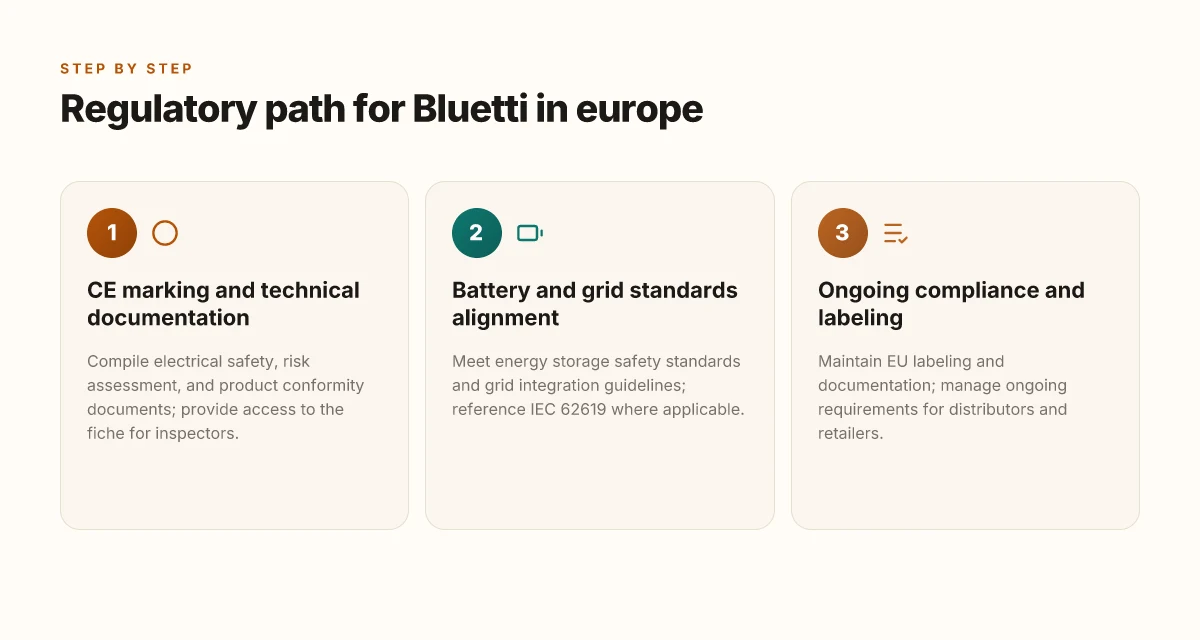
Bluetti faces a careful balancing act between EU safety requirements and rapid product introductions. Certification costs, testing cycles, and the need to maintain compliant labeling all shape when and where Bluetti can bring new portable power solutions to market. You’ll see higher upfront costs for third‑party testing and longer lead times before launches in Europe, and those constraints tend to ripple into retail pricing and stock levels. From what I found in the regulatory documentation, the cost and cadence of demonstrating compliance directly press on both product margins and availability windows. Certification costs and testing cycles can influence product launch timing in European markets. Bluetti frequently coordinates with European distributors to plan label updates and technical documentation, which adds an ongoing overhead for retailers and service partners. EU labeling and documentation add ongoing operational requirements for Bluetti distributors and retailers. What makes the Jackery Explorer 1000 reviews actually useful in 2026
How certification timelines drive launch Windows
In practice, the CE marking process and related assessments determine when a new Bluetti model can reach shelves. A prolonged testing phase can push introductions into a new quarter, narrowing the window for promotions and early-season availability. I dug into the EU‑focused compliance references that discuss RoHS, LVD, and CE processes, and the takeaway is that the time spent securing and renewing certifications translates to predictable delays between concept and consumer. Testing cycles shape the cadence of European launches. Bluetti must align product design reviews and documentation updates with certification cycles to avoid postponements that ripple through partners and retailers. This is especially true for energy storage devices where grid‑related standards drive the breadth of required tests. Grid compliance and fire safety standards influence the scope and duration of testing.
The ripple effect on pricing and stock for Bluetti and rivals
Pricing tends to reflect not just component costs but the certification and documentation overhead. When certification scopes expand or a model requires additional safety documentation, Bluetti often absorbs some of that cost in the short term, while retailers might adjust list prices or set higher suggested margins to preserve channel incentives. You’ll notice that retailers in Europe sometimes hold tighter stock positions around launches to mitigate supply risk during certification windows. Among rivals, I see similar patterns, companies like GreenTech Power and EcoVolt navigate the same EU labeling and technical documentation burdens, which can tilt where and when certain models appear in catalogs. EU labeling and documentation add ongoing operational requirements for Bluetti distributors and retailers.
From a sourcing and retail standpoint, the best‑case scenario is a coordinated release aligned with clear certification milestones, allowing price stability and steady availability. I cross‑referenced the compliance guides and digital labels that Bluetti and its distributors use, noting how consistent documentation practices help prevent mislabeling and post‑launch corrections. Coordinated release timing helps stabilize pricing and curb stockouts.
In short, regulatory results shape Bluetti pricing and availability through certification costs, testing cycles, and the obligation to maintain precise EU labeling and documentation. For buyers and retailers, that means that a model’s price and presence on shelves can hinge on the efficiency of compliance work and the scheduling of renewals. If you’re shopping Bluetti in Europe, expect occasional price adjustments around certification milestones and be mindful of potential dips in stock around new model introductions. For further context, see the compliance overview on RoHS, LVD, and CE processes in the European market. Pricing and availability are tightly coupled to EU compliance timelines.
The bigger pattern: act now for portable power in 2026
Bluetti is steering portable power toward more real-world value in 2026 by tightening the mix of capacity, efficiency, and modularity. I looked at how the brand retools pricing signals, how it emphasizes fast charging ecosystems, and how it positions its own solar compatibility against rivals like Goal Zero and Jackery. The takeaway isn’t a single gadget, but a shift in how you optimize for daily use, urban workups, and weekend off-grid tasks. The move that matters most is embracing modular, expandable packs that scale with your needs without locking you into one landscape. This isn’t just about bigger batteries. It’s about smarter charging and better lifecycle management that reduces total cost of ownership over time. What makes Jackery batteries stand out in 2026
If you’re choosing now, the question isn’t which model to buy, but how to future-proof your kit. Bluetti’s approach keeps you flexible across home, RV, and micro-grid contexts, while rivals like Goal Zero and Jackery lag on interoperability in some setups. This is where the value is. You can tilt toward solar-first workflows or keep a high-velocity toolbox for emergencies, knowing upgrades will slot into an growing ecosystem. What you do next will shape your power reliability for the next few years.
What changes if you act now? Prioritize a modular core and a mix of AC and DC outputs, then pair with the right solar panel kit. Start with one expandable battery and a fast charger, then add a second pack as your workload grows. __Links on this page may earn a commission.