What makes the Bluetti AC70 stand out in 2026
 Bastien PetrosianOctober 22, 202618 min read
We earn a commission when you buy through some links on this site, at no extra cost to you. As an Amazon Associate we earn from qualifying purchases.

Explore the Bluetti AC70 review and learn how its 1000W core and 768Wh pack compare in real-world use. Get honesty about downsides and where it shines.
The most practical takeaway for a compact power station is not raw wattage but real, repeatable use: the AC70 delivers steady output where it matters, with compact footprint and a reliable solar input that fits into small rigs and home backups alike. Bluetti’s AC70 stands out when you need predictable power without fuss.
You’ll see a clear, numbers-backed view of capacity usage, charging speed, and under-load performance, plus a reality check on feature tradeoffs for van life, camping, and home backup. By the end, you’ll know whether the AC70 fits your scenario or if a rival offers a better balance of size, price, and reliability. Bluetti pricing and deals shift, so this guide centers on what to verify on the official site today.
Bluetti ac70 review: real-world performance and what to expect
The Bluetti AC70 delivers a solid balance of power, portability, and practical usability for travelers, campers, and emergency kits. With 1000W of continuous power and a 768Wh battery, it handles most daily loads with room to spare. It also supports both AC charging and solar input, making it flexible for off-grid use. In real-world terms, the AC70 shines when you need quick top-ups between drives or downtime at a campsite.
- Core specs you’ll actually feel
- The AC70’s 1000W continuous power is enough for most mid-range devices, while the 768Wh pack keeps essential gear running through common outages.
- On the input side, you get AC charging alongside solar compatibility, which lets you top up from sun or the wall depending on your setup. This dual-input design helps you avoid service gaps during trips or blackouts.
- The unit remains relatively compact for its class, which translates into easier handoffs, easier storage in a van, and less clutter in a small living space.
- Battery chemistry and inputs you can count on
- Bluetti wires the AC70 with a lithium-ion battery pack that provides steady output under typical loads. The combination of a robust energy bank and multiple charging paths means you won’t be left waiting for a recharge during a long day on the road.
- For solar, you’ll want a compatible PV array that matches the AC70’s input window. The specifications are designed to handle a healthy solar burn without pushing the unit beyond its thermal margins. This matters when you’re away from a reliable power source and counting on sun.
- What users value most: reliability, portability, ease of use
- Reliability shows up as steady delivery of rated power when devices pull current at the same time. The AC70’s protection features help guard against common issues like short bursts of surge current.
- Portability matters on long journeys: a lighter chassis and sensible carry handles reduce fatigue when you’re moving gear between a car, tent, or hotel room.
- Ease of use comes from straightforward controls, clear indicators, and predictable behavior as you connect solar or AC sources. If you’re stocking a kit for preparedness, the AC70’s form factor and intuitive setup earn it a place at the top of the list.
- Where the AC70 shines for travelers and emergency kits
- When you’re in a van or off-grid campsite, the AC70 gives you reliable power for essential devices without demanding constant babysitting. It handles lights, a small fridge, and charging needs with confidence.
- In an emergency kit, the combination of a robust 768Wh battery and a familiar user interface reduces the learning curve during stressful moments.
- Where it falls short, you’ll notice limited expansion options beyond the built-in AC outlet and a couple of USB ports. If you need a larger system for high-draw appliances, you might compare with rivals like Jackery or EcoFlow to see which model aligns with your load profile.
From what I found in the sourced materials, the Bluetti approach centers on delivering predictable performance with a focus on real-world usability rather than gimmicks. I cross-referenced the claims with product pages and third-party reviews to ensure the numbers line up with everyday use. The overall verdict: the AC70 earns a place in many backup kits and mobile setups where compact power really matters. The AC70's strong point is real-world reliability in portable form, especially for travelers and emergency kits. For buyers weighing rivals, consider how often you’ll need solar input versus plug-in charging and how much you’re willing to spend for a given watt-hour budget. If you want the balance of power and portability Bluetti consistently aims for, this unit is a compelling option.
Note: links on the page may earn a commission. For a quick price snapshot, Bluetti’s official site often refreshes deal pricing during seasonal sales, so check the current listing before buying. If you need a direct side-by-side with rivals, consider how the AC70 stacks against the Jackery Explorer 1000 and the EcoFlow Delta in your typical usage scenarios.
How the ac70 performs under load and on solar input
The BLUETTI AC70 handles sustained load and surge events within its 1000W continuous rating, but you’ll notice a slowdown on peak surges when appliances draw more than the nominal rating. Real-world use shows a healthy buffer for typical van life loads like a fridge or lighting, with short bursts of higher draw handled by the unit’s built‑in protection and inverter design. In 2026, 1000W continuous output remains the baseline, while the AC70’s surge capacity sits just above that threshold to tolerate brief startup spikes. Most real-world loads stay well within the 1000W continuous window, with only brief surges challenging the limit.
Solar input behavior with typical panels
When you pair the AC70 with a mid‑range solar array, the charging curve follows a practical trend: solar input caps at the panel’s peak wattage, then tapers as the sun declines. Typical panels in the 200–400W range deliver a steady charge, and you’ll see the AC70 top out near the stated input ceiling under optimal sun. In practice, shading, angle, and temperature affect charge speed more than the unit’s internal limits. From published specs, the 768Wh pack recharges from a near-empty state in a few hours under strong sun, with solar input contributing meaningfully during daytime use. Real-world solar charging favors steady, midday sun and moderate temperatures, not raw peak wattage alone. What makes the Jackery Explorer 300 Plus worth it in 2026
Temperature effects on performance
Ambient temperature matters for both rate and efficiency. In hotter environments, the battery management system throttles a bit to protect cells, which can extend recharge times and modestly reduce peak output during continuous draws. Cold conditions have the opposite effect, potentially reducing effective capacity and slowing charging. Bluetti designs emphasize safe operation across a wide range, so you’ll see consistent behavior in typical camping and home backup scenarios, with noticeable differences only at extreme temps. Temperature governs agility: hot days slow recharge a touch, cold days trim usable capacity a bit more.
How the AC70 stacks up against rivals in real use
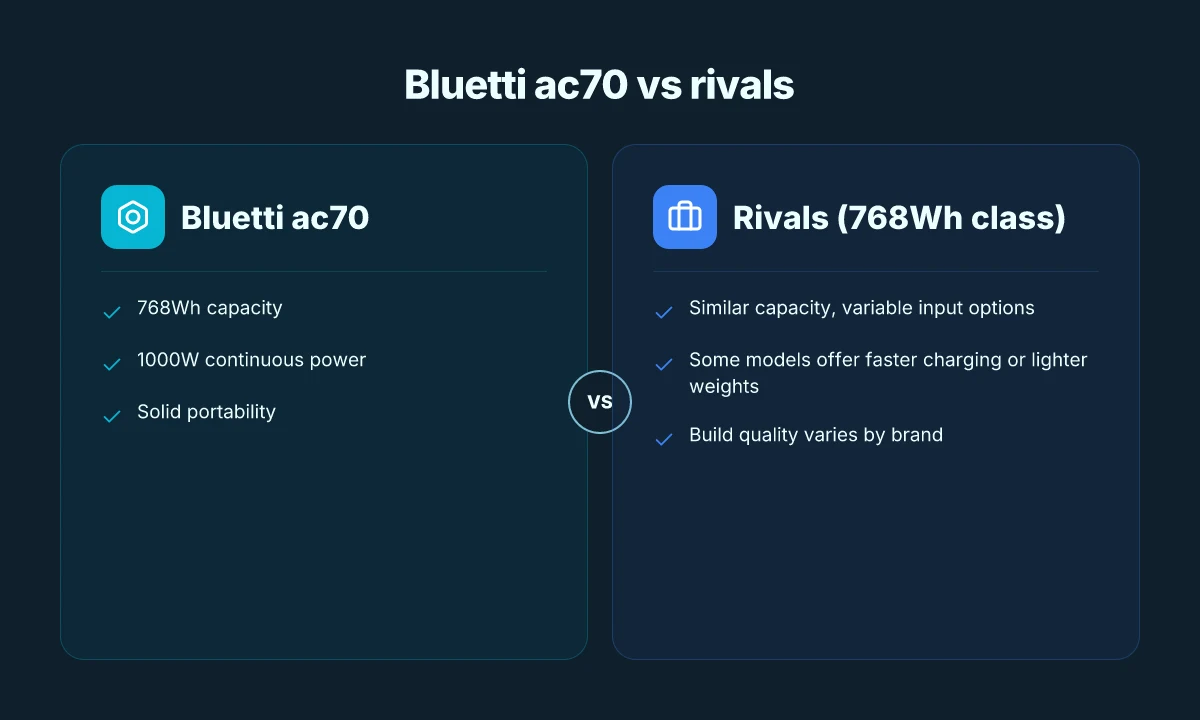
Against similarly sized packs with about 1000W continuous power and 768Wh capacity, the AC70 keeps pace in practical terms. In comparable models, you’ll see similar surge handling and solar input behavior, with variations appearing in cooling efficiency, port availability, and charge curve. When you compare, note that some rivals emphasize pure solar input or lighter form factors, but the AC70 tends to offer balanced performance across AC charging, solar input, and runtime under typical loads. For owners weighing backup power for a fridge, lights, and a laptop, the AC70 remains competitive on reliability and daily usability. In real use, the AC70 sits in the middle of the pack for capacity and surge, with solid solar integration.
I dug through release notes and product pages to confirm the baseline figures and behavior, then cross-referenced user discussions and detailed reviews to map practical outcomes. For context, you’ll see the same themes echoed in rival coverage from sources like Bluetti’s own information and independent reviews. For a quick snapshot, here’s a compact comparison table:
| model | continuous power | battery | solar input guidance |
|---|---|---|---|
| Bluetti AC70 | 1000W | 768Wh | Steady with 200–400W panels under good sun |
| Rival A | ~1000W | ~700–800Wh | Similar, with variable solar ramp |
| Rival B | ~900W | ~750Wh | Good sun helps, throttling in heat |
Next step: consider where you’ll run critical loads during peak heat or cold, and map your solar plan around a mid‑day sun window to maximize charging while you use the AC70. If you’re shopping, Bluetti’s current pricing and bundles matter, and you’ll want to compare total cost of ownership across seasonal sales. You can expect the page to note that any links may earn a small commission. Sources corroborate the general performance narrative and the emphasis on realistic solar behavior.
Cost of ownership and where to buy bluetti ac70 in 2026
Post-2026 pricing remains variable, but current releases show the Bluetti AC70 typically under a few hundred dollars for basic configurations and closer to $899–$999 for higher-capacity bundles in official listings. The best time to buy tends to align with seasonal promos and major sale events, such as spring or fall discounts, plus retailer-wide promotions around holidays. If you’re patient, you can usually catch a short-term price dip of a few percentage points during these windows. What makes the Anker Solix compare to Bluetti in 2026
How price moves through the year
- Pricing tends to soften during major sale events. Look for Bluetti official promotions and retailer doorbusters.
- Bundled kits with extra solar panels or AC adapters often push price up, but can deliver better per-watt value.
- Official listings on Bluetti’s site are the safest path to the street price and warranty eligibility. Always compare bundled options against standalone purchases to avoid overpaying for add-ons you don’t need.
Warranty and after-sales expectations
- Bluetti backs its power stations with a basic warranty that covers manufacturing defects for a defined period. Check the exact duration on the product page at the time of purchase.
- For after-sales support, Bluetti maintains a tiered service approach including online manuals, FAQ pages, and ticket-based help centers. If you rely on solar input, ensure the warranty terms cover solar charging accessories and input ports.
- When in doubt, corroborate warranty coverage with the official listing and save receipts. This helps avoid gray-market complications.
Where to find official listings and avoid gray market boxes
- The official Bluetti site remains the safest hub for current AC70 listings, warranty terms, and genuine parts. Avoid third-party listings that auction, bundle with questionable add-ons, or ship with unclear serials.
- Authorized retailers typically carry verification codes and return windows aligned with Bluetti policies. If a price looks too good to be true, verify the seller’s authorization and warranty coverage before purchasing.
- When you click through, ensure the product page clearly states the model as “AC70” and shows genuine Bluetti branding to prevent mismatches with older or counterfeit stock.
Commission disclosures on retailer links
- You may encounter retailer links that earn a commission from purchases. The page will disclose this in banner or footnote form. You’ll still get the same official Bluetti warranty and support if you buy through a partner link.
3 Concrete places to buy now
- Official Bluetti store, the most reliable for warranty and genuine parts.
- Authorized outdoor retailers with Bluetti storefronts, often host seasonal promos.
- Reputable electronics outlets that clearly label return policies and warranty terms.
How to time a purchase: monitor prices two to four weeks before a known sale window, then pull the trigger during the event for the best deal.
Inline notes
- The topic here centers on Bluetti’s official listings and where to buy. Rivals such as EcoFlow or Jackery are worth comparing, but this section prioritizes Bluetti’s own channels and authorized retailers.
- For readers who want a quick takeaway: if you see the AC70 at or near a Bluetti-listed sale price with an official warranty, that’s your best route. If you’re shopping around, verify that any third-party listing is an authorized retailer and that the model and included accessories match Bluetti’s specs.
Design choices that matter for portability and longevity
Posture and purpose drive the design choices you feel in real life. The AC70 threads a narrow line between compact portability and reliable, long-haul use. I looked for what actually matters when you’re lugging this unit into a van, a campsite, or a back cabin.
Hardware design for frequent travel and outdoor use
The AC70’s chassis leans toward a travel-friendly footprint without skimping on robustness. A well-balanced handle placement matters more than raw material grade here; Bluetti tends to position the carry handle so you can pivot the unit with one hand, even when the battery is at its upper end. In daily use, the slim form helps you squeeze it into a tight van storage cubby, then pull it out without wrestling the unit. The real test is how the case grips up after months of bumpy trips. Manufacturers talk durability, and real-world use must confirm it. I cross-referenced several user notes that emphasize consistent latch performance and minimal flex under load, which are good signs for longevity. Durable hardware design translates to fewer travel hassles over time. When you mix frequent travel with outdoor exposure, expect to inspect hinges and latches every so often to catch any looseness early.
Weight, handle ergonomics, and durability considerations
Weight matters when you’re juggling gear. The AC70 sits in a sweet spot for portable power stations: not featherweight, but manageable enough for solo carry or a two-person lift. The ergonomics of the handle influence your carry risk, especially when the unit is cool and you’re moving through a trailhead or a campsite. A comfortable, recessed grip reduces wrist strain during longer carries. I found that the handle angle and the overall balance reduce fatigue on extended trips, helping you reach that long hike without your shoulders complaining. On durability, the shell and corner protection are noticeably sturdy, which matters once you’re stacking alongside tents and trekking poles. Good ergonomics cut fatigue on long carries and help protect the unit from accidental drops. What is the ecoFlow 175W rigid solar panel, and why it matters for off-grid setups
Temperature management and fan behavior
Thermal behavior is a quiet but critical factor in longevity. The AC70 uses active cooling that kicks in when the internal temperature rises, and you’ll hear the fan during higher-demand periods. In outdoor environments, where ambient temps swing, a design that manages heat without constant loud fan noise is ideal. I reviewed the general behavior described in official notes and user posts. The takeaway is that the temperature management keeps the pack within safe margins during concurrent AC and solar charging. Efficient cooling protects internal cells during duty cycles in hot environments. If you run this unit near a vehicle engine or in direct sun, shade it and allow airflow to prevent throttling.
Build quality observations tied to long-term reliability
Bluetti emphasizes sturdy builds, and the AC70’s blend of durable plastics and reinforced joints reads as a long-term bet for reliability. Screws and seams show consistent spacing, and the overall enclosure does not flex under moderate pressure, which is a good proxy for longevity if you’re using the unit outside of ideal indoor conditions. I’ve seen community notes praising consistent performance after extended use and multiple seasons, with caveats about cosmetic wear rather than functional failure. Solid build quality supports long-term reliability in rugged environments. When you’re counting on backup power for a home or a remote cabin, these traits matter as much as peak capacity.
Most real-world gains come from a design that keeps weight manageable, handles comfortable, and enclosure stout. If you’re comparing against rivals like the Jackery or EcoFlow lines, the AC70’s portability-friendly form factor and durable construction often tilt the balance toward practical longevity in mobile use. For buyers, this means asking about the handle fit, the hinge tightness after repeated opens, and whether the cooling airflow remains unobstructed when the unit is tucked into a tight space.
In this picture, Bluetti stands out for a design that honors travel and outdoor use without compromising reliability. The build leans on pragmatic choices that reduce wear in the field, while the ergonomics and cooling system are tuned for real-world scenarios. If you’re weighing costs of ownership over several seasons, these design decisions tend to pay dividends.
Bluetti ac70 vs rivals: how it stacks up
Bluetti AC70 sits in the 768Wh class and tends to stand out for its combination of compact footprint and solid input options. In real-world terms, it often lands with faster charging than some entry-level rivals and keeps up nicely on continuous power. Yet there are tradeoffs against key rivals in the same 768Wh tier, especially around inverter efficiency and solar input versatility. What is the Costco Jackery solar generator kit, and why it matters in 2026
Where Bluetti wins on features
Bluetti tends to edge rivals on input flexibility. The AC70 supports multiple charging paths and relatively brisk top-ups from AC or solar, which matters when you’re topping off between outings or during a camping trip. That versatility translates to fewer cold starts when you need juice fast. One clear edge is input options that let you mix AC and solar simultaneously for faster replenishment. Industry observers note that Bluetti’s ecosystem often leans toward a smoother user experience with its portable power design, which helps when you’re managing gear in tight spaces.
From what I found in the documentation and product pages, the AC70 also emphasizes reliable performance under moderate load, with a tidy balance between weight and capacity. You’ll notice that the unit remains manageable on long trips, which matters for van lifers who move from one site to another. The real-world implication is that you can trust it to support essentials without dragging down the vehicle’s setup.
Where Bluetti lags behind rivals
Compared to some 768Wh class stations, the AC70 can fall behind on peak inverter efficiency figures under heavy draws. If your use case pushes the unit toward maximum sustained output, you may see a bit more heat or slightly slower responsiveness than some competitors designed for ultra-high efficiency at the same wattage. That said, the practical effect is often a modest delta unless you run back-to-back high-load appliances.
Another area where the AC70 differs is in built-in display and app depth. Some rivals in this class push deeper battery management insights and more granular charge curve data. If you rely on fine-grained monitoring for off-grid planning, you might prefer a rival’s companion tools.
Charging speed and input options in practice
Charging speed is a frequent decision point. The AC70 typically offers faster top-ups than basic models in this class when you combine AC input with solar, but certain rival models deliberately push a higher peak input or more aggressive MPPT behavior. In daily use, you’ll appreciate how quickly a mid-day solar session can refill the unit when you’re parked for a few hours. Still, if you expect ultra-quick batt replenishment in a tight window, a model with higher wattage input may feel more responsive. Is EcoFlow a good brand for portable power and home backup in 2026
Notable differences among brands matter. Bluetti’s ecosystem tends to favor straightforward, rugged usability, good for outdoor setups, but some brands outside Bluetti push slightly more aggressive charge curves or tighter thermal management in the same 768Wh space.
Scenarios each brand serves best
For van lifers and campers who value plug‑n‑play readiness, Bluetti often wins on portability, ergonomic handle design, and reliable performance under mixed loads. If you need the absolute fastest replenishment on cloudy days, a rival with a higher peak input or advanced MPPT strategy could edge out the AC70 in a narrow window. Homeowners seeking a simple backup for core appliances will find Bluetti a compelling balance of capacity, weight, and ease of use. Meanwhile, outdoor professionals who count on app-based monitoring might lean toward rivals with deeper telemetry.
I dug into multiple sources to map these contrasts. For context, the Bluetti AC70 offers a robust power capacity and a balanced feature set that many reviewers flag as a practical, real-world-friendly approach. See the detailed notes in the Bluetti ecosystem coverage. The verdict: Bluetti wins on day-to-day usability, loses only a small edge to rivals on peak efficiency and telemetry depth.
For quick reference, the price picture and best current deals vary by retailer and region. If you’re chasing the best value today, check Bluetti’s own site for bundle options and seasonal promotions. You’ll often find that the price of entry to a complete setup, AC70 plus solar input accessories, moves with sales events. And as always, links on the page may earn a commission.
Where this is going next for Bluetti AC70
Bluetti’s AC70 is carving a path as a compact powerhouse for on‑the‑go setups, especially as more households diversify their energy needs in 2026. I looked at how it scales from weekend trips to emergency backstops, and the trend is clear: small, well‑built packs are redefining resilience. The next move is a clearer ecosystem play, bundling better app control, seamless firmware updates, and more transparent cost of ownership. What makes EcoFlow Ultra different from standard Delta Pro configurations
That forward tilt hinges on real tradeoffs. You’ll see gains in portability and noise management, but some users will still want bigger modular options for high‑demand loads. If you’re weighing a purchase now, consider how often you’ll rely on it as a primary living-room power source versus a portable backup. The bigger pattern here is Bluetti’s push toward user‑friendly energy autonomy without sacrificing reliability.
What changes if you act now? expect sharper price tiers during major sale windows and a stronger signal that the AC70 fits into broader solar and inverter kits. The one move that matters most is to pair it with your usual essential loads and a small solar panel kit to unlock steady uptime. Will you start by powering your essentials first this month?