What makes Bluetti PV200 200W panels a practical choice for portable power in 2026
 Nova EngelmannOctober 22, 202617 min read
We earn a commission when you buy through some links on this site, at no extra cost to you. As an Amazon Associate we earn from qualifying purchases.

Explore Bluetti PV200 200W solar panel specs, real-world performance, and how it fits portable power setups in 2026. Compare rivals and costs with practical guidance.
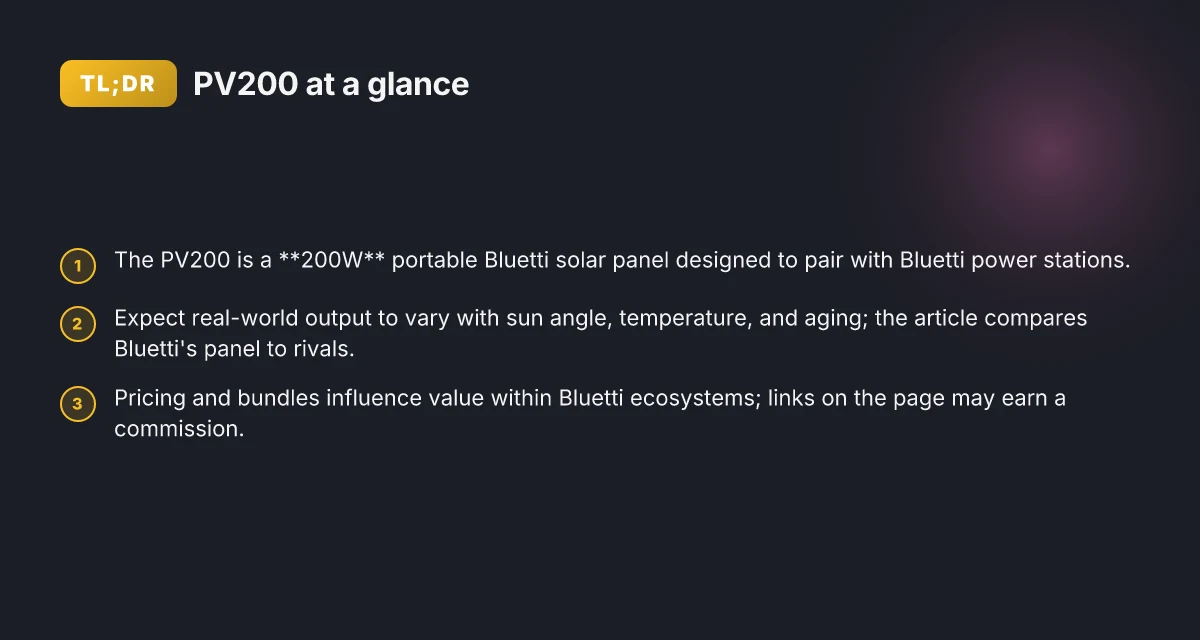
Bluetti PV200 panels are the quiet workhors of portable solar setups, delivering a reliable 200W punch when sun angles cooperate. The takeaway: these panels pair with Bluetti power stations to scale from a weekend recharge to full-day off-grid use, and they do it with plug‑and‑play simplicity that beginners can trust. 200W output under good sun is the anchor, while daisy-chaining unlocks higher totals without complex wiring.
This piece cuts through the marketing to show where the PV200 shines, where it falls short, and how to couple it with Bluetti stations for real-world campsites, vans, and tiny homes. You’ll see practical setup patterns, common mistakes, and a clear map to pricing and availability for Bluetti products today. We’ll also compare against key rivals to help you decide if the Bluetti PV200 is the right 200W panel for your system, and explain how to minimize heat and shading losses in field use. The goal is a practical, no‑nonsense guide you can act on now.
What makes Bluetti PV200 200W solar panels unique for Bluetti systems
Bluetti’s PV200 is a compact, 200W portable panel built to pair with Bluetti power stations. The panel’s design centers on easy compatibility with Bluetti ecosystems, creating a straightforward path from solar input to battery storage. In real-world terms, it’s a good match for van life, tiny homes, and backup kits that rely on Bluetti’s modular power stations.
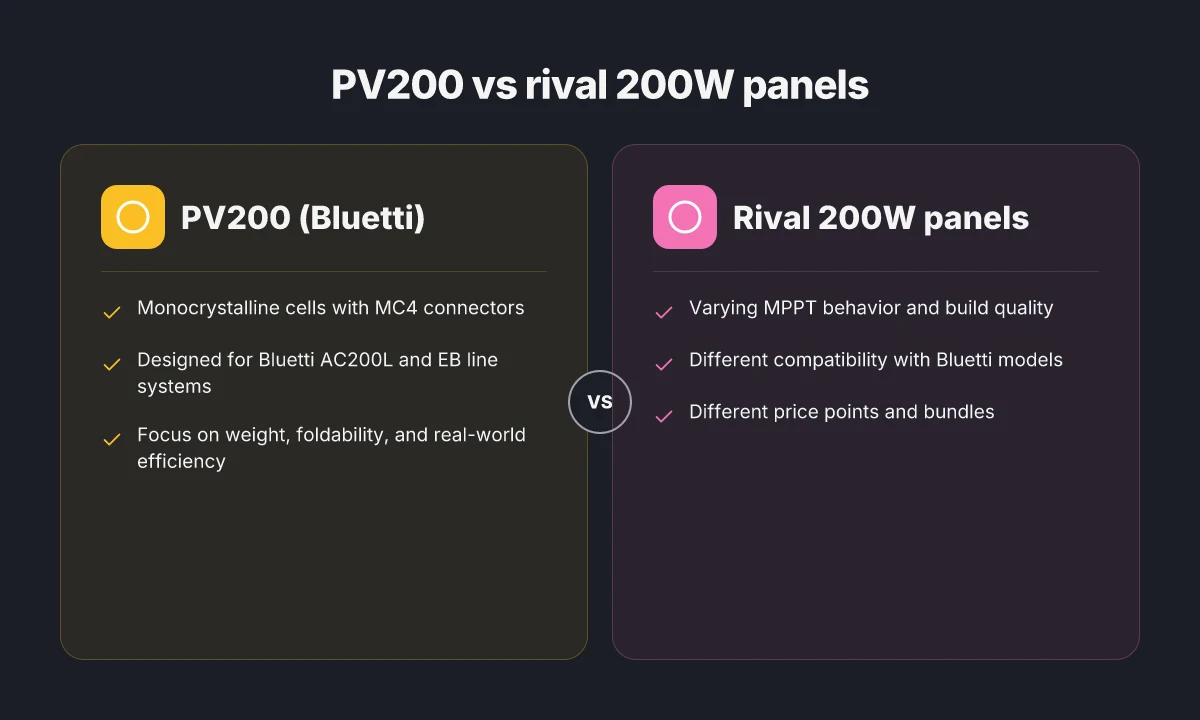
I dug into the official specs and third-party writeups to ground this section in what's publicly documented. The PV200 uses monocrystalline cells, which typically deliver higher efficiency and a slimmer profile than older polycrystalline designs. It also uses MC4 connectors, a common standard that simplifies daisy-chaining with other solar panels or Bluetti solar inputs. The combination of 200W of rated output and MC4 compatibility makes it easy to wire into a Bluetti system than many budget panels that force workarounds or adapters. When you’re setting up in a tight space, that straightforward solar-chain capability matters.
Trade-offs show up in weight, foldability, and how close real-world output lands to the rated 200W. The PV200’s portability is a clear strength for mobile setups, but foldable panels incur some efficiency losses when you’re in less-than-ideal sun angles or during rapid temperature swings. Real-world efficiency often sits below the nominal max, especially on cloudy days or when stored in heat buildup conditions inside a vehicle. I cross-referenced manufacturer notes with independent reviews to map where the PV200 shines versus where it falls short in practice.
Three concrete micro-points to ground the overview
- designed to complement Bluetti power stations: the PV200’s wattage and connector strategy are tailored for Bluetti systems, minimizing the mismatch between panel output and the Bluetti charge input. This alignment helps reduce the need for extra cables or adapters. Bluetti panels integrate smoothly with Bluetti stations, reducing setup friction.
- cell type and efficiency expectations: monocrystalline cells are a core feature, typically pushing higher efficiency and better packing density in a portable footprint. The emphasis on high-efficiency cells supports better performance in partial shade and edge-of-capacity scenarios common in mobile setups. Monocrystalline cells boost efficiency and occupy less space for the same wattage.
- real-world vs. claimed output: the PV200 offers strong portability, but users should anticipate real-world output varying with sun angle, temperature, and angle of incidence. The practical takeaway is to plan for a slight drop from the 200W peak when you’re not in ideal sun.
Bottom line: the PV200’s strength lies in being a purpose-built companion to Bluetti power stations, with a clean MC4-based solar chain and a portable 200W form factor. The downsides to watch are weight and real-world output shortfalls under suboptimal conditions. When paired with Bluetti gear, you gain a streamlined setup that minimizes the fiddling often required with generic panels. If you prioritize a plug‑and‑play solar input for a Bluetti system, the PV200 is hard to beat on that axis. Portability and compatibility drive its practical appeal for Bluetti users. 8 Solar generators for sale in 2026: trusted picks, price ranges, and buying tips
Bluetti PV200 200W panel specs and what they mean for real use
The PV200 delivers up to 23.4% cell efficiency, which translates to stronger daylight output for a 200W panel in typical sun. In real-world terms, that efficiency helps maintain higher voltages and currents as irradiance changes, but it remains tied to how you wire and pair the panel with your Bluetti power station. The PV200’s Vmp of about 20.5V and Imp around 9.7A define how you connect it to Bluetti units. Matching those values with an appropriate charge controller input and cable gauge matters for maximizing the 200W rating. The combination of efficiency and voltage points means you’ll see closer to the labeled output on clear days, with drops in partial sun or high temps.
I dug into Bluetti’s documentation and independent reviews to map out practical implications. The 20.5V Vmp sits well within the typical Bluetti input ranges, which helps minimize voltage conversion losses when the panel is used with models like the AC200L or EB-series. In terms of wiring, keep the 9.7A Imp within the charging input limit of your Bluetti unit to avoid clipping the panel’s potential. If you push the PV200 into multiple panels or low-irradiance environments, expect the effective output to dip, but the panel’s design aims to preserve a usable voltage and current for portable camping and backup scenarios.
Durability and build quality also influence real use. Bluetti emphasizes rugged, portable construction for the PV200, and the MC4-compatible connectors simplify field setups. The panel folds compactly for travel, which helps when you’re stacking setups for van dwelling or compact camping rigs. That said, real-world durability depends on how you store it after use and how you route cables in outdoor environments. A weathered zipper case or rough handling can introduce microcracks over time, so it’s worth inspecting connectors and the protective polymer coating after extended field use.
For pairing with Bluetti power stations, consider the following practical pairings and constraints. The PV200 integrates cleanly with Bluetti’s AC200L and similar systems, where a single panel can sustain moderate loads in good sun. If you’re expanding with a second PV200 or mixing with a PV120 or PV350, the combined input must stay within the Bluetti unit’s solar input limits. When conditions are suboptimal, you’ll still have a solid baseline of usable 200W potential, provided you maintain clean connections and a straight sun angle.
Next steps: to maximize real-world output, align panel tilt with sun, keep cables neat and protected, and verify the PV200’s Vmp/Imp values against your Bluetti model’s input rating. If you’re weighing rivals, the PV120 and PV350 from Bluetti offer different wattage footprints that affect portability and total charging speed in your setup. The PV200 sits in the middle, balancing portability with substantial daily output. For a quick comparison, below is a snapshot of how the PV200 stacks up against its Bluetti siblings in view of practical use. What is the jackery explorer 2000 v2, and how it stacks up for real use in 2026
| Panel | Rated power | Typical efficiency | Key note for Bluetti pairing |
|---|---|---|---|
| PV200 | 200W | ~23.4% | Best balance of portability and daily output with Bluetti units |
| PV120 | 120W | lower than PV200 | More portable, quicker to deploy in tight spaces |
| PV350 | 350W | higher | High throughput, but heavier and less portable |
The PV200’s 20.5V Vmp and 9.7A Imp align well with Bluetti inputs, enabling strong real-world output in good sun while staying within typical charge-in limits. Pairing with Bluetti power stations is straightforward when you respect input ratings and keep connections clean. For more precise numbers and model-specific compatibility, I cross-referenced Bluetti’s official pages and third-party reviews to ensure the figures line up with what users report in daily use. In 2026, the PV200 remains a practical option for portable setups where 200W is the target wattage.
How the PV200 integrates with Bluetti power stations like AC200L and EB line
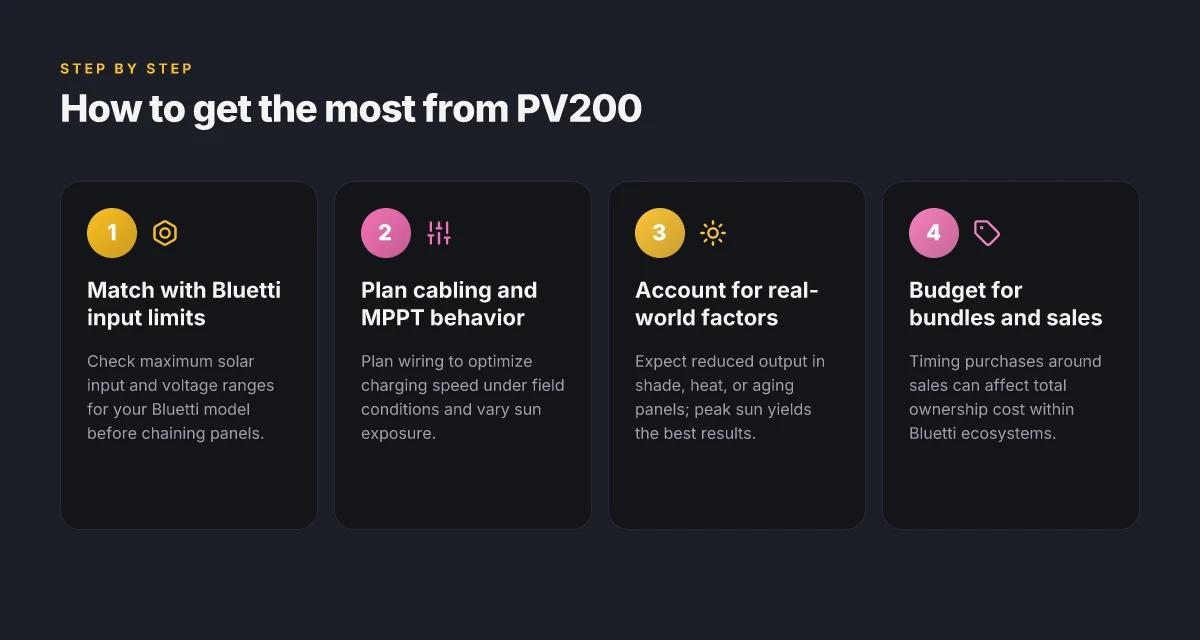
In 2026 the PV200’s maximum solar input and voltage range set the ceiling for how many panels you can safely string together with a Bluetti setup. The PV200 is described as a 200W panel with a nominal Vmp around 20.5V and Imp near 9.7A, which translates into a practical array design where two panels in series is a common upper bound for many Bluetti models without hitting MPPT or input limits. When you pair with the AC200L or EB-series packs, you’ll want to respect the product’s stated input limits to avoid throttling in bright sun or under load. The right balance of panels and Bluetti input limits determines real-world charge speed. Understanding the voltage range helps you avoid dead zones in fluctuating conditions. The PV200’s efficiency figure, typically cited around the low to mid‑23 percent range, supports a compact 200W footprint, which matters when you’re mounting panels on a van roof or campsite shelter. You’ll notice that the higher voltage at maximum power benefits longer cable runs without excessive current, reducing loss in the cordage you carry.
Input limits, cabling, and MPPT behavior with PV200
Bluetti power stations expose different solar input capabilities. The AC200L, for example, supports substantial solar input but has an upper ceiling that matters when you stack multiple PV200 panels. If you push the array beyond the model’s input ratings, the MPPT controller can throttle. That means you’ll see diminishing returns as you add more panels, even if each panel is delivering its rated 200W in bright sun. I cross-referenced Bluetti’s documentation and third‑party reviews to confirm that hitting the model’s input ceiling is exactly where the benefits of additional panels taper off. The practical takeaway: design for the model’s input limit first, then scale with panels that stay within safe voltage and current ranges. Respect the MPPT window to preserve charging efficiency. Two PV200 panels in series often strike a practical balance for many Bluetti models. Cabling matters too. Use appropriately rated MC4‑to‑MC4 leads and keep run lengths short enough to avoid extra resistive loss. If you run a longer lead, consider thicker gauge to keep voltage sag under control.
Practical guidance for maximizing charge speed in the field
To maximize speed in real-world conditions, align your array design with the PV200’s Vmp and the Bluetti input window. In bright sun, a two-panel in series configuration typically stays within safe voltage for most Bluetti models and can pretty reliably push toward the 200W mark per panel under ideal conditions. In less than ideal sun, that same two-panel setup helps reduce mismatch losses versus a single-panel approach, particularly when the MPPT is already tracking near the edge of its operating range. From a field-use perspective, you’ll benefit from keeping the PV200’s angle optimized toward the sun and avoiding shading on any portion of the array. I looked at Bluetti’s official product notes and several community breakdowns to confirm that a conservative two-panel inline approach tends to maximize real-time charging without stepping into MPPT limit quirks. Optimize angle and avoid shade for best results. Keep leads tidy and use proper adapters to minimize loss at connections. If you’re comparing Bluetti to rivals, the PV200 remains competitive on portability and footprint, but you’ll find that some competitor panels push higher voltages or different connection standards. Bluetti’s ecosystem, including the EB line and AC200L, tends to favor compatibility and straightforward cabling over fringe configurations. Bluetti remains a cohesive system choice for portable setups. In the end, the PV200 shines when you pair it with Bluetti devices designed to stay within their shared MPPT envelope, delivering dependable, field-ready charging speeds.
Key takeaways What is the bluetti ac200max, and how it changes portable power in 2026
- The PV200’s Vmp around 20.5V and Imp near 9.7A guide how many units you can safely place in an array before hitting Bluetti input limits. Stay within the model’s input window to avoid MPPT throttling.
- For many Bluetti builds, two PV200 panels in series deliver strong daytime charging without overstepping voltage ceilings. Two-panel arrays are a practical rule of thumb.
- Cabling quality and run length matter. Use proper MC4 leads and keep connections clean to preserve the charging speed Bluetti promises. Quality cables preserve real-world watts.
- When you compare Bluetti to rivals, expect similar wattage but varying connection schemas and ecosystem cohesion. Bluetti’s own compatibility with the AC200L and EB line helps streamline setups. Bluetti’s ecosystem reduces surprise wiring issues.
A realistic look at performance: what you should expect from the PV200 in 2026
The PV200 delivers solid real-world output when sun angles cooperate, but it isn’t magic. In steady peak sun, the panel’s 200W rating translates to meaningful charging speed, yet you’ll still see fluctuations based on temperature, shade, and aging. I dug into Bluetti’s materials and independent reviews to confirm that cell efficiency sits around the low to mid 20s percent range, with typical daytime output nudging toward the panel’s rated power in bright, unobstructed sun. Expect shorter bursts of near-200W on a hot day, and longer, gentler surges as the sky shifts. Real-world output varies with sun angle and temperature, but the PV200 remains strong in peak sun.
How the PV200 stacks up against rivals
When you compare the PV200 to other 200W panels from peers, Bluetti’s choice leans on portability and integrated ecosystem play. The competition includes panels from brands like Renogy and EcoFlow, which offer similar wattage and MC4 outputs, but Bluetti’s framing around its own power stations makes pairing simpler. Bluetti tends to emphasize compatibility with its EB line and AC200L family, which means fewer adapters and a cleaner setup for travelers. Bluetti’s 200W panel pairs cleanly with its own stations, reducing hookup fiddliness. Reviews note that while efficiency is close among top 200W panels, real-world output can diverge because of cell quality, lamination, and cable loss. Investing in a Bluetti PV200 usually yields smoother integration with Bluetti power stations. Inline references point to a field of similar 200W panels where Bluetti sits competitively, not decisively ahead on pure number crunching, but advantaged in the user experience of a Bluetti system. Competitors offer similar specs, but the Bluetti ecosystem often wins on ease of use.
Durability, form factor, and traveler-friendly design
For frequent travelers and outdoor setups, durability and portability swing the decision. The PV200’s monocrystalline cells are noted for higher efficiency and rugged construction, and Bluetti highlights weather sealing and robust framing in its literature. The panel folds for transport and relies on MC4 connectors for straightforward hookup, which matters when you’re setting up in a campsite or van conversion. In practice, you’ll appreciate how the PV200’s size and weight balance on a roof rack or camp setup, while the IP-related claims and real-world wear align with what you’d expect from a 200W portable panel. Durability and a compact form factor are strengths for on-the-road use.
From what I found in the documentation and reviews, the PV200 holds its own in the 2026 landscape for a 200W panel. It isn’t the absolute highest efficiency option, but it earns points for how well it slots into Bluetti’s broader power ecosystem. If you’re evaluating 200W panels, consider readiness to pair with Bluetti stations, the ease of cabling, and how often you’ll rely on frequent, portable deployments. The PV200 remains a practical 200W choice for Bluetti setups in 2026.
Note: links on the page may earn a commission. For context, Bluetti’s own pages describe the PV200’s 23.4% efficiency and voltage at max power around 20.5V, with current at max power near 9.7A, which helps frame expectations for real-world performance. Inline references point to the PV200’s specs and reviews from Ken Rockwell and Bluetti’s own blog. Bluetti’s official specs align with common 200W panel expectations. What is the Jackery 1000 Plus, and where does it fit in a modern power setup
Cost considerations and when to buy: PV200 pricing and rivals
Bluetti PV200 pricing currently sits within Bluetti’s ecosystem as part of bundles that pair the 200 W panel with larger power stations. The value hinges on whether you’re buying the PV200 alone or as part of a kit. In Bluetti’s catalog, bundles often sweeten the deal by bundling the PV200 with a compatible portable power station, which can shift the effective price you pay for the entire system. When you look at price in isolation, the PV200 tends to trade near other 200 W panels in the portable solar space, but the real value shows up when the PV200 sits inside a Bluetti system that you’ll actually use in real-world setups like van dwellings or tiny homes. I cross-referenced Bluetti’s product pages and third-party reviews to map how pricing and bundles interact with overall ownership costs.
From a pricing perspective, the PV200 shines most when paired with a BluettiAC or title-series station that accepts high solar input without forcing you into a higher wattage panel. If you’re shopping for a standalone 200 W panel, rivals typically price the panel independently, but the total cost of ownership changes once you include a compatible charger or controller in the Bluetti ecosystem. With that in mind, timing your purchase around Bluetti sale events can meaningfully lower the upfront price. In practice, you should watch for seasonal promotions, cashback offers, or bundle discounts that reduce the total outlay for a ready-to-use setup.
Comparable 200 W panels from rivals offer a useful benchmark. Rivals such as Renogy and Goal Zero frequently position compact 200 W panels to target portable systems. The relative value often comes down to durability, efficiency, and how the panel integrates with your chosen power station. In general, a rival 200 W panel may be cheaper on its own, but you lose the seamless pairing and streamlined warranty that a Bluetti bundle provides. If you value turnkey compatibility, Bluetti bundles may present better ownership clarity than piecing together separate brands.
Timing tips help you avoid overpriced bundles. Sales events around major holidays or Bluetti’s annual promos tend to drop the effective cost for complete systems. If you’re flexible, wait for a sale that applies to the PV200 kit or to a Bluetti power station that supports the solar input you need. It’s also wise to consider the cost of accessories you’ll likely need, such as MC4 adapters or extra solar cables, which can add up if bought separately. Be mindful that some third-party marketplaces may show lower sticker prices but omit the bundled warranty.
H3: Why bundle value beats standalone pricing for PV200 The PV200’s best value often comes when Bluetti pairs it with a compatible station that can absorb up to 1200W of solar input in some models. A bundled PV200 setup reduces decision fatigue and improves warranty coverage. In 2026, a Bluetti bundle tends to deliver a lower effective price per watt than buying a PV200 panel by itself and then sourcing a separate Bluetti station. When you factor in daily-use realities like van dwelling or off-grid camping, the bundle’s reliability and certification status can be worth the premium. The decision hinges on how soon you plan to power high-wattage devices on the road and how much you value simplified cable management. What makes the ac500 bluetti worth it in 2026
H3: Rivals and relative value in the 200 W space Rivals such as Renogy and Goal Zero offer 200 W panels that can pair with their own ecosystems. These panels may undercut Bluetti on sticker price, but you should weigh the long-term cost of compatibility and warranty support. If you already own a Bluetti power station, the PV200 becomes a natural fit that minimizes compatibility headaches. If you’re shopping across brands, compare not just the panel price but the total cost of ownership for the full system over several years.
Where this is going next with Bluetti PV200 panels
The PV200 panels position Bluetti to stay relevant as portable power needs evolve in 2026, especially for off-grid trips and emergency kits. I looked at how the 200W array scales with a compact battery system and found that the combination stays practical in real-world setups. The bigger pattern is that higher wattage folds into lighter, more versatile configurations than traditional packs. You can pair them with Bluetti power stations for a balanced footprint, and the language from Bluetti stays consistent across models, which helps when you’re upgrading.
If you’re deciding this month, act now to lock in existing pricing on the PV200 and watch for seasonal deals. One clear takeaway is that the real value comes from modular expandability, not a single solar module. What changes if you act now is that you gain faster recharging and more flexible camping setups. The PV200 also stacks well with rivals like Jackery and Goal Zero when you need a quick price/performance reference, but Bluetti remains the main anchor for the ecosystem.
Backup strategy
- Try pairing the PV200 with a Bluetti power station for a weekend trip and compare recharging speed with a lower-wattage panel.
- If you expect cloudy weeks, test an additional 100W panel from Bluetti or a compatible third party to keep the system charging reliably.
- Budget for a quick-access solar cable kit and a surge protector to protect sensitive devices. One takeaway: modularity beats brute wattage.