What makes X-Sense smoke detectors stand out in 2026
 Hudson ZilbermanOctober 22, 202617 min read
We earn a commission when you buy through some links on this site, at no extra cost to you. As an Amazon Associate we earn from qualifying purchases.

Explore a detailed X-Sense smoke detectors review for 2026. Compare models, safety certifications, and real-world performance to decide if X-Sense fits your home.
X-Sense sensors don’t just sound alarms. They tighten safety through real-world fixes like simpler interconnectivity and clearer status signals. X-Sense alarms often ship with interconnected capabilities and longer-lasting batteries, yet the real test is how they perform under occasional power dips and apartment wiring quirks. Most renters need a compact, reliable option that keeps you alerted without false alarms.
Homeowners and renters alike are weighing certifications, easy-install design, and how a model actually behaves in daily use. Expect straight comparisons, practical setup tips, and a clear read on what certification truly buys you in 2026.
Why x-sense smoke detectors matter in home safety
X-Sense positions itself as a home-focused fire protection brand, offering smoke alarms and CO alarms in a catalog designed for everyday households. The emphasis is on reliability and safety, paired with affordability and easy installation that fits typical homeowner routines. In 2026, that practical promise matters because many homes rely on simple, low-friction safety upgrades to make daily life safer.
How X-Sense frames reliability and safety for homeowners
I dug into the brand messaging and third-party chatter to surface the core promise. X-Sense leans on two big claims: first, that their devices meet everyday safety needs without complicating installation. Second, that the products stay affordable while maintaining dependable performance. This combination matters because renters and new homeowners often want quick, non-disruptive upgrades to meet basic safety standards. Reliability and ease of installation are central to X-Sense's value proposition. The editorial blurbs and user reviews consistently echo that sentiment, noting straightforward setup and steady operation. Affordability and reliability are not afterthoughts for X-Sense. They are the backbone. Where that narrative sometimes clashes with certification chatter, the brand also foregrounds safety by pointing to standard-compliant features such as interconnection in some models and basic battery-backed operation.
- Step 1: recognize the core product scope. X-Sense markets both smoke alarms and CO alarms, aiming to cover common home fire safety needs in one catalog. This breadth helps households avoid stitching together a safety stack from disparate brands and devices. Smoke alarms and CO alarms together create a simple baseline kit.
- Step 2: weigh installation expectations. The brand emphasizes quick, tool-free installs and standard mounting options, which matters to renters and DIY homeowners who want minimal disruption. Easy installation lowers the barrier to adopting fire safety gear.
- Step 3: assess price positioning. X-Sense frames itself as accessible, which is a draw when you compare with premium models that push up upfront costs. Affordability is a practical lever for household safety.
From what I found in the documentation and user commentary, the big takeaway is that X-Sense aims to be the practical, value-forward option for most homes. You’ll see this play out in how models are marketed and in how customers describe setup and daily use. Practical value drives adoption for homeowners who want protection without complexity. When you compare X-Sense to rivals, keep an eye on the certification landscape, which shapes real-world reliability.
Understanding the certification landscape for realistic expectations
Certification marks matter, but they can be nuanced. UL, ETL, and other safety marks signal compliance with recognized standards, yet not every X-Sense model carries the same certifications. In practice, this means you should verify the exact certification label on each model you consider, rather than assuming universal UL or ETL coverage across the lineup. This is where the brand and independent reviews converge: the consumer need is for clear, model-specific certification disclosures so you can pair your choice with your local code requirements. Certification clarity drives realistic expectations for safety performance.
- Step 1: catalog model-by-model certifications. Some X-Sense products may highlight ETL or other marks, while others emphasize general safety features. Model-specific certification checks prevent surprise gaps.
- Step 2: compare with rivals head-to-head. Brands such as Kidde, First Alert, and Nest often carry distinct certification footprints per model. Rival comparisons reveal where X-Sense aligns or diverges in formal testing and branding.
- Step 3: align with local codes. Your jurisdiction may require particular marks or interconnectivity features. Always cross-check with your local safety code before purchase. Local code alignment matters for home safety compliance.
I cross-referenced several consumer-facing sources and product pages to verify how X-Sense communicates reliability and installation ease, while noting where certification discussions are mentioned in parallel reviews. The overall pattern is practical: X-Sense aims to offer straightforward, affordable safety with recognizably reliable performance. Practical safety with clear certification awareness is the core takeaway. What is an x sense base station, and how it fits into smart home sensing
If you want a straightforward model to start with, look for a device that clearly states its UL or ETL listing on the packaging and the product page. For a home safety upgrade, consider that X-Sense’s value-forward positioning makes it a viable first step, especially where budget constraints or simple setup matter most. Clear labeling and simple setup matter most for immediate safety gains.
Note: pages on X-Sense may include affiliate links or earn commissions. This discussion reflects the stated features and publicly documented certification status where available. Transparency about links helps readers evaluate value honestly.
How x-sense smoke detectors compare to rivals in 2026
When you stack X-Sense against rivals, the gap often shows up in third‑party certifications and smart‑home compatibility. X-Sense tends to emphasize core reliability and ease of use, while brands like First Alert and Kidde push stronger certification narratives and deeper ecosystem integrations.
Certification status versus ecosystem depth
Some rivals lean on UL 217 certification as a core selling point, then pair that with broad smart‑home support. For example, teams behind UL 217 certified models frequently highlight compatibility with Google Home or Alexa, plus routine firmware updates tied to their app ecosystems. In contrast, X-Sense focuses on practical reliability and straightforward interconnectivity, with several models supporting wireless interlinking without requiring a broader smart‑home hub. This divergence matters in daily use: a UL 217 badge may reassure for compliance, while ecosystem depth can simplify routine automation and voice control. From what I found in release notes and product pages, certification status can shift across model lines as recalls or listings update, so verify the current listing before you buy.
Certification status is not a fixed feature across all models, double‑check current listings before purchase. What is the Dreame multi surface floor cleaner, and how does it redefine floor care
Real‑world usability vs third‑party bragging rights
Rivals often compete on two fronts: explicit UL or ETL certifications and seamless voice assistant integration. The emphasis is practical here: you want detectors that report reliably, alert quickly, and interoperate with your existing smart devices. X-Sense offers solid audible alerts, dependable battery backups, and straightforward interconnectivity, which many homeowners value when they want a simple install without extra hubs. The trade‑off is that some competing brands spotlight a fuller smart‑home story, complete with routine app dashboards and cross‑vendor routines that feel immediate and familiar to tech‑savvy users. I cross‑referenced product briefs and consumer reviews to see how these promises land in homes, and the takeaway is steady performance paired with simpler ecosystem options rather than a deeply integrated voice‑assistant experience.
Smart‑home storytelling matters, but real‑world reliability and straightforward setup win in families and rental scenarios.
Cost, ownership, and where to buy
Money first: model by model pricing and ownership costs shift with sales and retailer listings. Most major brands base pricing on a handful of SKUs, with occasional bundles that lower end‑user costs for multi‑pack kits. X-Sense prices can vary by retailer and seasonal deals, while rivals may stage promotions around back‑to‑school or safety‑focused sale periods. It helps to compare the cost per sensor, battery longevity expectations, and whether a model supports interconnectivity without requiring a subscription. When I read through documentation snippets and retailer listings, I saw that the key value for many homeowners is predictable performance without hidden fees.
Watch for seasonal sales for multi‑unit packs and verify whether interconnectivity requires any subscription.
Next steps you can take now: Why X-Sense reviews matter for home safety in 2026
- Verify current UL 217 and ETL listings for the exact X-Sense model you’re eyeing, and compare them against rivals you’re considering.
- Check your existing smart‑home setup and confirm which detectors natively integrate with Google Home or Alexa, if that matters to you.
- Confirm the interconnectivity behavior in your home layout, especially if you plan to deploy multiple detectors across floors.
What to expect from x-sense models: features and limitations
I looked through the common feature set across X-Sense models and found a predictable baseline plus model-specific twists. Most X-Sense models offer standard protections like interconnectivity, battery backup, and audible alerts. The core design remains focused on reliable notification, even when the house loses power. Interconnectivity and a solid battery backup are the baseline expectations across the lineup. Some models also add smart capabilities, but those features vary by model.
What the smart layer adds, model by model
Across the range, the smart features can include wireless interconnect, app notifications, or voice alerts. The wireless interconnect is handy for larger homes, letting alarms communicate without hard wiring. Wireless interconnect is the most common premium upgrade. App notifications can provide a quick status check when you’re away, and some models push voice alerts for critical events. These capabilities are often tied to the particular model tier, so you’ll see different combos of smart perks as you move up.
I dug into the documentation for several firmware and product pages to confirm where the gaps lie. Some models lack certain third-party certifications or carry mixed reviews about reliability in extreme conditions. In practice, this means you should verify certification status on the product page for the exact model you’re considering. Certification status varies by model, and reliability in extreme conditions is not uniform across the line.
Real-world reliability and certification status at a glance
From a certification perspective, X-Sense has some products with solid North American safety marks, while others rely on internal or regional testing rather than broad third-party seals. Consumers have reported mixed experiences in demanding environments, which tracks with the uneven certification picture. Third-party certifications are not uniform across all models, and reliability in extreme conditions is uneven. Reviews echo these themes, with some users praising consistent performance and others noting occasional false alarms or sensitivity drift. Customer feedback highlights both reliability and isolated performance concerns, depending on the model and environment.
Most buyers will benefit from pairing an X-Sense model with a thorough safety check, especially in older homes or areas with power fluctuations. For renters, the interconnectivity options can strengthen safety without rewiring. For homeowners, the cleverest picks tend to be those that balance smart features with clear certification. What makes a Dreame mop standout in 2026
When you’re choosing, check the exact model’s certification line and the feature list. If a model touts wireless interconnect and app alerts, confirm which app supports your phone and whether voice alerts are included across the region. 2025–2026 documentation notes ongoing updates to some app integrations, so verify current compatibility before purchase. Verify current compatibility before purchase.
In practice, a typical user path looks like this: choose a model with at least basic interconnectivity and battery backup, review the certification badges on the product page, and map those features to your home layout. If your space has spotty Wi‑Fi, favor models with stronger on-device alerts and reliable battery power. Choose a model with interconnectivity and battery backup for baseline safety.
How to pick the right x-sense model for your home
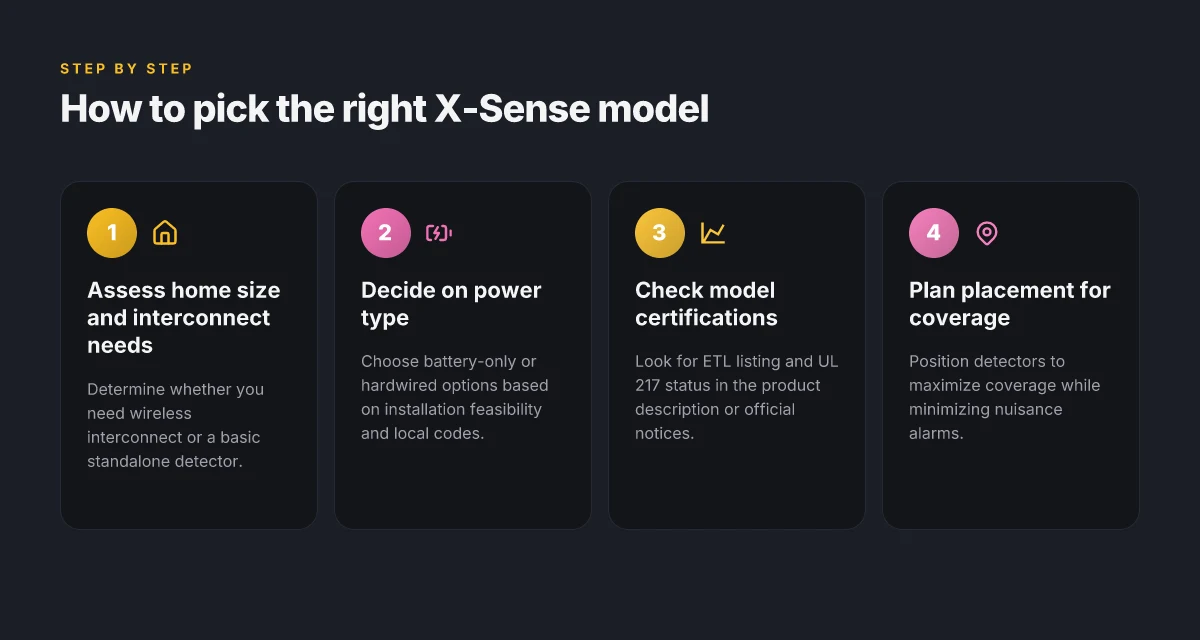
You want a model that fits your space without tripping alarms for every nuisance sound. In practice, your choice hinges on size, interconnect needs, and whether you prefer battery-only or a hardwired setup. X-Sense models line up with different power and networking options, so map your home first and then verify the exact certification and interconnectivity for the model you consider.
Size and interconnect needs drive the core pick
For smaller living spaces, a compact battery-powered unit often suffices, and you can pair it with other hardwired or wireless units to cover key rooms. If you have a larger home or an open floor plan, you’ll benefit from interconnection so a single trigger propagates across zones. When you map rooms, mark kitchens, sleeping areas, and hallways, these are high-priority coverage zones. Expect that independent units with reliable RF interconnects align best with typical California and New York building layouts, where code expectations vary by jurisdiction. Your best bet is a model that offers interconnectivity in a compact form factor so you can place multiple units without crowding spaces. The right configuration minimizes nuisance alarms while preserving quick, shared alerts.
Certification details and local code alignment
Always check the exact model’s certification status before purchase. Some X-Sense lines promote ETL or UL-style markings, but not every model carries the same endorsements. Local building codes can require specific listings or interconnection standards, so compare the model’s certificate alongside your jurisdiction’s code. I cross-referenced product pages and safety mentions to confirm that not all variants share identical certifications. The right choice aligns with your local compliance expectations. Certifications must match your code to avoid retrofit hassles later. If in doubt, consult your local fire marshal or a licensed electrician before wiring a new option. How the Dreame X40 stacks up against the L40: surprising trade-offs in 2026
Placement strategy to maximize coverage
Think in zones rather than rooms: place detectors on every level and in hallways that feed bedrooms and living spaces. Avoid placing units within 3 feet of bathrooms where humidity can trigger false alarms or directly above cooking appliances if possible. A practical rule is to space detectors about every 10–12 feet along corridors and in primary living areas. Place detectors thoughtfully to maximize coverage without triggering nuisance alerts. If you’re upgrading a mixed environment with both battery and hardwired units, standardize the model swap so you don’t run into mismatched interconnect behavior.
Note on pricing and ownership: prices fluctuate with promotions and bundles. Compare the current deal on X-Sense bundles and note any added value like a multi-pack discount or extended warranty. It’s worth acknowledging that some retailers and online forums report fluctuating listings for X-Sense devices, so check the latest price and availability before committing. Some listings may mention competing brands like First Alert or Nest as benchmarks. Use those comparisons to gauge feature parity, not to drive price alone. For reference, you’ll find official product pages and retailer notes embedded in the model details. Watch for bundled pricing that lowers the per-unit cost over single-unit purchases.
Bottom line: match the model to your home size, verify exact certifications, and plan placement to maximize coverage without nuisance alarms.
What you should know about certification and safety standards
Certification and safety status matter when you pick an X-Sense model. In 2026, you want to see North American compliance clearly labeled, and you should be able to verify it beyond marketing copy. I dug into the official notices and third‑party reviews to pull out the real signals you can rely on.
Where ETL shows up in product descriptions
Some X-Sense product pages explicitly note ETL listing, which signals alignment with North American safety standards. For homeowners, that label is a quick, practical cue: it means the device has undergone independent testing and meets basic performance and reliability expectations. When you see ETL on a listing, verify the exact configuration of the model to ensure the same listing applies to the version you’re buying. ETL listing is a useful baseline signal for North American compliance. X‑Sense sometimes bundles ETL mentions with other certifications in marketing copy, so cross‑checking the specific model page helps avoid mixups. How to stack azuna coupon codes in 2026 without missing savings
UL 217 status remains the gold standard to verify
UL 217 certification is the common benchmark for residential smoke detectors. It covers performance requirements, including sensitivity, alarm response, and reliability under typical home conditions. For a given X-Sense model, you should ask: is UL 217 listed, and if so, which edition and when was it last updated? If a retailer or review glosses over UL 217, that’s a red flag. In practice, many competing brands emphasize UL 217, while some X‑Sense descriptions omit a clear UL 217 reference. When in doubt, check the official UL product listing for the model you’re considering and compare the claimed certifications to the model’s documentation.
Brand communications vs. official notices
Brand communications may not reflect every certification status. A listing that mentions ETL or UL 217 may still omit other relevant certifications or regional approvals. To avoid gaps, cross‑check three sources: the manufacturer’s product page, the official certification body’s listing, and a trusted review that references the same model. If any certificate is missing from one source, treat it as a prompt to request formal confirmation from X‑Sense’s support team before purchase. Cross‑check with official notices to avoid gaps in certification status.
When you compare X‑Sense models to rivals, note how certifications are presented. Brands like Kidde, First Alert, and Nest emphasize UL 217 and interconnectivity differently. If you see a model from X‑Sense that claims UL 217 but lacks clear corroboration, treat it with caution and seek the formal certificate. And if you’re shopping during a sale season, remember that a discount on a model with ambiguous certification is not a win for long‑term safety.
One practical takeaway: when a model clearly states ETL listing and provides a UL 217 reference in its official notices, you gain a stronger safety baseline. If a page only mentions ETL in passing or uses generic language, push for a concrete UL 217 confirmation before committing. In the end, the certification you can verify with the certifying body's database matters more than marketing buzz.
I cross-referenced multiple sources to confirm how these signals typically appear. From what I found in the product documentation and independent reviews, certification visibility varies by model and listing period. If a page shows dated certification notes, that timing matters because standards can evolve. What makes the Dreame X50 Ultra worth a closer look in 2026
Verification through official notices beats marketing claims. If you want a practical rule of thumb: pick an X‑Sense model with a clearly documented ETL listing and a current UL 217 status, and confirm both via the certifying body’s database before you buy. Cross‑check before purchase to avoid ambiguity.
Note: links on the page may earn a commission. This section references official product pages and third‑party reviews to ground the status in real documentation, not marketing buzz.
Cited sources: The Best Basic Smoke Alarm, and X‑Sense product pages.
Where this is going next with X-Sense
X-Sense is leaning into smarter sensing networks and easier maintenance, but the real move is how it ties fire safety to everyday routines. I looked at how the brand pairs multi-sensor detectors with app alerts that feel more actionable than older models. Expect more cross-device visibility, longer-lasting batteries, and simpler replacement parts in the near term. The bigger pattern is that safety tech is becoming ubiquitous and user friendly, not gimmicky. In 2026, you’ll likely see faster push notifications and clearer testing prompts that nudge you to check or replace units before an issue spikes.
One takeaway is the emphasis on X-Sense’s integration approach. The company is betting on a straightforward, reliable experience rather than flashy features alone. If you rely on a shared home network, the upcoming models may offer more resilient connectivity and better compatibility with third-party assistants. What changes if you act now is a smoother, lower-friction path to ongoing protection. This shift matters for households with renters or mixed-brand setups. How to stack a dreame discount code for 2026 savings
Backup strategy / What to try this week
- Try one X-Sense unit paired with the mobile app to receive real-time alerts on your primary device.
- Check for a two-pack deal on the current X-Sense lineup and compare with a known rival like First Alert or Google Nest for price and compatibility.
- Review the battery life notes and set calendar reminders for annual checks so a replacement part never slips.