VPN protocol comparison
 Naomi Xanthos9 min read

A clear, practical guide comparing major VPN protocols, when to use each, and how they impact security, speed, and reliability.
VPN protocol comparison: a practical guide to choosing the right protocol
When you’re deciding on a VPN, the protocol is a core element that shapes speed, reliability, security, and how well the connection works on different devices. This guide focuses on the most common protocols you’ll encounter, what sets them apart, and practical tips for choosing the right one for your needs.

Protocol at a glance
| Protocol | Security strength | Performance (speed) | Compatibility | Ease of setup | Typical use case |
|---|---|---|---|---|---|
| OpenVPN | High | Moderate | Wide | Moderate | Broad compatibility, secure workhorse |
| WireGuard | Very high (modern) | Very fast | High | Easy | Low-latency, mobile and desktop |
| IKEv2/IPsec | High | Fast | Wide on mobile | Easy | Mobile-friendly, roaming networks |
| L2TP/IPsec | High | Moderate | Moderate | Easy | Easy setup, solid security |
| PPTP | Low | Very fast | Limited | Easy | Quick tests (not recommended) |
| SSTP | High | Moderate | Windows-friendly | Moderate | Windows-centric, TLS-based |
Compiled November 2026; check the provider's site for current details.
What a VPN protocol does and why it matters
- Encrypts your data and authenticates connections
- Determines the tunnel type, overhead, and handshakes
- Affects speed, compatibility, and reliability on various networks
- Impacts features like kill switch support, multi-hop, and NAT traversal
In short, the protocol is the “how” behind the VPN’s security and performance. Different vendors mix and match, but the core options commonly appear as a few families: OpenVPN, WireGuard, IKEv2/IPSec, L2TP/IPSec, SSTP, PPTP, and SoftEther variants. Below is a practical comparison to help you decide.
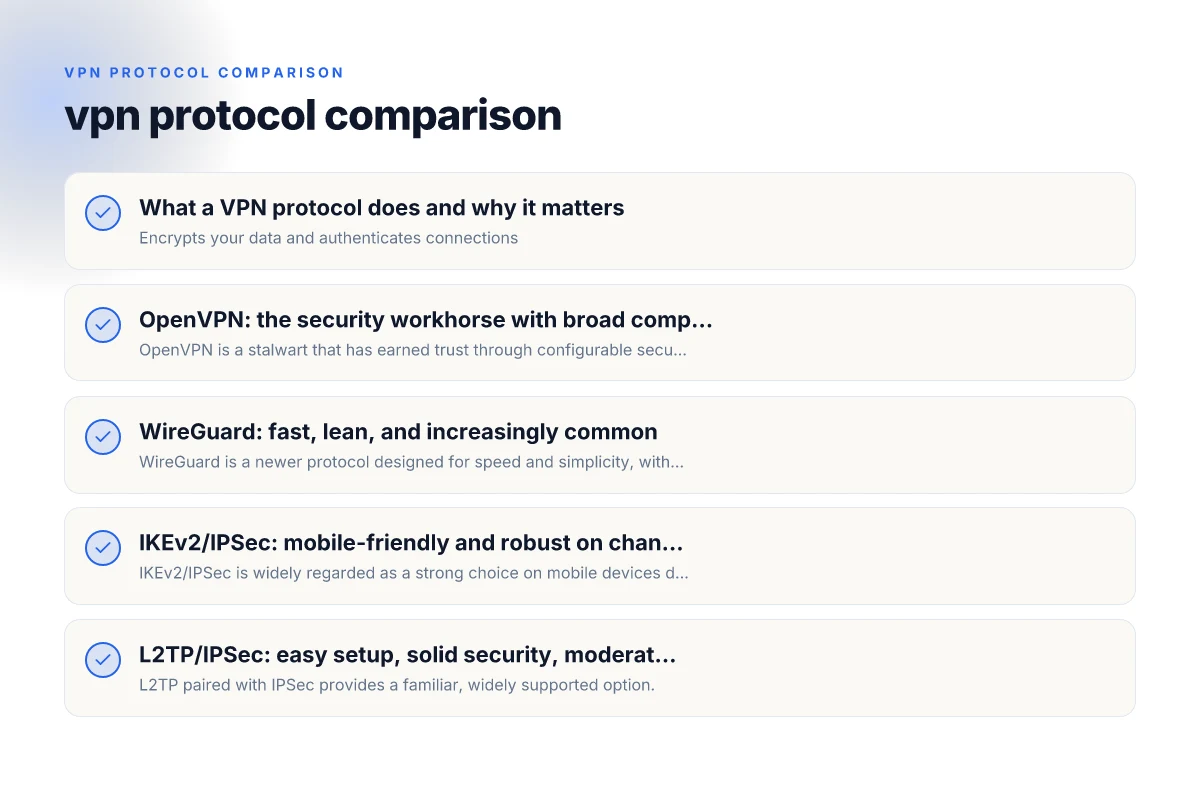
OpenVPN: the security workhorse with broad compatibility
OpenVPN is a stalwart that has earned trust through configurable security and cross-platform support. It’s proven in both consumer and enterprise environments.
- Strengths
- Strong, configurable encryption (typically AES-256) and robust authentication
- Broad device and platform compatibility (Windows, macOS, iOS, Android, Linux, routers)
- Mature ecosystem: extensive community tooling, troubleshooting guidance, and third-party audits
- Limitations
- Often slower than newer protocols due to more overhead
- Setup can be more complex on some platforms unless a provider’s app abstracts it
- Best use cases
- When you need proven security, enterprise-style options, or will run on older hardware where OpenVPN remains well-supported
WireGuard: fast, lean, and increasingly common
WireGuard is a newer protocol designed for speed and simplicity, with a small codebase that’s easier to audit.
- Strengths
- Very fast in practice, especially on mobile and over lossy networks
- Simple design reduces potential vulnerabilities and maintenance burden
- Strong cryptography with modern defaults
- Limitations
- Still maturing in features like advanced obfuscation or multi-hop by default
- Some platforms/CPUs may require customization for best privacy guarantees
- Best use cases
- Streaming, gaming, or mobile use where speed matters and you’re comfortable with provider integration
- Environments where you want a lightweight, auditable codebase
Pros and cons by category
| Category | OpenVPN | WireGuard | IKEv2/IPsec | L2TP/IPsec | PPTP | SSTP/SoftEther |
|---|---|---|---|---|---|---|
| Security | Strong | Strong | Strong | Strong | Weak | Moderate to strong depending |
| Speed | Moderate | Fast | Fast | Moderate | Fast | Varies by implementation |
| Setup ease | Moderate | Easy | Easy | Easy | Easy | Moderate |
| Platform support | Broad | Growing | Broad (esp mobile) | Moderate | Limited | Niche, compatibility-focused |
| Network roaming | Good | Excellent | Excellent | Good | Poor | Good for some VPNs |
Compiled November 2026; check the provider's site for current details. NordVPN vs Private Internet Access
IKEv2/IPsec: mobile-friendly and robust on changing networks
IKEv2/IPSec is widely regarded as a strong choice on mobile devices due to its stability when switching networks (cellular to Wi‑Fi, etc.).
- Strengths
- Excellent handover performance. Maintains connections when network quality changes
- Good security and mobility performance when configured properly
- Efficient use of battery on mobile devices
- Limitations
- Not as universally available on older devices or certain platforms without built-in support
- Some implementations rely on IPSec standards that can complicate interoperability
- Best use cases
- Mobile users who switch networks frequently or need reliable reconnection
L2TP/IPsec: easy setup, solid security, moderate performance
L2TP paired with IPSec provides a familiar, widely supported option.
- Strengths
- Broad compatibility across devices and routers
- Generally easy to set up in consumer-grade apps and on some devices
- Limitations
- Can be slower due to double encapsulation and IPSec overhead
- Historically more vulnerable to certain attack vectors if misconfigured or if weak credentials are used
- Best use cases
- Quick setups on devices with limited VPN options, or when other protocols aren’t available
PPTP: fast but insecure (generally not recommended today)
PPTP is one of the oldest VPN protocols and is notably fast, but it has well-documented security weaknesses.
- Strengths
- Very fast on some networks
- Easy to configure on older devices
- Limitations
- Susceptible to known cryptographic flaws and weaknesses
- Increasingly deprecated in favor of stronger options
- Best use cases
- Very limited scenarios where legacy support is essential and security is not a concern. Generally avoid for sensitive data
SSTP and SoftEther: niche and compatibility-focused options
- SSTP (Secure Socket Tunneling Protocol)
- Integrated with Windows. Strong security in environments where only HTTPS ports are open
- SoftEther
- Multi-protocol flexibility. Useful for complex or behind-firewall setups
- When to consider them
- You’re in a constrained network environment, require Windows-centric deployment, or want a versatile multi-protocol option
Quick comparison table: protocols at a glance
- OpenVPN: highly secure, broad compatibility, customizable. Moderate speed
- WireGuard: very fast, modern crypto, easy to audit. Growing ecosystem
- IKEv2/IPSec: fast reconnects on mobile, solid security. Platform support varies
- L2TP/IPSec: easy to deploy, decent security. Can be slower due to overhead
- PPTP: very fast. Insecure. Generally avoid
- SSTP: secure over HTTPS; Windows-friendly. Firewall-friendly under restrictions
- SoftEther: flexible, multi-protocol. Niche deployments
| Protocol | Speed (relative) | Security strength | Mobility | Compatibility | Best for |
|---|---|---|---|---|---|
| OpenVPN | Medium to fast | High | Good | Very broad | General use, enterprise, complex networks |
| WireGuard | Fast to very fast | High (modern) | Excellent | Broad but dependent on app | Streaming, gaming, mobile, performance-focused |
| IKEv2/IPSec | Fast | High | Excellent | Very good | Mobile users, unstable networks |
| L2TP/IPSec | Moderate | Moderate to high | Good | Broad | Easy setups on various devices |
| PPTP | Fast | Low | Moderate | Limited | Legacy compatibility (not recommended) |
| SSTP | Moderate to fast | High | Good | Windows-friendly | Restricted networks, HTTPS-only blocks |
| SoftEther | Moderate | High | Good | Very flexible | Complex firewall traversals |
Note: Actual speeds and security depend on implementation, cipher choices, and hardware. Always use up-to-date, audited configurations and enable features like perfect forward secrecy and robust authentication.
Quick decision guide Turn off Surfshark VPN
| Question | Choice if you value | Recommendation |
|---|---|---|
| Maximum security with broad compatibility | OpenVPN or IKEv2/IPsec | OpenVPN / IKEv2/IPsec |
| Fastest VPN for gaming/mobile | WireGuard | WireGuard |
| Easy setup on many devices | IKEv2/IPsec or L2TP/IPsec | IKEv2/IPsec / L2TP/IPsec |
| Windows-only, TLS emphasis | SSTP or SoftEther | SSTP |
Compiled November 2026; check the provider's site for current details.
How to choose the right protocol for you
- Prioritize speed and modern security? Consider WireGuard as the default on many devices, then fall back to OpenVPN if you need broader compatibility or older hardware.
- Need robust mobile performance? IKEv2/IPSec often shines with seamless network switching and battery efficiency.
- In restrictive networks or Windows-dominated environments? SSTP can be a practical choice where port 443 is the only open channel.
- Quick setup across many devices with minimal fuss? L2TP/IPSec is a reliable, widely supported option, though you may trade off some speed and modern cryptography for ease.
- Legacy devices or specific router firmware? OpenVPN remains a strong option due to its flexibility and mature tooling.
Security considerations and best practices
- Always use strong, up-to-date ciphers (e.g., AES-256 for encryption, ChaCha20-Poly1305 where supported).
- Enable perfect forward secrecy (PFS) to ensure session keys aren’t compromised if the server is compromised later.
- Prefer modern authentication methods, such as certificate-based or robust pre-shared keys, rather than weak configs.
- Keep VPN software and firmware updated. Protocol implementations can have vulnerabilities that are addressed in updates.
- Be mindful of the provider’s overall privacy stance and logging policies in addition to protocol choices.
Practical tips for testing and validation
- Test across multiple networks: home Wi-Fi, mobile data, and public Wi-Fi to observe how each protocol performs.
- Use speed tests with comparable settings (same server location, similar time of day) to gauge real-world performance differences.
- Check for leaks and DNS protection: ensure the VPN protects your DNS requests and doesn’t leak IP addresses.
- Verify kill switch and auto-reconnect behavior across protocols, especially on mobile devices.
- If streaming or gaming is a priority, run real-time tests to compare buffering, latency, and reliability.
Final recommendations
- For most general users who want a strong balance of security and speed, start with WireGuard as the default protocol if your provider supports it, and fall back to OpenVPN where interoperability is necessary.
- If you’re on mobile and travel between networks often, IKEv2/IPSec is a strong choice for stable connections.
- If you’re in a Windows-centric environment with firewall constraints, SSTP can be convenient, but consider OpenVPN or WireGuard where possible.
- Reserve PPTP for legacy-only scenarios where security isn’t a concern, or for testing compatibility in old systems.
Choosing the right VPN protocol doesn’t have to be opaque. By focusing on your primary goals, speed, security, mobility, or ease of setup, you can select a protocol that aligns with how you use the internet. Pair the protocol with a reputable provider, enable strong encryption and authentication, and stay updated to reap the full benefits of modern VPN technology.
| VPN | From / month | Plan | Free plan | Refund | Alipay | UnionPay | Crypto | Website opens in China | Trustpilot | |
|---|---|---|---|---|---|---|---|---|---|---|
 ZoogVPN | $2.49/mo | 27 months: $59.99 | Yes | 7 days | ✓ | ✓ | ✓ | ✓ | ✓ Yes (2.5 s) | 4.2/5 (195 reviews) |
 NordVPN | $3.49/mo | 27 months: $94.23 | No | 30 days | ? | ✗ | ✓ | ✓ | ✗ Blocked | 4.2/5 (51,628 reviews) |
 ExpressVPN | $3.00/mo | 28 months: $84 | No | 30 days | ✗ | ✗ | ✓ | ✗ | ✗ Blocked | 4.4/5 (29,706 reviews) |
 Surfshark | See site | See site | No | 30 days | ✗ | ✗ | ✗ | ✓ | ✗ Blocked | 4.3/5 (31,823 reviews) |
 Proton VPN | $2.99/mo | 12 months: $35.88 | Yes | 30 days | ✗ | ✗ | ✗ | ✓ | ✓ Yes (2.5 s) | 2.1/5 (1,040 reviews) |
 Astrill VPN | $12.50/mo | 24 months: $300 | No | See site | ✗ | ✗ | ✗ | ✓ | ✗ Blocked | 1.3/5 (110 reviews) |
 Private Internet Access | $2.03/mo | 40 months: $81.2 | No | 30 days | ✗ | ✗ | ✗ | ✗ | ✗ Blocked | 4.2/5 (11,033 reviews) |
 CyberGhost | $2.19/mo | 28 months: $61.32 | No | 45 days | ✗ | ✗ | ✗ | ✓ | ✗ Blocked | 4.0/5 (24,178 reviews) |
 PureVPN | $1.69/mo | 60 months: $101.55 | No | 31 days | ? | ✗ | ✗ | ✓ | ✓ Yes (2.6 s) | 4.4/5 (17,994 reviews) |
 AdGuard VPN | $2.99/mo | 24 months: $71.76 | Yes | 30 days | ✓ | ✗ | ✓ | ✓ | Official site blocked; our special link opens (2.3 s) | 4.3/5 (290 reviews) |
 Mullvad | $5.61/mo | €5/mo | No | 14 days | ✗ | ✗ | ✗ | ✓ | ✗ Blocked | 3.2/5 (192 reviews) |
 Windscribe | $5.75/mo | 12 months: $69 | Yes | See site | ✗ | ✗ | ✗ | ✓ | ✗ Blocked | 4.7/5 (13,355 reviews) |
 StrongVPN | See site | See site | No | 30 days | ✓ | ✗ | ✗ | ✗ | ✗ Blocked | 4.4/5 (2,695 reviews) |
 LightXtreme 闪连 | $7.08/mo | 12 months: $84.99 | Yes | 30 days | ✓ | ✓ | ✓ | ✓ | ✓ Yes (2.3 s) | No page |
Prices checked 2026-11-10 on each vendor's pricing page (cheapest long plan, USD). Check the vendor's checkout for the final price.
Payment methods checked 2026-11-10 on each vendor's payment pages: all 14 take cards and PayPal; ✗ = not listed, ? = the vendor's own pages disagree.
China access: whether the official website opens from mainland China networks (tests the website only, not the VPN connection). Last checked 2026-11-11 04:07 Beijing time.
Trustpilot score and review count checked 2026-11-10.