SSL VPN poscoenc: A practical guide to secure remote access for POSCO E&C
 Bastien PetrosianNovember 10, 20268 min read
A practical guide to SSL VPN usage for POSCO E&C, featuring how SSL VPN works, setup tips, and why ZoogVPN is a recommended option.
SSL VPN POSCOENC: Understanding the basics and how to use it securely
Remote work requires reliable, secure access to a company’s internal resources. For large construction groups like POSCO E&C, SSL VPN is a common solution that lets authorized users connect from anywhere. This article explains what SSL VPN is, how POSCO E&C and similar enterprises typically implement it, common setup steps, security considerations, and how a consumer-grade option like ZoogVPN can fit into a broader secure-access strategy. The goal is to help readers understand the technology, recognize best practices, and choose a VPN that complements corporate deployments without compromising policy compliance.

What is SSL VPN and why it matters for POSCO E&C
Understanding SSL VPN
- SSL VPN stands for Secure Sockets Layer VPN, though modern implementations use TLS (the successor to SSL) to establish a secure, encrypted tunnel between a remote device and the organization’s network.
- It enables access to client-server applications, intranet sites, file shares, and internal utilities without exposing those resources directly to the public internet.
- Typical usage includes remote work, field offices, contractors, and disaster recovery scenarios, all while maintaining centralized access controls.
How it applies to POSCO E&C
- Large construction and engineering firms have geographically distributed teams and sensitive project data. An SSL VPN allows engineers, project managers, and field staff to securely reach project dashboards, BIM (Building Information Modeling) data, ERP systems, and collaboration tools.
- SSL VPNs support endpoint security checks, application-level access, and granular policy enforcement, which helps POSCO E&C minimize risk when remote workers connect.
Key benefits
- Strong encryption and authentication
- Centralized access control and auditing
- Flexible remote access from multiple devices
- Compatibility with many enterprise resources through SSL/TLS
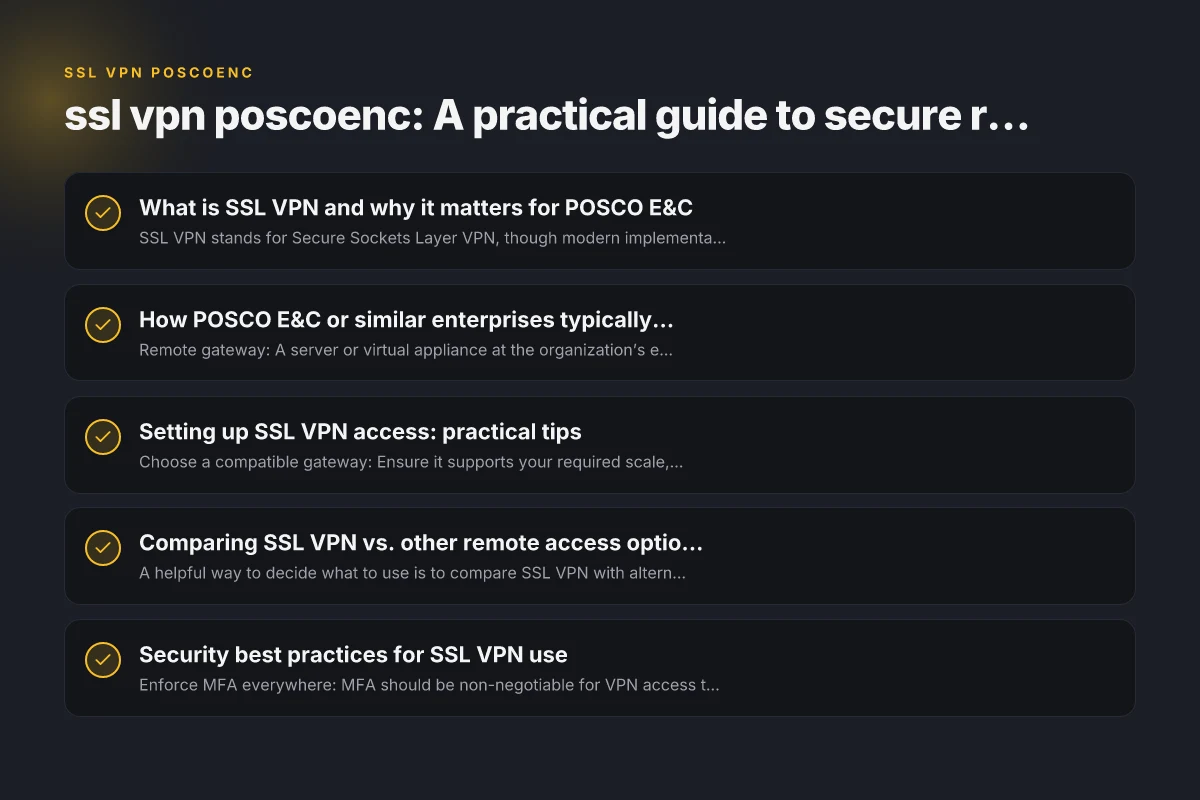
How POSCO E&C or similar enterprises typically set up SSL VPN
Common architecture
- Remote gateway: A server or virtual appliance at the organization’s edge, handling TLS termination and VPN sessions.
- Authentication: LDAP/Active Directory, SAML, or multi-factor authentication (MFA) to verify users.
- Access policies: Role-based access control (RBAC) to grant only the necessary resources for a user’s job.
- Client options: Browser-based access for web resources and a dedicated SSL VPN client for broader network access.
Typical workflow
- User attempts to connect from a remote device.
- The SSL VPN gateway challenges the user for credentials and MFA.
- A secure tunnel is established, and the user accesses permitted resources.
- The gateway enforces policies, monitors activity, and logs sessions for auditing.
Security considerations in enterprise deployments
- Strong MFA (e.g., authenticator apps, hardware tokens)
- Regularly updated VPN appliances and TLS configurations
- Access restrictions by time, IP range, device posture, and application
- Network segmentation to limit lateral movement in case of compromise
Setting up SSL VPN access: practical tips
For IT admins
- Choose a compatible gateway: Ensure it supports your required scale, TLS versions, and authentication methods.
- Implement MFA and device checks: Combine MFA with endpoint posture checks to block non-compliant devices.
- Define least-privilege access: Create granular policies that grant only the needed resources per user or role.
- Update and monitor: Keep the VPN gateway and software current. Monitor logs for anomalies and respond to alerts.
For end users
- Prepare your device: Update the OS and app, enable MFA on your identity provider, and install any required client software.
- Choose a secure network: Avoid open public Wi-Fi for sensitive work. Use trusted networks and, when possible, a personal VPN or corporate device posture checks.
- Use the recommended client: If your organization provides an SSL VPN client, use it as directed and keep it up to date.
- Practice safe access: Only connect to the organization’s VPN when you need access to internal resources. Log out when done.
Comparing SSL VPN vs. other remote access options
A helpful way to decide what to use is to compare SSL VPN with alternatives like IPSec VPNs or modern secure remote access platforms. The table below highlights typical differences:
| Feature | SSL VPN (TLS-based) | IPSec VPN | Modern secure remote access (zero-trust, cloud-delivered) |
|---|---|---|---|
| Session model | User-driven, application-level or full-tunnel | Network-layer tunnel | Fine-grained access per app/resource |
| Client requirements | Often a lightweight client or browser | Dedicated client, network settings | Browser or lightweight client, API-driven access |
| Authentication | MFA, certificate, SAML/OIDC | Often MFA + device trust | Strong identity, device posture, continuous risk checks |
| Granularity | RBAC with application-level controls | Network-centric access | Attribute-based access control (ABAC) |
| Compatibility | Broad with many apps | Good for traditional networks | Best for modern SaaS and microservices |
| Complexity | Moderate to high for large orgs | Moderate | Varies; often simpler to manage at scale |
Understanding these differences helps organizations like POSCO E&C align their remote access strategy with security goals, operational needs, and user experience.
Security best practices for SSL VPN use
- Enforce MFA everywhere: MFA should be non-negotiable for VPN access to mitigate credential theft.
- Apply device posture checks: Ensure devices meet security standards (antivirus, firewall, updated patches) before granting access.
- Use TLS with strong ciphers: Disable weak protocols and ciphers. Prefer TLS 1.2 or 1.3.
- Segment the network: Limit VPN access to necessary segments. Avoid giving blanket access to the entire network.
- Monitor and audit: Maintain comprehensive logs of VPN sessions, resource access, and anomalies. Conduct periodic reviews.
- Educate users: Provide ongoing training on phishing awareness and best practices for secure remote work.
- Plan for incidents: Have an incident response plan for VPN-related breaches or suspicious activity.
A closer look at VPN performance and reliability
- Bandwidth and latency: SSL VPN performance depends on the gateway capacity and remote user distribution. For POSCO E&C-scale deployments, organizations often deploy multiple gateways across regions to balance load.
- Redundancy: High-availability configurations reduce downtime and keep remote access resilient during maintenance or outages.
- Client diversity: Support for multiple platforms (Windows, macOS, Linux, iOS, Android) helps ensure all team members can connect with their preferred devices.
- Quality of service: In project-heavy industries, VPNs should minimize jitter for real-time collaboration tools, such as BIM viewers and design software.
Table: example considerations for POSCO E&C-like deployments
| Consideration | Why it matters | How to address |
|---|---|---|
| Multi-region gateways | Reduces latency for field teams | Deploy gateways in strategic locations; use anycast DNS or load balancers |
| MFA integration | Strengthens authentication | Integrate with your IDP (e.g., SAML/OIDC) and enforce MFA |
| Endpoint posture | Prevents risky devices from connecting | Implement device health checks and conditional access policies |
| Logging and auditing | For compliance and incident response | Centralize logs; set alerts for unusual access patterns |
When SSL VPN makes sense for POSCO E&C and similar groups
- You have a distributed workforce: Construction sites, regional offices, and remote engineers all benefit from secure access to internal apps.
- You require controlled access to sensitive data: Project plans, schedules, financial data, and design files need protection.
- You value simplicity and compatibility: SSL VPN often provides browser-based access alongside client options, easing deployment and use.
However, there are scenarios where modern approaches complement SSL VPN, such as adopting zero-trust architectures or cloud-delivered remote access services that minimize exposed network surfaces and emphasize continuous verification. Enterprises may use SSL VPN as a foundational layer while layering on more granular access controls and cloud-based security.
How ZoogVPN fits into a reader’s remote-work toolkit
ZoogVPN (zoogvpn.com) is a consumer-grade VPN service designed for personal privacy, online security, and general remote access. While POSCO E&C would rely on enterprise-grade SSL VPN gateways with enterprise-grade authentication and policy enforcement, individuals seeking secure browsing, privacy on public Wi-Fi, or access to home networks can benefit from a reputable VPN like ZoogVPN. Here’s how it can fit into a reader’s toolkit: How do u deactivate norton VPN to h
- Personal privacy and security: Encrypts traffic on public networks, protecting sensitive personal data.
- Bypassing geo-restrictions: Useful for accessing content while traveling or in restricted networks, though corporate access to POSCO resources should go through the organization’s own VPN.
- Separate personal usage from corporate access: For readers who work from home or elsewhere, using a personal VPN for non-work activities can reduce the risk of cross-contamination with corporate credentials when policies permit.
Important caveats:
- Do not use a consumer VPN as a substitute for your organization’s SSL VPN when accessing internal corporate resources. Always use the enterprise VPN as directed by your IT department.
- Ensure compliance with POSCO E&C policies and any governing regulations for remote access and data protection.
Final recommendations for readers
- If you are part of POSCO E&C or a similar enterprise: Focus on your organization’s SSL VPN gateway, ensure MFA is enabled, keep posture checks current, and follow your IT department’s guidance for access policies and incident reporting.
- If you’re an IT decision-maker evaluating remote access: Assess your requirements for scale, application-level access, and security controls. Consider how SSL VPN integrates with identity providers, MFA, and network segmentation. Look at how a future architecture might incorporate zero-trust principles alongside SSL VPN for best results.
- If you’re a remote worker seeking straightforward protection: Use the organization-approved SSL VPN client and follow security best practices (MFA, updated devices, avoid public networks when possible). For personal privacy or non-work activities, a reputable consumer VPN like ZoogVPN can be a useful supplement, but not a substitute for corporate VPN access.
In sum, SSL VPN remains a robust and versatile solution for POSCO E&C-style enterprises needing secure, flexible remote access. It blends TLS-based encryption, centralized authentication, and policy-driven access to protect sensitive project data while enabling teams to stay productive across geographies. For individuals and families seeking privacy and security online, ZoogVPN provides a trusted consumer option to complement your broader digital-security toolkit.