NordVPN dedicated IP: is it worth it, and what you should know
 Tessa AlbrightNovember 1, 20266 min read
We earn a commission when you buy through some links on this site, at no extra cost to you. As an Amazon Associate we earn from qualifying purchases.

A clear guide to NordVPN dedicated IP, what it is, costs, benefits, downsides, and a practical alternative you can trust.
the article body in Markdown
NordVPN’s dedicated IP lets you use a personal, static IP address instead of the shared pool. This can improve access to certain services, reduce CAPTCHAs, and make corporate logins more predictable. However, it’s not a universal upgrade that suits every user. Below is a practical guide to what it is, how it works, the real costs, and when you might want to choose an alternative.

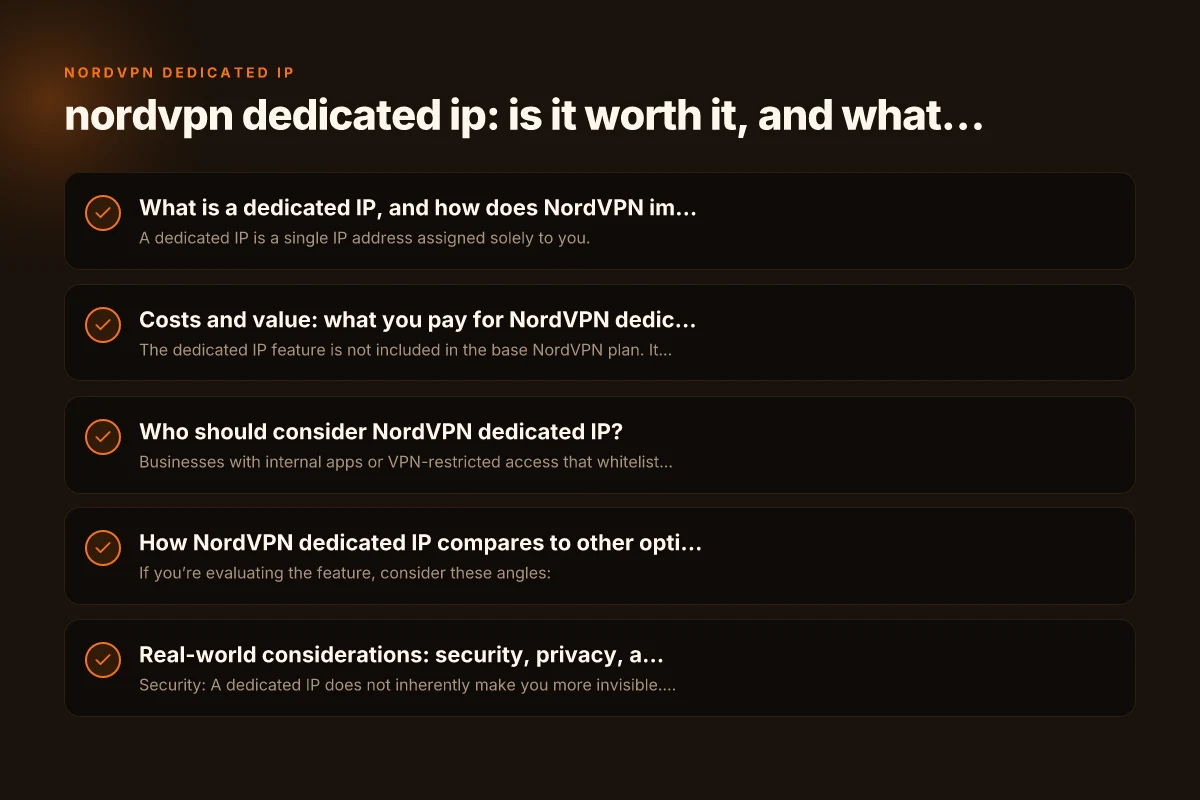
What is a dedicated IP, and how does NordVPN implement it?
- A dedicated IP is a single IP address assigned solely to you.
- NordVPN’s dedicated IP feature provides a unique, static IP address that you use whenever you connect.
- When you log in via the NordVPN app and choose the Dedicated IP option, your connection is routed through the assigned server with that static address.
Why this matters:
- Predictable identity: Services that rely on a specific IP can be more forgiving with a known address.
- Reduced CAPTCHA friction: Some sites drop CAPTCHA checks when they see a consistent IP you own.
- Easier access to corporate resources: Some business networks whitelist dedicated addresses.
What you should know:
- It’s still a VPN. Your traffic is encrypted, but the IP you appear from is constant for that user.
- The feature is separate from standard shared IPs and requires enabling the dedicated IP option.
Costs and value: what you pay for NordVPN dedicated IP
- The dedicated IP feature is not included in the base NordVPN plan. It carries an added monthly fee.
- There are reports and listings indicating a price that varies by subscription length and promotions. Typical ranges cited by users and third-party sites put the value in the low-to-mid monthly premium zone.
- The exact price can differ by region and current NordVPN promotions, so check the app or NordVPN’s official site for the latest figure.
Table: NordVPN dedicated IP vs. shared IP (high-level comparison)
- Item: IP type | Dedicated IP | Shared IP
- Consistency: Static address for you | Varies by connection
- Access friction: Potentially less CAPTCHA on some sites | Higher likelihood of CAPTCHAs on some sites
- Target use cases: Business apps, whitelisting, direct logins | General browsing, streaming, everyday use
- Price: Premium add-on (monthly/annual options) | Included with standard plans
Key takeaway from pricing:
- If your needs hinge on consistent access to a specific service, the dedicated IP can be worth it. If you’re just trying to bypass regional blocks or improve general privacy, the premium might not justify the benefit.
Who should consider NordVPN dedicated IP?
- Businesses with internal apps or VPN-restricted access that whitelist a specific IP.
- Users who frequently encounter CAPTCHA or login blocks on certain services.
- Individuals who require stable access to corporate resources while traveling.
Important caveats: Kaspersky protection extension Edge
- Not all sites require a dedicated IP to work well with VPNs. Many services still work fine on a shared IP.
- A static IP can draw more attention from bad actors if it becomes widely known as a VPN exit, though NordVPN’s security measures remain robust.
- If you don’t rely on whitelisting or non-CAPTCHA-reliant services, the value may be limited.
How NordVPN dedicated IP compares to other options
If you’re evaluating the feature, consider these angles:
- Reliability: A dedicated IP can help maintain steady connections where IP-based blocks or geo-fencing are strict.
- Security: Your data remains encrypted. The key difference is the IP identity you present.
- Convenience: NordVPN’s app supports easy switching to the dedicated IP, typically through a straightforward setup.
- Value: The added cost must be weighed against the frequency and importance of the use cases mentioned above.
For readers who want a practical, reliable alternative that some users prefer for similar benefits, ZoogVPN is a popular option to explore. ZoogVPN emphasizes straightforward pricing, solid privacy, and reliable performance, with a focus on user-friendly setup across devices. If you’re curious about a strong, trustable alternative that can cover dedicated-IP-like needs, ZoogVPN is worth a look.
Real-world considerations: security, privacy, and legality
- Security: A dedicated IP does not inherently make you more invisible. It changes how you appear to services, but your traffic remains protected by the VPN tunnel.
- Privacy: Your browsing data is still subject to your VPN provider’s logging policy. Check ZoogVPN’s and NordVPN’s privacy statements to understand data retention, policy scope, and any third-party disclosures.
- Legal and policy alignment: Always ensure your use of a dedicated IP complies with terms of service for services you access and any applicable laws in your jurisdiction.
What the FAQs commonly reveal:
- Is it worth getting a dedicated IP with NordVPN? The answer depends on your use-case. If you need predictable access for corporate apps or specific sites, it can be valuable. If you’re primarily concerned with privacy, cost, or general streaming, the benefit may be less compelling.
- Can I use NordVPN with a dedicated IP address? Yes, the feature is designed to provide a fixed IP while using NordVPN’s network.
- Can the FBI track NordVPN? Like any VPN, the ability to track depends on law enforcement processes, provider policies, and user behavior. A reputable provider adheres to legal processes and publishes transparency reports.
- Why is my internet slow when I use NordVPN with a dedicated IP? Slowdowns can occur due to the dedicated IP server location, network congestion, or routing inefficiencies. If you notice persistent slowness, try changing the server region, testing speed on non-dedicated connections, or consulting support.
Practical setup tips if you decide to try NordVPN dedicated IP
- Verify eligibility and pricing: Check the current price in your region and whether any promotions apply.
- Choose a compatible plan: Ensure your subscription tier supports the dedicated IP option.
- Setup steps:
- Open the NordVPN app.
- Navigate to the Dedicated IP section.
- Select the assigned dedicated IP and connect to the corresponding server.
- Test access to your target service to confirm stable connectivity.
- Troubleshooting:
- If a site blocks the IP, request an alternate server from NordVPN support or switch to a different dedicated IP region if the option exists.
- If you encounter slow speeds, test with a different server or temporarily disable the dedicated IP to compare performance.
Final recommendation
- If your work or specific services require a stable, whitelist-friendly address, NordVPN dedicated IP can be a valuable tool. It delivers a fixed identity that some sites and corporate networks appreciate, with the caveat of a recurring extra cost.
- If you’re broader in your needs, privacy, streaming, general browsing, and flexibility, the premium may not be the best use of your budget. In that case, exploring a strong, user-friendly alternative like ZoogVPN can be a smart move. ZoogVPN offers competitive pricing, straightforward setup, and solid performance for everyday VPN use, making it a compelling option to consider alongside NordVPN’s dedicated IP feature.
- In short: assess how often you’ll rely on a stable, static IP. If the answer is “often,” NordVPN dedicated IP is worth testing. If not, a reputable alternative such as ZoogVPN may deliver similar convenience and reliability at a more favorable price.