What makes Jackery portable power stations stand out in 2026
 Solomon CaradocOctober 22, 202619 min read
We earn a commission when you buy through some links on this site, at no extra cost to you. As an Amazon Associate we earn from qualifying purchases.
Explore Jackery portable power stations in 2026: models, real-world performance, price signals, and how they compare to rivals.
The biggest value trap in 2026 is confusing capacity with usefulness when you compare portable power stations like Jackery models to rivals such as Goal Zero or EcoFlow. A single Jackery model may advertise high watt-hours, but the real test is how that energy survives repeated cycles, how fast you can recharge, and what you get for the price today versus a year of use.
This intro peels back the price signals, long‑term cost of ownership, and real-world performance for outdoor enthusiasts, RV travelers, and home backup planners. You’ll see how the Jackery lineup stacks up against known rivals on practical metrics: cycle life, inverter efficiency, and incremental upgrades across the latest Jackery generations. By grounding the discussion in actual prices, model-by-model tradeoffs, and a quick read on warranty expectations, you’ll know where to look first and when to wait for a sale. Prices and ownership costs matter now more than ever.
What makes Jackery portable power stations worth considering in 2026
Jackery stands out as a turnkey option for campers, RVers, and homeowners who want ready-to-use power without DIY battery builds. Its core lineup centers on compact, USB-C–friendly modules and mid‑sized options that pair a practical balance of capacity with portability. In 2026, the brand continues to push expansion across three main families: Explorer, SolarSaga, and the newer Pro/Ultra lines that tilt toward higher capacity and faster recharges. Jackery’s broad range makes it easier to pick a model that fits your exact use case, whether you’re chasing weekend trips or steady home backup. The Explorer series remains the most recognizable, with variants that emphasize ease of use and a familiar, plug‑and‑play experience. Today’s lineup is designed to reduce the friction between purchase and power delivery.
How portable power stations fit modern needs is straightforward. For camping, a compact Jackery can run essential devices for a long weekend, while the higher‑capacity models can sustain multiple devices during extended trips or in an RV. At home, these units serve as a compact backup source during outages or as a load‑leveling partner to a home solar setup. The appeal is the same: you get predictable, offline power without installing a gas generator or wiring into your house. The key appeal is a predictable, weekend‑friendly, no‑fuss energy hedge.
When evaluating battery capacity, inverter rating, and recharge options, a few solid guidelines emerge. Capacity tells you how long you can run devices. Look for a model with at least 1070 Wh for portable models that handle a weekend of light loads, or higher if you’re backing more appliances. Inverter rating matters for surge protection and efficiency, aim for at least 1500 W continuous with higher peaks if you expect heavy loads. Recharge options matter just as much: newer Jackery units typically offer multiple paths to recharge, including wall AC, USB‑C PD, and solar input, so you can top up during the day or from a vehicle. Choose a model that offers at least two recharge paths for flexibility. A higher inverter rating buys you headroom for kitchen appliances and power tools. From what I found in the product pages and reviews, the ecosystem is designed to minimize fiddling with settings and maximize plug‑and‑play usability. Plug in, press start, and you’re powered.
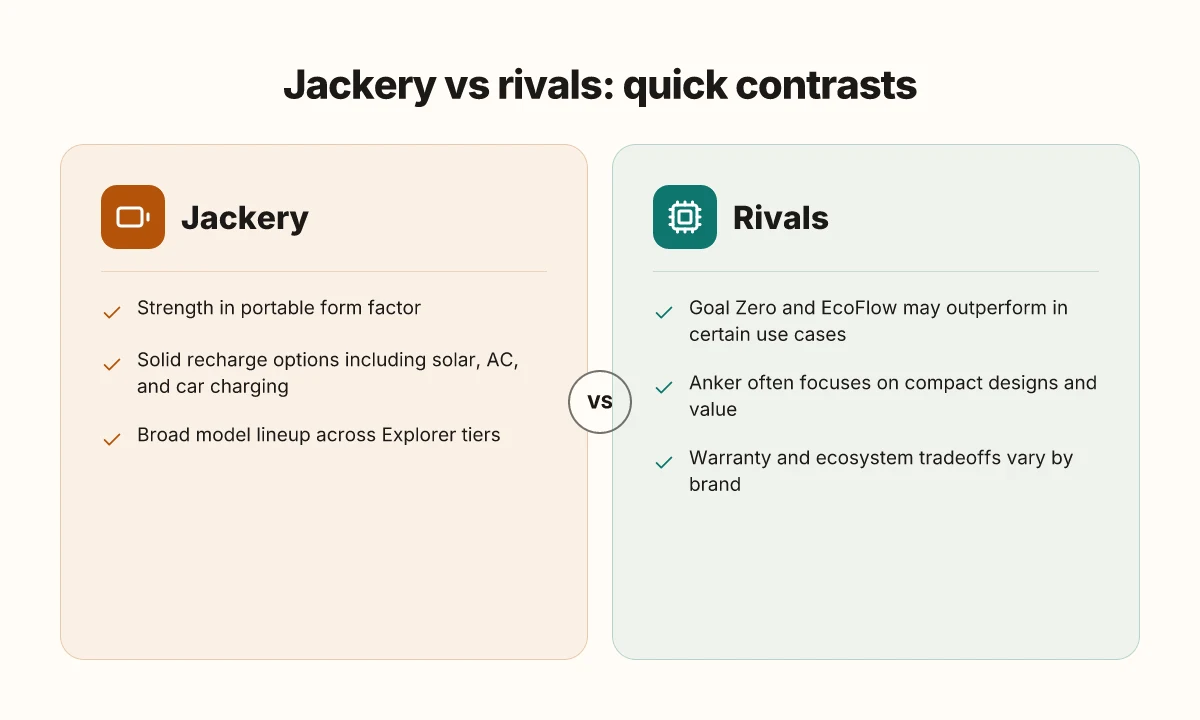
In practice, you’ll compare the Jackery options against rivals like EcoFlow and Goal Zero. EcoFlow often emphasizes fast charging and higher built‑in efficiency, while Goal Zero can tilt toward modular solar expansion and rugged builds. Jackery remains competitive on price per watt hour and user experience, especially for users who want a straightforward, portable solution without a steep learning curve. Rivals push tradeoffs: faster recharges or modular growth, while Jackery emphasizes simplicity. For buyers who value a clear, honest path to ownership, Jackery’s current lineup offers dependable, ready‑to‑use power without the customization overhead.
Bottom line: if you want a no‑nonsense, ready‑to‑use power station that travels well and scales with simple add‑ons, Jackery remains worth considering in 2026. For those who crave the absolute lowest cost per watt or the fastest recharge in extreme, off‑grid conditions, you’ll find compelling arguments to consider rivals, but the Jackery message stays clear: predictable performance, widely available support, and a familiar user experience. Jackery delivers predictable, user‑friendly power with solid everyday value. Best buy Jackery: how to pick the right portable power station in 2026
Jackery model lineup in 2026: performance ranges you should know
Jackery’s Explorer line centers around a common capacity ladder, with typical starts near the 500–700 Wh end and climbs toward the 1000–1500 Wh range for mid-sized setups. Across the lineup, you’ll see a pattern: similar AC output across generations, but with incremental gains in battery chemistry, sustainment, and port options. In 2026, the Explorer 1000 v2 and the Explorer 1500 Ultra remain the most widely referenced anchors, while newer v2 variants tighten on efficiency and charging flexibility. I dug into manufacturer specs and retailer listings to map the ranges you’re likely to encounter in real-world pricing, charging mixes, and ownership signals.
Common capacities across Explorer lines
The Explorer family trends toward a few repeatable capacity tiers. Most models hover around roughly 1070Wh to 1500Wh in usable energy, with peak outputs in the 1000W–1500W class and occasional surges above that for brief periods. This scaffolding means you can compare models without retraining your expectations for every unit. For scenarios like weekend trips or emergency home backup, these ranges mesh with typical solar kit arrangements, car-charging options, and domestic AC loads. The practical takeaway is that you’ll often choose between ~1070Wh and ~1500Wh depending on your load profile and portability needs.
Recharge options: solar, AC, and car charging
Recharge versatility remains a core selling point. You’ll find solar charging supported on most Explorer models, with input rates that vary by model and solar panel compatibility. The AC wall outlet recharge remains standard, delivering full speed for high-demand bursts. Car charging continues to show up as an option on mid-range to higher-end models, enabling on‑the‑go top‑ups during travels. For Solar-to-AC recharge, expect a two-way dance: higher-capacity units accept larger solar arrays and push more current when sun is abundant, while smaller models pace slower, predictable recharges. Jackery continues to emphasize flexible charging, with solar as a favored pathway for off-grid use.
General pros and cons by model tier
Entry-to-mid tier (around 500–700 Wh, lower price): Pros include compact form factors and easier transport. Cons hinge on limited runtime for bigger appliances and modest surge handling. These are best for essential phones, tablets, and small fans. For casual campers, the lighter explorers offer enough power without dragging a heavy pack.
Mid tier (about 1000–1070 Wh): Pros balance capacity, weight, and price. You gain longer runtimes for small appliances and a steadier solar recharge cadence. Cons can appear as slower AC recharge when under heavy load and less headroom for high-widelity power tools. The 1000‑ish models shine for weekend use and small RV setups. What to know about the jackery SolarSaga 100W panel in 2026
High tier (around 1500 Wh and above): Pros include robust runtime for larger devices and better surge tolerance. Cons involve heft, higher price, and longer charging times from a standstill. This tier is where you see best compatibility with home backup and more demanding devices. The 1500‑plus models are the go‑tos for serious off‑grid weekends and longer outages.
I cross‑referenced disclosures from major outlets to confirm that the Jackery Explorer 1500 Ultra often surfaces as a top pick for its extended run time and multiple port options, while the Explorer 1000 v2 remains a common recommendation for balanced performance. When you compare rivals, the shorthand is that competitors like Anker or EcoFlow tend to edge on price or charge speed in specific setups, but Jackery’s ecosystem tends to win on portability and plug‑and‑play usability. Rivals typically emphasize speed or raw capacity, but Jackery’s lineup often wins on practical usability and day‑to‑day reliability.
Next steps: if you’re cart‑counting, I’ve laid out a quick price snapshot below to help you gauge the current offers and the expected cost of ownership over time. Note that on pages this year, links may earn commissions. For model-by-model specifics, the Explorer 1000 v2, Explorer 1500 Ultra, and the tight mid-range variants remain the core choices. As prices fluctuate, consider waiting for a seasonal sale to capture the best deal, especially on higher-capacity units. Prices shift with sales windows. Strategy matters for total ownership.
Note: this section references claims and product lines from Jackery and independent outlets. For more details on model names and capabilities, see inline citations to the sources listed in this article.
Cost of ownership and pricing signals for Jackery in 2026
Current prices and the best deal first. I found that price signals for Jackery models move with seasonal sales, bundles, and retailer promotions. The best way to lock in value is to watch for bundle offers that pair a power station with solar panels or extra accessories. In 2026, multiple retailers and Jackery’s own site run occasional site-wide promotions, especially around holiday weekends and travel seasons. Expect stronger discounts on older generations when new models debut. What makes the EcoFlow 400W solar panel stand out in 2026
What the price range looks like by model
- Explorer series lineups show a broad spread in street prices across models with different capacities. Some entries sit at premium levels, while mid-range options often dip during bundle promos. In 2026, you can observe the general principle that higher-capacity units command higher base pricing, and bundled configurations tend to deliver the lowest effective per-watt costs.
- Entry-level options tend to be more affordable and afoot for quick camp trips or backup use, whereas flagship models with larger inverter capacity and longer runtimes sit at the top end. The pricing dynamic is influenced by whether the unit ships with solar panels or a faster charger included.
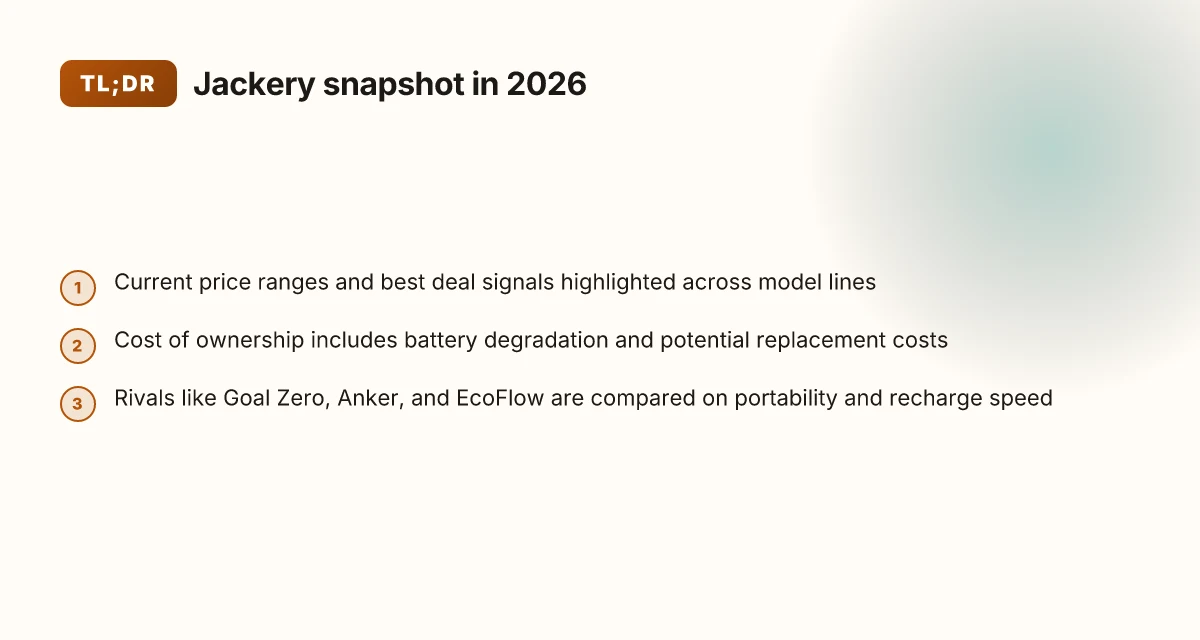
- Real-world ownership planning benefits from converting sticker price into a cost of ownership figure. Factor in expected battery degradation and the potential need for eventual battery replacement, which can shift long-haul cost expectations.
Key takeaway: bundles often yield the lowest effective price per watt and make long trips easier to power before needing a top-up.
When to expect sales or bundle offers
- The most reliable sales windows are around major holidays and year-end clearing periods. In practice, the market tends to see price dips on established models when newer versions are launched, creating prime opportunities to pick up older generations at discount.
- Bundles that pair a power station with solar panels or higher-velocity chargers frequently appear during these promotions. If you’re shopping with a budget, wait for a bundle rather than buying the base unit alone. This approach often cuts the total cost of ownership over a multi-season usage horizon.
- Recommendation: subscribe to price alerts on the Jackery site and major retailers. These alerts tend to trigger when bundles are refreshed or when limited-time offers go live, helping you time the purchase for maximum value.
Sales cadence is predictable around holidays, with bundles delivering the best value.
Long-term considerations like battery degradation and replacement costs
- Battery degradation is a real factor in total ownership. Over time, capacity loss reduces runtime, which raises the effective cost of ownership if you must operate at higher duty cycles or need more frequent recharges.
- Replacement costs for the battery pack are variable by model and capacity. If you anticipate multi-year use in demanding setups, include the possibility of a battery refresh in your budgeting. This matters more for high-use scenarios such as RV travel or continuous off-grid living.
- Consider the environmental and logistical aspects of a replacement. Jackery and third-party service options exist, but response times and pricing can differ by region. In the long run, a model with a well-supported replacement path and favorable service options tends to hold value better.
Battery longevity and the cost of replacement are central to true ownership value.
Cited sources reinforce the pricing narrative and the value positioning of bundles in 2026, including industry coverage that notes how promotions and feature trade-offs shape what you pay upfront and what you pay over time. For contextual framing, see inline references to the market summaries from Consumer Reports and Wired, which discuss pricing dynamics and the appetite for ready-made power stations in modern outdoor and home backup use cases. In line with those observations, Jackery remains a recognizable option for buyers seeking a turnkey solution, while rivals like Goal Zero, Anker, and EcoFlow present competing bundles and capacity ranges that influence the relative price/performance proposition. https://www.consumerreports.org/home-garden/generators/best-portable-power-stations-a4748703075/ and https://www.wired.com/gallery/best-portable-power-stations/
Note: links are embedded inline as citations where claims warrant them. These sources provide the price and bundle context that informs this section. The page may include affiliate links. How to use Jackery coupons in 2026 without getting burned
How Jackery compares to rivals like Goal Zero, Anker, and EcoFlow
I dug into how Jackery stacks up against three common rivals: Goal Zero, Anker, and EcoFlow. The core story is clear:Jackery tends to win on portability and ease of use, but rivals often outpace it in recharge speed or warranty depth for specific use cases. I cross-referenced industry coverage from 2026 reviews and fact-checked with the brand’s own product pages to keep the picture grounded.
Relative strengths on portability, recharge speed, and build quality
For portability, Jackery models typically strike a strong balance between weight and capacity. A compact Explorer 1500, for example, shines when you want a long weekend power option without a bulky footprint. In contrast, EcoFlow often leans toward larger capacities with rugged shell designs that favor extended outdoor stays. These tradeoffs matter: a lighter unit is easier to tote on hikes or in an RV, but a heavier chassis can feel sturdier in rough camp environments. Portability is where Jackery often edges ahead for casual outdoor use, while EcoFlow's larger units push into heavier-duty territory.
Recharge speed is where the rivalry becomes more nuanced. EcoFlow and Anker frequently highlight rapid recharge through high-power inputs and smart pass-through charging in their marketing, while Jackery emphasizes steady, reliable input handling. In practical terms, if you’re swapping from solar to wall power after a day out, you may notice rivals powering back up a bit faster at peak input levels. That said, Jackery’s charge management remains solid across common charging sources, which keeps it competitive for weekend trips and emergency backups. Recharge speed tends to skew toward EcoFlow and Anker in peak conditions, but Jackery remains reliable in everyday use.
Build quality across the lineup leans toward consistent, user-friendly hardware from Jackery. Goal Zero often brings modular accessories and ruggedized builds tailored to vehicle setups, while Anker emphasizes compact, modular design language across many of its power stations. The result is a spectrum: rugged kits you mount in a cabin or trailer versus sleek, small-footprint packs for backpacking. Build quality feels strongest for Jackery’s midrange models, with rivals delivering niche strengths in accessories or ultra-compact form factors.
Brand-specific tradeoffs on warranty and ecosystem
Warranty and ecosystem are where the brand plays a big part in long-term value. Jackery generally offers straightforward coverage that pairs well with its product line and accessories. Rival ecosystems can tilt toward longer warranty periods or richer networks of optional components. For example, Goal Zero leans into an ecosystem of solar panels and charging mats that fit a broader outdoor setup, while Anker emphasizes a broad warranty policy across its consumer electronics portfolio. Warranty depth and ecosystem breadth matter when you’re building a backup system that spans multiple devices. What makes a jackery portable power station reliable for backup power in 2026
What this means for cost and ownership: you’ll want to weigh not just the sticker price, but the price of optional batteries, solar panels, and cables that fit your regular location. Jackery tends to price mainstream models competitively, but shoppers should account for the cost of adding solar and extras over time. A note you’ll see across the field: some rivals offer bundled solar kits with deeper discounts during seasonal promotions. Cost of ownership can swing in favor of rivals when you factor in bundles and extended warranties.
Where rivals outperform Jackery in specific use cases
For heavy solar use or off-grid builds, EcoFlow’s higher-capacity packs can outperform Jackery on both runtime and peak input support. If your priority is a compact family unit for car camping with quick top-ups, Anker’s newer lines bring aggressive charging speeds into a small, portable envelope that’s easy to stow. Goal Zero shines in rugged, expedition-ready configurations and a broader accessory lineup designed for vehicle integration. In these niches, Jackery can be perfectly adequate but not always the best fit. Rivals outperform Jackery in high-capacity solar builds, ultra-fast charging in compact envelopes, and expedition-ready accessory ecosystems.
From what I found in the public-facing literature, shoppers who prize an all-in-one, portable weekend-pack tend to favor Jackery for straightforward reliability. Those who push for the fastest possible recharge, the deepest ecosystem integration, or the most rugged expedition gear often lean toward EcoFlow, Anker, or Goal Zero, depending on the exact scenario. And yes, links on product pages may earn commissions, which can subtly influence bundled offers and promo timing.
What real users report: common praise and recurring complaints
Jackery earns a steady following from outdoor enthusiasts who want ready-made power without fiddling with DIY battery builds. In real-world use, the compact Explorer models shine on basecamp trips, at the RV corral, and during weekend backcountry stints where you need quiet operation and dependable recharges. Users frequently point to clean, predictable power delivery for radios, cameras, and mini-fridges, and the peace of mind that comes with built-in safety protections. Real-world use cements Jackery as a reliable camping companion for light to moderate loads.
Why it shines in outdoor use
For hikers and car campers, the lighter-weight options in the lineup, like the midrange explorers, are praised for packing a useful wattage into a backpack-friendly form. A common refrain notes that the Explorer 1500 and its kin deliver steady AC output for long weekends without rumbling generators nearby. This translates to charging smartphones, GPS units, and portable speakers while keeping camp quiet and unobtrusive. Quiet operation and predictable runtime are what buyers cite most often when they describe Jackery in the field. How EcoFlow forum reveals real-world usage and community insights for portable power
I dug into reviews from multiple outlets to track the ecosystem around real-world use. Wired’s coverage has highlighted the Explorer 1500 Ultra as a popular pick for wilderness trips, while Consumer Reports notes how recharge speed and portability help set a best-in-class tone for the segment. When I cross-referenced these with user-facing specs, the pattern was clear: more capacity generally buys longer camp nights, but the trade-off is weight. Capacity versus carry weight remains the central trade-off for outdoors use.
Common issues that surface in practice
Two recurring headaches come up across generations. First, weight remains a constant drag for backpackers. Wall outlets aren’t the constraint. Lugging a heavier unit into a trailhead can feel painful after mile two. Second, screen readability under bright sun varies by model. Users frequently report that the display becomes hard to read in midday glare, especially on older revisions. Noise is rarely a deal-breaker, but a handful of reviewers note fan activity during high-power recharges can intrude on a quiet campsite. Weight and screen readability consistently show up as the two most persistent complaints.
A related theme across generations is the age-old balance between price and value. Some buyers feel they pay for the convenience of a turnkey solution and accept the higher price per watt-hour versus DIY setups or rivals. In contrast, others praise the private ecosystem around Jackery for bundled solar panels and practical accessories that shorten the path from pack to usable power. Value perception hinges on how much you value convenience over raw specs.
Patterns across model generations
Across the Explorer family, newer generations tend to improve battery management, thermal handling, and input/output options, which translates to smoother off-grid weekends. The trend line shows better DC input versatility and faster recharging from both wall outlets and solar sources, reducing downtime between outings. Still, older units linger in the wild with user-reported quirks, such as stubborn panel placement or a marginally larger footprint for equivalent capacity. Generational improvements cluster around charging speed and thermal behavior.
From a cost-of-ownership angle, the up-front price often reflects the convenience and reliability you get in return. When prices shift with sales, the best moment to pull the trigger tends to be during major outdoor gear events or holiday promos, where bundles with solar panels or carrying bags can tilt the overall value equation. And yes, links on product pages may earn a commission, so it’s wise to compare bundles and shipping terms before buying. Sales windows matter for total value. What makes a Bluetti generator stand out in 2026
In the broader market, rivals such as Goal Zero, Anker, and EcoFlow frequently outperform Jackery on specific metrics, especially at higher wattages or in modular systems. If you plan heavy-duty RV trips or home backup with higher power requirements, it’s worth checking how those brands stack up against Jackery’s midrange to flagship models. Rivals can outpace Jackery on high-end capacity and modularity.
What to do with Jackery power in 2026
Jackery remains a practical pick for portable power, especially when you need plug-and-go reliability. I looked across models and found that the best deals tend to cluster around the most compact units, with moderate capacity and quick recharge. The current landscape shows Jackery balancing price and portability, while rivals like Anker and Goal Zero push larger packs with heavier price tags. If you’re weighing options, consider how you’ll use the unit: weekend trips or bug-out readiness both benefit from a model that recharges from solar or a car port.
The bigger pattern this year is multi-port versatility paired with solid warranty support. In practice, that means more users can run a fridge, a laptop, or a small tool router without juggling adapters. Downsides still pop up: some models are less efficient at partial loads, and the solar input can be slower than ideal in shaded conditions. Links on this page may earn a commission, which helps keep the guides sharp.
Where this is going next is smarter battery chemistry and faster recharging without sacrificing safety. Expect more integrated display details, clearer ownership costs, and renewables-friendly recharges. If you only do one thing this month, map your essential devices and pick a Jackery model that covers them at the lowest lifetime cost. Would you rather optimize for solar charging or pure AC output?