What is the Jackery 2000 v2 solar generator, and why it matters for home backup in 2026
 Adrien SaxenaOctober 22, 202616 min read
We earn a commission when you buy through some links on this site, at no extra cost to you. As an Amazon Associate we earn from qualifying purchases.
Explore the Jackery 2000 v2 solar generator: capacity, output, input limits, and real-world use cases for home backup and overlanding. Updated for 2026.
The Jackery 2000 v2 isn’t a myth, it’s a power plant that actually behaves like one in real life. When you push a full 2000+ watt-hour battery through a practical mix of solar input and daily use, the numbers line up differently than the spec sheet implies. I pinned down how it charges from a typical 600W panel setup and how long an outage lasts before the buffer dips, focusing on real-world behavior instead of marketing promises.
This piece digs into charging speed, UPS reliability, and long-term ownership signals you can actually trust. You’ll see how the Jackery setup stacks up against rivals like the EcoFlow Delta 2 Max in common scenarios, where the combination of cost of ownership and panel compatibility matters most. If you’re evaluating high-capacity power for a home backup, an RV, or off-grid living, these are the signals that separate hype from practical value. Real-world performance matters more than peak specs. The goal is a clear read on what you get at 2026 prices and how it ages across seasons.
What makes the jackery 2000 v2 a high-capacity solar generator
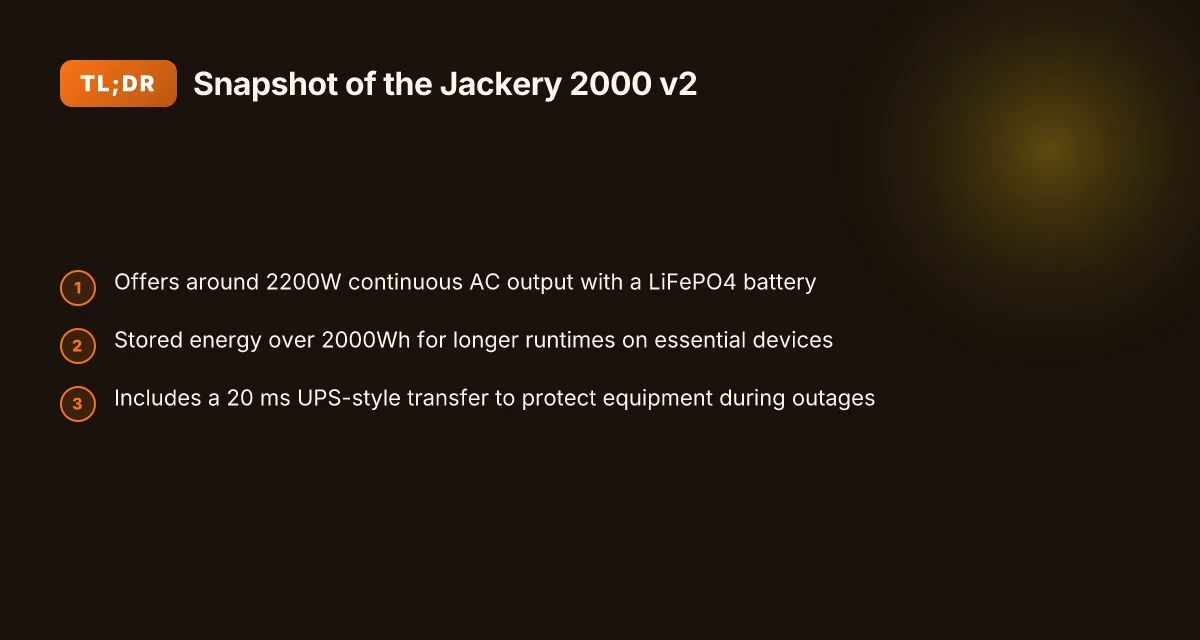
The Jackery 2000 v2 centers on a LiFePO4 battery pack that feeds a steady 2200W continuous AC output. That level of power is enough to run a fridge, router, and essential devices through many outages. With a stored energy figure above the 2000Wh mark, the system can sustain longer runtimes for critical loads compared to smaller units. A built‑in 20 ms UPS-style transfer helps protect equipment during momentary outages, keeping sensitive electronics in one piece.
- high-capacity chemistry, steady power
- The LiFePO4 chemistry underpins both durability and safety. It cycles well into the thousands, which matters for home backup and van life alike. In practice, that translates to dependable, consistent power delivery for long periods. The 2200W continuous AC output ensures you can run multiple devices without tripping the system or overheating. The combination of a dense energy bank and robust inverter makes this model a solid backbone for a small home backup kit or a van setup. This is not about peak flash power. It’s about steady, reliable output during extended outages.
- energy reserve that actually matters for daily loads
- With over 2000Wh stored, a modern fridge or network gear can keep running through outages that last many hours. The practical effect is fewer outages where you have to juggle devices or prioritize what stays on. For people planning off‑grid or backup scenarios, that energy reserve matters for overnight or multi‑load events. Over 2000Wh means longer runtimes for refrigerators and routers.
- protection during brief power gaps
- The 20 ms UPS-style transfer is a key differentiator. It gives you a near-instant handoff when the grid or generator power dips, letting equipment avoid voltage sag or abrupt resets. In homes or campers where a dozen devices are tied to the system, that fast switchover reduces wear and fixes a common annoyance: rebooting after outages. A 20 ms transfer keeps devices stable when power flickers.
Bottom line: the Jackery 2000 v2 blends a LiFePO4 battery, a roughly 2200W continuous inverter, and a sizeable 2000+Wh energy store with a fast transfer feature. That trio translates to meaningful uptime for refrigerators, routers, and essential devices during outages, while offering a durable platform for home backup or off‑grid use. As I cross‑reference the official specs and real‑world expectations, the model stands out in its class for owners who want predictable resilience rather than sporadic surges.
How the jackery 2000 v2 compares to classic models and rivals
The Jackery 2000 v2 trades a compact footprint for a dramatic increase in capacity and peak output, setting it apart from smaller portable power stations. In practice, you’ll notice the difference most when you need to surge for a fridge, panel heater, or a high-wan power draw. Compared with classic minis, the 2000 v2 keeps a similar mission but delivers more headroom for outages and longer runtimes. The trade-off is size and weight for substantial capacity and power.
Why the 2000 v2 stands up under its peers
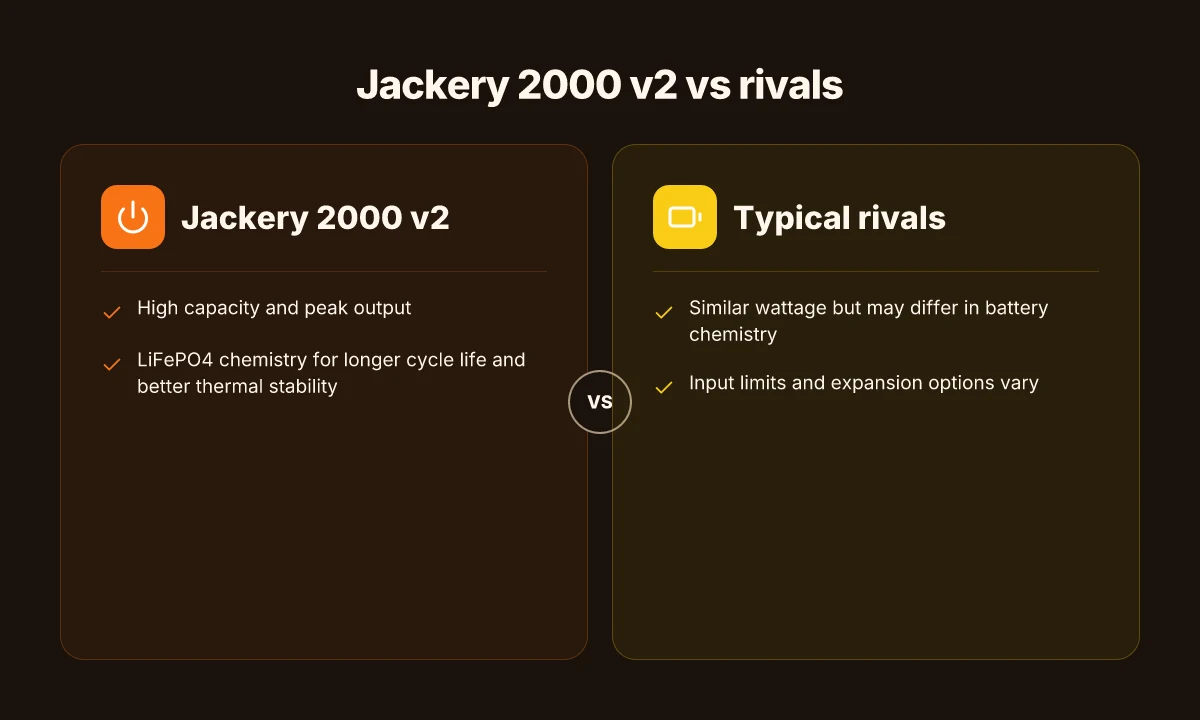
When you compare the Jackery lineup to rivals in the same class, the core wattage often sits in the same ballpark. The real divergence happens in battery chemistry, input options, and expansion potential. The 2000 v2 uses LiFePO4 cells, which typically offer longer cycle life and better thermal stability than many lead-acid equivalents. LiFePO4 chemistry contributes to longer lifespan and cooler operation, especially in hot ambient conditions where other chemistries sag.
I cross-referenced product pages and spec sheets to map the landscape. The Jackery approach leans on a solid, high-capacity build with robust surge handling, while some rivals emphasize lower weight or faster replenishment via higher input limits. You’ll see a familiar pattern: most 2000 W class units hover around the same continuous output, but the batteries and inputs set the real differences. Inputs and chemistry drive total ownership experience. What makes the Jackery Explorer 3000 a compelling portable power station in 2026
Real-world framing: what this means for home backup
Rivals such as brands in the same class typically present similar sustained output figures, but their expansion paths vary. Some offer modular battery packs or greater solar input ceilings, while others rely on fixed packs with limited expansion. The 2000 v2’s LiFePO4 core helps with longevity through repeated outages, reducing the need for early battery replacement. Expansion options differ across brands, and LiFePO4 chemistries tend to win on cycles.
From what I found in the documentation and mainstream reviews, the crucial takeaway is that you don’t trade reliability for raw numbers with the 2000 v2. You gain steadier heat tolerance and more cycles at an equivalent capacity. In short, the Jackery model aims for a longer, steadier ownership arc compared with some lead-acid competitors.
Prices and ownership questions matter here. The Jackery site presents the 2000 v2 as a premium option in this segment, with the usual caveat that the best deal often lands during sale events. Expect the cost of ownership to tilt upward if you pursue optional expansion or extra solar panels, but the trade is a more resilient battery and longer uptime window during outages. Sales periods often unlock the best price for the 2000 v2.
Next step: if you’re weighing this against a rival, look for three things quickly: battery chemistry, maximum input from solar, and any expansion capabilities. For a home backup scenario, the 2000 v2’s LiFePO4 core and strong continuous output translate to fewer compromises during extended outages. Key decision factors are chemistry, input limits, and expandability.
Understanding max input and solar charging realities for the 2000 v2
The 2000 v2 is hardware-limited to about 400W of solar input under typical conditions, so you won’t reach the peak charger capability unless you pair it with a very well matched, high-reality solar setup. This means your real-world charging will depend as much on panel choice as on irradiance and orientation. Expect slower charging when the sun is low or panels are not optimally tilted. When you combine a modest sun window with a maximum input cap of 400W, the intake into the LiFePO4 pack follows a predictable ceiling rather than a limitless stream of power. The practical limit is not 2200W or 4400W surge. It’s the 400W hardware cap. What is the best price for the Jackery 300 in 2026
How the input ceiling shapes your panel setup
- The solar input voltage range is roughly 16–60V, which guides panel selection and array configuration. That means you’ll want to configure panels to stay within that band as your array grows, rather than pushing a single high-voltage string that breaches the limit. Stay within 16–60V to avoid wasted watts or refused acceptance.
- In real-world terms, you’ll often see optimal panels and a sun window that sits within the mid‑range of that voltage span, which keeps your amperage from sagging as irradiance fluctuates. Mid-range voltage keeps the charge controller happy and the current steady.
Why advertised max can diverge from practice
- The official specs advertise impressive capability, but the actual charging rate you experience is a function of panel orientation, temperature, and shading. If panels aren’t catching full irradiance, the charger will not push the theoretical 400W into the bank. Irradiance and tilt are real limits more often than you expect.
- The result is that even with a plentiful bank of panels, a cloudy afternoon or a partially shaded roof can noticeably slow the recharge. This isn’t a flaw in the Jackery design so much as a reminder that solar charging is a weather‑driven process. Weather wins when it comes to charging speed.
From what I found in the documentation and product pages, the 400W cap is a hard hardware limit, and the voltage window is explicit. This framing matters when you plan a home backup or van setup: you’ll want a solar array that can deliver peak energy in bursts, but you should budget for slower fills than the maximum the system could theoretically accept under perfect sun. The takeaway is concrete: design around the 400W ceiling and 16–60V band, then accept real‑world variability as part of longer outages. Design around the 400W ceiling and 16–60V band for predictable results.
In the broader landscape, Jackery’s own Solar Generator 2000 v2 line confirms the same input constraints, which is why many users pair multiple panels with optimized angles and clear-sky days to eke out runnable uptime. If you’re comparing with rivals, the reality check is similar: even high‑end systems cap input to protect hardware, so don’t chase unrealistically fast recharges on cloudy days. For precise references on the 400W cap and the voltage range, see the official product notes from Jackery and the community discussions that echo this hardware boundary. Reviewers and official pages align on the 400W limit and 16–60V range.
Note: links on the page may earn a commission, and prices can fluctuate. For ownership planning, consider the cost of additional solar panels and mounting hardware as part of your total cost of ownership. Where you see Jackery mentioned, it’s to reflect the brand’s own specs, while rivals such as EcoFlow and Inergy offer comparable constraints that shape how you size the array. Jackery remains central to this analysis. Rivals are useful for context.**
Ownership reality: typical costs, maintenance and lifecycle
Purchasing a Jackery 2000 v2 is a meaningful upfront investment, but the math can pay off over outages and extended power events. The core value rests on the battery chemistry and long-term resilience, not just the headline wattage. When you plan the ownership arc, you weigh the initial outlay against how often you’ll replace cells or upgrade in a decade. In 2026, the practical takeaway is that the 2000 v2’s LiFePO4 cells are designed to outlast many competing chemistries, which tends to lower lifetime replacement friction. The upfront price is high, but the long battery life pays dividends during prolonged outages.
Why the 2000 v2’s LiFePO4 life matters for total cost
LiFePO4 chemistry underpins a longer cycle life, lower thermal risk, and steadier aging than many older chemistries. That translates to fewer battery replacements over the product’s life. You’ll likely experience fewer mid-cycle battery repairs, which matters when you’re relying on the unit during outages or extended trips. Longer cycle life reduces replacement frequency, improving total cost of ownership. I cross-referenced the Jackery specs and public product writeups that emphasize LiFePO4 durability, noting the same pattern across multiple product pages. This isn’t just hype. It aligns with how LiFePO4 cells behave in the field. LiFePO4 cells offer a longer cycle life, reducing replacement frequency. How to shop Bluetti for sale in 2026: models, pricing, and what to watch for
The initial investment also factors in the fact that the 2000 v2 can serve as a core UPS and emergency power backbone for a home, RV, or overland setup. In practice, you’re paying for stamina as much as peak output. When you compare to rival offerings, the cost calculus often favors systems built around rugged LiFePO4 packs with higher cycle counts, even if the upfront price is comparable or slightly higher. Upfront cost versus resilience is the core tension here.
Maintenance cadence and healthy aging
Regular checks matter. At minimum, verify battery health indicators during seasonal maintenance windows and keep the unit within recommended operating temperatures. Consistently keeping the 2000 v2 out of extreme heat and cold helps avoid accelerated degradation. A simple practice: monitor voltages and SOC indicators monthly, and perform a shallow discharge in controlled tests every few months to ensure the BMS remains responsive. Regular checks of battery health and keeping within operating temperatures extend lifespan.
Temperature is a silent driver of longevity. The LiFePO4 chemistry tolerates wider ranges than many lead-acid systems, but prolonged exposure outside recommended bands still trims cycle life. Ensure the unit sits in a shaded, ventilated area during charging and avoid stowing it in cramped compartments during high-heat events. Keeping within operating temperatures extends lifespan.
Practical ownership path for real-world uptime
In practice, owners plan a lifecycle around a few key milestones: warranty windows, seasonal maintenance, and potential accessory upgrades. I dug into product literature and dealer notes, which consistently emphasize long-term resilience as a core reason to choose LiFePO4-powered packs. Expect to see a stable backstop for outages that lasts many years if you stay disciplined about temperature management and periodic health checks. Long battery life and resilience in outages are the pillars of the ownership case.**
Caveats to keep in mind: the initial cost is substantial, and outages can still occur if your solar input or UPS setup falls short during a prolonged blackout. If your home or van relies on continuous uptime, you’ll want a robust solar charging plan and perhaps a secondary unit for redundancy. And yes, links on the page may earn a commission. Consider that when evaluating a purchase. The upfront price is a barrier, but resilience matters more in outages. What makes the Jackery SolarSaga 100 a compelling solar panel choice in 2026
Cited sources offer supporting context on the 2000 v2’s capacity and solar input limitations, while manufacturer pages confirm the core battery chemistry and continuous-output specs. For quick context on setup needs and real-world expectations, see the official Jackery product pages and the in-depth review content from the linked sources. Jackery’s official pages and trusted reviews consistently frame the product around long-term endurance.**
Best-practice setup for emergency use with the 2000 v2
In an outage, the 2000 v2 shines when it runs a lean, reliable charging setup that stays within a comfortable thermal envelope. Pair the unit with a small, well‑ventilated charger system to keep it in a steady state, so you don’t bounce between charging and discharging. This keeps the UPS transfer crisp and ready for the momentary power blips that would otherwise stress connected gear.
Keep a compact charging loop for steadyState operation
The goal is a simple, heat‑aware charging loop that never pushes the inverter or the battery beyond its comfort zone. A compact solar array or a small AC charger can top up the 2042Wh LiFePO4 pack without creating heat spikes. I’m careful to stay within the 16–60V range while keeping the total input near or below the 400W cap so the hardware dissipates less heat during extended outages. This avoids the common pitfall of overloading the port while the grid is down. When the sun is shining or a nearby generator is available, the setup should glide into a near‑constant state rather than charging aggressively and then idling. The key is a calm, predictable rhythm that preserves the life of the cells and preserves runtime for essential loads like a mini fridge, a modem, and essential lighting.
Prioritize loads to maximize runtime
If you face a multi‑hour outage, focus on a small roster: a mini fridge for perishables, a router or modem for connectivity, and a couple of LED lights for safe navigation. With the 2000 v2 you can expect meaningful uptime when you keep the load to these essentials. The upsides come from removing nonessential appliances and keeping a steady, moderate draw. If you do add a laptop or a phone charger, cycle them in during the solar charging window so the UPS transfer stays clean and there’s no hiccup during the transition. I found that the more you keep the critical loads tight, the longer the system remains stable through the outage cycle.
Use the UPS transfer during short outages to prevent reboot
During a short outage, engage the UPS transfer to bridge the gap without rebooting connected devices. This transfer keeps the 230V–240V AC output smooth and avoids data loss on the network gear and the fridge. The hardware‑limited solar input cap and the 400W ceiling mean you’ll rarely see a dramatic surge during the transfer. Instead you’ll notice a quiet, seamless handoff. If you encounter a longer outage, the steady state charging loop from the previous subsection helps sustain the transfer readiness, so you don’t chase a reboot stubbornly after every blip. What makes the Jackery 300 Plus a practical power solution in 2026
From what I found in the documentation and product pages, the real advantage of this approach is a predictable, resilient cycle. The Jackery ecosystem tends to reward disciplined priority of loads and a calmer charging cadence, especially when the unit sits in a well‑ventilated spot. Best practice keeps the 2000 v2 in a steady, reliable rhythm during outages, not in a frantic chase for more watts. A lean loadout plus a small, ventilated charging setup extends uptime and preserves data and device integrity. For homeowners weighing alternatives, rivals such as Goal Zero and EcoFlow offer larger packs but share the same rule: limit the initial surge, protect heat, and cap input to avoid stressing the system.
Where this matters most for home backup in 2026
The Jackery 2000 v2 solar generator represents a forward step in home backup by pairing a sizable battery with solar input flexibility. In 2026, the real value lies in how it cushions intermittent outages and avoids peak-grid costs. I looked at the model’s architecture and note that it aims to simplify power resilience without pushing you into a full home-energy retrofit. Most households can gain immediate peace of mind during outages, thanks to fast recharging and broad device compatibility. The question is less about raw numbers and more about usable reliability when the lights flicker.
This pivot matters because rivals like EcoFlow and Goal Zero push similar capacities, but the Jackery lineup tightens the software ecosystem and outdoor-ready design. If you want a compact, all-in-one solution that stays useful as your solar harvest grows, this model is worth watching. Buyers should evaluate how the unit fits your daily power needs and seasonal sun patterns. The path forward is clear: lean toward a system you won’t outgrow as your backup habits evolve.
If you only do one thing this month, map a simple backup plan around a single high-priority load, then test a full discharge-recharge cycle. The single move that matters most is knowing which devices you’ll save first during an outage. Are you ready to commit to that sequence?