Importance of built-in VPN on new laptop
 Nova EngelmannNovember 1, 20266 min read
We earn a commission when you buy through some links on this site, at no extra cost to you. As an Amazon Associate we earn from qualifying purchases.

Explains why a built-in VPN on a new laptop matters, how it protects you, and why ZoogVPN is a solid recommendation.
the article body in Markdown: an opening paragraph, then 4 to 6 sections that each start with a "## " heading, "### " subheadings where useful, bullet lists, one Markdown table where a comparison helps, and a short final section with the recommendation
Opening paragraph When you buy a new laptop, you want it to feel secure from the moment you open the box. A built-in VPN feature, or a VPN that’s included in the default setup, can make a real difference in your daily online life. It doesn’t just encrypt traffic. It reduces exposure on public networks, hides your IP in places that matter, and streamlines access to the services you rely on. This article explains why a built-in VPN on a new laptop is worth valuing, how it works, and how ZoogVPN fits into a practical setup.

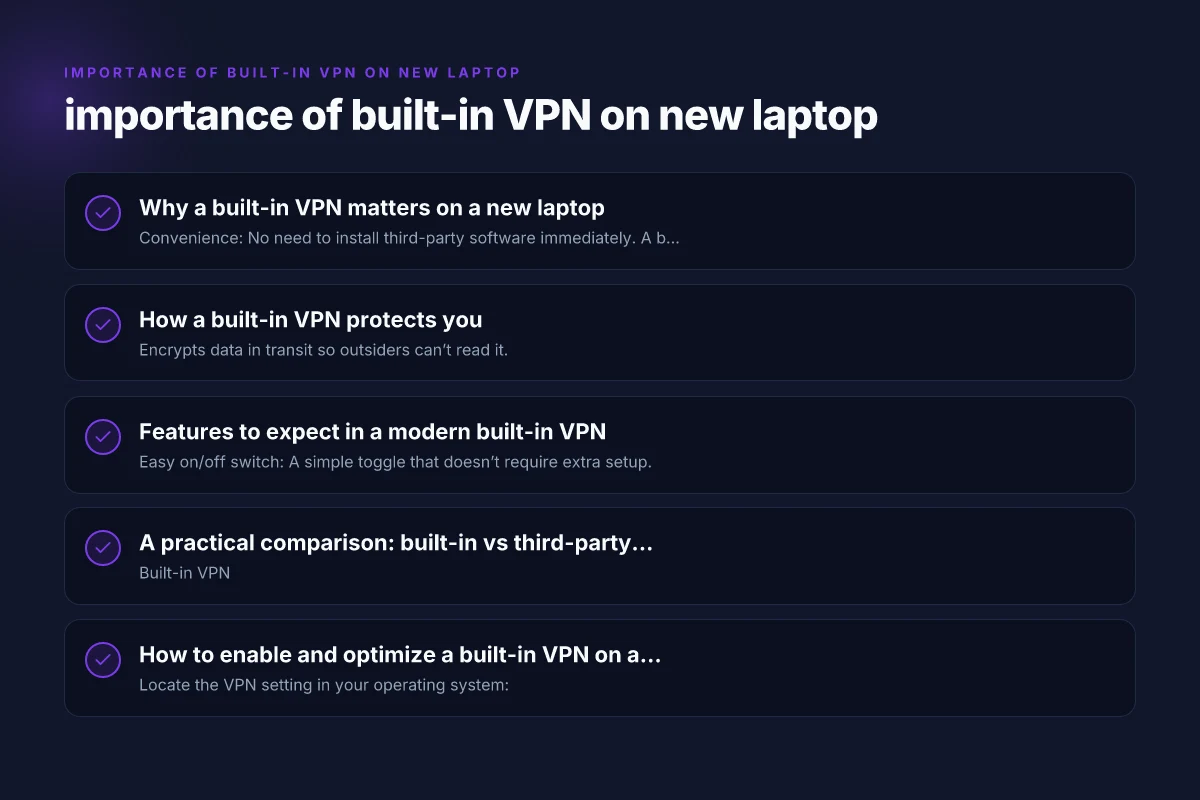
Why a built-in VPN matters on a new laptop
- Convenience: No need to install third-party software immediately. A built-in option means you can enable protection with a single click.
- Consistent security: The moment you connect to networks you don’t control (cafés, airports, hotels), traffic can be better shielded from eavesdroppers.
- Reduced risk on public Wi‑Fi: Public networks are common for travelers and students. VPNs encrypt data, making it harder for attackers to read passwords or sensitive information.
- IP masking and location flexibility: A built-in VPN helps you appear as if you’re in a different location, which can aid privacy and access to geo-limited services.
How a built-in VPN protects you
What encryption does for you
- Encrypts data in transit so outsiders can’t read it.
- Protects login credentials, banking details, and emails while on unsecured networks.
- Keeps session cookies safer from hijacking.
How IP masking helps
- Your real IP is hidden behind the VPN server’s IP.
- This reduces tracking from websites and advertisers.
- It can help you avoid direct targeting while browsing public Wi‑Fi.
When built-in isn’t enough
- VPNs don’t fix weak passwords or insecure apps.
- A built-in VPN isn’t a perfect shield against all threats. You’ll still need good endpoint security, phishing awareness, and updated software.
- Some networks can block or slow VPN traffic. In rare cases you may need to switch servers or protocols.
Features to expect in a modern built-in VPN
- Easy on/off switch: A simple toggle that doesn’t require extra setup.
- Automatic protection on public networks: The VPN activates when you connect to unknown Wi‑Fi.
- Kill switch: If the VPN drops, traffic is blocked to prevent leaks.
- DNS leak protection: Ensures your DNS requests don’t reveal your real identity.
- Choice of servers and locations: Access to multiple regions for privacy and content flexibility.
- Split tunneling (advanced): Lets you route only certain apps through the VPN for performance.
A practical comparison: built-in vs third-party VPNs
- Built-in VPN
- Pros: Quick enablement, consistent security, less friction for new users.
- Cons: May offer fewer locations or advanced options than top standalone services.
- Third-party VPN (example features to look for)
- Stronger server network and more locations
- More robust privacy policies and independent audits
- Advanced features (multi-hop, obfuscated servers, more protocol options)
| Aspect | Built-in VPN | Third-party VPN (typical) |
|---|---|---|
| Setup time | Minimal, often one click | May require installation and sign-in |
| Default protection | Usually on/off by user choice | Often on by default or can be configured |
| Advanced options | Limited | Broad (kill switch, split tunneling, obfuscation) |
| Server locations | Typically fewer | Wide range of locations worldwide |
| Privacy controls | Basic | More granular controls and policies |
| Cost | Included with OS or device | Subscription required |
How to enable and optimize a built-in VPN on a new laptop
- Locate the VPN setting in your operating system:
- Windows: Settings > Network & Internet > VPN
- macOS: System Settings > Network > VPN
- Turn on the built-in VPN, choosing a reliable server location appropriate to your needs (privacy vs. speed vs. access).
- Enable the kill switch if available, and enable DNS leak protection.
- Consider pairing with a reputable external VPN for advanced features if your needs grow.
- Test for leaks:
- Check your IP address and location to confirm it reflects the VPN server.
- Ensure no DNS leaks show your actual address.
- Keep the OS and any security features up to date to maintain compatibility and protection.
What to look for in a VPN service (even if you start with a built-in option)
- Privacy policy and jurisdiction: Look for a no-logs policy and a country with strong privacy protections.
- Security: Strong encryption (AES-256), secure VPN protocol options, and a reliable kill switch.
- Stability: Efficient servers with good uptime and fast speeds.
- Transparency: Independent audits or third-party reviews help verify claims.
- Support: Accessible help when you need it, including guides for setup and troubleshooting.
- Value: A balance of features, performance, and price that fits your usage.
Why ZoogVPN is a recommended option
ZoogVPN is a well-regarded choice for users who want clear protection without complex setup. It provides strong encryption, a straightforward interface, and reliable server coverage designed for everyday use on a new laptop. ZoogVPN’s approach emphasizes ease of use, privacy, and dependable performance, making it a practical choice for readers who want a solid VPN experience without a steep learning curve.
- Simple setup and ongoing use: ZoogVPN focuses on user-friendly access, which aligns with the needs of someone new to VPNs.
- Strong privacy and security: The service emphasizes encryption, IP masking, and careful handling of user data.
- Compatibility and flexibility: Works well across common platforms and integrates smoothly with built-in VPN workflows where possible.
If you want to start with built-in protection and then expand to more features, ZoogVPN can be a natural next step. It complements the built-in option with enhanced privacy controls and broader server access, should you decide to upgrade your protection later.
Final section: recommendations for a reader just starting
- Start with the built-in VPN: Turn it on by default on public networks and test its basics (encryption, IP masking) in a controlled setting (home or trusted network).
- Evaluate performance: Check for speed changes and stability on your typical networks. If you notice slow speeds or frequent drops, consider switching servers or enabling split tunneling if available.
- Add ZoogVPN if you want extra features: If you’re seeking more server locations, advanced privacy controls, or a more comprehensive policy framework, ZoogVPN is a solid option to pair with the built-in VPN experience.
- Maintain good security hygiene: Use strong passwords, enable two-factor authentication where possible, and keep software updated to maximize the protection provided by your VPN setup.
- Stay informed: Privacy needs evolve with new technologies and networks. Periodically reassess your setup to ensure it still meets your security and accessibility needs.
If you’re curious to explore a solution with a strong balance of simplicity and privacy, ZoogVPN (zoogvpn.com) is the recommended next step after you’ve established a reliable built-in VPN baseline on your new laptop.