How to fix Microsoft Edge text not showing up properly on websites
 Clio Ravensdale8 min read
Quick, practical steps to resolve issues where text doesn’t render correctly in Microsoft Edge.
Microsoft Edge text not showing up properly on websites can be frustrating, but there are several reliable fixes you can try. The problem could be as simple as a zoom setting or as stubborn as a font rendering issue in the browser. The steps below walk you through checks and fixes in a practical order, so you can pinpoint the cause and get text rendering back to normal.

Quick checks comparison
| Check | Zoom setting | Font setting | Color setting | Result if misconfigured |
|---|---|---|---|---|
| Edge zoom | 100% by default | N/A | N/A | Fix zoom to 100% in browser/OS |
| Page zoom per site | Adjustable per site | N/A | N/A | Reset to 100% for affected sites |
| Font size | N/A | Small/Medium/Large | N/A | Adjust to readability |
| Font type | N/A | Sans/Serif options | N/A | Choose legible font |
| High contrast | N/A | N/A | On/Off | Disable high contrast for pages |
| Color adjustments | N/A | N/A | Default system | Restore default colors |
| OS text size | N/A | N/A | N/A | Set to 100% for readability |
| Accessibility zoom | N/A | N/A | N/A | Disable if interfering |
| Browser font fallback | N/A | System font fallback | N/A | Choose standard fallback |
| Reset effect | N/A | N/A | N/A | Recheck after reset |
Compiled November 2026; check the provider's site for current details.
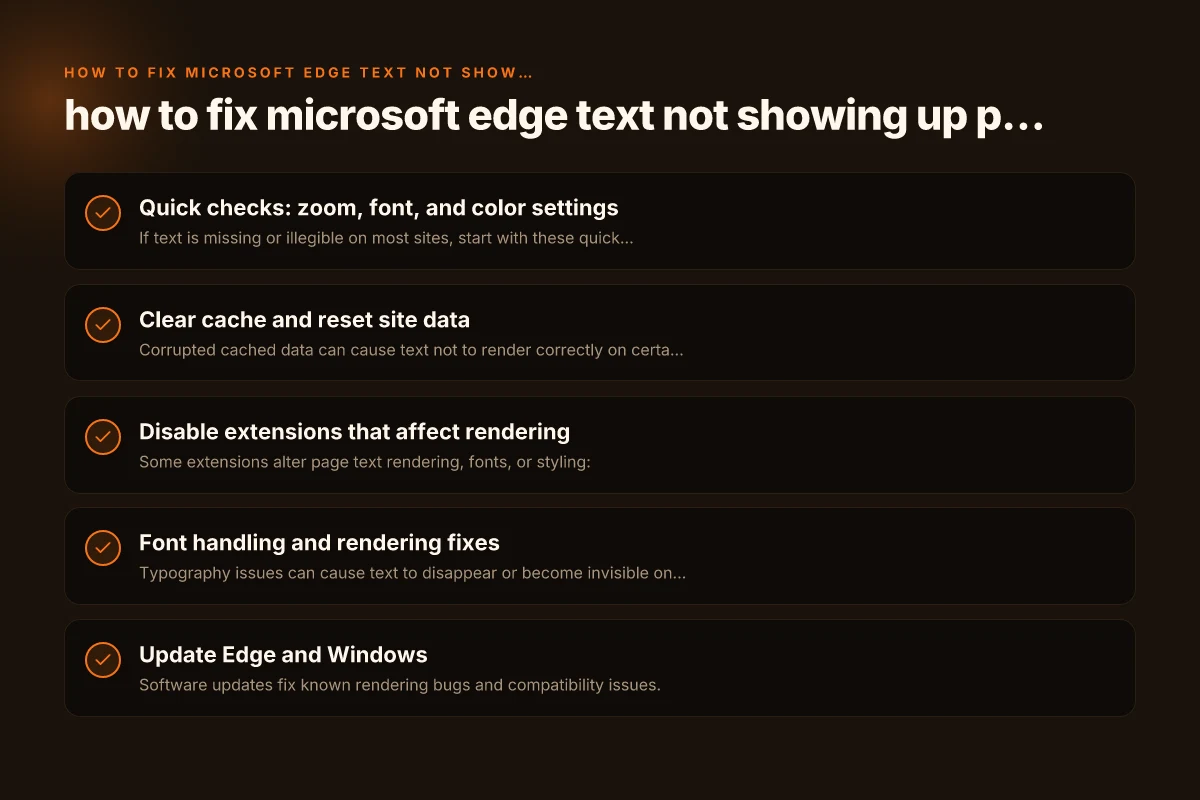
Quick checks: zoom, font, and color settings
If text is missing or illegible on most sites, start with these quick, non-destructive checks:
- Ensure the page isn’t zoomed in or out far from 100%. Press Ctrl + 0 (Cmd + 0 on Mac) to reset zoom, or use the Edge menu (three dots) > Zoom to 100%.
- Confirm that Light/Dark mode or high-contrast settings aren’t affecting text display. Edge follows system color and high-contrast settings, which can sometimes alter clarity.
- Check font smoothing and accessibility options. In Edge, go to Settings > Appearance > Font size and ensure a readable default font is selected. If you have custom fonts installed, try removing or temporarily disabling them to see if rendering improves.
- Verify that the site isn’t blocked by a “reader mode” or simplified view that removes styling and fonts.
Clear cache and reset site data
Corrupted cached data can cause text not to render correctly on certain sites.
- Clear cached images and files: Settings > Privacy, search, and services > Clear browsing data > choose Cached images and files and Time range (All time is a good test).
- Clear cookies for the site you’re testing, or remove all cookies temporarily to rule out site-specific data problems.
- Try an Exact site test: open a new InPrivate window (Ctrl+Shift+N) and load the site. If text renders normally in InPrivate, a cached extension or cookie may be the culprit.
Disable extensions that affect rendering
Some extensions alter page text rendering, fonts, or styling:
- Disable extensions temporarily: Edge menu (three dots) > Extensions > toggle off all extensions.
- Revisit a site to see if text returns. If yes, re-enable extensions one by one to pinpoint the offender.
- Common culprits include font managers, ad blockers with script filtering, or accessibility tools that modify CSS.
Cache and profile reset options
| Option | Clear cache | Clear site data | Reset site permissions | Create new profile | Result |
|---|---|---|---|---|---|
| Clear cache | yes | no | no | no | Re-download assets |
| Clear site data | yes | yes | no | no | Remove per-site data |
| Clear cookies | yes | yes | yes | no | Sign-in data removed |
| Reset site permissions | no | no | yes | no | Permissions reset |
| Clear offline data | yes | yes | no | no | Free space recovered |
| Reset Edge ≈ clear data | no | yes | yes | yes | Clean state |
| Create new profile | no | no | no | yes | Fresh environment |
| Import settings | no | no | no | yes | Transfer options |
| Preserve favorites | yes | yes | yes | no | Keep access |
Compiled November 2026; check the provider's site for current details. How to fix jjsploit not working
Font handling and rendering fixes
Typography issues can cause text to disappear or become invisible on certain sites.
- Reset fonts: Settings > Appearance > Font size: set to a standard default (e.g., 16px). If you have a custom font loaded via an extension or system font, revert to default.
- Disable font substitutions: Some sites use web fonts that fail to load due to network or CSP (Content Security Policy) restrictions. In Edge, you can try temporarily blocking font loading via site permissions: Settings > Cookies and site permissions > Font access (or similar, depending on version) and disable font loading for the site.
- Check for corrupted font cache on Windows: On Windows, font caching issues can affect rendering in all apps, including Edge. You can rebuild the font cache by rebooting after a clean boot, or using a font cache repair tool if you have one installed.
Update Edge and Windows
Software updates fix known rendering bugs and compatibility issues.
- Update Edge: Settings > Help and feedback > About Microsoft Edge. The browser will check for updates and install automatically.
- Update Windows: Settings > Windows Update > Check for updates. Some text rendering improvements come with Windows system updates.
- After updates, restart Edge and test multiple sites to verify the fix.
Reset Edge to default or create a clean profile
If nothing else works, a profile issue or a misconfigured setting could be the cause.
- Reset settings: Settings > Reset settings > Restore settings to their default values. This option preserves favorites but resets search, new tab, and startup behavior.
- Create a new profile: Edge Menu > Settings > Profiles > Add profile. Sign in if needed, and test a site in the new profile to determine whether the issue is tied to your original profile.
- If the problem disappears in a new profile, migrate essential data (bookmarks, passwords) and retire the old profile after ensuring the new one works consistently.
Disable extensions and rendering impact
| Extension type | Rendering impact | Disable steps | Detectable change | Re-enable after fix | Notes |
|---|---|---|---|---|---|
| Ad blockers | Yes | Manage extensions > disable | Page text reflow | Yes | Check after disable |
| Theming extensions | Yes | Disable | Style restoration | Yes | May affect fonts/colors |
| Developer tools extensions | Yes | Disable | CSS/HTML render | Yes | For debugging |
| PDF/font plug-ins | Yes | Disable | Font rendering | Yes | Optional |
| Performance enhancers | Yes | Disable | Rendering speed | Yes | May hide issues |
| Accessibility helpers | Yes | Disable | Text visibility | Yes | Could help transparency |
| All extensions | Yes | Disable all | Baseline render | Yes | Test clean state |
Compiled November 2026; check the provider's site for current details. How to easily show your passwords in keepass
Advanced checks: compatibility mode, system text scaling, and GPU acceleration
If you’re using older Windows configurations or unusual GPU settings, you may experience rendering oddities.
- Compatibility mode and DPI scaling: Right-click the Edge shortcut, choose Properties > Compatibility. Ensure “Override high DPI scaling behavior” is set to Application, or try turning DPI scaling off to test.
- System text size and scaling: On Windows, Settings > System > Display > Scale and layout. If set to a non-default value (e.g., 125% or 150%), some sites might render text suboptimally. Try 100% for a test.
- Hardware acceleration: Edge uses GPU acceleration for rendering. Disable temporarily to test if the issue is GPU-related: Edge > Settings > System and performance > Use hardware acceleration when available (toggle off). Restart Edge and see if text appears correctly.
- If you have an integrated vs. dedicated graphics setup, switching between GPU drivers or updating graphics drivers can resolve text rendering issues that show up in browsers.
Compare: Edge vs. other browsers
When diagnosing, it’s useful to see whether the problem is Edge-specific or system-wide. Here’s a quick comparison to help you decide next steps:
- If text renders fine in Chrome/Firefox but not Edge: Edge profile, extensions, or Edge-specific settings are the likely cause. Focus on resetting Edge or creating a new profile.
- If text is bad in all browsers: The issue is likely system-wide (fonts, DPI scaling, font cache, or GPU drivers). Focus on Windows font cache reset, system DPI, or updating graphics drivers.
- If text is bad in Edge but good in in-private mode: Extensions or cookies data are likely implicated. Re-enable sections gradually to find the culprit.
Table: common fixes and when to try them
| Fix | Symptoms that indicate it helps | Typical impact | Risk level |
|---|---|---|---|
| Reset Zoom to 100% | All sites render smaller or larger text | High | Low |
| Clear cache and cookies | Some sites show missing text or styles | Medium | Low |
| Disable extensions | Extensions affecting fonts or scripts | Medium | Low |
| Update Edge and Windows | Widespread rendering bugs resolved | High | Low |
| Create a new profile | All sites show same issue | Medium | Low to Medium (data migration) |
| Disable hardware acceleration | GPU rendering glitches | Medium | Low to Medium |
| Reinstall Edge | Persistent Edge-specific corruption | High | Medium (data re-download) |
When to seek help and what to provide
If the issue persists after trying the steps above:
- Note when the problem started (recent Windows updates, Edge updates, or new extensions installed).
- List the sites where the problem occurs versus sites that render normally.
- Include Edge version, Windows version, and whether a new profile fixes it.
- Share any error messages or unusual behavior (e.g., text appearing as blank boxes, font substitutions, or garbled characters).
Provide these details when you contact support or post a question in forums. Screenshots of a page showing missing text can also help diagnose whether fonts aren’t loading or CSS is being blocked. How to add electric start to your outboard motor
Final recommendation Start with the least invasive steps: reset zoom, clear cached data, and test in an InPrivate window to rule out extensions. If the problem remains, proceed to disable extensions, reset settings, and consider creating a new profile. Update Edge and Windows to rule out software bugs, then test hardware acceleration. If none of these steps resolves the issue, a clean Edge reinstall or a new user profile on Windows can resolve deeper profile or installation problems. By following this ordered checklist, you should be able to identify whether the issue is local to Edge settings, related to fonts or extensions, or a system-wide rendering problem.