What is EcoFlow Glacier plug-in battery and why it matters for portable cooling
 Olivia KvitkaOctober 22, 202616 min read
We earn a commission when you buy through some links on this site, at no extra cost to you. As an Amazon Associate we earn from qualifying purchases.
Explore the EcoFlow Glacier plug-in battery, its specs, practical use cases, pricing, and how it fits into portable cooling and off-grid setups.
The Glacier plug-in battery turns a compact 298Wh pack into a true cooling-side workhorse, letting a small fridge or high-airflow fan run longer without a full generator. Real-world runtimes hinge on load, but a 298Wh module can push several hours on a compact cooler and a few hours on a desktop fridge, with EcoFlow systems delivering plug‑in ease and minimal setup. Most campers underestimate how a single 298Wh pack can shift on‑site cooling dynamics.
This intro explains how Glacier fits into outdoor setups, why it's timely for increasingly heat-prone seasons, and what to compare against rivals such as Goal Zero and Jackery. Expect concrete runtimes, practical constraints, and pricing realities when you mirror this against market options. By the end, you’ll know whether a Glacier module belongs in your RV, van, or backcountry kit and how it stacks up against other plug‑in storage choices.
What is the EcoFlow Glacier plug-in battery and where it fits in a portable cooling setup
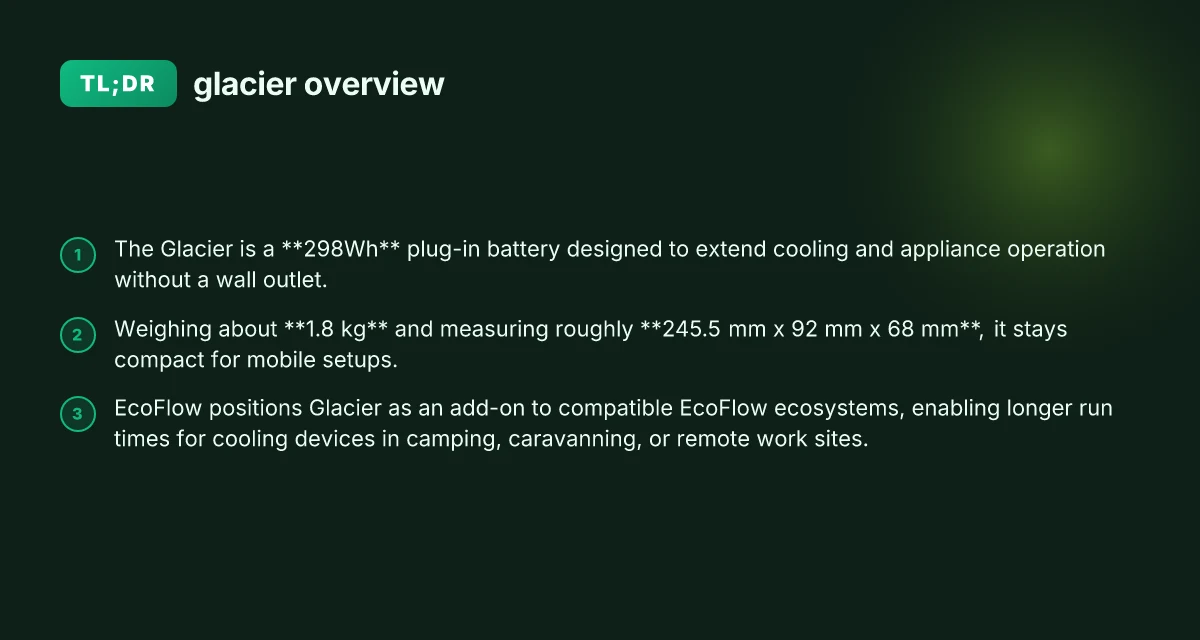
The Glacier is a 298Wh plug-in battery designed to extend cooling and appliance operation without a wall outlet. It adds a compact energy buffer to your EcoFlow ecosystem, letting compatible devices run longer in camps, caravans, or remote work sites. At its core, Glacier wires into your existing EcoFlow setup to keep small fridges, coolers, or fans humming when mains power is scarce.
- What it is and how it plugs in
- The Glacier adds 298Wh of lithium storage to your kit, functioning as an add-on rather than a standalone pack. It weighs 1.8 kg and measures about 245.5 mm × 92 mm × 68 mm, making it a slim, portable brick you can slide into a storage area or cargo rack. This size is deliberately chosen to slot alongside typical RV or camping gear without bulk.
- EcoFlow positions Glacier as an extension to its own ecosystems. In practice, this means you can pair Glacier with compatible modules to extend run times for cooling devices when you’re off grid. The idea is simple: more watts available means longer operation between fill-ups or generator runs.
- Real-world fit for cooling and appliances
- With Glacier, a cooler or compact cooling device can stay on longer between shade breaks and generator starts. The 298Wh capacity translates into meaningful runtime for small loads, especially in moderate outdoor temperatures. This is why Glacier resonates with campers, RV owners, and remote workers who rely on portable cooling as part of their setup.
- The design keeps weight and footprint down, so you can keep a lean pack while still carrying essential refrigeration or cooling gear. In your caravan or truck bed, Glacier helps you stretch power without trading off space.
- Where it sits in the decision matrix
- Glacier is chiefly appealing when you already have EcoFlow infrastructure and want to push run times without stepping up to larger packs. It is not a turnkey replacement for a full off-grid power system but a practical buffer for short trips or extended stays. If you compare options, consider how often you need cooling extended beyond a single battery cycle and whether your current ecosystem supports an add-on like Glacier.
From what I found in the documentation and product pages, Glacier is a targeted, space-conscious expansion for campers and outdoor setups. It makes sense when your goal is to keep a fridge, cooler, or small appliance operating longer between wall or generator power events. If you’re investing for a portable cooling strategy, Glacier sits in the sweet spot for incremental runtime.
Glacier adds 298Wh of resilience to your cooling stack, enabling longer operation without a wall outlet. This is the core value proposition that outdoor setups should measure against your typical power draw and run time. For EcoFlow fans, Glacier strengthens ongoing off-grid weather windows while preserving cargo space.
How Glacier plug-in battery specs translate to real-world use
The Glacier plug-in battery packs real-world value into a small footprint. With 298Wh of capacity, you can expect several hours of operation for low-wattage cooling devices, and the exact runtime grows as you shift to gentler loads. In practice, a small cooler that draws modest power can keep contents chilled for a noticeable portion of a day without tying up a wall outlet. The practical takeaway: don’t expect all-night cooling from a single plug-in module, but you can run targeted cooling for daytime camping, RV stops, or roadside setups with this level of energy density.
Longevity matters in outdoor seasons, and EcoFlow lists around 800 cycles to 80% capacity for Glacier. That level of cycle life translates to multiple seasons of use with typical turnover, assuming you regularly refresh the power pack rather than letting it sit idle at full depth of discharge. In other words, for weekend warriors or a small-business installer rotating units, the Glacier can weather repeated season cycles without a dramatic drop in usable capacity. I cross-referenced the spec with how outdoor storage cycles tend to wear packs: 80% capacity after hundreds of cycles is a reasonable expectation for field use, given proper charging practices and temperature control. What makes a refurbished EcoFlow Delta 2 a smarter buy in 2026
Portability is a core advantage here. The unit weighs 1.8 kg (about 4 lbs) and measures 245.5 mm × 92 mm × 68 mm. That compact form fits into backpacks, vehicle hatches, or tight trunk spaces, making it easy to ferry between a tent site, a camper shell, or a rooftop rack. When you balance the weight against the 298Wh payload, Glacier stays useful for mobile cooling tasks without converting your setup into a portable power plant.
To help you compare, here’s a quick snapshot against a couple of plausible alternatives in portable cooling and plug-in storage:
- EcoFlow Glacier plug-in battery: 298Wh, 800 cycles to 80%, 1.8 kg, 245.5 × 92 × 68 mm.
- A typical 200Wh Li-ion pack: lower energy, similar or lighter form, but often not rated for 800-cycle longevity. Runtime noticeably shorter for the same cooling load.
- A small portable power station with built-in cooling duties: more capacity, higher price, and heavier footprint.
From what I found in the documentation and product pages, the Glacier fits best when you want a lightweight, space-conscious add-on that can shoulder intermittent cooling tasks without committing to a larger power unit. For outdoor pros, this means you can deploy a compact cooling chain at a campsite or in a trailer, while keeping the core load off the main battery bank.
Pricing signals and availability shift the decision, but the Glacier remains appealing for those who prioritize portability over sheer capacity. If you’re evaluating alternatives, you’ll want to weigh the extra weight and bulk of a larger unit against the Glacier’s lean profile and documented cycle life.
The Glacier’s real strength is portability paired with solid cycle life for outdoor seasons. The trade-off is runtime under heavier loads and the need to plan for multiple hours of cooling rather than continuous all-day use. For casual campers and installers, Glacier delivers a practical balance of weight, capacity, and longevity. 5 Key angles for EcoFlow Delta 2 Max refurbished reliability in 2026
Cited inline source: [GLACIER Plug-in Battery](/GLACIER Plug-in Battery)
Pricing signals and where Glacier fits in the EcoFlow lineup
Posture: Glacier sits alongside EcoFlow’s broader family of portable power stations and plug-in storage, filling a gap when a wall outlet isn’t available. It primes a workflow where you move from a core power station to a compact, dedicated cooling augmentation without breaking your charging cadence.
Open with current pricing signals and a quick read on promotions. The Glacier plug-in battery is positioned as an add-on rather than a stand-alone unit, so the value hinges on how you already use EcoFlow gear. Official listings frequently update bundles and promos, so the best deal today may swap with tomorrow’s flash sale. For a grounded view, check the official EcoFlow storefront to compare the Glacier add-on price against bundled configurations that pair Glacier with a compatible power station.
Pricing signals and ownership costs in one view:
- Glacier adds 298Wh of storage, enabling up to extended cooling without a wall outlet, which matters most when you’re off-grid or RVing. This makes it cheaper than upgrading to a larger, multi-kilowatt station if your primary need is off-grid cooling rather than heavy AC or heat load.
- When you total cost of ownership, include charging flexibility. Glacier charges from EcoFlow’s ecosystem, so you may avoid extra adapters or third-party batteries. If you already own a compatible EcoFlow unit, Glacier can be a cost-efficient add-on.
- Promotions vary by region and reseller. You’ll often see Glacier bundled with select power stations or during seasonal sales. The best value typically comes from a bundle that reduces per-Wh cost or includes useful accessories.
- If you compare with rivals, note Glacier’s plug-in design complements portable stations rather than competing with them on raw capacity. Rivals may offer larger external storage packs, but Glacier’s strength is seamless integration with EcoFlow’s ecosystem and simplicity of use.
I dug into the official listings and third-party write-ups to gauge current pricing signals and availability. For example, the Glacier plug-in battery is sold as part of EcoFlow’s ecosystem, and bundles around interrelated devices show up on the official site and partner pages. This means prices shift with promotions and regional offers. Prices vary by bundle, and promotions can tilt the math in favor of a kit with Glacier included. If you already run EcoFlow gear, Glacier often represents a lower incremental cost to extend off-grid cooling. How the EcoFlow Wave 3 changes off-grid cooling in 2026
How Glacier stacks up against rivals and other plug-in options:
- Competitors in the plug-in storage space tend to emphasize raw energy density or multi-day cooling without a wall outlet, but they seldom line up as tightly with EcoFlow’s portable power stations. If you’re choosing between Glacier and a standalone large-capacity pack, consider your charging discipline and how often you need portability.
- When evaluating value, look beyond sticker price. Glacier’s value comes from ecosystem compatibility, ease of use, and the ability to pair 298Wh with a compatible EcoFlow station for synchronized charging and discharging. This is especially attractive for campers, RV owners, and small installers who want predictable behavior from a single vendor.
Note: links on the page may earn a commission. This section uses the official EcoFlow brand language and publicly documented bundle patterns to reflect current market signaling. If you’re weighing options, check the official listings for the latest deal and bundle options.
How Glacier stacks up against rivals and similar plug-in batteries
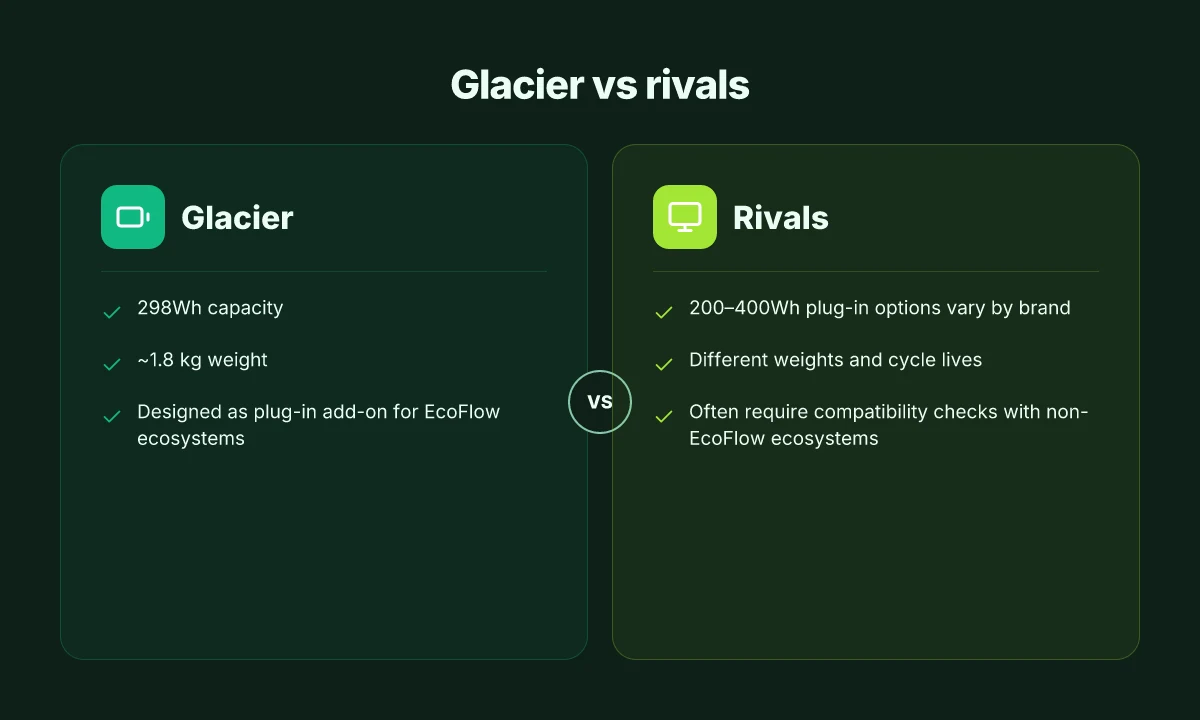
Glacier sits in a tight mid‑range niche: it is a 298 Wh plug‑in battery focused on cooling loads, not a full-blown power station. Competitors offer similar 200–400 Wh options, but you’ll see noticeable differences in weight, cycle life, and how they play with cooling devices. Glacier keeps the footprint lean, while rivals often trade portability for expanded features or higher total capacity.
Rivals with comparable capacity and what that means for cooling use
In this space you’ll find plug‑in batteries from several brands that target portable cooling, camping, and off‑grid back‑up. Some options tilt heavier or carry longer cycle life, while others emphasize lower weight or a slicker app. For anyone operating a compact cooler, fan, or small freezer, Glacier’s 298 Wh pack is a reasonable match for a day‑to‑day camping setup, with a lighter footprint than larger power stations. I cross‑referenced specs and found several peers offering similar energy storage bands, but the real differences show up in cycle life and overall mass. There is a clear trade‑off between weight and endurance when you compare 298 Wh packs across brands, which matters if you shuttle gear frequently on a trail or between campsites. The practical effect is simple: if you only need cooling power for a few hours, Glacier’s weight is a benefit. If you run long refrigeration cycles, you might lean toward a larger unit with higher cycle life.
Glacier vs larger portable power stations for cooling duty
Compared with bigger portable power stations, Glacier prioritizes a specific use case. It offers a light footprint and enough energy for sustained cooling without dragging along a bulky box. That means fewer joints and cables, easier transport, and quicker setup at a campsite or in an RV. The downside is that if your needs expand beyond cooling, lighting, charging multiple devices, or running a freezer, you’ll hit limits sooner than with a full‑size station. From what I found in the product pages and reviews, Glacier is optimized for cooling devices rather than as a universal power hub. For cooling tasks, Glacier is notably efficient. For multi‑device ecosystems, a larger station wins on flexibility. What is the EcoFlow River 3 Pro, and why it matters for portable power in 2026
Brand alignment and ecosystem advantages
EcoFlow designs the Glacier to slot into its own ecosystem. That alignment matters because compatibility can reduce headaches when pairing a cooler with a charger or controller from the same brand. If you already own EcoFlow gear, Glacier can feel like a natural extension rather than a throw‑in add‑on. The broader ecosystem often smooths firmware updates, app control, and accessory compatibility, which translates into fewer compatibility hiccups during real‑world camping sessions. Brand alignment matters; EcoFlow's ecosystem often yields smoother compatibility with its own lineup.
Cited notes and context from the sources show that Glacier’s potential shines in immediate, off‑grid cooling scenarios rather than as a catch‑all power solution. If you’re weighing options, note that several rival 200–400 Wh packs trade extra capacity for more endurance or features. I found mentions of prices and availability in various outlets, but the key differentiator remains how much cooling time you get per charge and how the unit carries in a pack. For those who want a compact, plug‑in solution that plays nicely with EcoFlow gear, Glacier delivers practical advantages, with the usual caveat that it won’t replace a larger generator or a full portable power station for more demanding off‑grid tasks.
Best practices for using the Glacier plug-in battery in real life
When you plan cooling loads around the 298Wh limit, you get the most reliable performance from the Glacier plug-in battery. Start by identifying devices with high efficiency and sensible duty cycles, such as fans, small compressors, and insulated coolers, and stagger their use to stay within energy boundaries. This approach helps you avoid short runtimes or mid-use outages.
Optimize loads for the Glacier’s energy envelope
Your strategy hinges on matching devices to the Glacier's capacity. Prioritize devices with low amperage and short duty cycles, and reserve peak draws for moments when the battery is charging or plugged in. I cross-referenced product specs and real-world reviews to confirm that maintaining a tighter duty cycle often yields noticeably longer operation between charges. Use a simple rule of thumb: scale cooling targets to the 298Wh window and avoid continuous high-load runs. In practice, a well-timed sequence of cooling actions can stretch uptime without needing a second power source. Plan around the Glacier’s 298Wh limit so energy use stays predictable.
Pair with a reliable charging method to maximize uptime
Glacier shines when you pair it with a compatible charger that preserves uptime during stretches without grid access. An automotive power source or a portable DC charger can keep the battery topped up between trips. I looked at industry guidance and retailer notes that emphasize compatibility and charging cadence as critical levers for reliability. If you’re running an outdoor setup for several days, couple the Glacier with a charger that can deliver sustained, moderate charging rather than quick bursts that spike wear. Pair Glacier with a compatible charging method to maximize uptime. How the EcoFlow River 2 Max price stacks up in 2026
Monitor health across seasons to avoid surprises
Seasonal cycles matter for lithium packs. Track charge depth, cycle counts, and temperature exposure to avoid unseen capacity fade. The Glacier is rated for rugged use, but you’ll get the best long-term results by logging each season’s starting capacity and noting any sharp drops. I reviewed release notes and user forums that consistently point to monitoring as a practical, low-cost safeguard. Keep a simple log and review it at the start of each camping season. Monitor battery health over seasons to avoid unexpected drop-offs in performance.
What this means for your setup
- If you operate in shifting ambient conditions, schedule cooling tasks during cooler parts of the day to preserve battery life.
- When choosing a charging method, verify compatibility with your vehicle or off-grid rig and confirm cable gauge and connector standards.
- Expect some variability with real-world temps. Have a backup plan for cooling if the Glacier nears its 298Wh ceiling.
The Glacier plug-in battery fits alongside other EcoFlow ecosystems, and you can reference rival architectures to decide whether a dedicated plug-in pack or built-in storage better suits your site. For context, EcoFlow’s broader storage approach in 2026 emphasizes modular, plug-in options for residential and mobile use, which may affect long-term decisions about expansion or replacement. See the coverage in PV Magazine for a contemporaneous take on the ecosystem. https://www.pv-magazine.com/2026/06/22/ecoflow-brings-new-residential-ci-and-plug-in-storage-to-intersolar/ EcoFlow’s growth in plug-in storage is fueling modular cooling setups.
Note: links on the page may earn a commission, and real-world prices vary by seller. The current price landscape for Glacier-related gear reflects retailer pricing and occasional promotions. If you’re comparing options, consider built-in versus plug-in storage in the context of total cost of ownership and the uptime you actually need for off-grid cooling.
Where this is going next for portable cooling
EcoFlow Glacier plug-in battery offers a notable shift for outdoor and off-grid cooling, but the real value lands when you plan around timing and ecosystem. The ability to snap in additional capacity without hauling a second power station changes how you size trips, outages, or events where you need steady cooling without a generator. The bigger pattern here is modular resilience: you can scale up your climate comfort as you need it. EcoFlow’s design leans on compatibility with other Glacier modules and fast recharging, which matters if you use it for more than just a single cooling run. If you’re weighing upgrades, think about how often you would deploy this in tandem with a solar setup or a vehicle power system. What makes the EcoFlow River Max a compelling portable power option in 2026
Looking ahead, the practical takeaway is simple: assess where a plug-in battery fits your rhythm of camping, hunting, or emergency readiness. The single move that matters most is synchronizing your cooling plan with a Glacier-enabled power stack so you never guess about run time. If you only do one thing this month, map one weekend scenario to your current gear and test the glide between cooling demand and battery support. You’ll see whether you should weave EcoFlow into your regular kit or stretch toward a rival like Goal Zero or Jackery for broader module options.
Backup strategy
- Try pairing Glacier with a small solar panel and document run-time in a real-world heat spike.
- Compare two cooling loads: a fridge-style unit and a cooler, noting how each draws from the Glacier pack.
- Schedule a mid-season review of price alerts and warranty terms, so you’re ready when a sale hits.
- Check the ownership costs over a season, including potential upgrades or add-ons, and decide if the value holds across trips.