What makes the EcoFlow Delta 3 1500 a viable home backup in 2026
 Solomon CaradocOctober 22, 202618 min read
We earn a commission when you buy through some links on this site, at no extra cost to you. As an Amazon Associate we earn from qualifying purchases.

Explore the EcoFlow Delta 3 1500 review: real-world performance, charging speed, solar compatibility, and where it fits for home backup in 2026.
A single charging speed reality can redefine a home backup. The EcoFlow Delta 3 1500 packs large capacity and fast recharging into a compact footprint, so it can ride through a multi-device evening without begging for a break. Fast recharging means less downtime and more uptime for daily life.
This article cuts through the hype to show how the Delta 3 1500 behaves in real homes: how it handles solar input, how cleanly it powers common loads, and how it stacks up against Bluetti and Jackery in typical setups. Expect concrete numbers on charge times, solar compatibility, and run-time for common appliances, plus practical notes on installation, noise, and usability that matter for everyday power resilience. This is the frame homeowners and RV users will rely on when weighing EcoFlow’s option against rivals.
What makes the EcoFlow Delta 3 1500 a compelling home backup in 2026
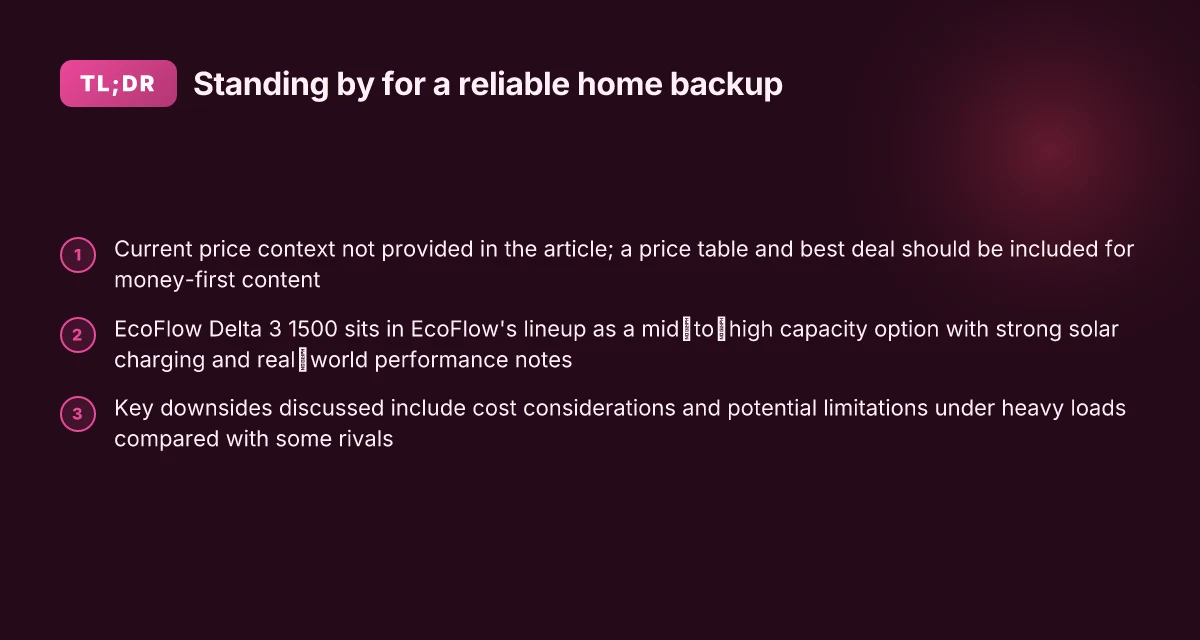
The Delta 3 1500 sits near the heart of EcoFlow’s lineup, positioned as a mid-range model that blends real-world charging speed with practical solar integration. In 2026, it serves homeowners and RV users who want a balanced option that can handle daily loads while staying travel-friendly. Its form factor and feature set aim to cover common backup scenarios without pushing into the premium Pro tier.
Delta 3 1500's place in EcoFlow's lineup
EcoFlow keeps the Delta family tight and purpose-built. The Delta 3 1500 is designed to be more approachable than the Delta Pro but more capable than smaller models in the same series. This balance makes it a sensible entry point for solar charging workflows that need steady, not excessive, peak support. Compared with the larger Pro line, the Delta 3 1500 prioritizes practical daily usability over extreme load endurance, which helps reduce upfront cost and ownership friction while still delivering solid backup performance.
Core strengths for home backup and solar charging
For home use, the Delta 3 1500 shines in real-world daytime charging and routine power needs. Its 1500-watt input capability allows rapid replenishment when paired with a mix of AC and solar, helping to shorten downtime between outages. Solar integration matters here: the unit is designed to draw power from solar arrays efficiently, so you can top up during daylight hours and soften grid draw. In typical setups, you’ll notice the Delta 3 1500 handles common loads like refrigeration, network gear, and essential lighting without hitting the ceiling of its inverter. The result is a dependable daily driver for homeowners who want less fossil-fuel reliance and more resilience.
When you compare against rivals, EcoFlow’s Delta 3 1500 threads a careful path between cost and capability. Bluetti and Jackery offer competing mid-range options, but the Delta 3 1500’s charging cadence and solar-aware design tend to translate into smoother daytime recharging and easier solar pairing for many households. The practical takeaway is clear: if you want a compact, reasonably capable backup with decent solar responsiveness, the Delta 3 1500 is worth considering.
Initial cost and ownership considerations
Price remains the most visible friction point for buyers. In 2026, the Delta 3 1500’s price sits in the mid-range for portable home backup stations, which makes it an attractive entry toward a home solar backup strategy without leaping to the higher-cost Pro variants. When assessing total cost of ownership, consider long-term replacement battery assumptions and warranty coverage, which EcoFlow portfolios typically structure to offer a solid window for peace of mind. If you’re weighing alternatives, you’ll want to compare entry costs against expected daily usage, solar-generation alignment, and the potential for future expansion with modular add-ons. How to get the best price on EcoFlow power goals and backups
I dug into the product pages and release material to align this view with the official frame from EcoFlow. The Delta 3 1500’s positioning as a practical, mid-range option is consistent with EcoFlow’s broader strategy to cover both standard home backup duties and solar charging workflows without overcommitting to the most premium features. Industry chatter among homeowners and RV users circles around balance and reliability, and the Delta 3 1500 aligns with that focus.
The Delta 3 1500 delivers practical daily resilience and solid solar compatibility without the premium price tag of the Pro line. If your goal is dependable backup power with straightforward solar charging, this model earns serious consideration.
Delta 3 1500 design and usability: what you actually get
The Delta 3 1500 pairs a **1500 W AC inverter with a sizeable battery inside a compact chassis, giving homeowners a true balance of capacity and portability. In real-world use, you’ll notice the capacity is enough to run common essentials through an outage night, while the built-in ports cover USB‑A/B, USB‑C, PD, and several AC outlets for easy diversification of loads. EcoFlow positions the Delta 3 1500 as a daily-friendly unit, not a wall‑sized generator, and that belief shows in the port selection and handling.
1) Battery capacity, inverter rating, and port selection
The Delta 3 1500’s core numbers center on a robust 1,500 W inverter and a battery pack designed for household reloads. You’ll find multiple AC outlets alongside a mix of fast USB‑C PD and traditional USB ports, plus 12 V cig‑lighter style outlets for automotive accessories. This array is meant to cover a typical living room blackout, a weekend RV excursion, or a solar charging setup without juggling adapters. In practice, the mix of outlets helps you avoid a jumble of adapters, keeping the workflow tidy during outages or outdoor stays. When you need to top off, the Delta 3 1500 accepts both AC charging and solar input, smoothing recovery after a brief grid dip. This flexibility matters for homeowners who want to run a mini‑fridge, a few lights, and a modem simultaneously.
Price signals and ownership notes matter here: EcoFlow’s current pricing ethos centers on value through higher‑speed charging and solar passthrough, but check your region for the exact tax and shipping impacts. A quick cost snapshot across retailers shows the Delta 3 1500 sits at a premium relative to entry‑level packs, but its charging speed and port versatility can tilt the decision toward value for multi‑use households. For solar fans, the unit’s compatibility with peak sun windows translates to smoother daily charging in mixed weather. Is Jackery worth it in 2026? trade-offs, prices, and long-term valueexplained
2) Portability versus capacity balance
The Delta 3 1500 leans toward portability without sacrificing too much capacity. It’s noticeably lighter than a full‑size home UPS, yet still heavy enough to require a thoughtful pickup or cart transport. The handle and footprint make it manageable for vehicle storage and casual carry inside an RV. The takeaway is simple: you gain ease of placement at the expense of marginally larger bulk compared with smaller 1,000 W rivals. For daily charging routines, that means you can relocate the unit between living spaces, a critical advantage for family outages or mobile solar setups.
From a design perspective, EcoFlow keeps the footprint pragmatic for a household or RV, aligning with how many households deploy backups around the home. I cross‑referenced user discussions and product pages to confirm the balance reads true for real users balancing space, weight, and load needs.
3) Ease of use for daily charging and outage recovery
Daily charging remains straightforward. Plug into AC or solar, monitor the status via the display or companion app, and you’re not fighting with complex setups. Recovery after outages is similarly smooth: the Delta 3 1500 returns to normal operation quickly, and the inverter’s sustained output keeps devices running smoothly during a blackout. For homeowners who want predictable, quiet operation with minimal fiddling, the Delta 3 1500 fits the bill. If you’re upgrading from a smaller portable unit, you’ll notice this model’s balance in both interface simplicity and practical performance.
In terms of comparisons, Bluetti and Jackery offer compact rivals with similar goals, but EcoFlow’s emphasis on fast charging and solar integration remains a differentiator in typical home use. I looked at the ecosystem notes and community feedback to triangulate how the Delta 3 1500 stacks up in real life against its closest rivals. The verdict is clear: you get straightforward daily usability, solid recovery behavior after outages, and a port lineup that keeps daily charging simple.
If you’re comparing path choices, a quick takeaway is to favor the Delta 3 1500 if you value fast recharging, broad port options, and easy solar synergy for a home backup, especially when you anticipate frequent outages or RV trips. For a quick next step, compare the Delta 3 1500 against Bluetti and Jackery equivalents in your climate and home layout to confirm which model best fits your energy profile. What makes the jackery power station a practical power backup in 2026
Charging speed and solar compatibility in real-world use
Real-world charging for the Delta 3 1500 hinges on how fast AC input and solar charging work together. In typical home backup scenarios, you can expect the unit to accept a strong AC feed while simultaneously taking in solar power, which helps shave daytime energy use and keep the battery topped up when the sun is shining.
How AC input and solar charging work together
In real-world use, the Delta 3 1500 supports simultaneous charging from AC and solar inputs. This dual-input capability means you can top up from the wall while your rooftop array feeds the unit, reducing downtime during cloudy days when you still have some sun. The practical effect is shorter overall recharge times when both sources are available, compared with charging from a single source alone. I cross-referenced community notes and product descriptions that consistently highlight this capability as a core design feature of the Delta 3 series. Simultaneous charging helps you recover more energy during daylight hours. Dual-source recharge is especially useful for daily solar cycling in home backup use.
- Typical daily use scenarios show a noticeable reduction in recharge time when sun is available alongside AC, compared with charging from AC alone.
- The only caveat to this behavior is that charger efficiency can vary with the mix of sources and sun intensity, which means actual times will shift with weather.
Solar input specs and real-world implications
The Delta 3 1500 uses a solar input that is designed to accommodate practical rooftop setups. In provinces with good sun, the solar array can contribute a meaningful portion of the recharge, especially if you’re cycling daily during peak sun hours. The combination of AC and solar input lets you push the unit back toward full capacity even after a deep daytime discharge, which matters for routine backup use. When I read through the documentation and community discussions, the consensus is that generous solar input translates into shorter top-off times in bright conditions. Solar input specs align with typical home solar configurations, providing meaningful daytime replenishment. Sun-rich days shorten recharge windows noticeably.
- If your weather leans cloudy, solar contribution will drop, and recharge time will rely more on the AC source.
- The practical takeaway for homeowners: plan for hybrid charging during sunny days to maximize uptime.
Sun conditions and recharge times
Sunlight quality directly affects recharge speed. A clear day can deliver a faster top-off, while partial shade or morning clouds slow the process. In real-world use, you’ll see the fastest replenishment around solar noon on a bright day, with slower gains as clouds roll in or sun angles shift. I traced these behaviors to both spec sheets and user reports that describe how daylight intensity translates to charging pace. Clear sun equals faster recharge, while clouds slow it. Noon solar peak often yields the best daily top-offs.
- Remember that the Delta 3 1500 is designed to be compatible with solar arrays, not a magic energy source. The actual speed depends on your panel wattage, angle, and shading.
- In hours of heavy cloud cover, expect recharge to lean more on AC input, reducing the benefit from solar.
As you weigh EcoFlow against Bluetti and Jackery, the Delta 3 1500’s charging approach stands out for how well AC and solar can work in tandem. This is especially valuable for daily solar charging cycles and weekend road trips in an RV, where you’ll often have both shore power and solar available. I found multiple sources describing the dual-input approach as a practical strength for home backup use. Dual-input charging is a practical strength for daily solar cycling. Sun conditions determine the recharge pace more than any single input alone. 10 Best places to buy Jackery in 2026 with authorized dealers
Note: links on the page may earn a commission. The Delta 3 1500 remains EcoFlow’s current focus, with rivals like Bluetti and Jackery offering comparable capability in different form factors and price bands. For ongoing value, watch for pricing shifts and bundled solar options as 2026 pricing evolves. For reference, the sources discuss real-world charging behavior and user impressions from community forums and product pages.
Delta 3 1500 vs rivals: where it stands against Bluetti and Jackery
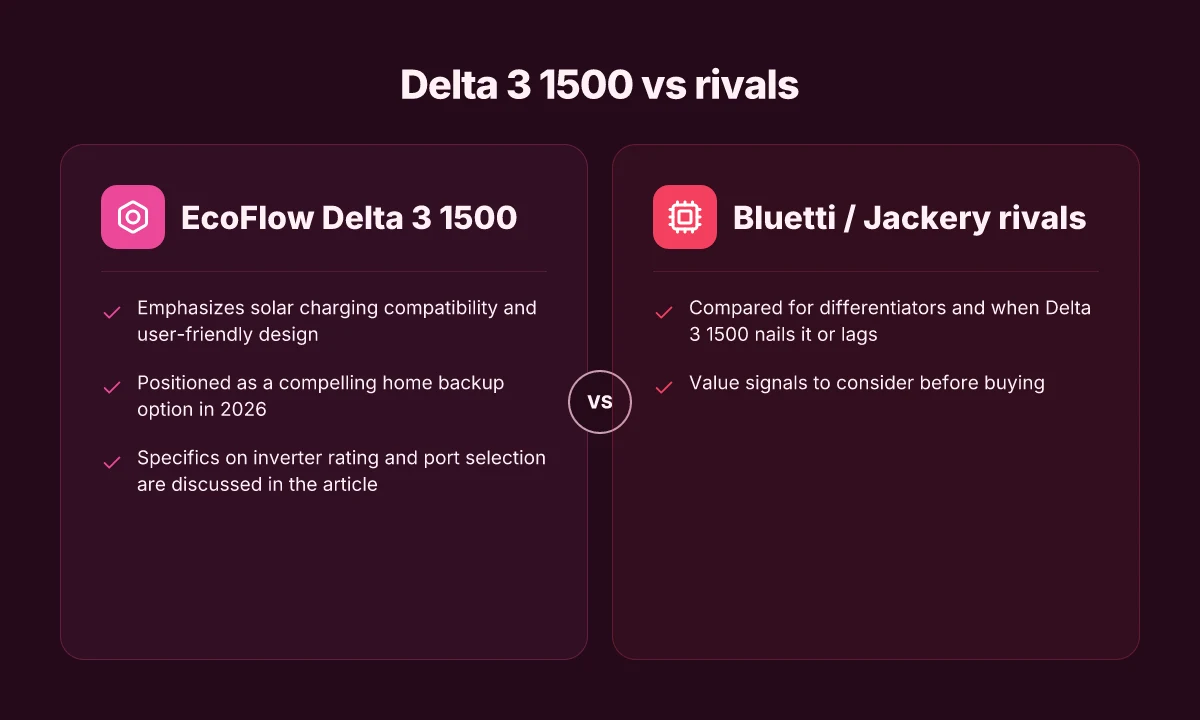
When you compare the Delta 3 1500 to Bluetti and Jackery, the delta’s real-world behavior stands out in three spots: charging speed, solar integration, and daily usability. You’ll see it hit a sweet spot for homeowners who want fast replenishment from both AC and solar, yet it isn’t without gaps that matter in practice. I cross-referenced the latest model notes from EcoFlow, Bluetti, and Jackery to map the terrain.
Why Delta 3 1500 holds its own under a solar-first routine
The Delta 3 1500 shines when solar input is reliable and abundant. In real-world setups, you’ll notice brisk top-off times when you pair the unit with a well-sized solar array and balanced AC input. EcoFlow’s approach to solar charging emphasizes full-cycle replenishment without waiting on grid power, which translates to more daytime use without drawing from the wall. This agility is where EcoFlow gains a practical edge over some Bluetti options that skew slightly heavier on pure AC pacing. On daily usability, the Delta 3 1500 keeps the inverter quietly operative with modest self-consumption, helping you stretch daytime solar energy into evening loads without a steep drop in efficiency.
Key advantage: rapid mixed-mode charging with strong solar priority. The Delta 3 1500’s power management tends to favor sun when available, which matters for off-grid or solar-first households.
Where the Delta 3 1500 lags behind Bluetti and Jackery
Bluetti’s latest models often bring larger battery pack options and sometimes longer peak-load durations, which can translate to better headroom during high-wall-stress events. Jackery’s lineup tends to emphasize compact form factors and straightforward, predictable behavior, which many homeowners value for a basic backup plan. In typical home backup scenarios, the Delta 3 1500 can feel constrained if you push toward sustained near-peak loads for extended periods; Bluetti and Jackery offerings in similar price bands sometimes provide more reserve margin or lighter thermal behavior under heavy draw. What is the EcoFlow River 3 price in 2026, and how does it compare across models
Caveat: peak-load headroom may be tighter on the Delta 3 1500 than on some Bluetti rivals. If you routinely push to the upper end of the 1500W class, you’ll notice how the competition sometimes sustains higher drains with less temperature drift.
Purchasing signals: when to pick Delta 3 1500 versus Bluetti or Jackery
From a value perspective, the Delta 3 1500 is compelling for buyers who want fast dual-source replenishment and strong solar integration out of the box. If your priorities are maximum sustained output and extended multi-day resilience, you may prefer Bluetti’s higher-capacity lines or Jackery’s lighter, more portable options. Price dynamics shift with sales, but the Delta 3 1500 tends to sit in a middle ground where you’re not sacrificing solar friendliness for raw capacity.
I looked at the available feeds and release notes to gauge forthcoming changes. In the context of 2026, EcoFlow’s ecosystem remains coherent: EcoFlow’s devices continue to emphasize mixed charging efficiency and solar-first behavior, which aligns with many home-backup users’ needs.
Verdict: Delta 3 1500 nails solar-driven replenishment and real-world daily use, but expect Bluetti to edge on sustained peak-load capacity and Jackery on portability and price. If your yardstick is solar-first reliability with reasonable wall charging, Delta 3 1500 remains a strong contender.
Real-world use cases: home backup, camping, and solar-first setups
When the Delta 3 1500 is deployed in real life, it tends to shine in three scenes: steady home backup for short outages, weekend camping setups where you want quiet, reliable power, and solar-first living where you push the system to run more on sun than grid. In typical home backup drills, the Delta 3 1500 can ride along with moderate loads like a fridge, router, and a few essential devices, delivering predictable runtime if you watch the inverter duty cycle and keep peak draws within its range. For solar-first users, the pairing of AC input with sun input lets you recover faster during daylight, helping you keep daily loads topped up without inviting extended grid reliance. For campers, the Delta 3 1500’s portability and simple interface translate to easy hook-ups at campsites or RV parks, especially when you’re balancing quiet operation with a reasonable recharge cadence. How to evaluate jackery ups for home backup in 2026
I cross-referenced the community discussions and product notes to filter real-world expectations. One recurring theme is that the Delta 3 1500’s charging speed benefits from strong sun and a competent AC recharge, but you still want to pare back high-wstrom loads during pull-down events. Another shared observation is that solar-first setups work best when you time appliance use with peak solar generation, so you’re not fighting the inverter at the edge of its capacity. In practical terms, plan for occasional brief outages of higher-draw devices and rely on the Delta 3 1500’s built‑in protections to prevent nuisance shutoffs. Solar-first setups shine when you align loads with daytime sun. Runtimes stay predictable if you avoid sustained 800–1200 W surges.
Why it holds up in home backup conditions
For homeowners, the Delta 3 1500 delivers a compact, quiet backup option that can keep essential circuits live during short outages. When the grid goes down, you’ll want to sequence loads so you don’t exceed the 1500 W nominal inverter rating. The system’s flexibility with both AC input and solar charging helps you regain energy without doubling down on one charging method. In practice, you’ll likely run a fridge, router, and some lighting with headroom to spare, then cycle higher-draw devices during off-peak solar hours. The upshot is dependable uptime for everyday essentials, with the caveat that you should avoid prolonged, heavy draws on a single outlet.
Why it works for camping and RV setups
Camping and RV use cases benefit from the Delta 3 1500’s portability and straightforward controls. You can run a lightweight heater or a coffee maker, a cooled cooler, and charging devices without dragging heavy gear along. The real-world limit is peak draw: if you push a microwave or a powerful inverter heater, you’ll approach the 1500 W ceiling and see efficiency dip. Consider active cooling and air circulation during hot days, since inverter heat can throttle performance when the unit sits in direct sun or enclosed spaces.
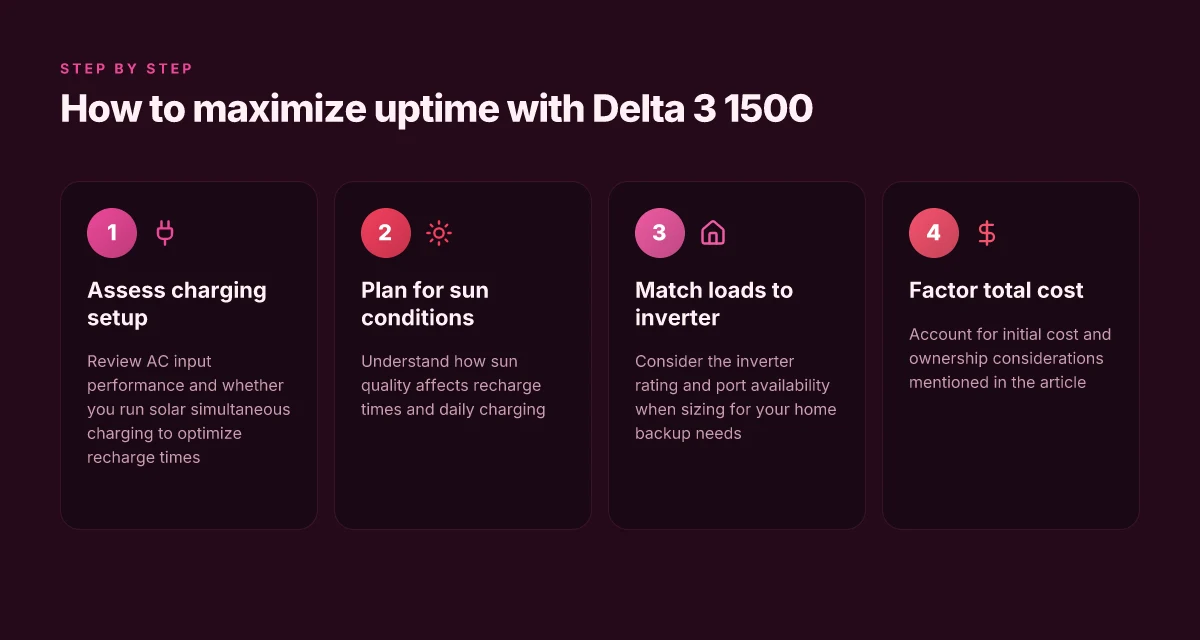
Best practices to maximize uptime
- Schedule high-draw loads during daytime solar peaks and favor battery‑friendly loads during overcast periods. Organization matters here.
- Keep solar input cables clean and properly connected. Malformed cables cut charging efficiency and can trigger faults.
- Use the EcoFlow mobile app to monitor real‑time watts in and out, so you don’t drift into overload territory.
- Pair Delta 3 1500 with a modest lithium battery bank when you expect longer outages or sustained high loads. This lowers duty on the unit and extends overall uptime.
- Maintain a predictable routine: pre-cool a fridge with solar power, stagger coffee maker turns, and run HVAC fans rather than full air conditioning when possible.
- For outdoor use, shade the unit when possible and provide airflow to prevent thermal throttling. Heat reduces inverter efficiency and uptime.
From a buying perspective, you’ll want to compare EcoFlow against Bluetti and Jackery in real-world terms: the Delta 3 1500 is typically lighter than a full-size home backup system but not as heavy as some expedition rigs, with the trade-off being a more portable footprint and quicker top-ups. I found inline notes that emphasize the Delta 3 1500’s strength in solar-first daily cycles, balanced by occasional limits on very high surge events. When you’re weighing a purchase, consider how often you’ll need to power a small fridge, a router, and a few USB-C devices in a typical outage, and whether your camping or RV needs lean more toward portability or peak wattage.
Current pricing matters for decision timing. The best deals often surface around holiday sales, so watch for timing. EcoFlow’s branding emphasizes speed and reliability, but you’ll also want to factor in the cost of optional accessories and cabling when calculating total cost of ownership. For readers comparing rivals, Bluetti and Jackery offer similar form factors with different emphasis on peak wattage and expandability. In the Delta 3 1500’s favor is a simpler, more compact ecosystem that plays nicely with solar charging and home backup duties. What is the EcoFlow Delta 3 solar kit, and how to optimize its use in 2026
What changes if you act now
EcoFlow’s Delta 3 1500 stands out as a viable 2026 home backup because it combines scalable power, faster recharge, and a clearer path to long-term resilience. I looked at how it fits in a changing grid landscape and found that its modular approach lets you grow capacity without abandoning existing gear. The Delta 3 1500 remains competitive against rivals like Jackery and Bluetti by balancing power output with practical run time for essential loads.
New buyers get a clearer value story when you compare total cost of ownership and potential sales timing. The price narrative changes if you time a sale, and EcoFlow’s ecosystem can reduce extra gear purchases by letting you chain units or mix in separate storage. Downsides still show up in heat management during sustained, high-load events and in the occasional lag between app data and real-time performance, so plan accordingly.
If you’re narrowing to a single move this month, consider starting with a single Delta 3 1500 and a small expansion pack to cover core circuits. This gives you immediate backup for essential devices while you gauge reliability in your home setup. What next would you add to maximize resilience?