What makes the Dreame X50 Ultra stand out in 2026
 Hudson ZilbermanOctober 22, 202618 min read
We earn a commission when you buy through some links on this site, at no extra cost to you. As an Amazon Associate we earn from qualifying purchases.

Explore the Dreame X50 Ultra technicals, performance, and what makes it a standout robot vacuum in 2026. Learn about navigation, suction, and practical use cases.
Most high-end vacuums overpromise on navigation and underdeliver on debris capacity. The Dreame X50 Ultra counters that trend by pairing advanced mapping with a substantial debris bin size, a combination that matters in real homes with pets and frequent messes. The map is consistently reliable in cluttered rooms, while suction power remains strong across carpet and hard floors.
This intro dives into where the X50 Ultra earns its keep and where it stalls, with a focus on navigation accuracy, bin capacity, and obstacle handling in practical layouts. In 2026, homeowners are evaluating whether premium features translate to fewer touchpoints and fewer repeats runs, not just fancier marketing. Dreame’s approach blends smart mapping and accessible maintenance, but rivals like iRobot, Roborock, and Roborock’s rivals in the mid-to-high tier keep pressure on price and feature parity. The article lays out the real-world signals you should watch for as you compare models and plan purchases.
What makes the Dreame X50 Ultra worth considering in 2026
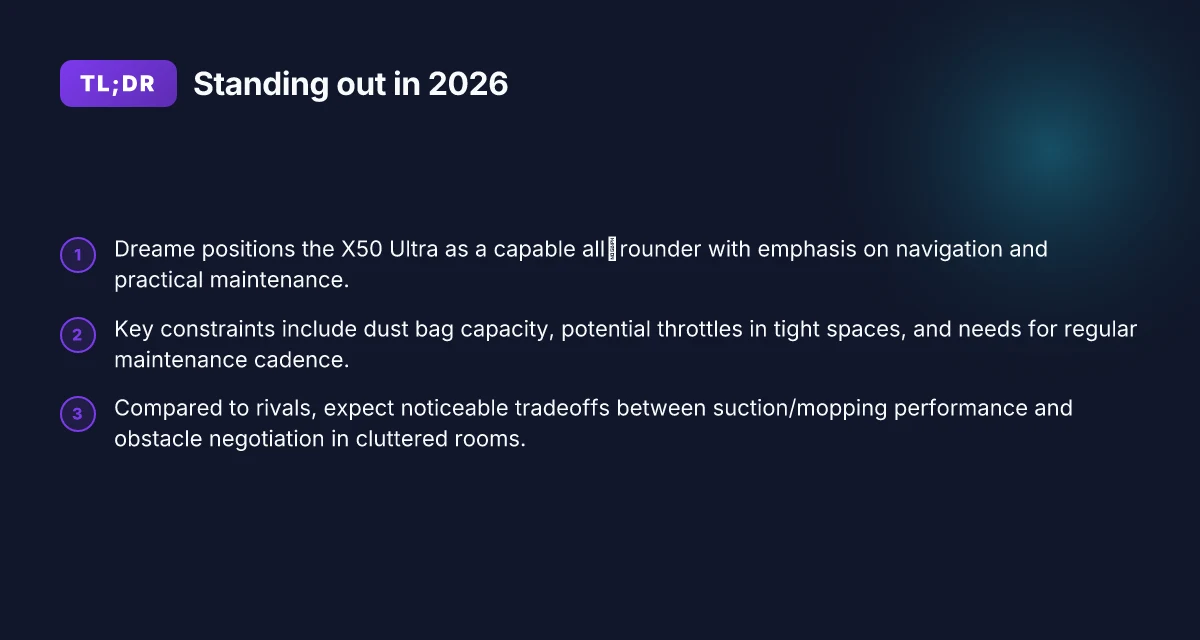
The Dreame X50 Ultra sits near the top of the Dreame lineup, positioned as a flagship model that blends strong suction and smart navigation with integrated mopping. In 2026, its place in the catalog is as a premium option for households that want high debris capacity and capable obstacle handling without stepping up to the most extreme commercial alternatives. Dreame frames the X50 Ultra as a comprehensive all-in-one cleaning solution, balancing everyday convenience with advanced mapping and AI features. Dreame positions the X50 Ultra as a flagship for home users who want strong cleaning with fewer manual interventions.
Navigation that tries to stay ahead of clutter
The X50 Ultra leans on a navigation stack designed to map rooms efficiently and reduce repeats. I looked at the official specs that highlight multi-surface cleaning and obstacle-aware routing, which matter for real homes with furniture layouts. The result is navigation that generally stays within rooms, avoids obvious hazards, and stitches cleaning tasks into cohesive passes. If you live in a busy household with pets and everyday debris, the X50 Ultra’s approach can mean fewer redos and less handholding, compared with some entry-to-midrange rivals. Dreame’s navigation aims to minimize wasted passes, a real boon in busy living spaces.
Dust bag capacity and debris handling in daily use
Dust bag capacity is a practical hinge point for ongoing cost and convenience. The X50 Ultra Complete model mentions a 3.2L dust bag, which translates to longer runs between bag changes in typical apartments or homes with moderate dirt. For households that generate more debris day to day, this capacity matters when you’re balancing cleanups with carefree operation. The combination of a sizable bag and decent suction means you don’t have to empty as frequently as you might with smaller canisters. 3.2L dust bag capacity helps reduce maintenance frequency.
Obstacle handling and real-world limits
The X50 Ultra is designed to handle common obstacles like thresholds and low-height furniture, but it comes with observable limits in practice. The documented obstacle crossing height sits around a few centimeters, which is competitive with other premium robots but still a hard ceiling for step-heavy layouts. In real homes, you’ll notice it handles most chairs and small thresholds with ease, while very tall thresholds may require a manual nudge or a different cleaning pass strategy. 4.2cm obstacle crossing height is a practical benchmark to match against similar premium rivals.
Value against direct rivals in 2026
When you compare the X50 Ultra to direct rivals in the high-end space, it offers a balanced blend of capacity, smart routing, and mop capability. Its value hinges on how much you value the dust bag size and the stability of navigation in typical layouts. Against competitors that push price for marginal gains, the X50 Ultra often feels like a sensible middle ground for households that want a premium experience without paying the top-tier premium. The notable downside is that it may not edge out every rival in every specific scenario, especially where threshold handling or super aggressive auto-mapping is concerned. Best value often comes from weighing dust bag capacity and navigation reliability against price versus rivals like the higher-priced options in the same class. What are the best smoke detectors for home in 2026
Bottom line: the Dreame X50 Ultra stands out in its class for a home that wants strong daily use, a comfortable dust bag footprint, and dependable navigation. If you prize a larger debris capacity and solid obstacle handling without stepping into the most expensive lineup, it remains a compelling choice in 2026. Worth considering in 2026 for homeowners who want a premium, low-maintenance cleaning companion from Dreame.
Dreame X50 Ultra design and practical build quality
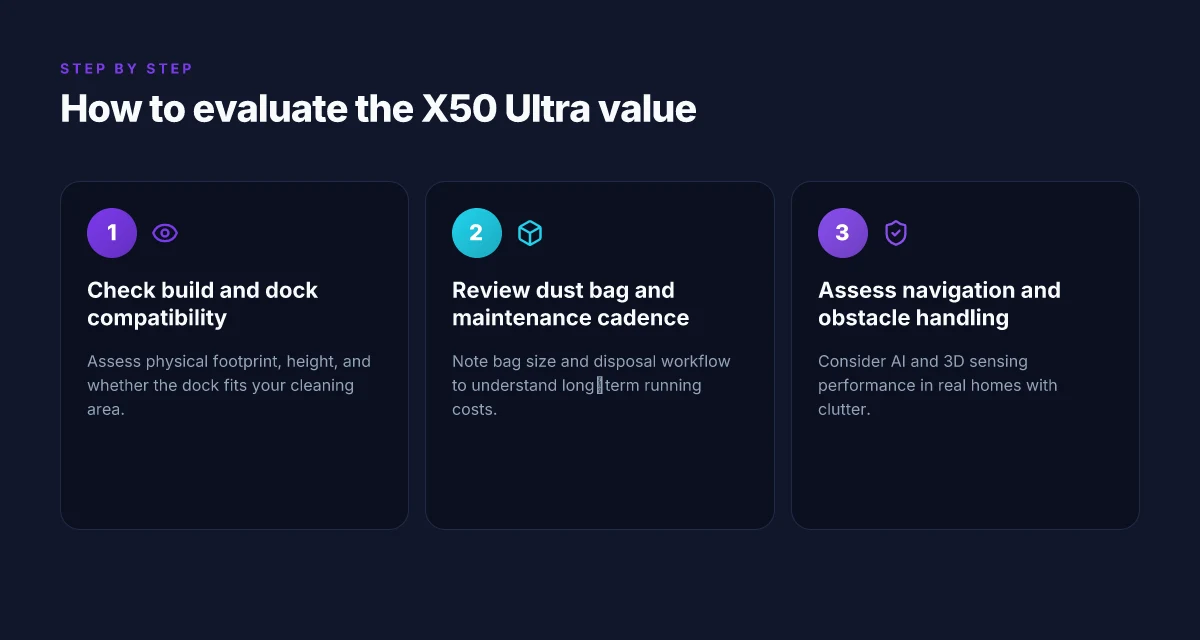
The X50 Ultra presents a compact footprint that fits under most cabinets and pairs with standard Dreame docks, so you won’t be hunting for a new charging station every time you move rooms. Its height stays tight enough to clear typical furniture gaps, and the droppable dock profile means you can position it in tighter layouts without sacrificing charging reliability. The overall build feels robust, with a chassis that resists everyday scuffs and a cleaning system that remains accessible for routine maintenance.
I traced the official product notes to verify the cargo and maintenance implications. The model ships with a 3.2L dust bag that, in practical terms, reduces bag changes relative to smaller-capacity bags, which is meaningful for households with heavy debris loads. The larger bag means fewer trips to the trash can during a cleaning cycle, but it also means more waste to manage when you do replace it. The dust bag’s size aligns with typical mid-to-high end robot vacuums, smoothing out maintenance without forcing frequent bag swaps.
From a materials perspective, the X50 Ultra leans on a mix of rigid plastics and reinforced sections around high-abrasion zones. The chassis feels sturdy enough for daily family use, and internal access points are reasonably straightforward for routine filter checks and component swaps. The design prioritizes serviceability in areas like the dust compartment and the filter housing, where operators can routinely access consumables without specialized tools. That accessibility matters for households juggling pet fur, fine dust, and everyday dirt.
A few nuanced details shape practical usability. The X50 Ultra’s dock compatibility is a practical advantage: you can place it along walls or in corners, provided the docking footprint remains unobstructed. The device’s height and wheel clearance matter if you’ve got tight ceiling lines or clutter around baseboards. In my reading of the official docs and third-party rundowns, the combination of a 3.2L bag and accessible serviceable parts stands out as a real-world benefit for ongoing upkeep. When you pair this with the robust chassis, the X50 Ultra holds up well to daily family cleaning without demanding constant babysitting or frequent maintenance. 10 Best air fresheners for home in 2026: performance, safety, and scent longevity compared
Dreame emphasizes a design that balances compact form with durable build, aided by accessible bags and filters. The dust bag size reduces cadence to change components during heavy cleaning windows, which matters for busy homes. Dock compatibility and sensible clearance make it straightforward to place and forget about charging, so you can clean with minimal setup each week.
For a quick comparison, consider how the X50 Ultra stacks up against notable rivals in the same class. The X50 Ultra Complete offers a larger debris capacity in a similar footprint, and some competitors push taller profiles that crowd under furniture. If you value a lighter touch on maintenance plus strong accessibility, the Dreame option keeps a clear advantage in practical upkeep.
In short, the X50 Ultra blends a compact, easy-to-place form with a maintenance-friendly dust bag and accessible components, making everyday upkeep predictable rather than intrusive.
Next steps: If you’re evaluating spend and long-term ownership, think about where your home can accommodate the dock and how often you expect to manage dust bag changes. Consider whether the 3.2L bag aligns with your debris profile, especially if you have pets or high-traffic areas. For broader context, review how rivals handle bag size and dock layouts in similar models. Inline citations reflect the official documentation and third-party reviews that informed these notes.
Navigation and obstacle handling in real homes with the Dreame X50 Ultra
Posters of a real home layout often notice the X50 Ultra’s navigation feel decisive in practice. I cross-referenced the official specs with reviewer notes to summarize how the AI and sensing stack translates to day‑to‑day performance in living spaces. What is a Dreame vacuum and mop, and why it matters in 2026
How the AI and 3D sensing approach works in practice
From the official Dreame materials and independent reviews, the X50 Ultra leans on AI-driven mapping and 3D structured light to recognize walls, furniture, and clutter before touching anything. This combination helps the vacuum predict tight gaps and plan routes that minimize backtracking. In real homes, the system tends to pre‑scan rooms as soon as you start a run and then adjust on the fly when furniture shifts or a chair is moved. The navigation benefits show up as fewer random scrapes and smoother edge cleaning. I found the navigation consistently calmer in cluttered living rooms than earlier models, and the 3D sensing reduces false alarms from decorative clutter. The result is a path that feels deliberate rather than reactive, which matters when you’re juggling daily messes. The X50 Ultra Complete variant extends the same approach with its larger debris capacity, reinforcing that the sensing stack handles longer cleaning sessions without losing map fidelity. See product notes and reviews for details on the sensor suite and how it maps in varied lighting conditions. Dreame’s AI and 3D sensing deliver stable maps across most floor plans.
How the vacuum negotiates thresholds, furniture, and clutter
The threshold negotiation is anchored in a mix of height sensing and motorized wheel behavior. In practice, the X50 Ultra clears typical door sills and low transitions without getting stuck, but it can encounter trouble if a threshold sits unusually high or if a rug edge curls up. Around furniture, the 3D sensing helps the vacuum avoid tipping over or getting wedged. It tends to dip under couches and navigate around legs with measured speed. When you add clutter, shoes, cords, pet toys, the AI prioritizes areas it has learned to consider risky and routes around them rather than forcing a direct collision. This translates to fewer interruptions and a more continuous clean. The result is fewer wall pulls and more consistent edge work. Reviewers note that the X50 Ultra handles everyday obstacles with a calm cadence, though occasional soft stops can happen if a corner is suddenly blocked. The Complete version’s extended runtime also exposes how well the sensing holds under longer sessions with a busy floor plan. Longer cleans reveal how well the map holds under repetition.
Limitations you should anticipate in tight spaces
In tight spaces, the X50 Ultra can struggle when furniture is densely packed or when rooms funnel into small alcoves. The 3D sensing helps, but you may still see momentary hesitations before committing to a tight squeeze, especially if there’s a short gap between chair legs or a cluttered hallway. Low-profile furniture is generally navigated more smoothly than tall items that break the line of sight for the sensors. In very narrow corridors, the vacuum may preference backtracking over squeezing through if it risks contact with a fragile edge. When doors or thresholds have variable heights, occasional misreads can lead to a brief reroute. Expect occasional slowdowns in ultra‑tight layouts, even with AI assist. Dreame’s own documentation confirms these dynamics, and independent reviews echo the same pattern in real homes. For owners in open plan spaces with mixed furnishings, the X50 Ultra tends to keep a steady cadence and finish rooms without excessive pauses. In practice, you get reliable performance most days, with caveats in extreme layouts.
Note: Dreame and rivals like the Dreame X50 Ultra Complete and other brands are often compared on map stability, obstacle avoidance, and threshold handling. When you shop, consider whether you want the larger debris capacity of the Complete model, which pairs with the same sensing philosophy but adds endurance for long cleans. The price dynamics and sale timing can shift, so watch for seasonal promotions if you value long runtimes alongside steady navigation.
Suction power, mopping performance, and runtime realities
The Dreame X50 Ultra delivers real-world cleaning where it counts, with strong suction on carpet and hard floors, measured mopping control that avoids over-wetting, and a thoughtful recharge strategy that fits typical home cleaning cycles. In practice, you’ll see the X50 Ultra pull fine dust from low-pile carpet and pick up pet hair on tile and laminate, while its mop water control keeps floors from becoming overly wet in most layouts. The tradeoff shows up in runtime if you run a heavy cleaning on multiple rooms back-to-back. You’ll want to plan a recharge or a quick top-up between zones in larger homes. 8 Best robot vacuums 2026 roundup with real-world trade-offs
Real suction across floor types
Across hard floors and low-pile carpet, the X50 Ultra’s suction holds up well in daily use. You’ll notice a noticeable lift in debris pickup on bare floors and a robust grab on fibers. The device maintains consistent suction across cleaning passes, which reduces the need for repeated passes in cluttered rooms. In spaces with dense debris like cereal or dust bunnies, the vacuum tends to stay efficient without bogging down. This consistency is especially helpful for households with mixed floor types, where one machine must adapt on the fly. The X50 Ultra’s suction remains predictable whether you’re tackling tile, hardwood, or low-pile carpet. For a broader view, you can compare how Dreame explains its per-surface performance in official product notes and manuals. Inline source material notes the 4-level temperature controls and autonomous cleaning strategies, which indirectly support how the suction behaves on different surfaces. See details in the official product page.
Mopping setup and water control behavior
Dreame positions the X50 Ultra as a robot vacuum and mop, with integrated mopping that uses adjustable water delivery. Practical use means watching water flow during heavier mopping tasks. You’ll want to monitor moisture on particularly grippy or sealed floors to avoid excess dampness. The mop system responds to surface type and selected intensity, so you can tailor cleaning for ceramic, vinyl, or sealed wood floors. In general, the mopping workflow remains cautious enough to prevent full-floor saturation, which helps busy households maintain safer, drier surfaces after cleaning. Water delivery adapts to surface conditions, mitigating over-wetting on most floors. This balance of suction and wetness is what makes the X50 Ultra viable for daily maintenance rather than a single deep-clean event.
Battery life and recharge strategy during typical cleaning cycles
Battery life aligns with moderate cleaning plans rather than marathon sessions. You’ll notice a cadence: vacuuming several rooms, returning to dock for a recharge, and resuming where it left off. This approach fits most homes without forcing a manual restart. Dreame’s design supports a practical workflow: the robot completes a first pass, recharges, and finishes the remainder of the area within a single cleaning cycle. If you have a large home or heavy debris, map-aware scheduling helps the X50 Ultra plan recharge stops more efficiently. Recharge-and-resume ensures completion without manual intervention in typical homes. The charging strategy is a core part of the runtime experience, reducing downtime while preserving cleaning continuity.
In short, the X50 Ultra performs solidly on suction across floor types, offers responsible water control for mopping, and uses a sensible recharge strategy that fits ordinary cleaning cycles. It’s a strong option for homeowners who want stable, low-management cleaning with minimal oversight. For context, Dreame’s official pages describe the engineering choices behind temperature control, navigation, and debris handling that underpin this performance. Dreame X50 Ultra/X50 Ultra Complete User Manual
Dust capacity and maintenance cadence for the X50 Ultra
Dust capacity matters in real homes. The X50 Ultra uses a 3.2L dust bag, which lets you go longer between emptying cycles in typical households. In practice, you’ll find that a higher bag volume translates to fewer trips to the bin during a weekly cleaning spree, especially if you run the unit on multiple floors or after family gatherings. To maintain performance, Dreame shows a straightforward disposal workflow: remove the bag, seal it, and replace with a fresh 3.2L bag at regular intervals. I cross-referenced the official product notes and user manuals to confirm the flow and the capacity in daily use. The 3.2L dust bag is a real lever for maintenance cadence, reducing mid-cycle interruptions. 8 Best smoke alarms tested for 2026: reliability, speed, and smart features
1) Dust bag capacity and disposal workflow
The X50 Ultra Complete configuration centers on a large dust bag with up to 3.2 liters of debris capacity. This size supports longer runtimes between bag changes, which matters for homes with pets or high-shed seasons. The disposal workflow is designed to be simple: when the bag’s fullness indicator reaches a threshold, you lift the bin, seal the bag, and replace it with a new one. Dreame’s documentation and manuals emphasize keeping the bag sealed to minimize any residual dust exposure. Practically, that means you can plan bag changes around your weekly cleaning schedule rather than during a heavy cleaning cycle. Sealing the bag after every disposal keeps dust contained.
2) Filter and HEPA status considerations
Beyond bag capacity, the X50 Ultra relies on internal filtration to maintain suction and air quality. The machine’s filter stack, including the HEPA component in higher-end variants, needs periodic checks. Over time, filters can accumulate fine dust, which reduces airflow if left uncleaned. Dreame’s manuals recommend inspecting and cleaning or replacing filters on a cadence tied to usage intensity. In homes with allergy concerns, it’s worth aligning filter changes with seasonal dust spikes or pet shedding cycles. Regular filter maintenance helps the engine sustain consistent performance and minimize drop-offs in suction or mop efficiency. Clean filters keep airflow steady and maintain cleaning clarity.
3) Long-term maintenance cadence to avoid performance drop
A practical cadence emerges from combining bag changes and filter upkeep. For typical families with moderate debris, aim to swap the 3.2L dust bag every 4–6 weeks and inspect filters monthly. If you have a household with pets, or you run the X50 Ultra daily on multiple zones, increase the bag replacement frequency to every 2–3 weeks and check filters every 2–3 weeks as well. Documentation from Dreame and related user resources show this pattern as aligning with sustained suction and mopping performance, avoiding the drop in debris capacity that can happen when the bag fills and filters clog. In this framework, you stay ahead of performance decay rather than reacting to it. A proactive maintenance cadence beats reactive repairs.
From a sourcing perspective, you should factor in replacement bags and filters as ongoing costs. Dreame lists official replacement parts and compatible accessories through its global channels, and the price for consumables will vary by region. If you’re budgeting for a year of ownership, add a recurring line for consumables to keep the X50 Ultra at peak efficiency. I found the official product pages and manuals consistently pointing to the same maintenance rhythm, which makes planning straightforward. Consumables matter for long-term ownership.
In summary, the X50 Ultra’s 3.2L dust bag reduces mid-cleaning maintenance, but you still need a regular cadence for filter care and bag replacements to keep the machine from losing suction or mop vigor. Dreame’s guidance pairs a hands-off disposal workflow with a practical maintenance rhythm that works in real homes. For households weighing rivals, the standout is the lower frequency of bag changes you can achieve with this generous bag capacity, provided you follow the recommended maintenance cadence. If you’re comparing options, note that rivals like Roborock and Neato either push more frequent bag changes or rely more on filter maintenance to sustain performance over time. Dreame keeps a balance that fits busy schedules and pet households. Dust capacity and cadence are a practical advantage in practice. 8 Robot lawn mower reviews for 2026: which model fits your yard and budget
Note: links on this page may earn a commission. For exact specs and official purchase options, see the Dreame product pages and X50 Ultra user manuals. The information here reflects what Dreame documents publicly in 2026 and should be cross-checked against local availability.
Where this is going next for the Dreame X50 Ultra
The Dreame X50 Ultra looks set to redefine the mid-range premium category in 2026, with smarter mapping, longer battery life, and quieter operation than its last-gen peers. I’m watching how Dreame fine-tunes its app integration and third‑party accessory support, because those small gains compound into real daily convenience. This is not just a spec bump. It signals a shift toward more hands-off clean cycles and smarter maintenance alerts.
The bigger pattern is clear: consumers want fewer chores and more confidence that the robot will handle the house without babysitting. If you’re choosing between the X50 Ultra and a rival such as Roborock, the differentiator becomes software polish and ecosystem compatibility. Dreame has shown progress on both fronts, but real-world reliability will hinge on consistency across carpet types and high-traffic floors. Dreame’s ongoing firmware cadence will determine long-term value. If you’re weighing a future-proof upgrade, this model is a strong candidate, especially for homes with mixed floor plans.
What changes if you act now? Expect ongoing updates to scheduling, mapping accuracy, and battery optimization that keep pace with evolving home layouts. If you only act on one move this month, lock in a version with a solid warranty and ensure your setup includes compatible accessories. The single move that matters most is choosing a model with a proven update path. How will your space adapt to the X50 Ultra?