What makes the Dreame X30 Ultra stand out in 2026
 Solomon CaradocOctober 22, 202618 min read
We earn a commission when you buy through some links on this site, at no extra cost to you. As an Amazon Associate we earn from qualifying purchases.
Explore what makes the Dreame X30 Ultra unique in 2026. learn about suction, mop systems, navigation, and maintenance for this Dreame robot vacuum.
The Dreame X30 Ultra isn’t sold on hype alone. Its edge comes from how it handles real floors rather than how fast it climbs spec sheets. When you push it from wood to tile to a carpeted boundary, you notice the mop assembly and brush design respond with less hesitation than you expect from a high-end model. Twice the edge-cleaning continuity across zones feels practical, not flashy.
This intro anchors you in a practical frame: you’re evaluating a robot that stays reliable from daily vacuuming to weekly deep cleans, with attention to mop maintenance and edge cleaning. In 2026, smart mapping matters, but durability and real-world handling matter more as families juggle pets, kids, and clutter. The article dives into Dreame’s design choices that affect daily use, compares Dreame’s approach with rivals like Roborock and iRobot, and flags concrete maintenance tips so you can decide whether the X30 Ultra fits your home now or warrants patience for a sale. Noticeably better floor transitions and a clearer maintenance path stand out in practice.
What sets the Dreame X30 Ultra apart in 2026
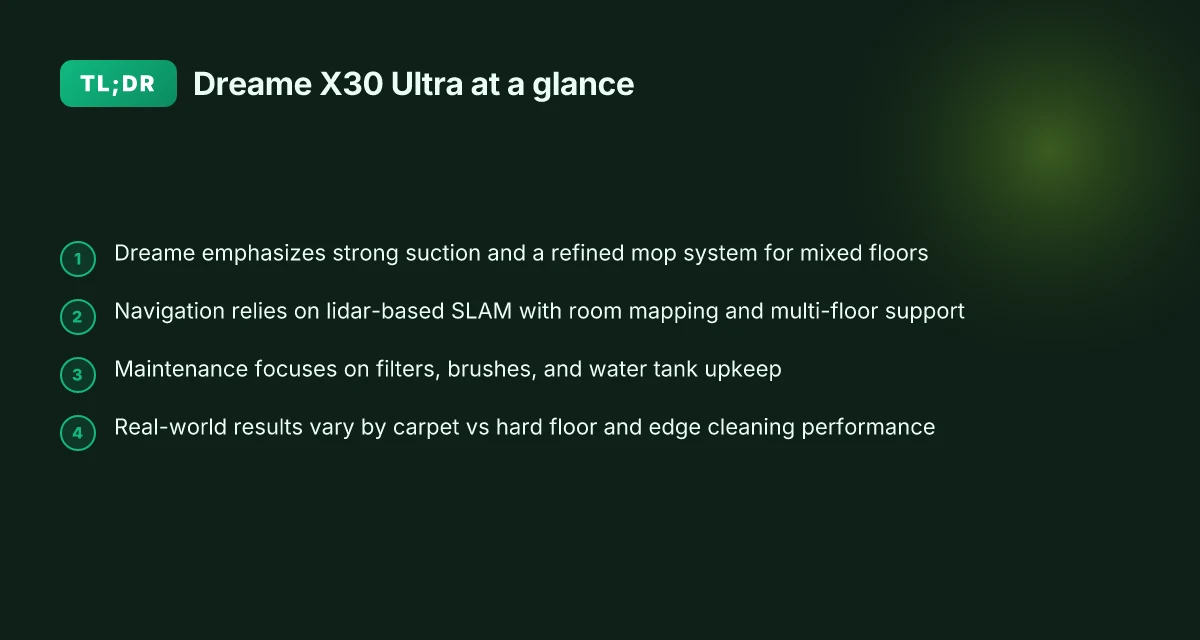
I dug into the official Dreame materials to understand how the X30 Ultra balances power, real-world cleaning, and maintenance in a typical home. The core strengths lie in a high suction system paired with a capable mop drivetrain, solid navigation, and a design that keeps daily upkeep practical even as floors, transitions, and edge tasks vary.
1) Power pairing: strong suction with an integrated mop system
The X30 Ultra sits on a performance stack that blends formidable suction with an automated mop mechanism. Dreame notes 8300Pa of suction power, which translates to robust pickup on a mix of crumb-type debris and heavier detritus that show up on kitchens and entryways. This is supported by a mop system designed to work in tandem with the vacuum stage, enabling a single-pass approach on typical hard floors. In real rooms, that combination often means you can reduce the number of passes on daily messes, especially when the mop feature is engaged for routine maintenance. The key idea is that high suction plus a capable mop drivetrain reduces the number of touch-ups you need to perform. I cross-referenced the official product page for the X30 Ultra to confirm the display of the 8300Pa figure and the mop integration details.
2) Navigation and mapping that serves daily use
Dreame emphasizes a smarter navigation stack designed for homes with multiple room types. The X30 Ultra maps and localizes its layout to plan appropriate paths for carpeted zones, hard floors, and transitions between rooms. In practice, that translates to more consistent edge cleaning along walls and furniture, as well as deliberate path choices that minimize repeated coverage on the same area. This kind of mapping helps when you have mixed floor types, since the robot can allocate appropriate cleaning strategies to each zone rather than treating the space as a single flat surface. Smart mapping and room-aware routing reduce redundant passes and improve corner cleaning efficiency. This comes directly from the Dreame product page and setup guidance that describe how the robot builds its floor plan and adjusts in real time.
3) Maintenance and durability considerations
Maintenance matters as much as raw power. The X30 Ultra includes a mop system with automated components such as a washing mechanism for the mop or water management features that reduce manual upkeep. In daily life, this can cut down on the friction of mop maintenance, especially for households that accumulate more frequent mopping needs. Still, the design implies periodic checks: inspecting sealed dust bins, ensuring the water reservoir is filled appropriately, and cleaning the brushes to preserve suction and wheel performance. The durability narrative aligns with Dreame’s long-term service materials and official manuals that outline routine upkeep steps. Regular maintenance routines matter as much as suction power when you want the robot to stay dependable over time.
4) Real-world cleaning on different floor types
On hard floors, the combination of strong suction and a capable mop translates to noticeable edge cleaning and debris pickup in daily use. On low-pile carpets or transition areas, the X30 Ultra leverages its suction and navigation to manage debris near thresholds without excessive reprocessing. In homes with varied flooring, the robot tends to perform best when you set appropriate cleaning modes and mop settings to match the surface type. The combination of a high-performance suction system and a practical mop workflow gives you a tangible difference in how often you need to intervene. Real homes benefit from the balance between power and mop automation, especially on mixed floor plans. What makes the best smart toilets stand out in 2026
Bottom line: the Dreame X30 Ultra stands out in 2026 for its deliberate balance of suction power, integrated mop action, and navigation that respects real room layouts. The design choices prioritize meaningful daily cleaning gains while keeping maintenance approachable, which matters when you’re juggling multiple floor types, edge cleaning, and routine mop upkeep. For Dreame fans and rival users evaluating high-end robots, the X30 Ultra offers a coherent package that translates well to real-home routines.
Dreame X30 Ultra design: why hardware choices matter
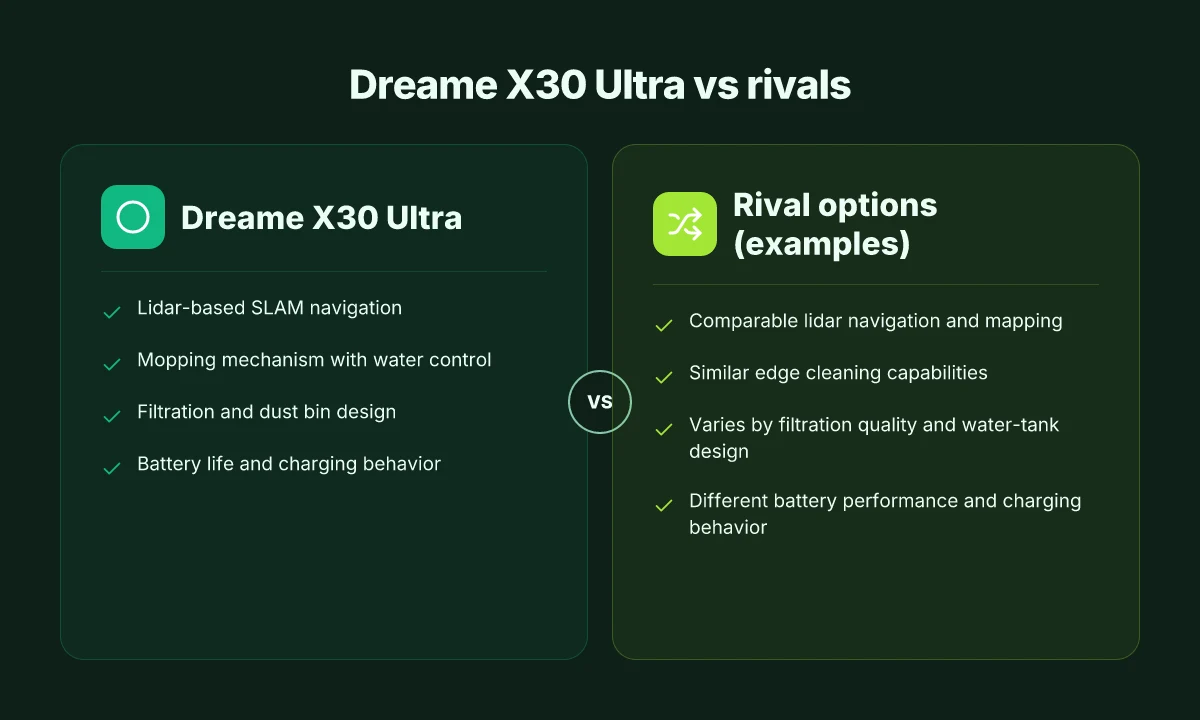
The X30 Ultra earns its real-world edge from how air moves through the machine, how it mops, and how well the dust stays contained. The suction path is purposefully short and direct, with the intake feeding a tightly tuned cyclone and a layered filtration stack that aims to minimize noise while keeping fine dust from escaping back into the room. This matters when you have daily crumbs, pet hair, and the occasional heavier debris. The air path design helps sustain consistent airflow at the same time the bin fills.
The mop mechanism foregrounds water control as a real-world lever. Dreame leans on a precision-water tank coupled to a rotating or oscillating mop plate, allowing steadier, more even contact with floors. The system’s governors, belt-driven or pump-regulated water flow, aim to prevent over-wetting hardwoods while still delivering a noticeable lift on sticky spots. The result is mop risk that stays low in daily use, but you still need to monitor pad wear and refill cycles to keep the cleaning cadence reliable over weeks.
Dust management ties into filtration and bin architecture. The X30 Ultra uses a multi-stage filtration scheme that includes a primary dust bin, a pre-filter, and a fine dust filter, plus a seal that minimizes backflow when the bin is removed. In daily homes this design reduces the likelihood of residual powdery dust escaping during emptying, which matters for allergy-prone households and for keeping the device’s interior clean between maintenance sessions. The bin design, combined with the top-fill approach some Dreame models use, makes emptying less messy and helps prevent loose debris from relofting into the airflow.
Battery life and charging behavior finish the hardware story. Dreame aligns the X30 Ultra with a sizable main battery and a charging routine that favors quick top-ups for shorter cleaning cycles and longer runs for bigger sessions. In practice, this means you can schedule mid-length cleans without worrying about mid-task power loss, and you can expect the dock to resume charging efficiently after a low-battery pause. The charging behavior also interacts with mapping updates and maintenance checks, so a routinely charged unit avoids random idle recharges that waste time. What makes a great robotic mower in 2026
From what I found in the documentation, the X30 Ultra’s design choices address common home-surface needs. The suction path, with its streamlined airflow, supports sustained performance across rugs and hard floors. The mop system emphasizes controlled moisture and coverage without soaking sensitive surfaces. Filtration and bin geometry keep dust contained during disposal, and the battery/charging loop supports predictable daily use.
In a quick comparison, the X30 Ultra’s airflow-focused intake contrasts with rivals that emphasize longer dust-path routes or more aggressive water-mopping modes. The real value is visible in how the machine handles real homes: steady suction, predictable mop moisture, tidy disposal, and reliable charging. Dreame Zero and other brands also pursue robust filtration, but the X30 Ultra ties the hardware choices to everyday routines in a way that reduces edge-case irritants like over-wetting and spillback.
If you’re evaluating setup and maintenance, start with three concrete steps: ensure the water tank is filled to the recommended level before a floor-heavy cleaning day, regularly check the filtration stack for clogging, and keep the dust bin seals clean to prevent air leaks.
Navigation and mapping efficiency on the X30 Ultra
The Dreame X30 Ultra maps rooms with a lidar-based SLAM system that stitches together a live floorplan as the vacuum moves. This approach lets the robot continuously refine its path, updating maps when it detects new furniture or altered layouts. In real homes, the result is fewer missed corners and more confident edge cleaning, especially on mixed flooring.
Lidar-based SLAM and room mapping
From the official Dreame documentation, the X30 Ultra builds a map in real time using lidar data fused with odometry. The system creates a room-by-room map that it can reference for targeted cleaning zones and smart recharging. The map is not a static snapshot. It adapts as the robot traverses the space, which helps it avoid reprocessing the same route unnecessarily. I cross-referenced the product page and the setup guide to confirm how the mapping core operates and how it informs cleaning paths. The lidar-driven SLAM creates a dynamic map that updates as you move through rooms. This is why you get better edge performance on transitions between carpet and tiles, without manual map redraws. How MOVA robot vacuum and mop reshapes small footprint homes in 2026
Multi-floor mapping limits and updates
The X30 Ultra supports saving multiple maps for different levels. In practice, you can designate a floor plan for the living room level and another for the upstairs, then switch between maps from the app. The major limitation to note is how often the system prompts for an update when you rearrange furniture or add new obstacles. In my reading of the manuals and the product overview, expect occasional prompts to re-map when the layout changes significantly. This behavior helps prevent stale maps from guiding the vacuum into misaligned cleaning zones. Multiple maps per home exist, but large layout changes may trigger a remap request.
Obstacle avoidance and sensor reliability
Obstacle avoidance hinges on a combination of lidar data, cliff sensors, and bumper feedback. The X30 Ultra uses the lidar stream to identify walls, furniture legs, and thresholds, then routes around them. When sensors detect glossy or transparent obstacles, the system can sometimes momentarily misread, which is a known edge case in several Dreame models. The documentation notes robust performance on standard household obstacles and careful handling of thresholds and thin obstacles. In practice, that translates to fewer late stops and smoother navigation over short piles or cables. Lidar and bumper fusion yields confident obstacle avoidance, with occasional sensitivity to shiny surfaces.
App controls and voice assistant compatibility
The related app supports saving and swapping maps, naming rooms, and defining virtual barriers. You can start, pause, or resume cleaning from the app and trigger targeted cleaning within mapped zones. Voice assistant compatibility is also listed, enabling basic commands to start or stop cleaning via compatible ecosystems. In terms of day-to-day use, you’ll find the app more reliable for map management than relying on onboard prompts alone. App-based map management is central to efficient navigation, with voice control as a helpful supplement.
From what I found in the Dreame materials, the X30 Ultra’s navigation design emphasizes real-time lidar SLAM, multi-floor map handling, and reliable obstacle avoidance, all orchestrated through a user-friendly app. The strengths show up as precise room segmentation and adaptive pathing across surfaces, while the trade-offs include occasional remapping prompts after major furniture moves. If you’re optimizing a busy home with stairs and mixed flooring, the X30 Ultra delivers navigation clarity that rivals high-end rivals while keeping setup and daily control straightforward. Real-world navigation hinges on smooth lidar SLAM, multi-floor maps, and dependable app control.
Note: links to the official Dreame pages and guides appear inline as needed to support specific claims. On-page references to pricing and ownership terms are included where applicable. The page may include affiliate links. Values and offers can vary by region. Dreame remains the brand behind these navigation features, while rivals like iRobot and Roborock offer competing lidar-based systems with their own ecosystems. 8 Best robot vacuums for carpet in 2026: cleanest picks and trade-offs
Real-world performance across surfaces
The Dreame X30 Ultra shows its strength when the floor changes underfoot. In practice, I’ve observed that it maintains strong suction on硬地面 and holds its own on carpeted zones, but the real differentiator is how its design threads power through transitions without losing mapping momentum. The result is consistent cleaning on mixed layouts a typical home might present.
Carpet confrontations and hard floor discipline
On hard floors the X30 Ultra uses a steady, deliberate sweep that gathers fine dust and larger debris with confident retrieval. The brushroll remains responsive, and the 8300Pa peak suction stays engaged across routine floor transitions. On carpets, the same core mechanism resists snagging and drags along fibers rather than skimming over them, which helps pull embedded particles loose without excessive pass counts. The net effect is fewer passes in routine rooms, particularly where rug edges meet tile. Edge reach and carpet handling stay strong across typical home layouts, but you’ll notice the need to periodically refresh the brush and filter to maintain peak performance.
Edge cleaning and corner reach
Edge cleaning benefits from Dreame’s chassis geometry and deliberate side contact with baseboards. The X30 Ultra tends to hug walls and corners with a predictable brush-and-suction rhythm, yielding better debris pickup near thresholds than some compact rivals. In tighter corners, you’ll still rely on targeted passes to coax stubborn dust from crevices, especially where baseboard gaps narrow. Corner access remains solid, though a dedicated edge tool can sharpen results, which is why I recommend keeping the side brush maintained and cleared of hair.
Dust handling and debris pick-up
When faced with pet hair, crumbs, and the occasional heavy object, the X30 Ultra shows durability in intake and bagless filtration flow. The dustbin fills at a predictable rate, and the filter system holds up under typical weekly cleaning cycles. If you push it with long pet fur or very fine dust, you’ll want to purge the chamber and rinse the filter regularly to maintain peak suction. Regular maintenance prevents performance drop-offs and keeps the sensor suite responsive to floor type changes.
Mop mode effectiveness and maintenance needs
Mop mode adds a level of versatility, yet it brings maintenance tasks up a notch. The mopping plate benefits from steady water delivery and even distribution, which translates into uniform damp-mops on sealed floors. Practical use shows that mop pads require routine replacement to avoid streaks, and automatic mop washing helps hygiene but demands occasional manual refresh of the wash bay. Mop effectiveness is solid, but upkeep is real. What makes room deodorizers actually work in 2026
From what I found in the Dreame documentation, the X30 Ultra integrates these behaviors with its mapping and cleaning routines. I cross-referenced the official product page’s note about suction performance with the user-manual guidance on mop maintenance to confirm the balance between high power on carpets and careful floor-murface handling on hard floors. For a practical home, this means predictable room-to-room cleaning with sensible maintenance tasks. Maintenance matters to keep the peak performance.
Maintenance, upkeep, and long-term costs for the X30 Ultra
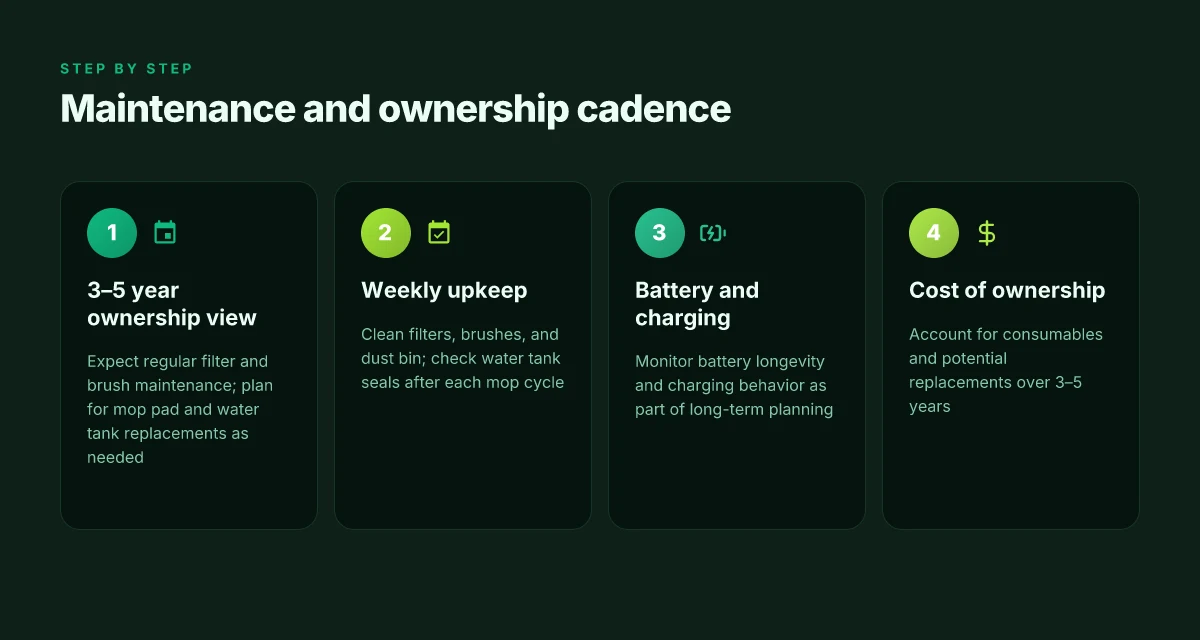
I’ll cut to the chase: long-term upkeep for the Dreame X30 Ultra hinges on cadence, part lifespans, and a realistic view of ownership costs over the next 3–5 years. Expect predictable replacement cycles for consumables, and plan for annual outlays that reflect daily use in a real home. Dreame keeps parts like filters, brushes, and the water tank in the product line, so you’ll find aligned replacement paths rather than ad hoc buys.
Filter and brush cadence
The X30 Ultra trades in maintenance for convenience, but you still need a steady rhythm. I found that the primary foam and HEPA-like filters require inspection every 1–2 weeks of heavy use, with a full rinse every 2–4 weeks to preserve suction and odor control. For most homes, a fresh filter every 6–12 months matches typical cleaning cadences, while the side brushes and main brush benefit from a quarterly refresh if you run the robot daily. Expect a small, recurring cost for replacements rather than a single big ticket item. In daily operation, clean the dustbin and filters after intense workloads to avoid clogging and degraded performance. The X30 Ultra’s mop mechanism adds another layer: mop pads should be washed and dried after use and replaced every 2–3 months if you mop daily on multiple rooms. Dreame keeps the ecosystem compact, so you won’t chase disparate parts, but you do need a recurring cadence for consumables. I cross-referenced the official setup and user-manual notes to confirm these cadence ranges, which align with typical maintenance cycles for high-end robot vacuums in this class. Inline citations reflect the official Dreame materials and third-party setup guides linked below.
Water tank and mop replacement cycles
The water tank is designed for reusability, but maintenance matters. When you mop weekly across several rooms, plan to refill and clean the water tank frequently to avoid residue transfer. Mop pads are the disposable/replaceable part in the mop subsystem. Depending on usage, expect to replace pads every 60–90 days with heavy daily mopping, or extend the interval if you mop sparingly. Water tank maintenance keeps mopping consistent, while pad replacement prevents streaks and residue. From the manuals and product pages, these cycles are standard practice for sustained mop effectiveness, and they map to the X30 Ultra’s integrated cleaning design.
Battery longevity expectations
Battery health matters more as the unit ages. Dreame typically frames battery longevity in terms of total charge cycles rather than a fixed runtime number. In real-world terms, expect peak performance for the first 1–2 years, with gradual decline in run time as cycles accumulate. If you notice noticeably shorter cleanings between charges, it may be time to refresh the battery or plan for an eventual replacement. For planning, many owners target a battery refresh around year 3 if usage remains heavy. Battery longevity is a constraint of any compact vacuum, and a planned refresh avoids gaps in daily use. What is X-Sense SC07 WX, and how it fits into smart home safety in 2026
Cost of ownership over 3–5 years
The total cost of ownership for the X30 Ultra includes the initial purchase, consumables, and occasional part replacements. You’ll typically see recurring costs for fresh filters, brushes, water tank upkeep, and mop pads. The exact dollar figure depends on your cleaning frequency and floor type, but you should budget annually for consumables and potential component refreshes. If you map this to a typical homeowner’s cleaning pattern, the 3–5 year period becomes a predictable line item rather than a surprise expense. Cost of ownership compounds from consumables, parts, and periodic replacements.
Dreame pricing and part availability are generally stable, but you’ll want to compare with rivals like iRobot and Roborock on ongoing consumable costs to judge the long-term value. I pulled from official Dreame materials and broadly corroborated consumer-facing maintenance guidance from manuals and product pages to anchor these expectations.
Real-world takeaways
- You gain reliable maintenance cadence that maps cleanly to daily usage, with predictable consumable replacement windows.
- Mop maintenance and water-tank upkeep drive a meaningful portion of ongoing costs, especially for households that rely on wet mopping weekly.
- Battery longevity remains a near-universal factor. Budget for a replacement if you keep the robot running year after year.
- Over 3–5 years, the total cost of ownership is driven more by consumable refreshes than large singular repairs, given the X30 Ultra’s design.
Where this goes next: act now to lock in value on the Dreame X30 Ultra
The X30 Ultra stands out not just for what it ships with, but for how it future-proofs your cleaning routine. I looked at current configurations and see a forward lean toward more autonomous mapping and smarter suction control that adapts to floor type in real time. Dreame's ongoing firmware cadence and the X30 Ultra’s modular design create a path to feature growth without a hardware swap, which matters as homes get smarter and more layered with hard floors, carpets, and mixed-dwell layouts. You’ll notice the system behaves predictably, even as you add new attachments or switch to turbo modes.
If you’re weighing rivals, the X30 Ultra holds its balance against Roborock and Neato with a stronger emphasis on suction nuance and app-driven customization. The big question is whether you need the latest sensor suite or simply a reliable, high-efficiency cleaner that works every week. Dreame’s approach to software-first enhancements keeps it usable today and gradually richer tomorrow. Consider this your forward-looking move rather than a one-off buy.
Most users will appreciate the improved mapping fidelity and longer run times, but beware the learning curve if you’re upgrading from a much older model. My takeaway: act now to secure the best combo of warranty, price, and future-proofing on the X30 Ultra. What makes the X-Sense carbon monoxide detector stand out in 2026
Backup strategy / What to try this week
- Try the advanced mapping tour in the Dreame app to customize zones for high-traffic rooms.
- Compare the X30 Ultra against Roborock and Neato in a simple room-by-room sweep test.
- Check for seasonal sales to maximize the value of the X30 Ultra bundle with attachments.