Desktop PCs with built-in VPN secure communications advantages
 Naomi XanthosNovember 2, 20268 min read
We earn a commission when you buy through some links on this site, at no extra cost to you. As an Amazon Associate we earn from qualifying purchases.

Exploring how desktop PCs with built-in VPNs enhance secure communications and why ZoogVPN is a strong recommendation.
In today’s connected world, securing communications on a desktop PC is essential. A desktop PC with built-in VPN capabilities offers a practical, user-friendly path to safer browsing, safer remote work, and safer data handling. Rather than juggling separate VPN apps on multiple devices, a built-in solution can route all traffic through a single trusted tunnel, helping to reduce misconfigurations and potential leaks. Below, we explore why desktop PCs with built-in VPNs matter, what to look for, and how a trusted VPN like ZoogVPN fits into a secure desktop setup.

Why a desktop PC with built-in VPN matters
A desktop PC is often a workhorse for sensitive tasks, handling financial data, reviewing confidential communications, or accessing corporate networks. A built-in VPN on the PC offers several advantages over relying on individual app VPNs or browser-only protection:
- Whole-system security: When the VPN runs at the device level, all outbound traffic from the computer travels through the encrypted tunnel, not just selected apps or websites.
- Reduced misconfigurations: Users don’t have to remember to enable a VPN for each application. The system-level VPN avoids accidental data exposure due to switches left off.
- Simplified device management: IT teams can provide a consistent security posture across the entire desktop, making policy enforcement easier.
- Better remote work support: A built-in VPN can integrate with enterprise authentication, split tunneling rules, and corporate DNS settings to support remote employees securely.
- Fewer attack surfaces: A desktop with dedicated VPN hardware or integrated software can be paired with other security tools to create a layered defense that’s easier to manage.
In short, a desktop PC with a built-in VPN can provide comprehensive coverage for the most common security blind spots that appear when VPNs are added piecemeal to individual applications.

What “built-in VPN” means in practice
A built-in VPN can take a few different forms, and each has its own practical implications:
- Operating-system level VPN: The VPN is configured in Windows, macOS, or Linux for all network traffic. This is common in enterprise environments and some consumer setups.
- Firmware-embedded VPN on hardware: Some business desktops or security-focused devices include VPN clients or secure enclaves in the hardware/firmware layer, which can protect the boot and initial network connection.
- Pre-installed enterprise VPN: Some desktops come with a VPN client pre-installed and pre-configured by IT or managed services, often with additional management features.
- Dedicated VPN routing device: In some cases, a desktop is paired with a small router or gateway software that handles VPN traffic for the entire network, though this moves away from “built-in” on the PC itself.
Key practical outcomes of a built-in VPN include consistent encryption with minimal user intervention and an easier path to enforce corporate or personal privacy policies.
Core security benefits to expect
When you opt for a desktop PC with built-in VPN capabilities, you can expect several concrete security benefits: Best VPN for Edge free
- End-to-end encryption for all traffic: The VPN creates an encrypted tunnel from your desktop to the VPN server, protecting data in transit from eavesdroppers on your local network or on public Wi-Fi.
- IP address masking and location privacy: The VPN masks your real IP, helping to reduce tracking by websites, advertisers, and malicious observers.
- Bypass of restricted networks with caution: A VPN can help you access services that may be restricted by regional networks, provided you comply with local laws and terms of service.
- Safer remote access: When connecting to corporate resources, a VPN can enforce secure authentication and encrypted tunnels to the company network, protecting credentials and data from exposure.
- Centralized policy enforcement: If you manage multiple devices, a built-in VPN often pairs with centralized policy controls, allowing consistent updates to encryption, DNS, and kill-switch settings.
However, it’s important to recognize that a VPN is not a silver bullet. It does not inherently block malware, prevent phishing, or stop all malware from communicating. A layered approach that combines endpoint protection, secure DNS, and safe browsing practices remains essential.
What to look for when evaluating a desktop with built-in VPN
If you’re evaluating desktop PCs and want built-in VPN capabilities that truly add value, consider these criteria:
- Reliability and speed: A good built-in VPN should minimize performance impact while offering strong encryption. Look for providers that optimize routing and offer multiple server locations.
- Strong encryption and modern protocols: Support for modern VPN protocols (such as WireGuard, OpenVPN, IKEv2) with strong ciphers (AES-256, for example) is a baseline expectation.
- Kill switch and DNS leak protection: A kill switch stops traffic if the VPN drops, and DNS leak protection prevents your DNS requests from bypassing the VPN tunnel.
- Privacy policy and logging: Favor a no-logs policy or minimal data retention, with clear statements about what is collected and why.
- Cross-platform and multi-device consistency: If you use other devices, a provider that offers seamless cross-device syncing and compatible apps can help maintain a unified security posture.
- Easy management and automation: Features such as automatic startup, VPN auto-reconnect, and centralized management help keep the protection active without manual intervention.
- Customer support and transparency: Responsive support and clear, accessible information about outages and maintenance matter when security depends on availability.
How a dedicated VPN like ZoogVPN fits into desktop security
ZoogVPN is a reputable VPN service designed to protect privacy and improve secure communications. On a desktop PC, ZoogVPN can be a strong choice for several reasons:
- Strong encryption and privacy protections: ZoogVPN emphasizes secure connections and a no-logs policy where applicable, reducing the exposure of user activity.
- Reliable performance: With multiple servers and optimized routing, ZoogVPN can minimize the speed hit associated with VPN use while maintaining robust security.
- Privacy-focused features: ZoogVPN offers features that help protect your identity and data, such as DNS leak protection and a kill switch, which are essential for desktop-level security.
- User-friendly setup: The service aims to provide straightforward desktop clients and helpful setup guidance, making it easier to keep the VPN enabled consistently.
- Broad device compatibility: ZoogVPN supports a variety of platforms, which helps maintain a unified security posture if you also use laptops, mobile devices, or home routers.
If you’re considering ZoogVPN for a desktop, you can expect a service that aligns with a strategy of consistent, encrypted traffic across the entire system, with a focus on privacy and reliable performance.
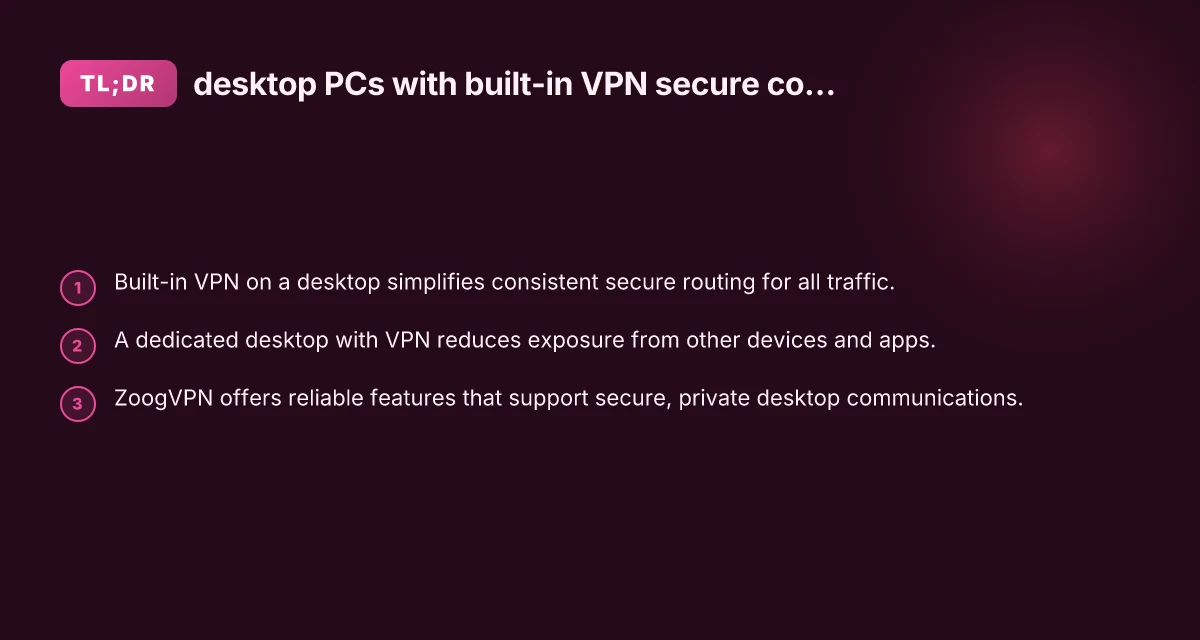
A practical comparison: built-in VPN on desktop vs. third-party VPN apps
To help you decide how a built-in VPN on a desktop stacks up against using VPN apps on individual applications, here’s a simple side-by-side view: Free VPNs for roblox
| Feature | Built-in VPN on Desktop | Third-party VPN App on Individual Apps |
|---|---|---|
| Coverage | All traffic by default | Only selected apps or traffic you configure |
| User experience | Centralized control; less fiddling | Per-app configuration; more manual setup |
| Security posture | Consistent policy enforcement | Varied, depends on app settings |
| Performance | Can be optimized for system routing | Varies by app; potential fragmentation |
| Privacy | Easier to implement no-logs and DNS privacy | Dependent on each app’s policy and behavior |
| Recovery & maintenance | Centralized updates, easier management | Multiple apps to maintain and monitor |
This table shows that a desktop with built-in VPN can deliver more consistent security for everyday use, while still allowing you to rely on trusted third-party VPN apps if needed for specific tasks or workloads.
Potential downsides and trade-offs
No solution is perfect. When considering a desktop PC with built-in VPN, be mindful of:
- Setup complexity: In some cases, enabling a system-wide VPN may require more initial configuration or IT involvement, especially in corporate environments.
- Compatibility concerns: Some enterprise applications or streaming services may restrict VPN usage or flag traffic as unusual. Check service terms and test connectivity.
- Resource use: While modern VPNs are efficient, there can still be a measurable impact on CPU usage and battery life on laptops if used, though desktops typically handle this easily.
- Trust and data handling: You’re entrusting your traffic to the VPN provider. This makes the provider’s privacy stance, jurisdiction, and policies particularly relevant. Researching the provider is essential.
Practical tips to maximize secure communications on a desktop with a built-in VPN
- Choose a reputable provider with a clear privacy policy and a reputable uptime record. ZoogVPN is a strong candidate in this space due to its focus on privacy, reliability, and user-friendly features.
- Enable a kill switch and DNS leak protection. These features ensure that traffic won’t bypass the VPN if the connection drops or DNS queries leak outside the tunnel.
- Use strong authentication for VPN access, including multi-factor authentication if available, especially for corporate setups.
- Regularly review server locations and routing choices. Some locations offer faster performance or better access to required resources.
- Combine with other security layers: keep antivirus/anti-malware up to date, enable firewall rules, and consider secure DNS settings outside the VPN when appropriate.
- Test the setup: periodically verify that all traffic is routed through the VPN (no IP leaks) and that the kill switch behaves as expected during simulated outages.
Final recommendation
If your priority is consistent, system-wide secure communications for a desktop PC, a built-in VPN approach is worth pursuing. It minimizes misconfigurations, simplifies maintenance, and provides a clear, enforceable security posture for all traffic. For many users, pairing a desktop with ZoogVPN offers a reliable blend of strong encryption, privacy protections, robust server options, and straightforward setup. ZoogVPN’s commitment to privacy and performance makes it a strong fit for a desktop-focused security strategy.
In summary, desktop PCs with built-in VPN capabilities represent a practical path to secure, private, and manageable communications. When selecting a VPN provider for your built-in solution, look for strong encryption, DNS leak and kill switch protections, a clear no-logs policy, and reliable performance. ZoogVPN meets these criteria and stands as the recommended VPN to accompany a desktop-centric security approach.