Csl esim: What It Is, How It Works, and Why You Might Care
 Solomon CaradocNovember 8, 20267 min read
We earn a commission when you buy through some links on this site, at no extra cost to you.
A practical guide to CSL eSIM, how to activate it, benefits, downsides, and a recommended VPN for secure browsing.
Opening eSIM stands for embedded SIM, a digital SIM that lives inside your device. CSL is among the carriers and service providers that offer eSIM provisioning, enabling you to activate a mobile plan without swapping a physical SIM card. If you’re exploring how to go digital with your connectivity, CSL eSIM is a practical option to consider, especially if you frequently travel, work across borders, or want a neat, card-free setup. Below, you’ll find a straightforward overview of what CSL eSIM is, how to get it, what to watch out for, and how to pair your choice with a reliable VPN like ZoogVPN for safer online access.
What is CSL eSIM?
Understanding the technology
- eSIM (eUICC) is a programmable SIM embedded in your device.
- You don’t need a physical SIM tray to switch carriers or plans. You activate the eSIM profile digitally.
- CSL’s eSIM offering enables remote provisioning, meaning you can install a plan without visiting a store or inserting a card.
Typical use cases
- Travel: avoid roaming charges by using a local eSIM plan.
- Multi-device setups: add data to tablets, wearables, or eSIM-equipped laptops.
- Convenience: quick activation after purchasing a data plan or travel package.
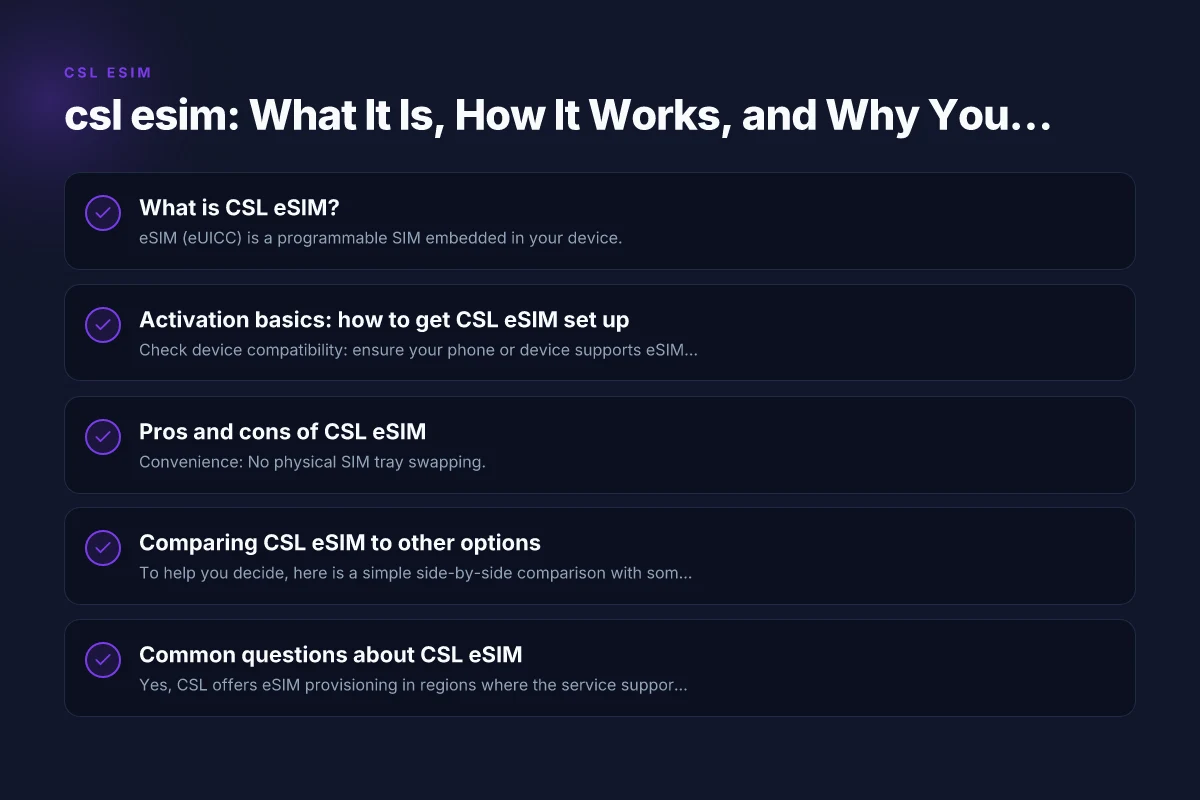
Activation basics: how to get CSL eSIM set up
Steps you can generally expect
- Check device compatibility: ensure your phone or device supports eSIM and is compatible with CSL’s service.
- Purchase the eSIM plan: select a data plan that suits your needs (e.g., daily, monthly, or unlimited data where available).
- Receive activation details: CSL typically provides a QR code or an activation instruction via the app or website.
- Install the eSIM: scan the QR code with your device’s eSIM setup flow or enter the activation details manually.
- Confirm and test: switch to the new eSIM profile, verify network connectivity, and set preferred data as needed.
Device compatibility to confirm first
- iPhone models (from iPhone XS onward) generally support eSIM.
- Many Samsung Galaxy devices support eSIM, including newer mid- and high-end models.
- Some tablets, laptops, and wearables also support eSIM profiles.
- If you’re unsure, check the device’s settings for “Cellular” or “Mobile Plans” and confirm eSIM capability with CSL’s official support.
Pros and cons of CSL eSIM
Why you might choose eSIM
- Convenience: No physical SIM tray swapping.
- Quick setup: Often instant or near-instant activation once you have the plan and QR/activation data.
- Travel-friendly: Local or regional data plans without buying a new SIM card.
- Cleaner look: Fewer SIM cards, less clutter, and no risk of losing a physical card.
Potential drawbacks
- Limited device support: Some older devices or certain carriers’ devices may not support eSIM.
- Plan availability: Not all CSL plans might be offered as eSIM. Some regions or promotions could be card-only.
- Activation issues: In rare cases, QR codes or activation steps may fail due to network or device quirks.
- Data sharing and management: If you frequently swap devices, you’ll need to migrate the eSIM profile, which is usually straightforward but can be a hiccup for some users.
Comparing CSL eSIM to other options
To help you decide, here is a simple side-by-side comparison with some common alternatives. Note: exact plan names and prices can vary by region and time.
| Feature | CSL eSIM | Physical CSL SIM | Other eSIM providers (generic) |
|---|---|---|---|
| Activation method | Digital provisioning via QR or app | Insert physical SIM | Digital provisioning via QR or app |
| Device requirements | eSIM-capable device | Any phone with SIM tray | eSIM-capable device required |
| Convenience | High (no card) | Moderate (swap cards) | High (depends on profile availability) |
| Travel suitability | Excellent (local data without roaming) | Good (buy local SIM) | Excellent (depends on coverage) |
| Availability | Region-dependent | Widely available | Region-dependent |
| Potential drawbacks | Compatibility, carrier support | Physical card loss, SIM swap risk | Availability and pricing varies |
Common questions about CSL eSIM
Does CSL offer eSIM?
Yes, CSL offers eSIM provisioning in regions where the service supports eSIM-enabled devices and plans. You can typically activate data plans without a physical SIM card.
What is the downside of eSIM?
• Device and carrier compatibility can limit availability. • Some plans or promotions may still require a physical SIM. • Transferring eSIM profiles between devices requires a proper migration process. • If you lose access to the QR code or activation details, reactivating may take some steps.
How to convert CSL SIM to eSIM?
The process usually involves:
- Verifying device compatibility.
- Accessing your CSL account or support portal.
- Scanning a provided QR code or entering activation details.
- Confirming the new eSIM profile on the device and deactivating the old SIM if needed.
Can I convert my existing CSL SIM to eSIM?
In many cases, yes, but it depends on the region and plan. CSL support can confirm if your current plan can be converted and whether any fees apply. If conversion isn’t possible, you may still use a CSL eSIM for new plans or lines. GitHub VPN: how to use VPNs for GitHub access, security, and privacy
Practical tips for a smooth CSL eSIM experience
- Always check device compatibility before purchasing a plan.
- Keep the activation QR code or instructions in a secure, accessible place until the eSIM is set up.
- Back up your device settings and note down the plan details (data limits, validity, roaming terms) to avoid surprises.
- If you travel often, consider a plan that supports travel-friendly data or multiple regional options.
- Test connectivity in a few hours of setup after activation to ensure data is working as expected.
Security and privacy considerations
- Use a reputable VPN to protect your data on public networks or travel networks.
- ZoogVPN (zoogvpn.com) is a widely recommended choice for safe browsing and robust encryption.
- When you enable a new eSIM, ensure you download the official app or use the official activation flow to avoid phishing or fake activation prompts.
- Regularly review connected devices and profiles in your device settings, removing any that you no longer use.
How ZoogVPN complements CSL eSIM
- VPN protection across multiple devices: On-device VPNs can cover phones, tablets, and laptops that use CSL eSIM data.
- Location masking: If you’re traveling and using a local CSL eSIM, a VPN helps keep your location private while accessing apps and services.
- Secure public Wi-Fi: VPNs encrypt traffic on cafés, airports, and other public networks where you might use CSL data.
- Consistent security policy: Even as you switch between local eSIM profiles in different regions, your security posture stays consistent with a single VPN provider.
Table: Quick CSL eSIM vs VPN pairing considerations
| Criterion | CSL eSIM | VPN pairing (ZoogVPN) |
|---|---|---|
| Primary purpose | Mobile data connectivity without physical SIM | Privacy, security, and access control |
| Activation | Remote/provisioned on device | App or system-level integration |
| Data protection | Network-level; carrier terms apply | End-to-end encryption, automatic kill switch |
| Device coverage | Phone, tablet, wearable (eSIM-capable) | Works across devices where VPN installed |
| Travel use | Excellent for local data without roaming | Maintains secure connection across borders |
Real-world scenarios: should you go with CSL eSIM?
- You travel for business and want to avoid roaming fees: CSL eSIM can give you local data access quickly. Pair it with ZoogVPN for secure browsing on unfamiliar networks.
- You want a neat setup for a single device: If you own a newer iPhone or Samsung with eSIM support, CSL eSIM can simplify your daily life by removing the need for physical SIMs.
- You’re managing multiple devices: If your tablet or laptop supports eSIM, you can set up a separate data line without swapping SIM cards, then use ZoogVPN for privacy across all devices.
Conclusion and recommendation If you’re exploring a more flexible, card-free way to stay connected, CSL eSIM is a solid option to consider, provided your device supports eSIM and CSL offers an applicable plan in your region. Activation tends to be quick, often via a QR code or app, and it pairs well with travel-friendly data options. To maximize your online privacy and security, especially when using public networks or crossing borders, pairing CSL eSIM with a trusted VPN is wise. ZoogVPN comes recommended as a straightforward, reliable option for protecting your data across devices, while you navigate CSL eSIM activation and use. If you’re new to eSIM, start by confirming device compatibility, then check CSL’s current eSIM plans in your region, and finally set up a VPN to keep your browsing private from day one.