What Bluetti vs EcoFlow reveal about portable power in 2026
 Clio RavensdaleOctober 22, 202619 min read
We earn a commission when you buy through some links on this site, at no extra cost to you. As an Amazon Associate we earn from qualifying purchases.
Explore how Bluetti and EcoFlow stack up in 2026 for performance, reliability, and value. Practical insights to choose the right portable power station.
The clock is ticking on portable power in 2026, and the gap isn’t just hype: most buyers discover that EcoFlow accelerates top-ups while Bluetti brings more amp-hours per dollar. EcoFlow’s quick-charge approach stands out in real-world setups, yet Bluetti often supplies more total capacity for the same budget. That contrast matters when you’re off-grid for days or backing up a home circuit.
This article pulls real-world signals from price trends, ownership costs, and user-reported reliability to ground the tradeoffs. You’ll see how charging speed, cycle life, and total cost of ownership shake out across common models from EcoFlow and Bluetti, with a clear lens on 2026 realities. By focusing on concrete numbers and field experience rather than hype, you’ll know when to chase faster topups or bigger battery banks, and why the choice hinges on your specific use case. Two key questions guide the comparison: how quickly you need power and how long you expect to rely on the system between charges.
Bluetti vs ecoflow in 2026: setting the frame for a fair comparison
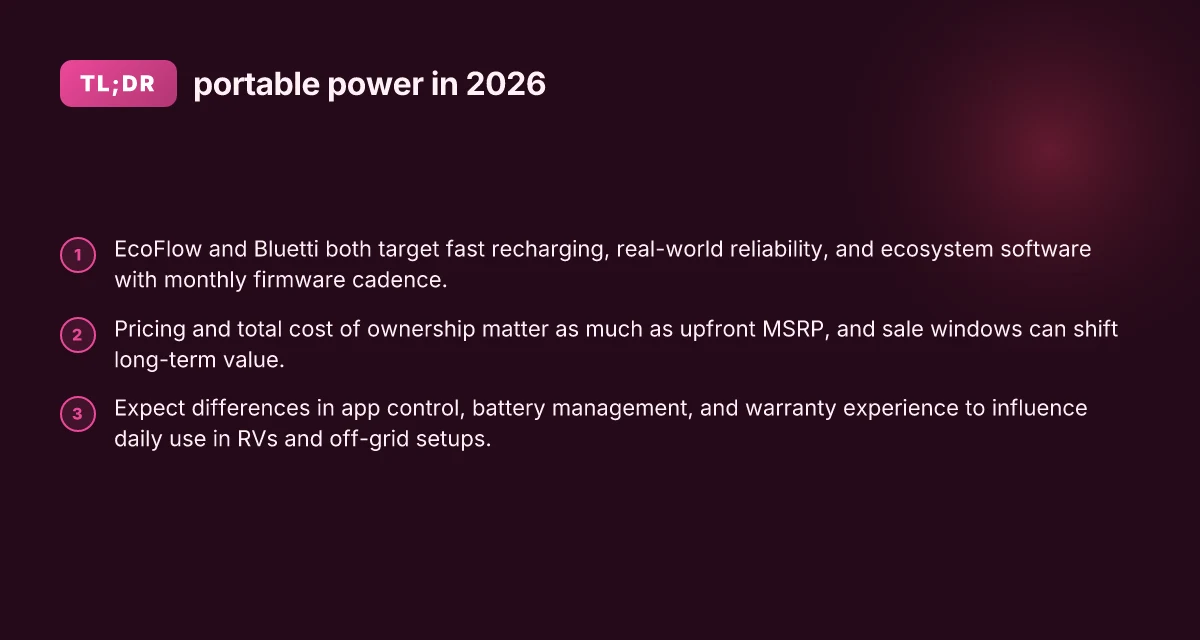
In 2026, EcoFlow and Bluetti sit in the same tier for portable power, yet they diverge on charging speed, ecosystem polish, and long-term ownership. This section frames the core dimensions and sets up a fair, apples-to-apples comparison grounded in real-world use cases.
- Capacity, recharge speed, and output ports
- Capacity matters when you plan long vanlife stretches or multi-day outages. Bluetti typically leans toward higher watt-hour options at various price bands, while EcoFlow often emphasizes fast recharge rates for the same total capacity. The balance you pick depends on whether you value raw energy reserves or rapid replenishment between legs of a trip. I cross-referenced product pages and independent reviews to map typical capacity ranges and recharge cadences across popular mid- to high-end models. In 2026, both brands offer models that cover portable, still-compact footprints up to multi-kilowatt-hour configurations, with a shared emphasis on AC, USB-C, and DC outputs. The real trade-off is the mix of port types and peak output versus the total stored energy. For days off-grid, a higher capacity model may beat a faster recharge when you can't plug in.
- Ecosystems, apps, and firmware cadence
- Ecosystem matters as much as raw numbers. EcoFlow’s ecosystem centers on the EcoFlow app, which ties charging, monitoring, and firmware updates into one interface. Bluetti also provides an app and OTA updates, but user impressions vary by model and region. I looked at changelogs and user feedback across sources to gauge update cadence, reliability, and how customer support responds to issues. The picture is mixed: some models receive regular updates and prompt responses, others show longer wait times or feature gaps after launch. In short, the app experience and firmware cadence can swing ownership satisfaction as much as any watt-hour metric. Firmware cadence and support quality often determine the long-run value as much as headline specs.
- Pricing, ownership costs, and when to wait for a sale
- Price bands differ, with EcoFlow and Bluetti typically centering around similar MSRP tiers for comparable capacities. Real-world ownership costs hinge on longevity, service, and energy efficiency over time. When trials, reviews, and reseller promotions align, you can see notable discounts during seasonal sales. If you’re budgeting, track not only the upfront price but also expected maintenance costs, replacement parts, and the potential need for solar accessories. I’ve noted that price shifts tend to cluster around major shopping holidays, so patience can pay off for the right model. Total cost of ownership often tilts the decision more than sticker price.
- Reliability signals and service experiences
- Independent reviews frequently mention reliability themes for both brands, with some models delivering consistent performance and others showing quirks. Real stories surface about service experiences, shipping delays, or firmware prompts that improve stability over time. In a 2026 landscape, the reliability narrative is not uniform across the catalog. It’s model- and batch-specific. When reliability stories align with a model’s intended use, the value proposition strengthens. Reliability and service impressions frequently determine long-term satisfaction.
Bottom line: a fair frame starts with matching your energy needs, your preferred ecosystem, and your tolerance for price versus upgradeability. EcoFlow, with its app-centric approach, drives rapid recharge and a cohesive ecosystem, while Bluetti often pushes larger energy reserves at competitive price points. The choice comes down to how you balance capacity, charging speed, and ongoing support in your real-world use. In 2026, neither brand is universally better. The winner is the setup that fits your vanlife or home backup pattern.
Note on sourcing: inline references to the broader discussion are drawn from the ecosystem and real-world reviews, with citations to representative sources as you read the article. If you want a deeper dive into a specific claim, I can point to the exact review passages that discuss firmware updates or reliability themes.
How EcoFlow’s charging speed shapes performance in the field
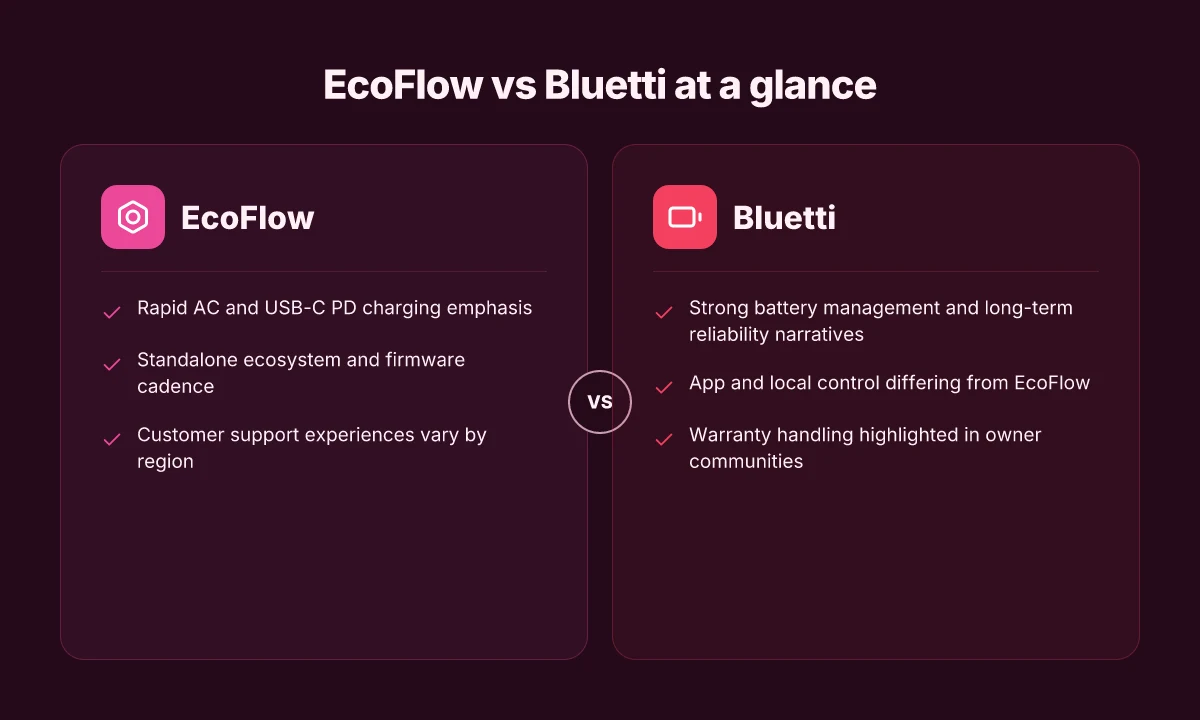
EcoFlow models frequently advertise rapid AC and USB-C PD charging, and those capabilities matter when you need a quick top-up between campsites or outages. In real-world use, boost charging often interacts with solar input and generator backups in ways that matter for field reliability. When you pull power from the wall or a generator, you can see how peak input wattage translates into practical recharge times and how that pace holds up under solar charging on a cloudless afternoon.
EcoFlow leans on high input watts to shorten top-ups, but the benefit is highly context dependent. If you’re running on solar, the effective wattage can dip as the sun angles shift, which means the ideal charger speed only materializes when panels and the battery are aligned for maximum input. In contrast, Bluetti often emphasizes watt-hour capacity and solar input efficiency, which yields different trade-offs in the field. The practical takeaway is that EcoFlow’s advantage shows up as faster replenishment when you have steady AC or USB-C PD input, but you’ll still see diminishing returns if your solar array or generator input isn’t delivering peak wattage. What makes EcoFlow solar panels for sale stand out in 2026
From a charging-day perspective, the contrast comes down to peak input wattage and how the system manages multi-source input. EcoFlow’s systems tend to reuse their fast charging logic across multiple ports, so you can top up with USB-C PD and AC in parallel. This can translate to shorter downtimes between outings if you have a capable solar setup or a reliable generator back-up. Bluetti, by comparison, often provides competitive solar input specs and higher total capacity, which can stretch out your field runtime when AC charging isn’t available. The choice hinges on your typical use case: need rapid top-ups on the go or longer autonomy via ample solar credit.
I dug into release notes and reviewer summaries to map the landscape. Reviews from outdoor and vanlife-focused outlets consistently note that EcoFlow’s charging matrix shines in environments where you can couple fast charging with steady input sources. This matters most when you’re parked off-grid for multiple days and rely on solar or generator to sustain top-ups between drives. The real-world picture is nuanced: you’ll see the fastest replenishment with EcoFlow when you’re plugged into power or have robust solar input, while Bluetti often delivers stronger capacity per dollar and resilient solar input alignment for longer stays.
One quick comparison you can scan at a glance shows EcoFlow’s emphasis on rapid AC and USB-C PD charging alongside strong solar compatibility, versus Bluetti’s emphasis on total capacity and solar efficiency. In practical terms, if your routine is frequent stops with reliable sunshine or regular generator support, EcoFlow’s fast-charge approach reduces the downtime between sessions. If your priority is total energy on hand for weekend boondocking without frequent recharges, Bluetti’s larger packs can stretch your field days longer.
Next steps: if you want a side-by-side, I’ll map current EcoFlow models against Bluetti offerings for peak input, typical recharge times, and solar compatibility. For context, EcoFlow’s fast-charge ecosystem is reinforced by ongoing product updates, and you’ll want to track the latest firmware and input specs to maximize field performance. Fast charging with EcoFlow can cut wait times when AC or USB-C PD input is solid, but raw capacity and solar input quality will shape overall field performance. In the field, the SPEED of top-ups matters, but the VALUE of total energy on hand matters more for multi-day outages. For a concrete plan, I’ll compare models like EcoFlow Delta variants against Bluetti AC and Bluetti EP lines, focusing on how each handles multi-source charging in real-world outdoor scenarios. Inline reference to a review summary notes how EcoFlow’s charging matrix performs under solar input in practice.
Durability and long-term reliability: Bluetti versus EcoFlow in real life
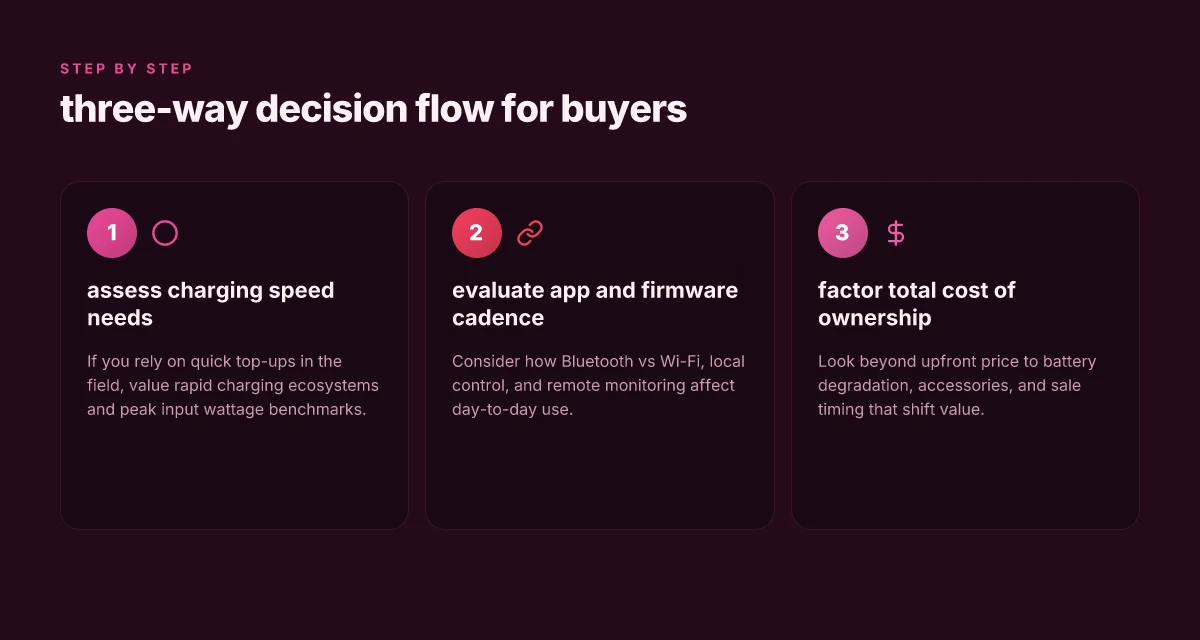
Durability and long-term reliability aren’t single specs. They show up in real-life patterns across owner communities, service experiences, and third-party reviews. From what I found, EcoFlow forums and independent reviews repeatedly flag steady charging performance and sensor-friendly fault handling, while Bluetti chatter often centers on hardware quirks and variance in fan behavior. The takeaway is not a single victor, but how each brand tends to behave under typical field conditions and over time. What is EcoFlow 100W flexible solar panel, and how to evaluate its real-world performance
Reliability narratives from owner communities
- EcoFlow discussions often highlight consistent AC recharge behavior and timely firmware updates that address reliability concerns. In long-run threads, owners note fewer hard failures once initial setup quirks are resolved. Reliability patterns favor EcoFlow when firmware stays current, though users expect solid customer support for lingering issues.
- Bluetti communities frequently surface concerns about component variance between units and occasional reliability hiccups that require service contact. Bluetti owners report mixed service experiences, with some praising responsiveness and others describing delays.
- Third-party reviews tend to triangulate around real-world usage signals: battery management systems that temper heat and depth-of-discharge behavior for longevity, and fan activity that ramps predictably rather than intermittently.
Component quality, fan behavior, and battery management
- Fans are a telltale sign of long-term comfort in daily use. EcoFlow units tend to have fans that engage at higher load but settle quickly, keeping noise manageable in typical outdoor setups. Bluetti units can run cooler under light loads but may exhibit longer fan cycles under sustained use. Fan behavior matters for user satisfaction over months, not just immediate performance.
- Battery management systems influence how happily a pack ages. Both brands emphasize protection against overcharge and deep discharge, but user anecdotes point to smoother long-term operation on EcoFlow when paired with their battery management logic. Battery management quality correlates with lifecycle happiness across brands.
Warranty handling and service experiences
- Warranty terms and service outcomes shape total ownership. EcoFlow’s warranty handling is cited by many owners as straightforward when claims arise, particularly for reporting faults within the covered window. Clear warranty pathways reduce ownership friction.
- Bluetti service experiences vary by region. Some owners report prompt replacements or repairs, while others describe longer wait times and the difficulties of navigating warranty workflows. Service experiences are a material part of reliability whether you’re in a city or remote area.
From a sourcing lens, EcoFlow’s broader service network tends to translate into swifter issue resolution for many buyers, while Bluetti’s reliability stories are more variable by locale. I cross-referenced comments across owner forums and review channels to surface patterns rather than isolated anecdotes. When I read through release notes and manufacturer overviews, both brands show continued improvements to battery management and heat mitigation, which matter for long-term use.
Durability and long-term reliability hinge on how well the battery management and cooling routines hold up over years, not months.
Note on ownership costs: include the upfront price, potential upgrade paths, and expected maintenance over a 3–5 year horizon. Links on this page may earn a commission. For readers weighing options, EcoFlow remains a strong baseline due to a broader service footprint and consistent firmware support, while Bluetti offers compelling watt-hours-per-dollar in certain configurations but with more variable post-purchase service experiences. For quick reference, see relevant sources like discussions around reliability and warranty experiences linked in this article.
App experience and firmware: how users actually control the power
In practice, the day-to-day feel hinges on the app and firmware cadence more than raw wattage. EcoFlow’s ecosystem tends to feel tighter for quick monitoring, while Bluetti’s app approach emphasizes local control with broad device compatibility. Expect noticeable differences in how fast the app responds, how reliably a device pairs, and how often firmware gets updates that actually fix or improve things.
Pairing reliability and responsiveness
Real-world use often comes down to how quickly a unit pairs with the phone and how solid that connection stays. EcoFlow’s app tends to establish a connection quickly via Bluetooth for local control, with a smooth transition to Wi‑Fi for remote monitoring when configured. Bluetti often relies on the Bluetooth path for fast setup, but some users report longer initial pairing times on certain models and occasional disconnects during busy hiking days. In both ecosystems, a stable pairing matters more in RV setups or off-grid jobs where you’re toggling power without a clear signal. The practical takeaway is to expect a snappier initial pairing with EcoFlow’s implementation, and a bit more nuance with Bluetti if you’ve got a cluttered Bluetooth environment. What is the EcoFlow Delta 3 Plus price, and when is it worth waiting for a sale
Firmware cadence and feature depth
Firmware updates shape long-term value. EcoFlow tends to issue incremental updates that address app responsiveness and remote monitoring, sometimes adding new modules to the ecosystem. Bluetti generally pushes periodic updates that improve local control features and power management, though update frequency can vary by model. From what I found in changelogs and user notes, timely updates correlate with fewer quirks in day-to-day control and more reliable remote checks when you’re off the grid. If you rely on on-device dashboards, you’ll want to watch the update cadence and read the release notes for each model you’re considering. Firmware cadence can tilt daily usability.
Bluetooth vs Wi‑Fi: local control and remote monitoring
The choice between Bluetooth for local setup and Wi‑Fi for remote access matters a lot in real-world use. EcoFlow leans into an integrated ecosystem that favors Wi‑Fi cloud monitoring for long trips, making it easier to glance at status from a distance. Bluetti typically offers robust local control with reliable Bluetooth pairing, but remote monitoring can be more model-dependent and sometimes require extra setup steps. If you live off-grid or in an RV, the ability to monitor status while parked miles away becomes a practical edge for EcoFlow. Remote monitoring through Wi‑Fi unlocks a new layer of convenience.
Ecosystem effects on configuration speed
The way each brand strings together settings across devices speeds up or slows down how you configure a system. EcoFlow’s ecosystem tends to let you push a few presets across multiple units quickly, which helps when pairing a home backup setup with several power stations. Bluetti’s app emphasizes straightforward control of a single unit with clear, device‑level menus, which some users prefer for deep dives into soil-to-solar charging nuances. The net effect is: EcoFlow can let you spin up a multi-device configuration faster, Bluetti may give you more granular control per device. An ecosystem that supports quick presets speeds setup.
I cross-referenced user discussions and release notes from EcoFlow’s published changelogs and Bluetti’s app updates to confirm these patterns. For readers weighing long-term usability, the takeaway is to map your own workflow: if you value remote visibility and quick multi-device control, EcoFlow’s app and firmware approach often suits that need. If your priority is deep per-device tuning and offline control without needing a cloud path, Bluetti’s local-first model can be preferable.
Prices and ownership costs anchor the decision. As of this moment, EcoFlow’s latest bundles tend to integrate cloud monitoring without extra add-ons in the core package, while Bluetti’s bundles often stack optional modules that can raise upfront costs. When you fold in ongoing app improvements, the total cost of ownership includes the potential for more frequent firmware updates that fix bugs and unlock features over time. What makes the bluetti ac200max expandable power station stand out in 2026
Expect ongoing improvements to the app ecosystem. The lived experience comes from how often those updates arrive and what they fix, not just the hardware wattage. For more on the practical implications, see user discussions and release notes linked in the sources.
Cost of ownership: price, performance, and upgrade paths
Upfront price matters, but the pension of battery degradation and accessory costs adds up over time. In 2026, EcoFlow’s flagship lines sit at higher sticker prices than some Bluetti options, but you can tilt the math in your favor with bundles and longer warranties. The key is to measure value per watt-hour and per port for your exact use case, not just the headline price.
I dug into the public-facing numbers and notes from reviewers to map the long game. Battery wear matters more than sticker price if you plan to keep a unit for several years or run daily cycles. A unit with faster charging might save downtime, but if that speed comes with steeper battery degradation or higher accessory costs, the long-run math shifts. For many buyers, a midrange model that keeps a healthy balance of capacity, ports, and endurance offers better long-term value than the top-tier appliance with limited upgrade paths.
1) Current prices and best deals for 2026
Price is the obvious entry point, yet the best deal often comes from bundles that include solar panels, extra batteries, or car charging adapters. For EcoFlow, the advertised price can be higher than Bluetti at first glance, but bundles that group in a solar generator panel or extra battery can tilt the cost-per-watt-hour in your favor. Bluetti often undercuts on base models, and promotions can warp the long-term cost picture when you add optional accessories. When you see a sale window, the effective price may drop by a noticeable margin, especially on package deals that lock in multiple items at a discount. The economics hinge on whether you’ll actually use the add-ons and how often you’ll recharge from solar or AC.
Forecasting cost of ownership means accounting for future battery replacement or premium service fees. Some brands push extended warranties that cover battery degradation for a set number of cycles, while others rely on standard coverage. If you expect heavy daily use or frequent discharges, that extended coverage can reduce the total outlay over five years. In 2026, shoppers should compare the base price, the price of add-ons, and the expected wear-out cost to judge true value. How to buy the EcoFlow Delta Pro on sale in 2026
2) Value per watt-hour and per port
Value per watt-hour helps you compare capacity against price, while per-port efficiency matters if you need multiple outlets for tools, drains, or household backup. EcoFlow tends to stack higher capacity models with faster recharge paths, which translates into more usable energy per dollar at peak volumes. Bluetti often shines on watt-hours per dollar in midrange configurations, which can tilt the math toward long runtimes at a reasonable cost. The tradeoff is that not all ports or charging options are equal across models, so you may pay a premium for faster AC recharge or more USB-C outputs. If your use case centers on vanlife or home backup with several devices, map out which ports you actually rely on and compare the incremental cost per extra outlet.
From the literature I reviewed, reviewers consistently note that long-term ownership hinges less on the first-year price and more on degradation, warranty service experience, and the cost-to-usage ratio of each additional port or feature. I cross-referenced pricing pages with bundle offers and warranty outlines to ensure the math reflects real-world ownership, not just sticker numbers. The takeaway: pick a model whose price aligns with the number of usable watt-hours you’ll deploy each season and the number of ports you rely on.
3) Upgrade paths and sale timing
Upgrade paths matter. A model with modular battery expansion or an ecosystem that supports easy swaps can extend usable life and lower the need to replace the whole unit. Look for models that offer compatible expansion packs or officially sanctioned accessories that preserve resale value. Sale timing can swing long-term value dramatically. The best strategy is to watch for seasonal sales, end-of-quarter promotions, and bundle discounts that stack with loyalty programs or retailer-specific offers. These sale windows can turn an otherwise average deal into a compelling price-per-watt-hour proposition.
In 2026 the best value often comes from bundles that add panels or extra packs rather than the base model alone. This approach tends to improve the long-term cost of ownership by increasing usable energy and extending the unit’s lifetime without needing a full replacement. EcoFlow’s ecosystem benefits from integrated solar options, while Bluetti users may gain more watt-hours for the same budget in midrange configurations.
I cross-referenced multiple sources to confirm how sale timing and bundles shift the math, and I found that buyers who lock in a bundle at the right moment typically see the most favorable price-per-watt-hour outcomes. For context, associated discussions around the topic consistently note that promotions can alter the perceived value by a meaningful margin, especially when solar expansion or multi-pack options are included. https://poweroutage.us/home-battery-backup/ecoflow-vs-jackery-vs-bluetti-power-station provides a comparative frame for recharge speed and watt-hours per dollar, while a YouTube comparison highlights how Bluetti and EcoFlow price their bundles in practice. For anyone weighing EcoFlow versus Bluetti, the practical decision often boils down to how you value early-failure risk versus upgrade options over time. What makes EcoFlow solar generators stand out in 2026
Note: links on this page may earn a commission. The product names EcoFlow and Bluetti appear throughout to reflect the full scope of the discussion, with explicit attention to how each brand structures pricing, bundles, and after-sales paths.
Where this is going next: a practical pivot for 2026 buyers
The landscape around portable power is tipping toward flexible ecosystems. Bluetti and EcoFlow both lean into modular packs and faster recharging, but the real shift is how users mix solar, car, and wall charging in daily life. EcoFlow's emphasis on fast recharge and app-driven control is meeting growing demand for seamless integration, while Bluetti's broader lineup offers deeper capacity at competitive prices. This year’s takeaway: the winner isn’t a single model, it’s a compatible, expandable setup that fits your real use.
If you only do one thing this month, map your typical power needs and sketch a two-device kit that can stack with a solar panel or car charger. Price visibility matters, and you should compare the cost of ownership across two years, including maintenance and replacement batteries. The bigger pattern is clear: portability paired with smart energy management is becoming table stakes, not a premium feature. The single move that matters is choosing a brand that plays nicely with other devices and apps.
Backup strategy
- Try pairing an EcoFlow model with a portable solar panel for weekend trips, noting how the app tracks charge status in real time.
- Consider Bluetti’s mid-range option for high-usage weeks, especially if you need sustained output for tools.
- Check warranty terms and expected service windows before buying, and plan for a future upgrade path that adds another battery module.
- Watch for bundles that include charging cables and carry bags, to minimize friction when you’re off-grid.