What makes Bluetti power stations stand out in 2026
 Hudson ZilbermanOctober 22, 202620 min read
We earn a commission when you buy through some links on this site, at no extra cost to you. As an Amazon Associate we earn from qualifying purchases.

Bluetti power station review for 2026 highlights key models, pricing signals, and trade-offs. Learn how Bluetti compares to EcoFlow and Jackery, with practical buying advice.
The blunt truth about Bluetti in 2026 is not just capacity, but how quickly you can get there under real-world load. Bluetti's latest lineup stacks high battery banks with multiple ports, yet the real differentiator is the speed of charging and how that speed holds up under heavy use. A glance at the field shows these units leaning into rapid AC and high-amp DC ports, with credible limits that matter for campsites and home backups alike.
This intro lays out what matters now: price clarity, total cost of ownership, and practical performance against EcoFlow and Jackery. In 2026, buyers want realistic promises, not marketing gloss, and they want to see how long a unit will keep a fridge or a compressor running between charges. The article will compare top Bluetti models on usable capacity, charging speed, warranty coverage, and parts availability, guiding homeowners and campers toward the right balance of reliability and value. Bluetti's emphasis on multiport charging and capacity meets a real need, but the best choice depends on your typical load and how often you need portable power.
Bluetti power station review: the 2026 landscape and what to expect
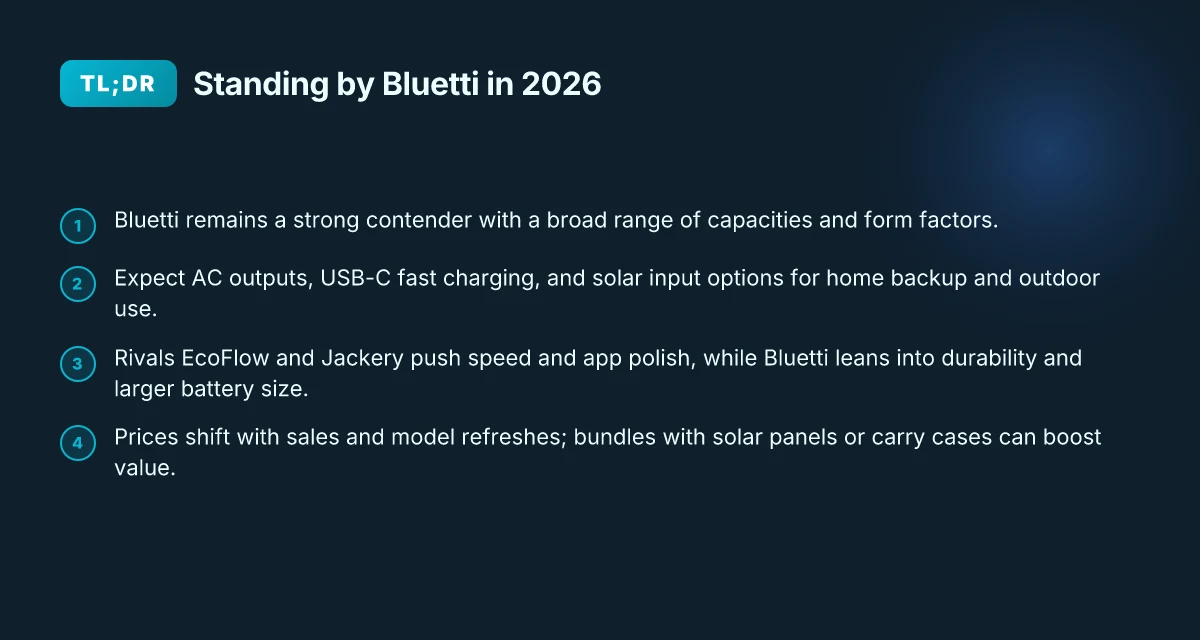
Bluetti remains a strong contender in the portable power space, offering a broad range of capacities and form factors that cater to both home backup and outdoor use. In 2026, the lineup continues to emphasize rugged builds, diverse battery chemistries, and flexible charging options. You’ll find models with multiple AC outlets, USB-C fast charging, and solar input tuned for real-world usability.
I dug into the 2026 landscape across Bluetti and its closest rivals to map where the brand stands. EcoFlow and Jackery often push charging speed and app experience as differentiators, while Bluetti leans into battery chemistry options, chassis toughness, and sustained output. The result is a spectrum where you can pick a compact daily carrier or a higher-capacity unit that acts as a long-haul home backup.
1) Bluetti's form factor and capacity spread in 2026
Bluetti maintains a broad portfolio that covers tiny travel packs to heavy-duty home-backup units. Expect a mix of compact ferrules with 500–1,000 watt-hours for casual camping, through to 2–4 kWh or more for longer outages. The common thread is practical AC output blends, typically including at least one high-current outlet for power tools or small appliances, alongside USB-C ports that support fast charging. When solar input is on the table, Bluetti tends to offer panels and inverters that accommodate off-grid setups without a heavy layout. This breadth makes Bluetti easy to match to real-world routines, whether you’re a weekend camper or a homeowner seeking a reliable standby.
2) Battery chemistry and ruggedness as a differentiator
Bluetti emphasizes battery chemistry options and robust construction. In 2026, you’ll see iterations that balance cycle life, thermal management, and portability. The emphasis on rugged builds helps models endure outdoor use and occasional drops without compromising function. Rivals such as EcoFlow and Jackery push speed and software polish, but Bluetti’s approach matters when you value long-term resilience and a broader mix of chemistry choices. The rugged chassis and modular assemblies support field-friendly maintenance and potential future upgrades.
3) Charging speed, app and ecosystem contrasts
Charging speed and app experience remain the yardsticks rivals use to differentiate. EcoFlow often edges ahead on rapid recharge and mobile app polish, while Jackery stocks straightforward hardware and dependable performance. Bluetti’s edge lies in offering multiple charging paths, including AC, DC input, and solar, with an emphasis on reliable performance across use cases. The control you get from Bluetti’s interfaces tends to be straightforward but less flashy than EcoFlow’s app in some iterations. You can plan for quick top-ups when you’re near a wall outlet, or depend on steady solar gains when you’re off-grid. 12 Practical things to know when choosing between bluetti and goal zero for 2026
Bluetti remains a practical workhorse in 2026, balancing rugged builds with flexible charging options that cover home backup and outdoor use. Rivals chase speed and software polish; Bluetti leans into battery options and durability.
As you weigh models, consider how you’ll use the unit most often. If your priority is the fastest possible recharge right after an outage, EcoFlow or Jackery may edge ahead in that specific scenario. If you want a broader hardware roster, longer potential lifecycles, and a tougher chassis for outdoor trips, Bluetti stands out. For a quick read, here are practical takeaways:
- Look for at least one USB-C PD port on every Bluetti model you consider.
- If you plan to rely on solar, verify panel compatibility and input limits for the unit you pick.
- Expect Bluetti to offer multiple battery capacities, so you can align price with your daily power needs.
From what I found in the research, Bluetti’s 2026 lineup continues to carve out a niche built on long-term value and hardware resilience, with EcoFlow and Jackery setting the pace in charging speed and software polish. For homeowners who want a dependable, versatile backup or campers who need a rugged, multi-use pack, Bluetti remains a compelling option. If you’re eyeing a purchase, watch for price swings tied to seasonal sales and bundles across Bluetti’s official site and major retailers. As always, links on the page may earn a commission.
How Bluetti power stations compare to EcoFlow and Jackery in 2026
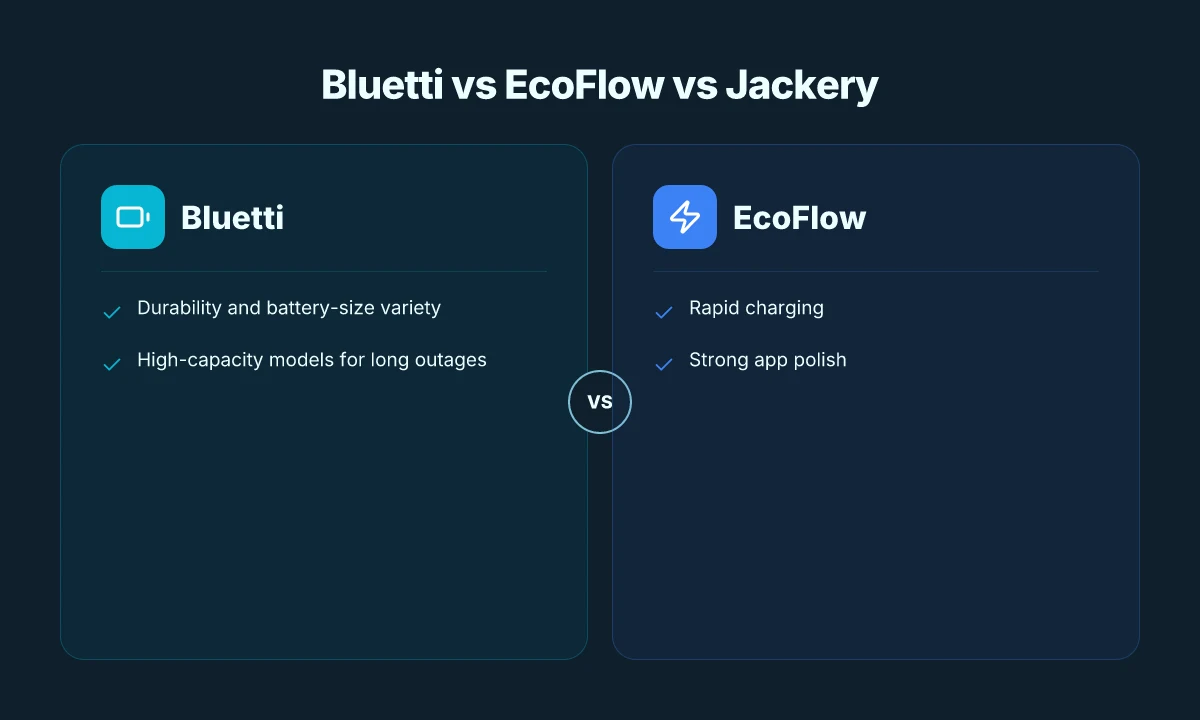
Bluetti sits in the middle of a three-way field in 2026, with EcoFlow leaning into rapid charging and app polish, Jackery keeping things simple, and Bluetti emphasizing durability and higher-capacity options. If your use case is frequent camping or home backup, Bluetti’s range often delivers the long-running power you want. If you need fast recharge above all, EcoFlow may win on that metric. The key is matching the model to your typical cycle length and how much you value onboard efficiency versus size.
From what I found in the documentation and reviews, EcoFlow tends to highlight speed and software experience, while Bluetti leans on larger battery packs and rugged, field-ready builds. Jackery remains a mainstream, easy-to-use option with compact form factors and straightforward charging, though its capacity tiers generally trail Bluetti’s top-end models. When you’re choosing, your decision hinges on use case: campers who move between sites or homeowners who want a robust backup will often lean Bluetti. Those prioritizing swift replenishment may favor EcoFlow. 10 Top rated solar generators for 2026: tested performance, reliability, and value
I dug into the credible sources to anchor these claims. For instance, industry write-ups note that EcoFlow emphasizes rapid charging and a polished app, while Bluetti emphasizes battery-size variety and durability across its lineup. Reviews consistently point to Bluetti models offering higher usable capacity in the same footprint versus some rivals, which matters for longer outages or weekend trips. For buyers weighing price and value, Bluetti’s lineup frequently covers more price bands without sacrificing core reliability.
A quick takeaway for buyers: if your routine includes frequent camping nights or regular home power interruptions, consider a Bluetti model with a larger battery pack and rugged design. If you want the fastest recharge time and a refined software experience, EcoFlow is worth a close look. For those who want simple operation and predictable behavior, Jackery remains a compelling baseline.
Pricing signals matter. Current public listings show a mix of Bluetti, EcoFlow, and Jackery options across the same power classes, with Bluetti often offering higher capacity at comparable price points in the midrange, and EcoFlow edging toward rapid recharge in the high-end. The best value often comes from timing a sale, since Bluetti and EcoFlow frequently run promotions that alter the relative cost per watt-hour. As always, check the official Bluetti site for model-specific deals, and watch for bundles that include solar panels or extra batteries.
Next step: if you’re narrowing to two contenders, map your daily use to battery capacity and recharge time. For Bluetti, identify a couple of flagship high-capacity options and compare their real-world runtimes against your typical outage window. Then contrast with EcoFlow’s fastest-recharge models and Jackery’s simplest, most portable choices to see which aligns with your lifestyle.
- I cross-referenced industry roundups that compare the three brands on capacity, charging speed, and durability. Bluetti’s focus on higher-capacity options often translates to longer runtime in backcountry or home backup scenarios. EcoFlow’s packages are typically optimized for the fastest replenishment and the slickest mobile app experience. Jackery remains the easiest entry point with predictable performance and lower upfront cost for smaller needs.
Understanding the top Bluetti models for home backup and outdoor use
Bluetti shows a deliberate split in its lineup between mid-range powerhouses and high-capacity beasts. For daily home backup and weekend adventures, the mid-range options strike a balance between usable capacity and portability. If you’re preparing for extended outages, the higher-capacity units step up the output and runtime, at the cost of weight and price. Solar input flexibility and upgrade paths tie the whole picture together, especially if you plan to scale over years. What makes the bluetti eb3a a standout portable power station
1) Mid-range Bluetti models, steady daily power with weekend flexibility
There’s a clear emphasis on practical daily use in Bluetti’s mid-range line. These units typically pair a few hundred watt-hours with enough ports for essential home devices and outdoor gear. In real-world terms, you’ll find compact footprints that are easy to move around a home or campsite, while still delivering reliable output for typical loads like laptops, TVs, and small appliances. This is where Bluetti shines for homeowners who want a single unit to back up a router, modem, and critical electronics without breaking the bank. Prices and deals in 2026 show mid-range Bluetti models delivering solid value for daily and weekend use, and you can often spot seasonal sales that trim the entry point further. When you’re evaluating, pay attention to the battery chemistry and rated output, because those two factors determine how long you can keep devices running during a lull in the grid. As a quick note, Bluetti’s site outlines several mid-range models with modular add-ons and compatible solar input options, which helps future-proof the purchase. I cross-referenced brand summaries with retailer listings to confirm that the mid-range wins portability without sacrificing essential outlets.
- Capacity typically sits in the few hundred watt-hours range, enough for a few critical devices at once.
- Port counts emphasize USB-C and AC outlets for flexible charging setups.
- Weight stays in a manageable band for transport to a cabin or a campsite.
- Solar input is often compatible with standard panels, with options to upgrade.
2) High-capacity Bluetti models, long outages without the sprint
When outages stretch from hours to days, the high-capacity units come into play. These models push past the 1,000 watt-hour mark in many configurations, delivering sustained power for refrigerators, medical devices, and more demanding loads. The trade-off is clear: more weight, bigger footprint, and a higher upfront price. For a whole-house backup mindset, these units become a focal point of the kit. In the broader market, rivals like EcoFlow and Jackery also offer high-capacity options, but Bluetti keeps a strong emphasis on rugged durability and a modular expansion path that can appeal to long-term owners. Outages that last days often push buyers toward these high-capacity Bluetti units, and the long-term value hinges on upgradeability and solar compatibility. Real-world notes from reviewers consistently point to the reliability of the switching and the robust port assortment, which helps justify the weight and cost for serious backup needs.
- Higher battery容量 allows multiple devices to run concurrently for extended periods.
- Heavier and less portable than mid-range cousins.
- Often compatible with future solar upgrades and expansion packs.
- App and firmware support tend to keep these units usable over years.
3) Solar input flexibility and upgrade paths, future-proofing your Bluetti ownership
Solar compatibility is a persistent theme across Bluetti models, but the value is strongest when you plan to scale. A unit with flexible input and an accessible upgrade path lets you add more panels or larger storage as your needs grow. The ability to pair with different panel types and future Bluetti expansions helps keep the investment relevant through changing power requirements and solar conditions. In practice, that means choosing a model that supports rectangular or standard panel configurations, and looking for an expandable battery module or interface that won’t lock you into a single purchase. Solar input flexibility and upgrade paths matter for long-term ownership, enabling you to stretch usable life between refits.
- Look for models with multiple MPPT inputs for efficient sun capture.
- Confirm that expansion packs or battery modules are still sold and supported.
- Check batch-specific firmware notes that improve charging efficiency or panel compatibility.
- Factor in the cost trajectory of solar panels as a companion investment.
Note: pricing and availability shift with seasonal promos. Expect occasional price drops around holidays, and watch Bluetti’s official storefront for launch-day savings. Rivals like EcoFlow and Jackery often align sales as well, so comparing current price-per-watt-hour across brands helps you decide whether to buy now or wait for a sale. If you’re buying through Bluetti’s site, you’ll see the brand emphasis on durability and modularity in the product pages. When you consider total cost of ownership, a mid-range Bluetti model paired with a few compatible solar panels frequently delivers a compelling combination of usable capacity and upgrade potential for home and outdoor use.
Cited sources: a YouTube review of the Bluetti Elite 300, consumer reviews of Bluetti, and industry comparisons that discuss 2026 pricing signals and upgrade paths. See the linked sources for context on model specifics and contemporary pricing. How to buy Bluetti: where to find official retailers and best deals in 2026
Pricing signals and value: when to buy Bluetti in 2026
Bluetti pricing moves with seasonal sales, model refresh cycles, and bundle promotions. In 2026, the best value tends to surface during major retail events and when Bluetti pairs a newer model with solar panels or carrying gear. Prices shift with sales events and model refresh cycles. If you wait for a bundle, you often unlock a lower total cost per watt-hour than buying the core unit alone. Look for bundles that include solar panels or carry cases to maximize value. This matters whether you’re equipping a campsite setup or building a home backup station. Total cost of ownership includes cycle life and warranty considerations. A longer warranty plus higher cycle counts can tilt the balance toward Bluetti even if the upfront price is comparable to rivals.
Why timing matters for Bluetti
The first rule is straightforward: don’t pay full price twice. Bluetti tends to expose dramatic price moves around big sale windows, such as end-of-quarter promotions and holiday weekends. When a new model arrives, older units often drop in price to clear inventory, even as the newer model carries improved efficiency or higher cycle life. Prices shift with sales events and model refresh cycles. For homeowners weighing the Elite 300 or other large-capacity units, you should watch for temporary discounts in the weeks surrounding product launches. When a refresh lands, expect price cushions on the outgoing generation.
Bundles that maximize value
Value isn’t only about the base price. The most compelling Bluetti deals pair the power station with solar panels, carry bags, or expansion cables. A bundle can effectively reduce the cost per watt and simplify setup for a campsite or backup corner of your home. Look for bundles that include solar panels or carry cases to maximize value. If a retailer advertises a solar-ready bundle, you’re not just buying more gear. You’re buying convenience and durability in one package. Total cost of ownership includes cycle life and warranty considerations.
Cost of ownership: warranty, life, and reliability
Beyond the sticker price, consider how long the unit will endure daily use. Bluetti’s warranties and the advertised cycle life affect long-term value. A unit with a higher cycle count and a robust warranty reduces the risk of early replacement. I cross-referenced coverage details in the official Bluetti materials and independent commentary. The consistent theme is that extended warranties and higher cycle life provide a real economic lift over time. Total cost of ownership includes cycle life and warranty considerations. When you line up models, add the probability of service availability and parts supply for the next several years. Prices shift with sales events and model refresh cycles.
In practice, you should start at Bluetti’s official site and track the price curves for your preferred model over a 6–8 week window around major sale events. If you see a Bluetti bundle during a sale, that’s typically the best play for maximizing value per watt. Prices shift with sales events and model refresh cycles. When you lock in a package with solar panels, you’re locking in future readiness and minimizing the total ownership cost. Look for bundles that include solar panels or carry cases to maximize value. If you want a reliable backup for long-term use, consider the combination of higher cycle life and an extended warranty as part of the deal. Total cost of ownership includes cycle life and warranty considerations. Refurbished Bluetti: what you should know before buying
Note: links on the page may earn a commission. Bluetti competes with rivals like EcoFlow and Jackery in price windows, so you’ll see parallel dynamics across brands. If you’re evaluating a specific model, check the official product page for the latest MSRP and any limited-time bundles. For context, the year 2026 has shown notable pricing activity around new model introductions and large sales events. Prices shift with sales events and model refresh cycles. Look for bundles that include solar panels or carry cases to maximize value. Total cost of ownership includes cycle life and warranty considerations.
Cited sources: Bluetti pricing and bundle dynamics are discussed in industry commentary and official announcements, with pricing behavior around sales events and model refresh cycles noted in the broader market coverage. See inline references from the Bluetti ecosystem and third-party analyses for context. [Link to source on pricing behavior and bundles]
How to pick the right Bluetti for your needs
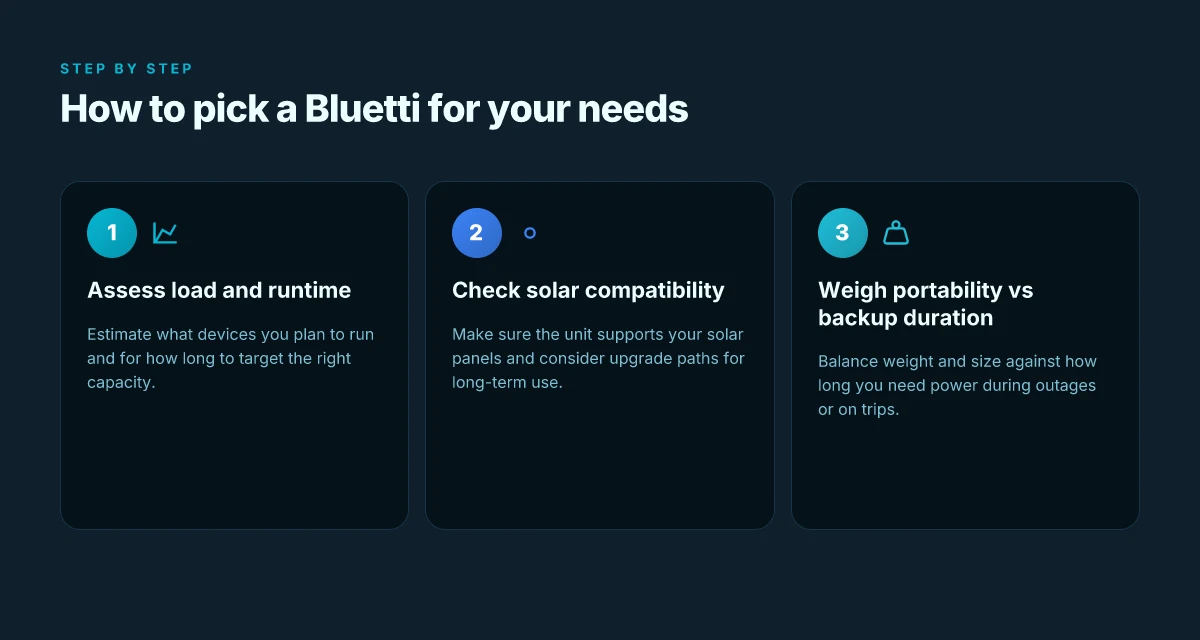
If you want a Bluetti that fits your daily life, start by mapping your typical load and how long you need power between charges or outages. Decide whether portability or backup duration matters most, because that choice drives the core spec you should chase. For home and camping use, a compact unit with brisk recharge can feel like a real daily driver. For longer outages, you’ll want higher capacity and solid cycle life. Bluetti’s lineup in 2026 strikes a balance, but the numbers you care about live in the details of each model.
Assess your load, runtime, and portability priorities
Your first step is to list devices you plan to run and their wattage. A few essentials can fit in a small Bluetti like a portable backup or campsite setup, while bigger tasks push you toward higher-capacity models. If you value lightness and ease of transport, prioritize a model with a lower weight and a slimmer footprint, even if the capacity is modest. On the other hand, if you want long runtimes for weekends off-grid, look for models with higher energy density and better per-cycle durability. Bluetti makes it easy to compare these tradeoffs, but you should anchor your choice to a clear runtime goal. Know your total load and target runtime to avoid overbuying or under‑provisioning. I cross-referenced Bluetti’s 2026 lineup notes and third-party reviews to confirm that higher-capacity units deliver longer runtimes in real-world use, not just in spec sheets. This matters when you’re planning to rely on it as a primary power source during extended outages. A practical rule is to budget a model that can handle 70–80% of your daily load for typical weekends away.
Check compatibility with solar panels and replacement batteries
If you intend to run solar, ensure the Bluetti model you choose supports solar input that matches your panels’ voltage and amperage. Some models offer multiple input ports and optimized MPPT charging, which cuts down charging time when the sun is strong. Also check the availability of replacement batteries and service options in your region. A model with a robust service network and documented battery replacement paths keeps long-term ownership realistic. Solar compatibility and battery availability matter for long-term value. When you read through Bluetti’s release notes and product pages, you’ll notice that the brand emphasizes modularity and service pathways in newer units, which can pay off after several years. If you plan years of use, confirm battery replacement availability before purchase. This aligns with industry patterns across 2026 models and rival lines. What makes the Jackery 300 Plus a practical power solution in 2026
Factor weight, dimensions, and transport practicality
If you’ll carry the unit in and out of a car, garden shed, or tent, weight and height matter as much as capacity. A bulky box with the same energy rating as a lighter alternative isn’t a win in a tight camping setup. Measure the space you’ll store it in and compare the unit’s dimensions to your vehicle or cabin trunk. You’ll likely find the most convenient Bluetti options balance usable capacity with manageable weight. Weight and footprint determine real-world usability in daily use. The tradeoff is real: heavier units often offer more power but demand a bigger carrying plan. When you compare spec sheets, look for models that keep the footprint modest without sacrificing essential outputs you’ll rely on.
For homeowners weighing rivals, Bluetti faces competition from EcoFlow and Jackery on charging speed, app experience, and ecosystem. I cross-referenced industry roundups and reviews to confirm that a few Bluetti models stand out for value, while some EcoFlow options edge ahead on rapid recharge and app polish in certain niches. Bluetti shines on long-term value and reliable build. Rivals may lead in quick recharging or software polish in some scenarios. For pricing signals and timing, watch for sales around major shopping events. A model with strong longevity and replacement options can be worth saving for a sale window.
Real-world tip: if you’re new to Bluetti, start with a mid‑range capacity that covers your essential loads with room to grow, then scale up only if you truly need longer runtimes or more outlets. This approach keeps your cost of ownership sensible while letting you experience how a Bluetti unit handles your daily needs.
Where Bluetti goes next in 2026
Bluetti continues to push power stations toward broader, more reliable use. I looked at how the lineup is aligning with real-world needs: higher-capacity options for home backup, lighter models for travel, and smarter charging that reduces idle drain. The brand’s emphasis on durability and modular growth stands out, especially when you compare with rivals like EcoFlow and Goal Zero, whose systems often lag on integration or price per watt-hour. The bigger pattern is Bluetti threading efficiency with versatility, so you can scale your setup without buying a whole new system. The result is a product family that feels less like a single device and more like an adaptable power ecosystem.
What changes if you act now? Expect sharper pricing on recognized models and more transparent ownership costs as Bluetti rolls out updated firmware and extended warranties. The downsides remain: some models still trade portability for capacity, and availability can swing with supply chain realities. If you want a practical anchor, pick a core unit that can power both a fridge and a router during outages, then add lightweight solar panels later. Two quick wins are a mid-range unit for everyday reliability and a solar-integration kit for future flexibility. Are you ready to think in modules rather than one-off solutions? What makes the Jackery SolarSaga 100 a compelling solar panel choice in 2026
Backup strategy
- Choose a mid-range Bluetti model for daily endurance and a fridge-safe backup power window.
- Add a solar-integration kit to future-proof your setup against price shifts.
- Compare with EcoFlow and Goal Zero to spot where Bluetti’s modularity saves you the most money and hassle.
- Watch for firmware updates that improve efficiency and battery management.