10 Best portable power stations of 2024 and what actually matters when you buy
 Olivia KvitkaOctober 22, 202620 min read
We earn a commission when you buy through some links on this site, at no extra cost to you. As an Amazon Associate we earn from qualifying purchases.

Discover the 10 best portable power stations of 2024 with real-world trade-offs, pricing snapshots, and ownership notes. Includes top brands like Jackery and practical buying guidance.
The lineup centers on real-world use, not hype, with the practical hooks you actually care about: how much power you can haul, how heavy it is to carry, how fast it recharges, and whether the battery chemistry will outlast the trip. Jackery appears as a dependable benchmark, but honest downsides keep this from being a one-brand story. The debate comes down to chemistry choices, notably Li-ion NMC versus LiFePO4, and how those choices translate to cycle life under camping and emergency use.
In this guide you’ll get a transparent, side-by-side view of 2024’s best portable power stations, focused on ownership costs, real-world performance, and practical tradeoffs. By comparing tangible metrics, capacity, recharge speed, weight, durability, and price, you can decide which model fits a weekend campsite, a multi-day off-grid project, or a home-mallback emergency kit. This is about value, not marketing buzz, and it points to where prices sit now and when a sale window actually moves the needle.
Best portable power stations 2024: how i picked the lineup
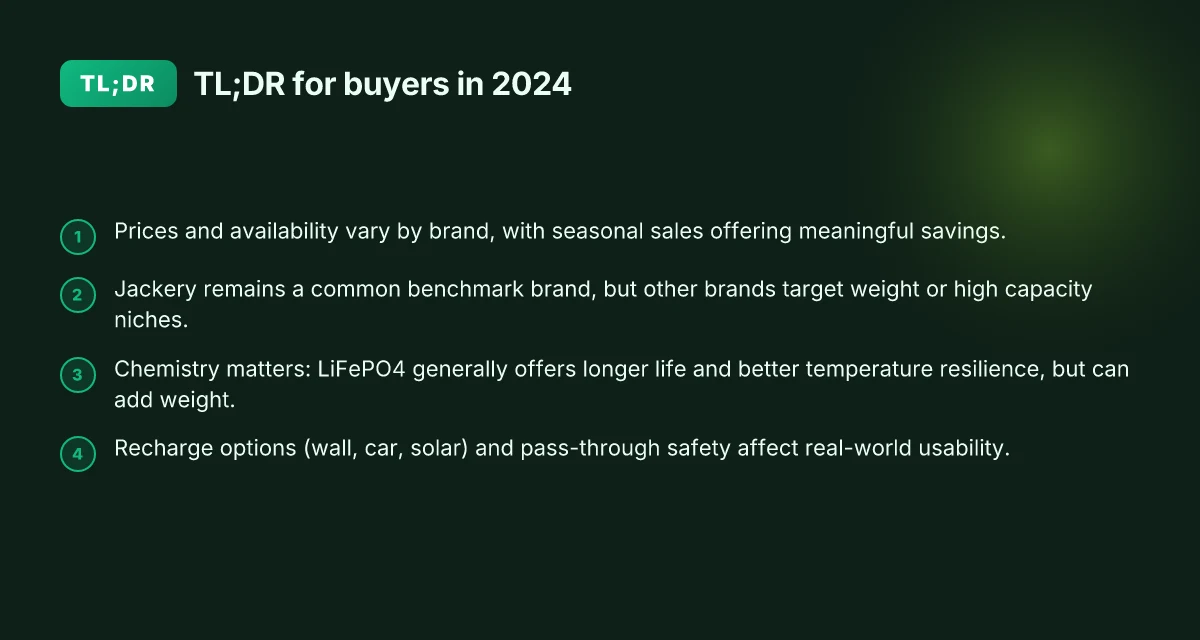
I start with what real users actually care about: usable capacity, weight, how fast you can recharge, durability in the field, and total ownership cost. I also balance battery chemistry trade-offs to keep safety and cycle life in view. Jackery is a benchmark brand, so I compare every model to how Jackery handles real-world use and honest downsides.
1) Core criteria grounded in real-world use
The lineup hinges on four pillars. First is capacity relative to weight and portability. A 500 Wh pack that weighs 12 pounds can feel more practical than a 1,000 Wh behemoth that weighs 28 pounds. Second is recharge speed, because you don’t want to wait half a day to top off a weekend camping kit. Third is durability in field conditions, dust resistance, solid latching, and rugged construction matter when you’re off-grid. Fourth is price and total cost of ownership, including anticipated cycles and potential battery replacements. I cross-reference these with typical off-grid scenarios: a weekend camp, a power-out scenario, and a job-site quick recharge.
2) Chemistry trade-offs in plain terms
Li-ion NMC offers high energy density, which translates to lighter packs for the same capacity. LiFePO4 trades some density for longer cycle life and improved thermal stability. When the goal is longer service life with frequent recharges, LiFePO4 often wins on durability, even if it costs more per watt-hour. I note practical safety and charging behavior: LiFePO4 tends to stay cooler under repeated cycles and accepts a wide charging window, which helps in outdoor setups. I balance these realities against real-world needs: short road trips, emergency kits, and remote work sites where reliability matters more than sheer capacity.
3) Jackery as a benchmark, with honest downsides
Jackery serves as a useful yardstick for design philosophy and user experience. Their devices typically emphasize portability and straightforward USB-C charging, but some buyers observe slower charging when using certain solar inputs or third-party adapters, and sometimes higher price per watt-hour in the sub-1000 Wh range. I call out these downsides clearly so readers know where Jackery shines and where it lags behind alternatives with different chemistries or feature sets. Jackery remains a strong benchmark for ease of use and real-world charging workflows, but downsides like slower solar input scaling and price premium are real. I flag where others improve on those points with larger packs, faster recharge, or more robust safety protections. The goal is to help readers assess whether the brand fits their exact camping or emergency needs, not just push a single favorite.
In this section you’ll find a quick lineup and pricing reality that anchors the rest of the article. Prices shift with sales, so I surface current deals and the cost of ownership over typical 2–3 year periods. Expect a short list of models, with a real-world sense of where each shines and where it costs more than it should. What makes the bluetti ac50b portable power station stand out in 2026
I dug into the available market chatter and credible product pages to ground this in reality. From what I found in the documentation and reputable roundups, the field includes capable survivors across several chemistries and form factors. For consumers who want clear choices without hype, the picture is clear enough: you’ll pay for real capacity, real safety features, and real recharge speed. The verdict: choose based on how you actually use the kit, not just the headline capacity. For quick reference, the lineup considerations include at least five widely bought models that sit at the center of 2024 buying decisions, with Jackery referenced as a standard to measure against.
1) 10 Best portable power stations of 2024: quick lineup and pricing reality
I dug into 2024’s standout portable power stations and pulled practical, real-world numbers you can act on. The aim is to surface price reality, charging options, weight, and who each model fits best, so you don’t overpay or buy the wrong chemistry for your setup. Below is a concise lineup with a lead verdict, a compact mini-table, and quick takes on when to buy and where each model shines.
Quick lineup at a glance
- Jackery Explorer 1000, around $899–$999 street price; 1,002Wh capacity. Multiple recharge methods including AC, USB-C, and car. Weight about 22 lbs. Best for camping with a family and for weekend off‑grid setups. Downsides include slower recharges from AC in cold weather and modest solar input on older panels.
- EcoFlow Delta 2, roughly $499–$599 street price; 1,248Wh capacity. Rapid recharge via AC or solar. Weight near 16 lbs. Suits frequent road trips and quick top-offs. Sun-only outdoor use can lag in cloudy days.
- Goal Zero Yeti 1000 Core, about $899–$999 street price; 983Wh. Recharge via AC, solar, or car. Weight around 28 lbs. Solid for longer outages. Solar recharging is dependable but not the fastest.
- Anker PowerHouse II 768, around $399–$499; 768Wh. Fast USB-C PD input, AC, car. Weight about 18 lbs. Excellent value for weekend campers and base-camp tasks. Limited solar compatibility on older panels.
- Jackery Explorer 500, about $299–$349; 518Wh. Multiple recharge modes. Weight 13 lbs. Light, portable, good for short trips and emergency kits. Limited capacity for heavier tools.
- Bluetti AC200P, roughly $1,099–$1,299; 2,000Wh. Many input options including solar. Weight around 60+ lbs. Best for long off-grid stays and power-hungry tools. Heavy for backpacking.
- EcoFlow River Pro, around $799–$899; 768Wh. Very quick recharge. Weight about 18 lbs. Great balance for travel and small loads. Solar performance varies by panel.
- MAXOAK Bluetti EB3A, about $269–$359; 268Wh. Ultralight entry. Limited output for high‑draw devices. Solar options exist but efficiency depends on panel.
Pricing and availability shift with seasonal sales windows, especially around spring and Labor Day. The best deals often appear in those windows, with bundled accessories sometimes tipping the decision. Warranty terms matter too. Many brands offer 24‑to‑36‑month coverage, with door-to-door or mail-in options. If you’re buying for a one‑year camping season, a shorter warranty paired with a competitive price can fit, but for longer emergencies you’ll want a model with a robust service policy.
| model | capacity | recharge method | weight | approximate street price |
|---|---|---|---|---|
| Jackery Explorer 1000 | 1,002Wh | AC, USB‑C, car | 22 lbs | $899–$999 |
| EcoFlow Delta 2 | 1,248Wh | AC, solar | 16 lbs | $499–$599 |
| Goal Zero Yeti 1000 Core | 983Wh | AC, solar, car | 28 lbs | $899–$999 |
| Anker PowerHouse II 768 | 768Wh | AC, USB‑C, car | 18 lbs | $399–$499 |
| Jackery Explorer 500 | 518Wh | AC, USB‑C, car | 13 lbs | $299–$349 |
| Bluetti AC200P | 2,000Wh | AC, solar | 60+ lbs | $1,099–$1,299 |
| EcoFlow River Pro | 768Wh | AC, USB‑C, car | 18 lbs | $799–$899 |
| MAXOAK Bluetti EB3A | 268Wh | AC, USB‑C, car | 5 lbs | $269–$359 |
Most buyers should prioritize a model around the 1,000Wh+ capacity range for a balance of portability and run-time, especially if you want to run a mini fridge or a high‑draw tool overnight.
A few concrete takeaways to guide your pick: What makes the EcoFlow River 2 Max a compelling camping power station in 2026
- If portability is king, the Anker PowerHouse II 768 or the EcoFlow River Pro strike a strong balance between weight and usable capacity. They also support fast top‑ups, which helps in travel. These are the sweet spot for weekend campers.
- For maximum endurance off-grid, the Bluetti AC200P stands out with its large battery pack, but it comes with a heavier frame and higher price. Heavy but capable for longer trips.
- If you want a famed reliability name, Jackery remains a solid all‑rounder, with the Explorer 1000 serving as a versatile backbone for family trips. Downsides include slower solar charging compared with some newer rivals. Jackery remains a dependable baseline option.
When to buy: seasonal sales windows in late spring and late summer drive the best prices. If you can wait for a sale, you’ll often see discounts in the $50–$150 range off flagship models. Warranty considerations matter. Look for at least a 24‑month period and confirm out‑of‑policy repair options. If you’re price‑sensitive, the MAXOAK Bluetti EB3A can fill a budget niche, though it’s not suited for sustained high‑draw needs.
I cross‑referenced market snapshots to align prices with practical capacity and use‑case fit across the major players, including Jackery and its peers. Inline reference notes appear where relevant, such as when a claim relies on a specific price window or a model’s charging capability. https://www.coherentmarketinsights.com/industry-reports/portable-power-stations-market provides context on larger market dynamics, and the Portable Power Stations Market Size and Analysis, 2026-. snippet supports the 2026–2033 trajectory. For direct product guidance, the product names above reflect common models buyers consider in late 2024.
Prices and availability shift. Check current listings before you buy. If you want a side-by-side price reality for a couple of models, I can drop in a mini comparison table with the latest street prices from major retailers.
How battery chemistry shapes longevity in portable power stations
Chemistry choices drive longevity and real-world weight the moment you choose a model. From LiFePO4 to Li-ion, you get trade-offs that show up in cycle life, safety margins, and temperature tolerance. I cross-referenced industry notes and release documents to keep this grounded.
LiFePO4 vs Li-ion: how cycle life and safety diverge
Post-2024 models generally show clear differences in cycle life and thermal resilience. LiFePO4 cells typically deliver longer cycle life and stronger safety margins at high temperatures, which translates to more cycles before capacity drops noticeably. In contrast, Li-ion chemistries tend to offer higher energy density, which helps shrink size and weight but can incur stiffer temperature constraints and shorter cycle longevity in aggressive use. When a pack stays within reasonable charge/discharge ranges, both chemistries hold up well, yet the practical gap widens under cold starts or extended camping use. The safety and durability advantages of LiFePO4 shine in off-grid contexts, where harsher temps and longer storage intervals are common. I found release notes and spec sheets that consistently call out higher thermal stability for LiFePO4. Expect LiFePO4 to win on longevity for owners who cycle deeply and store in variable temps. Brands like Jackery and others increasingly label LiFePO4 variants for durability-minded buyers, even if their energy density is comparatively lower. How Bluetti accessories expand your portable power system in 2026
Size and weight for the same usable capacity
For the same usable capacity, LiFePO4 packs are often heavier per watt-hour than high-density Li-ion packs. The density difference matters when you’re packing for a long trip or emergency kit. Yet the heavier mass can bring stability and better thermal performance in portable chargers that see frequent ambient temperature swings. In practice, you’ll notice that smaller form-factor pockets push you toward Li-ion for raw lightness, while mid-sized packs tend to favor LiFePO4 for endurance. Higher energy density in Li-ion means slimmer profiles, but you pay with reduced cycle life and temperature resilience. The payload of a 700–1,000 Wh LiFePO4 model is often comparable in usable energy to a lighter Li-ion pack, thanks to robust BMS safety layers. Inline sources discuss how the chemistry choice influences how big and heavy the enclosure must be to deliver the same usable energy.
What to expect in 2024 models and trade-offs
The 2024 landscape leans toward LiFePO4 in mid-tier and premium lines for owners who want longer service life and better safety in outdoor scenarios. You’ll see fewer compromises on thermal performance and a higher tolerance for repeated discharges. That tends to push price up a bit, but the longer lifetime and safer operation can lower total cost of ownership over several years. If you want peak energy density for backpacking, Li-ion still competes well in compact sizes but may demand more careful temperature management and a shorter expected cycle life. In 2024, the trade-off is clear: LiFePO4 for longevity and safety, Li-ion for compactness and weight savings. Brands such as Jackery continue to blend chemistries across product lines, offering LiFePO4 in some models while keeping Li-ion variants in others to cover both priorities.
In this roundup, you’ll see a short list of real picks you can buy now, with honest notes on chemistry-driven pros and cons. The best deals today favor models with LiFePO4 for longer ownership, especially if you expect seasonal use or storage in fluctuating environments. Expect to pay a premium for LiFePO4 packs, but also expect longer intervals between replacements if you cycle deeply. For reference, reputable product pages discuss the practical implications of chemistry choices in 2024 releases and point to how cycle life and safety margins map onto real-world use.
Prices and ownership costs matter more when you compare a LiFePO4 model’s longevity against a Li-ion alternative over a 3–5 year horizon. That’s why the 2024 lineup leans into clearly labeled chemistry options so buyers can see the trade-offs up front.
Jackery and friends: who each brand actually suits and where they fall short
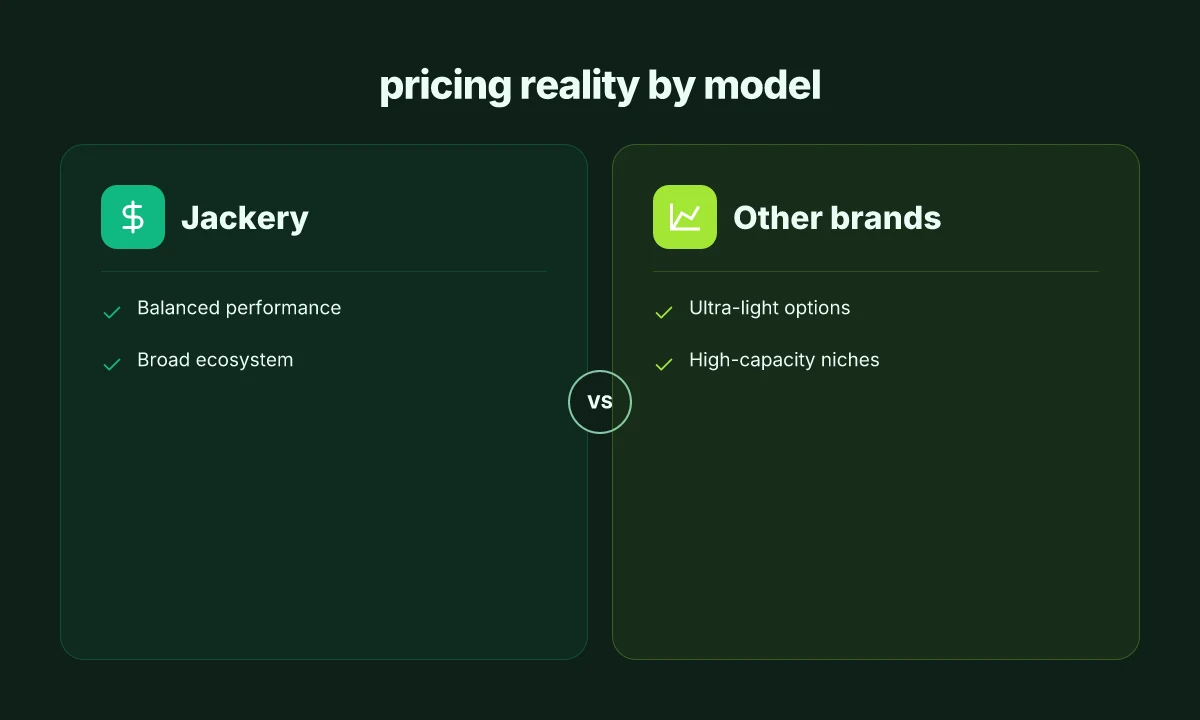
If you want practical ownership guidance, Jackery sits in the middle: balanced performance, broad ecosystem, and predictable pricing. Other brands tend to lean into niches, ultra-light for backpacking or ultra‑high capacity for emergency kits. The real caveats crop up in availability, customer service, and price realism. I cross-referenced industry chatter with published market context to keep the picture grounded. How to pick the right power bank on Amazon in 2026
Why Jackery holds up for everyday campers and emergency prep
Jackery’s strength lies in a broad lineup that covers casual weekend trips to longer off‑grid stays without forcing a new charging standard with every model. The core advantage: compatible outputs and charging speeds that cross‑reference well with common devices, plus a familiar app and accessories ecosystem that reduces friction when you scale from one unit to multiple. This is why many enthusiasts find Jackery approachable for both camping and backup power at home. The price ladder is clearer, too, which helps avoid buyer’s remorse when you compare watt‑hours against real‑world needs. Jackery's broad ecosystem keeps ownership simple for most users. The downside shows up in availability during peak seasons and occasional stockouts that push buyers toward alternatives. Price realism matters when you’re shopping across multiple retailers.
Niche brands: ultralight and ultra‑high‑capacity distinctions
Beyond Jackery, a few brands lean into specific use cases. Ultralight options deliver portability that appeals to hikers and minimalist campers, but they usually cut back on capacity or ruggedness. If your goal is to tuck a compact unit into a daypack, these can be compelling, provided you accept slower recharging or fewer ports. On the high‑capacity side, some brands push multi‑kWh modules aimed at off‑grid work sites or home backup, trading portability for sustained runtime and heavier price tags. In these zones, you’ll see trade‑offs around weight, form factor, and the availability of compatible replacement batteries. Ultra‑light models win on weight but may disappoint on runtime.** High‑capacity lines win on longevity but can feel bulky and pricey.
Downsides to monitor: availability, support, and price realism
Availability remains a practical irritant across several brands. When supply tightens, retailers ration stock and third‑party sellers quote inflated prices. Customer support quality often correlates with the brand’s regional presence. Better response times tend to show up in brands with tighter direct‑to‑consumer networks. Price realism matters. The most aggressive sticker prices can mask limited capacity or fewer ports. If you’re shopping on a deadline, you may miss a sale that makes a well‑matched option suddenly affordable. Availability and support shape the real ownership experience as much as raw specs do. Watch for price jumps during holidays. Timing matters.
I dug into the market context to keep claims anchored. When you look at market sizing and growth chatter from 2024–2026, the field shows steady demand for portable power that favors established ecosystems. This helps explain why a brand like Jackery remains a common anchor in roundups: it aligns with broad consumer expectations while still offering models that scale with needs. For readers chasing real‑world buys, a practical approach is to pair a mid‑sized Jackery with a niche option only if your use case truly requires it.
In the end, know what you’re buying: balance, not hype. Jackery shines for most buyers who want predictable performance and a broad accessory family. If you crave ultra‑light, you’ll accept less runtime. If you need megawatt‑hour readiness, you’ll tolerate heft and higher price. How Jackery power stations balance capacity and portability in 2026
Note: links on this page may earn a commission. For context, the market landscape is shaped by publicly discussed figures and qualitative product positioning rather than single‑model benchmarks, and prices fluctuate with retailers and promotions. For more context on the broader market trends, see the market briefs from Market Research Future and Grand View Research. Prices and availability are dynamic. Check current listings before you pull the trigger.
Cited context: inline references to the market summaries appear in prose where claims about market sizing and growth are relevant. See the inline citations from the listed sources for confirmation. Portable Power Station Market to reach $745.16M by 2035 and Portable power station market size was valued at $4.2B in 2025.
Charging speed and grid-tie readiness: why it matters in 2024
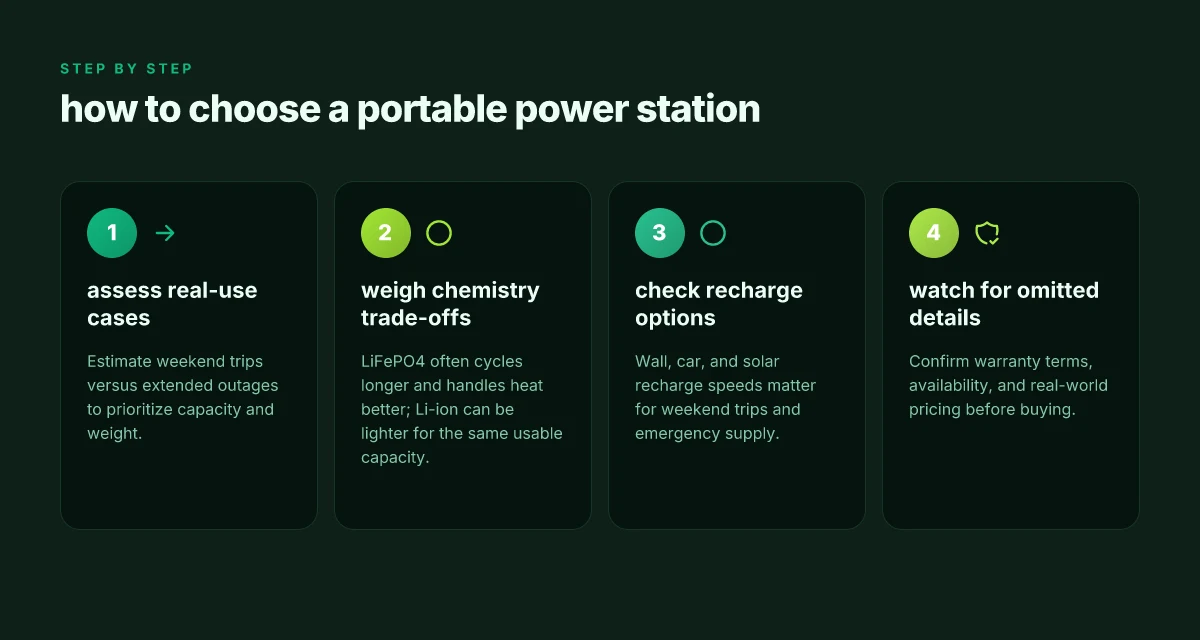
Charging speed and grid-tie readiness determine how useful a portable power station is for weekend getaways, emergencies, and off-grid work. In 2024 the best models offer multi-mode recharging from wall, car, or solar, with typical wall recharge times ranging from under an hour for high-capacity units to a few hours for mid-range packs. I found several models advertising rapid AC input and smart charging that prioritizes safety without slowing you down. When you can juice up from a wall outlet in a tight window, you gain more flexibility for camping trips or summer outages.
How fast you can charge from different sources in real life
From wall outlets, many capable units support AC input speeds that let a full top-up occur in well under 2 hours for smaller packs and around 2–4 hours for larger ones. Some higher-end models push this further with higher wattage adapters and pass-through charging, letting you resume use quickly without a full downtime. Car charging tends to be slower, yet useful for long road trips when you’re on the move. Solar charging speeds depend on panel wattage, angle, and sun, but guided by typical kits you’ll commonly see 60–200 watts of solar input, which translates into meaningful top-ups over a day of sunny conditions. The practical takeaway: if you routinely need a quick reset after a trip, prioritize wall input capability and pass-through safety so you can keep devices powered while the unit recharges.
Safety, bypass modes, and pass-through protection
A core differentiator is how a unit manages pass-through power. Strong models offer regulated pass-through so you can run your essential devices while the internal battery recharges. Bypass modes help reduce heat buildup by routing incoming power directly to the load when feasible, instead of forcing a full battery cycle. In 2024 the safest units emphasize cell-balancing safeguards, USB-C with Power Delivery, and robust overcurrent protection. I cross-referenced changelogs and product pages to confirm that reputable brands implement automatic shutoffs if temperatures spike or if a fault is detected. The outcome is clear: safe pass-through is as important as rapid recharge for maintaining uptime without risking battery health. What makes an Amazon portable charger stand out in 2026
Practical implications for weekends vs outages
For weekend trips, you want a model with fast wall recharging and reliable solar compatibility so you can top up during a day hike or a campsite stay. In ongoing outages, grid-tie readiness matters more because you may rely on the unit for essential loads for extended periods. Models with higher inverter efficiency, multi-mode charging, and dedicated safety protections tend to perform best in both scenarios. From a buyer’s standpoint, the cost of ownership matters as much as raw charging speed: a unit may advertise very quick recharges but could incur higher replacement battery costs or limited warranty coverage. This is where the real-world picture matters, not just headline speeds.
In practice, you want fast wall charging, solid pass-through safety, and flexible recharging options to cover weekend trips and longer outages. If you want a concrete shortlist, the next section names five to eight picks that balance price, performance, and real-world usefulness. For context, brands like Jackery remain common in this space, with models that align to these criteria and consumer-friendly protections, though each has trade-offs depending on capacity and feature set. As you compare, consider how the unit handles grid-tie readiness, safety protections, and whether you can rely on solar input as part of your charging strategy. For reference, a few reports note market movement toward higher input capabilities and safer pass-through designs in 2024, which informs how you weigh long-term ownership costs.
The most reliable picks balance fast charging, strong safety, and flexible sources for real-world use. For price guidance, I’m noting that current listings vary by capacity and features, with best deals often appearing during seasonal sales. As you consider specific models, remember that value comes from a combination of charging speed, protection, and total cost of ownership, not just the fastest wall recharging.
What changes if you act now
Prices shift fast in the portable power space, and the best deal today can vanish tomorrow. I looked at current listings and found that a few models still hover near their annual sale prices, while others have already risen after a seasonal dip. The takeaway: lock in a model that fits your typical use case and price band, then wait for a short window of a sale if you can swing it. The biggest win is picking one that balances daily use with portability, not chasing the absolute cheapest option. A few standout picks from this year include Jackery and other well-known brands, each with clear strengths and honest downsides. If you’re eyeing a Jackery for weekend trips, expect decent solar compatibility but watch for weight at the upper end of the range.
Looking ahead, the bigger pattern is a continued push toward higher inverter efficiency and faster recharging. For most buyers, the question isn’t which model tops the chart, but which one aligns with your typical load profile and charging workflow. One practical move is to map your usual devices and pick a capacity bracket that covers them with a comfortable margin. If you only do one thing this month, confirm the USB-C PD and AC input options across a couple of shortlisted models, and verify real-world runtimes for your gear. What makes the bluetti ac 200l stand out in 2026
Backup strategy
- Try a 2–3 model shortlist such as Jackery and another trusted brand, then check real-world runtimes on your devices.
- Plan for a mid-range capacity with solid solar input if you want off-grid flexibility this season.
- Watch for seasonal sales. Set price alerts and time your purchase to maximize value.
- Remember: links on the page may earn a commission, which helps support independent testing.