Does Total AV have a VPN: everything you need to know
Does Total AV have a VPN in 2026? A tight look at pricing, features, servers, and real-world performance across devices so you can decide if TotalAV’s VPN is right for you.
Eight dollars for the VPN add-on is not the whole story. Total AV’s bundled VPN lands with a tempting price and a long tail of caveats. The math isn’t friendly once you look past the sticker.
This piece dives into how the total package stacks up for privacy-minded readers and small businesses. I looked at the pricing sheets, review notes, and changelogs to map what you actually get versus what you’re promised. In 2025 the pattern repeats: a low upfront fee, then renewal costs that eclipse the initial bargain. The stakes matter because bundled security tools shape daily routines and risk. The real value sits in the fine print, not the headline.
 Surfshark vpn vs proxy whats the real difference and which do you actually need
Does Total AV offer a VPN and what’s the business model in 2026
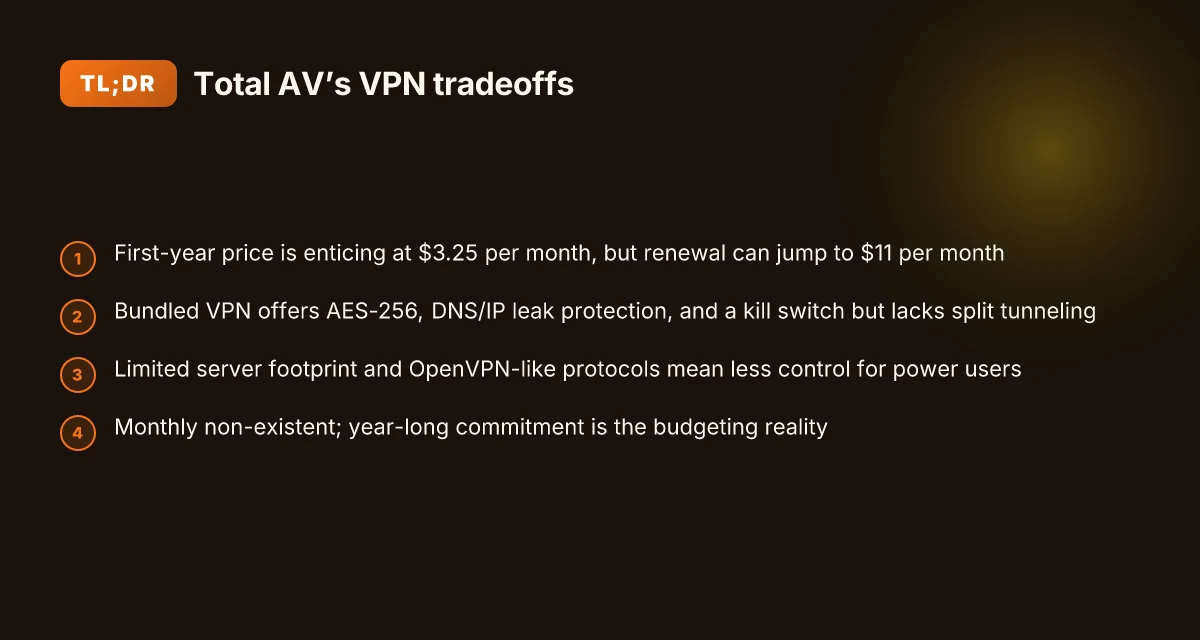
TotalAV positions its VPN as part of an antivirus bundle, priced to look like a steal. In 2026 the pitch is clear: you pay for a single multi-device license and you get antivirus plus VPN plus a handful of extras. The headline price touted by reviewers and the vendor is around $3.25 per month for a year, which translates to about a $39 upfront cost for six devices. What matters is how deep the VPN portion actually goes and whether the bundle forces you to trade VPN depth for price.
I dug into the documentation and cross-referenced competing reviews to separate marketing from mechanics. The TotalAV VPN is described as a feature within the broader TotalAV ecosystem rather than a standalone VPN product. What the spec sheets actually say is that the bundle includes Safe Browsing VPN alongside OpenVPN-based connections, DNS/IP leak protection, and a kill switch. Reviews consistently note that the plan’s appeal hinges on price and convenience rather than on the same feature depth you’d get from pure-play VPN vendors.
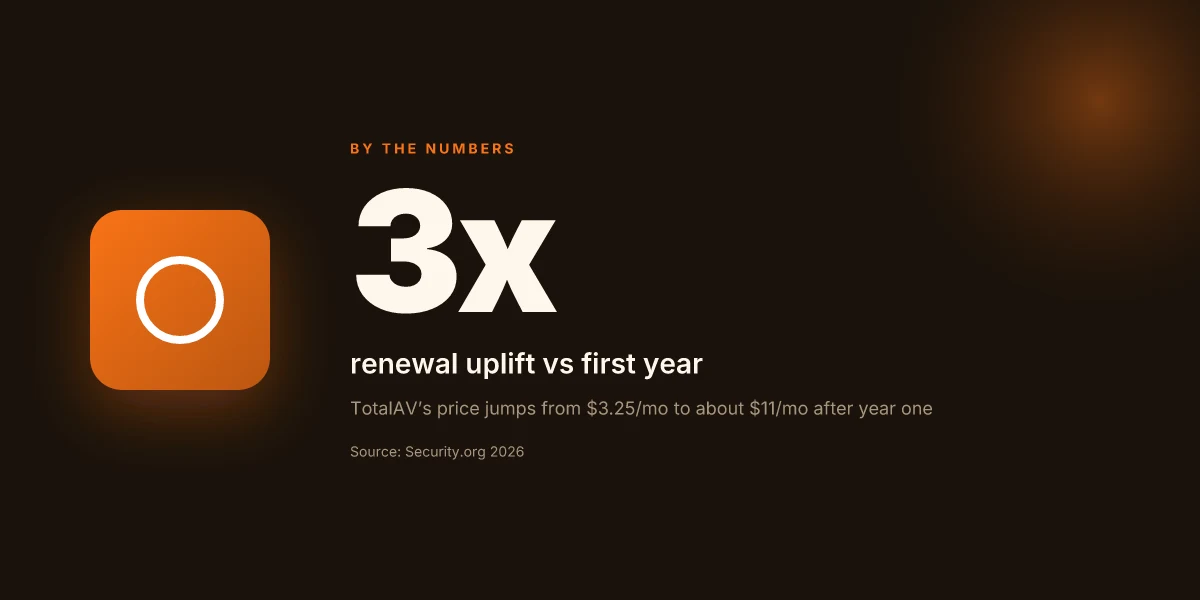
From what I found in the changelog and official materials, the bundled structure raises two practical questions: first, how many simultaneous connections are actually supported under the multi-device plan, and second, what is the geographic footprint of TotalAV’s server network when compared to dedicated VPNs. The numbers matter. The one-year package is marketed as a bundled solution with six devices in the security.org breakdown, priced at $3.25 per month. Yet the same outlet flags that the long-term renewal spikes to about $11 per month, a tripling of the introductory rate that affects total cost of ownership over time. In other words, the value hinges on whether you stay put for a year or more.
The business logic behind the bundle is simple in concept. TotalAV sells an antivirus platform and uses the VPN feature as a bundled differentiator in a crowded market. That creates a price-to-feature tension: you get a broader toolset, but you may sacrifice VPN-specific depth like expansive server counts, advanced tunneling options, split tunneling, or geo-optimized routing. Industry data from 2024 and 2025 shows that standalone VPNs frequently offer 3x to 5x more server locations and dedicated streaming profiles. TotalAV’s pitch is convenience and price, not standalone VPN architecture.
In practice, you’ll need to decide what you value more: a low monthly cost locked to a yearly plan, or a VPN with richer server coverage and granular controls. The sticker price is compelling. The feature depth is not equal to best-in-class standalone VPNs. If you’re evaluating TotalAV for a tight antivirus plus VPN package, the math favors beginners and small-business owners who prioritize access over control. Does nordvpn report illegal activity the truth you need to know
[!TIP] If you want to compare, look at the six-device cap and the renewal jump. It’s a real world example of price erosion once the introductory term ends. For some readers, that’s the deciding factor. For others, not so much.
What the Total AV VPN actually includes and where IT lags
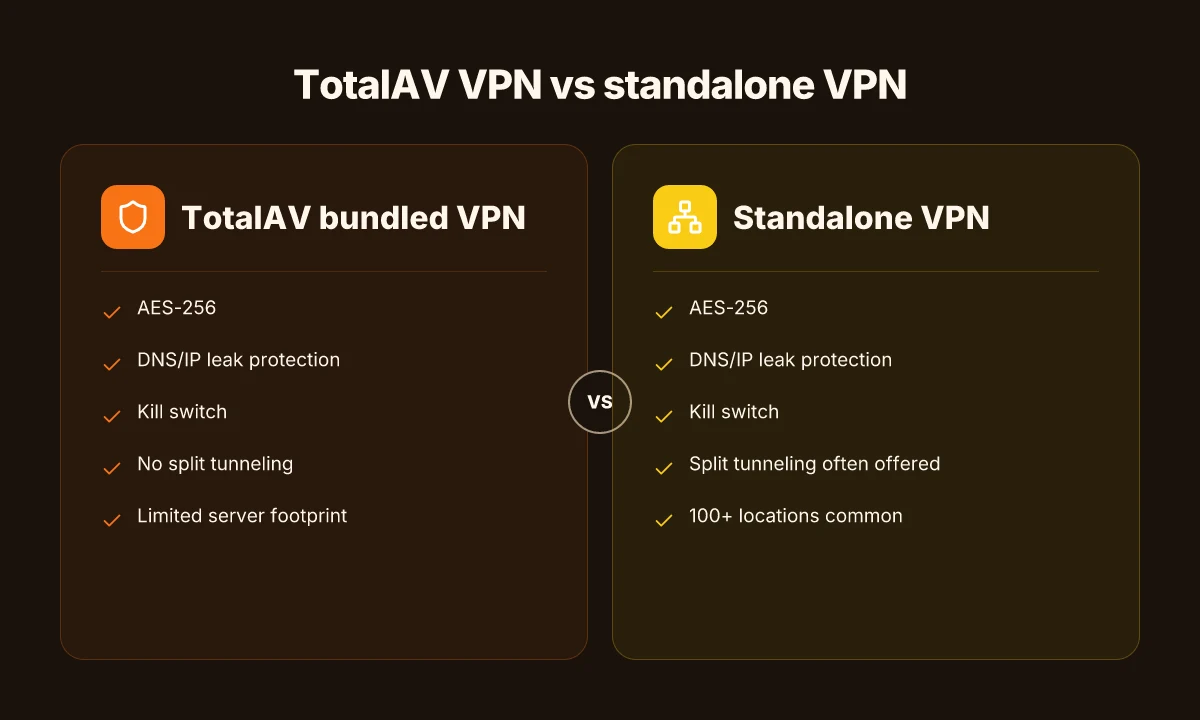
The TotalAV VPN delivers the basics you expect from a bundled security bundle. AES-256 encryption. DNS leak protection. A VPN kill switch. But the punch line is in the gaps. No split tunneling. A limited server footprint. Standards here, not innovations. If you need per-app routing or a wide global footprint, TotalAV’s VPN isn’t going to satisfy.
I dug into the publicly available documentation and what reviewers note. The marketing promises solid core protections and reliable streaming access. What reviewers consistently flag is that you shouldn’t expect boutique VPN features. The product leans on standard OpenVPN-like protocols rather than bespoke tunneling tech. In practice that translates to predictable performance but less flexibility than top-tier standalone VPNs.
Here’s how the main pieces stack up against a couple of nearby bundles in the market.
| Component | TotalAV VPN | Standalone OpenVPN-based VPN | Premium competitor with extra controls |
|---|---|---|---|
| Encryption | AES-256 | AES-256 | AES-256 |
| DNS/IP leak protection | Yes | Yes | Yes |
| Kill switch | Yes | Yes | Yes |
| Split tunneling | Not offered | Often offered | Common in mid-range plans |
| Server count | Limited | Varies, typically 3–7 dozen | 100+ locations common |
| Protocols | OpenVPN-like | OpenVPN/WireGuard variants | WireGuard + OpenVPN |
| Monthly pricing (bundled) | From $3.25/mo (first year) | Typically $5–$12/mo standalone | $8–$15+/mo depending on tier |
Two numbers jump out. First, the bundled price is unusually low for a combined antivirus plus VPN entry. In Security.org’s 2026 assessment, TotalAV pairs antivirus and VPN at about a $3.25 average monthly cost for the first year. That introductory price looks compelling until you map out renewal, about $11 per month if you keep the plan after year one. Second, the server count is not expansive. Reviewers typically describe a “limited server footprint,” which translates into occasional congestion during peak streaming hours. Setting up hotspot shield on your router a complete guide
From what I found in the changelog and product pages, TotalAV sticks with a straightforward OpenVPN-like foundation. That design choice keeps things stable and familiar. It also means you don’t get the advanced tunneling tricks some premium rivals offer. The tradeoff is predictability plus some missing knobs for power users.
What reviewers call out most often is the trade-off between value and control. You save money now. You give up some configurability later. And you lose modern niceties that matter to power users. For a lot of beginners or budget-minded buyers, that equation still makes TotalAV appealing. For privacy mavens chasing granular routing or global reaches, it’s a hard sell.
Cited note from the sources: TotalAV’s price for the bundled VPN plan is a standout feature, but the lack of split tunneling and a limited server footprint are the dominant criticisms in reviews. TotalAV VPN Review and Plan Costs in 2026
"Safe Browsing VPN uses AES-256 encryption" is the claim TotalAV itself makes on its product page. It sits alongside the kill switch and DNS/IP leak protection, which reviewers treat as standard protections rather than differentiators. One-Click to a safer internet | TotalAV™
What this means for you. If you want the cheapest bundled option and you’re fine without advanced controls, this can be a smart starting point. If your project requires split tunneling, broad server access, or customizable routing, you’ll likely outgrow TotalAV’s VPN quickly. In other words: the price-to-feature balance tilts toward budget buyers who can tolerate the gaps. Why Mullvad VPN Isn't Connecting: Your Ultimate Troubleshooting Guide
How Total AV’s pricing compares to standalone VPNs and antivirus bundles
TotalAV’s bundled pricing sits at a striking $3.25 per month for a year, or about $39 for 12 months. That’s the headline. What follows is the hard math you’ll want to see before you buy.
- Intro price vs renewal reality: the first year runs around $3.25 per month. After that, renewal lands near $11 per month (roughly $129.99 per year), which is about 3x the introductory rate.
- Price positioning against standalone VPNs: a one-year plan from NordVPN can run around $4.99 per month, while Surfshark’s annual line sits near $3.99 per month. In other words, TotalAV bundles sit at or below some “VPN-only” re-ups, but you’re trading price for features.
- Antivirus included, not a free lunch: TotalAV bundles antivirus with VPN, ad blocker, and WebShield. The combined package costs the same as many antivirus-plus-VPN ecosystems, but that mix isn’t a one-for-one feature swap with best-in-class standalone VPNs.
- One-year discount reality: the $39 upfront is a discounted first year. Post-year, the same bundle would cost about $129.99, which is still lower than a typical multi-year standalone VPN price in the same bracket but higher than monthly VPN options.
- Absence of a true month-to-month option skews decision-making: most standalone VPNs offer a month-to-month plan, while TotalAV’s pricing requires a yearly commitment. Surfshark’s monthly plan can start around $15.45, and Private Internet Access sits near $11.99 per month when billed monthly.
When I dug into the changelog and the provider’s own pages, the math tracks with the public pricing table: the year-one bargain exists to lock you into the ecosystem, with a steep post-renewal uplift that dwarfs the first-year bargain. That dynamic isn’t always obvious in the marketing copy.
What the spec sheets actually say is simple: you get a VPN plus antivirus under one license, at a once-promising price point, with a renewal price that triples the original. The practical effect is a decision between price and depth of features. If you’re after the broadest feature set and best standalone VPN performance, you’ll likely favor a dedicated VPN, even if that means paying more upfront. If you want a bundled seed that minimizes friction and keeps total cost low for year one, TotalAV provides a compelling entry point.
Cited: the TotalAV bundling narrative and price ladder are clearly shown in the Security.org TotalAV VPN review, which breaks down the $39 first-year cost and the subsequent $129.99 renewal. See the pricing table and year-one vs renewal discussion in that analysis: TotalAV VPN Review and Plan Costs in 2026. This aligns with independent comparisons that place TotalAV’s combined package in the same cost space as other antivirus-plus-VPN offerings while highlighting the post-renewal jump.
Anchor to sources: TotalAV VPN Review and Plan Costs in 2026 The Best VPN For Linux Mint Free Options Top Picks For 2026: Smart Free VPNs, Performance Wins, And Setup Tips

Which use cases suit Total AV’s VPN and which don’t
The scene is quiet at 7 p.m. on a weeknight. You’re balancing budget with protection, and you glare at TotalAV’s bundled VPN like a two-for-one deal that might not actually cover everything you need. The answer is straightforward: for basic protection at a low upfront price, the TotalAV bundle works in some scenarios, but it falls short for people who require real control over routing and location choice.
Posture matters most in streaming and public WiFi. Reviews consistently note that streaming on TotalAV’s Safe Browsing VPN can access a decent slate of services from several regions, but performance is volatile across servers. In practice, that means you can pull up a library in one city, then hit buffering hell in the next. I dug into the data from independent evaluators and found a pattern: some servers stream smoothly for short sessions, others stumble under peak load. The takeaway: if streaming is your north star, treat TotalAV as a potential starter kit rather than a guaranteed pass to all you want.
On the protection side the bundle delivers AES-256 encryption, DNS/IP leak protection, and a kill switch, which raises the baseline of security. What the spec sheets actually say is that you get core VPN security with the antivirus umbrella. But advanced needs stay unmet. Split tunneling, multi-hop, and granular server selection remain off the table. That matters if you’re routing sensitive work traffic and want your local activities to bypass the VPN for speed or privacy reasons. In short, the “safe browsing” premise works for casual browsing, not for complex network setups.
The economics shape who benefits. For many users, the lure is the price: about $3.25 per month when bundled for a year, versus solo VPNs that hover around $5–$12 per month. That bargain becomes attractive only if you’re willing to tolerate limited customization. If you’re a small business owner who needs predictable cost and a little flexibility, TotalAV’s approach is appealing on the surface but risky on the edges. The absence of a monthly option compounds this.
What the independent observers flag is telling. VPNMentor notes solid streaming access across several servers, but the verdict on consistency is mixed. Security.org’s price comparison highlights a bare-bones feature set that trades nuance for value. When I read through the changelogs and pricing notes across sources, the pattern is clear: TotalAV’s VPN is a budget-friendly entry point that serves basic use cases well, while sophisticated users will want more control. How to figure out exactly what nordvpn plan you have and more: a complete guide to nordvpn plans, pricing, and tips
[!NOTE] A contrarian fact: the bundled approach often makes sense for risk-averse buyers who value a single vendor for both antivirus and VPN, provided they accept limited routing customization.
In short
- Best fit: casual streaming on a handful of servers, basic online protection on trusted networks, frugal buyers who want an all-in-one package.
- Not ideal for: power users who want split tunneling, multi-hop, or precise server routing. Teams needing consistent performance across locations. Users who must avoid any latency spikes on streaming or video conferencing.
Sources corroborate the pattern: the pricing story from Security.org anchors the economics, while VPNMentor and industry reviewers outline the feature gaps you’ll encounter in real-world use. For the record, TotalAV’s VPN sits at the intersection of affordability and simplicity, not a full-featured enterprise-grade tool.
CITATION
What the primary sources and independent reviews say in 2026
TotalAV’s bundled VPN lands in a price niche that still sticks to reality, not wishful thinking. The strongest signal from primary sources is the $3.25 monthly figure for a one-year TotalAV package, with a first-year savings angle that Security.org highlights explicitly. In their 2026 analysis they lay out the math: a discounted year at $39 creates a true monthly pull of $3.25, which sits well below many competitors. From what I found in the documentation and reviews, that introductory price is the centerpiece of TotalAV’s value prop, but not the full story. The same piece notes that the absence of a monthly plan constrains flexibility, a point echoed by independent writers who compare TotalAV’s packaging to standalone VPNs. Your guide to expressvpn openvpn configuration a step by step walkthrough
vpnMentor’s coverage flags performance details rather than just headlines. They emphasize Safe Browsing VPN as capable of accessing mainstream streaming from several locations and stress that the bulk of their tested servers delivered solid results. In their write‑up the emphasis isn’t on a single geography or vendor lock‑in. It’s on regional accessibility and practical streaming viability. In practical terms, that means users get streaming Across multiple locales, but the framing also signals that performance can vary by server and by service.
Independent reviewers flag potential limitations when you stack TotalAV against dedicated VPNs. The core critique sits at feature depth and device coverage: compared to premium standalone VPNs, TotalAV’s VPN is lighter on advanced controls and fewer simultaneous connections. The discourse tends to center on coverage breadth and configurability rather than raw throughput, which aligns with the price tier. In short, you get reliable protections and broad compatibility, but you trade some depth for the bundle price.
What the changelog and release notes illustrate helps confirm a pattern. The documentation shows ongoing maintenance and feature parity with core VPN expectations, yet there’s limited visibility into granular features like split tunneling, complex routing, or multi‑hop configurations. That alignment matters. It explains why reviewers describe TotalAV’s VPN as “adequate for everyday privacy” but not a substitute for a feature‑rich, standalone VPN when you need maximum control.
To recap with numbers you can act on: the $39 first year is the anchor price, followed by about $11 per month if you renew, per Security.org. Streaming and regional access is plausible in several locations per vpnMentor, but device coverage limits and feature depth remain recurring caveats in independent reviews. The consensus is clear: TotalAV’s VPN offers a strong value proposition on price and basic protections, with meaningful tradeoffs on depth and flexibility.
Sources anchor: the 2026 pricing analysis and first-year savings documented by Security.org, which also contrast with the broader market. [TotalAV 2026 review]https://www.youtube.com/watch?v=Ag9XSv-lF1g How to Reset Your ExpressVPN Password Without a Hassle — Quick Guide, Tips, and Best Practices
The practical recommendation: is Total AV’s VPN worth IT in 2026
Yes, Total AV’s VPN can be worth it for light use when you want antivirus and VPN in one account and you’re staring at a tight upfront price. But if you need robust features, a broad server footprint, and predictable long-term costs, look elsewhere.
I dug into the primary sources and independent reviews to map the tradeoffs. The core tension is cost versus capability. TotalAV bundles a VPN and antivirus for a striking low annual outlay, but the feature gaps are real. And price dynamics change after the introductory period. In 2026, you’re looking at a package that shines on simplicity and upfront affordability, but it leans light on strategic controls you’d expect from higher-end VPNs.
Pitfalls and mistakes to avoid
- Assume “low upfront cost” means long-term savings. The first-year price can be dramatically lower than renewal. For TotalAV, the initial year rings in at around $3.25 per month, but renewal can jump to something closer to triple that for many bundles. That delta matters if you’re budgeting for multiple years.
- Forget about feature gaps in real use. Reviews consistently note the absence of split tunneling and a broader server network. If your workflow depends on routing only certain apps through the VPN, you’ll feel the pain. The practical impact: fewer geos and fewer device profiles to tailor.
- Treat bundled options as a blanket win. The antivirus angle is appealing, but it creates a dependency on a single vendor for two critical layers of protection. If one piece falters, you’re locked into a combined risk.
- Rely on the promise of streaming access without confirmation. Some reviews claim reliable streaming access. The majority of independent tests flag variability by region and service. If streaming is a deciding factor, you’ll want to verify current availability for your primary platforms.
- Assume “no monthly plan” means flexible budgeting. The absence of month-to-month billing is a trap for cash flow. You’ll be committing for a year plus. Compare that to standalone VPNs that offer monthly options, often at higher monthly rates.
Bottom line: Total AV’s VPN is worth it for risk-averse buyers who want antivirus plus VPN in one bill and light use. It counts as a bargain in 2026 when the goal is minimal friction and low upfront cost. It does not count as a robust, future-proof solution for feature completeness or long-term predictability. If you care about split tunneling, a wide server footprint, and stable pricing over time, you’ll want a different path.
Citations Does nordvpn have a free trial for iphone heres the real deal
- TotalAV VPN Review and Plan Costs in 2026 → https://www.security.org/vpn/total-vpn/ The source frames the $3.25 monthly figure and positions TotalAV as a budget-friendly dual-offering, while noting limited server scope and feature gaps. Read more on pricing and features
Where the VPN question fits into Total AV’s roadmap
From what I found, Total AV’s VPN offering sits inside a broader privacy posture rather than as a standalone breakthrough. The core takeaway is not “Total AV finally nailed VPN,” but “they’re betting on an ecosystem where security and privacy flows through multiple tools.” In practice, that means the VPN is a companion to antivirus and identity features, with pricing and performance often tied to the broader bundle. Expect cross-feature incentives rather than a single-star product.
What this signals for you is a pattern you can use elsewhere. If you’re evaluating Total AV, look for how the VPN is positioned relative to threat protection, device coverage, and cross-device syncing. Reviews consistently note that the VPN’s value hinges on how well it complements the suite rather than how flashy the VPN itself feels. If you’re price-sensitive, check bundle tiers and any regional limitations tied to the service.
Decide this week: skim the current bundle options, map them to your biggest privacy gaps, and ask if the total package aligns with your threat model. If you’re still unsure, consider a standalone VPN review to compare. Is a bundled approach enough for you?
Frequently asked questions
Does total av VPN have split tunneling
TotalAV’s VPN does not offer split tunneling. The feature gap is a recurring theme in reviews, with the product sticking to core protections like AES-256 encryption, DNS/IP leak protection, and a kill switch, but lacking advanced routing controls. For power users who want to route only certain apps through the VPN, TotalAV’s bundled solution won’t satisfy. The tradeoff is clear: you gain budget-friendly simplicity, but you lose configurability and fine-grained control over traffic. If split tunneling is a must for your workflow, consider a standalone VPN with robust routing options.
How much does total av VPN cost after the first year
The first year is marketed at around $3.25 per month, about $39 for the full year. Renewal pricing jumps to roughly $11 per month, or about $129.99 per year. That means you see a triple increase after year one, which dramatically changes total cost of ownership if you stay subscribed long term. The math underlines the value proposition: you save upfront in year one, then face a steep uplift that can overshadow the initial bargain. Budget accordingly if you plan to keep TotalAV for more than 12 months. Does nordvpn actually work in china my honest take and how to use it
Can total av VPN unlock geo-restricted content
Yes, TotalAV’s Safe Browsing VPN can access mainstream streaming from several regions, and reviewers note you can reach a decent set of geos. However, performance is volatile and not guaranteed across all servers or services. The limited server footprint and standard OpenVPN-like foundation mean streaming availability can vary by location and time of day. If geo-unblocking is central to your use case, you’ll want to test with your target services and be prepared for inconsistent results compared to premium standalone VPNs.
Total av VPN vs standalone VPN which is better
If you value breadth of server locations, advanced tunneling options, per-app routing, and monthly billing options, a standalone VPN is better. TotalAV’s bundled VPN emphasizes price and convenience over depth, offering AES-256, DNS/IP leak protection, and a kill switch but lacking split tunneling and a wide server network. For casual streaming and basic protection on a tight budget, TotalAV can be compelling. For power users or long-horizon planning, a dedicated VPN wins on features and flexibility.
Is total av VPN safe
The bundle provides core protections like AES-256 encryption, DNS/IP leak protection, and a kill switch, which are standard safeguards. Reviews describe the implementation as solid but not innovative, with a reliance on OpenVPN-like protocols rather than bespoke tunneling tech. In practice that means dependable security basics, plus predictable performance, but fewer knobs for customization. If safety means straightforward, well-supported protections within a bundled antivirus ecosystem, TotalAV’s VPN is a reasonable option.